Code: AC10
Subject: DISCRETE
STRUCTURES
PART – II, VOL – I
DESCRIPTIVES
Q.1 Solve the
recurrence relation
 . (5)
. (5)
Ans: The given equation can be written
in the following form:
tn
- 2tn-1 = 0
Now successively replacing n by (n – 1) and then by (n – 2) and so
on we get a set of equations. The process is continued till terminating
condition. Add these equations in such a way that all intermediate terms get
cancelled. The given equation can be rearranged as
tn – 2tn–1 = 0
tn–1 – 2tn–2 = 0
tn–2 – 2tn–3 = 0
tn–3 – 2tn–4 = 0
.
t2 – 2t1 = 0
t1 – 2t0 = 0 [we stop here,
since t0 = 1 is given ]

Multiplying all the equations respectively by 20, 21,
…, 2n – 1 and then adding them together, we get tn
– 2nt0 = 0
or, tn = 2n
Q.2 Find the
general solution of
 (9)
(9)
Ans: The general solution, also called homogeneous
solution, to the problem is given by homogeneous part of the given
recurrence equation. The homogeneous part of the given equation is
Code: AC10
Subject: DISCRETE STRUCTURES

The
characteristic equation of (2) is given as
The general solution is given by
Q.3 Find the
coefficient of  in
in  . (7)
. (7)
Ans: The coefficient of x20 in
the expression (x3 + x4 + x5 + …)5
is equal to the coefficient of x5 in the expression (1 + x + x2+
x3 + x4 + x5 + …)5 because x15
is common to all the terms in (x3 + x4 + x5
+ …)5. Now expression (1 + x + x2+ x3 + x4
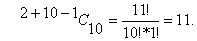
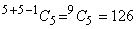
+ x5 + …)5 is equal to  . The required coefficient is
Q.4 If  find L(G). (7)
Ans: The language of the grammar can be
determined as below:
S ®0 S 1 [Apply rule S ®0 S 1]
®0n
S 1n [Apply
rule S ®0 S 1 n ³ 0 times ]
® 0n
1n [Apply rule S
® e]
The language
contains strings of the form 0n 1n where n ³ 0.
Q.5 By using
pigeonhole principle, show that if any five numbers from 1 to 8 are chosen,
then two of them will add upto 9. (5)
Code: AC10
Subject: DISCRETE STRUCTURES
Ans: Let us form four groups of two numbers from 1 to 8 such that sum the
numbers in a group is 9. The groups are: (1, 8), (2, 7), (3, 6) and (4,5).
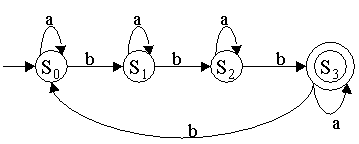
Let us consider these four groups as pigeonholes (m). Thus m = 4.
Take the five numbers to be selected arbitrarily as pigeons i.e. n = 5. Take a
pigeon and put in the pigeonhole as per its value. After placing 4 pigeons, the
5th has to go in one of the pigeonhole. i.e by pigeonhole principle
has at least one group that will contain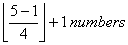 . Thus two of the numbers, out of
the five selected, will add up to 9.
. Thus two of the numbers, out of
the five selected, will add up to 9.
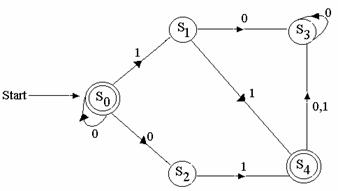
Q.6 Test
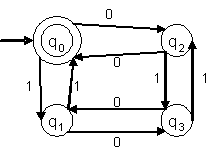
whether 101101, 11111 are accepted by a finite state machine M given as follows
: (9)

Where
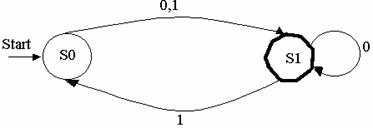
Ans: The transition diagram for the given FSM is as below:
The given FSM
accepts any string in {0, 1} that contains even number of 0’s and even number
of 1’s. The string “101101” is accepted as it contains even number of 0’s and
even number of 1’s. However string “11111” is not acceptable as it contains odd
number of 1’s.
Q.7 Let
L be a distributive lattice. Show that if there exists an a with
 (7)
(7)
Ans: In any distributive lattice L, for
any three elements a, x, y of L, we can write
Code: AC10
Subject: DISCRETE STRUCTURES
x = xÚ (a Ù x)
= (xÚ a) Ù (xÚx) [Distributive law]
= (aÚ x) Ù x [Commutative and Idempotent
law]
= (aÚ y) Ù x [Given that (aÚ x) = (aÚ y)]
= (a Ù y) Ú (y Ù x) [Distributive law]
= (a Ù y) Ú (y Ù x) [Given that (a Ù x) = (a Ù y)]
= (y Ù a) Ú (y Ù x) [Commutative law]
= y Ù (a Ú x) [Distributive law]
= y Ù (a Ú y) [Given that (aÚ x) = (aÚ y)]
= y
Q.8 Check
the validity of the following argument :-
“If the labour market
is perfect then the wages of all persons in a particular employment will be
equal. But it is always the case that wages for such persons are not equal
therefore the labour market is not perfect.” (7)
Ans: Let p: “Labour market is perfect”; q : “Wages of all persons in a
particular employment will be equal”. Then the given statement can be written
as
[(p®q) Ù ~q] ® ~p
Now, [(p®q) Ù ~q] ® ~p = [(~pÚq) Ù ~q] ® ~p
= [(~p Ù ~q) Ú (q Ù ~q)] ® ~p
= [(~p Ù ~q) Ú 0] ® ~p
= [~(p Ú q)] ® ~p
= ~[~(p Ú q)] Ú ~p
= (p Ú q) Ú ~p = (p Ú ~p) Ú q = 1 Ú q =1
A tautology. Hence the given statement is true.
Q.9 Let
 find
find
(i) Prime implicants of E, (ii) Minimal sum
for E. (7)
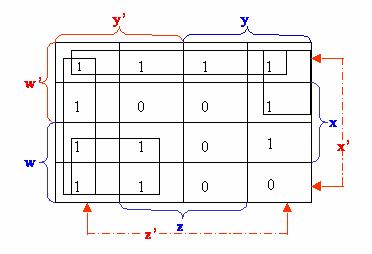
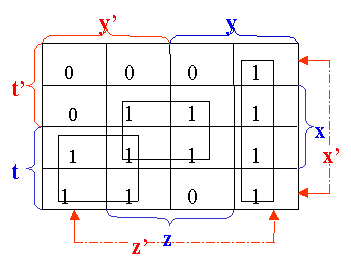 Ans: K –map for given boolean
expression is given as:
Ans: K –map for given boolean
expression is given as:
Code: AC10
Subject: DISCRETE STRUCTURES
Prime
implicant is defined as the minimum term that
covers maximum number of min terms. In the K-map prime implicant y’t covers
four min terms. Similarly yz’ and xz are other prime implicants. The minimal
sum for E is [y’t + yz’ + xz].
Q.10 What
are the different types of quantifiers? Explain in brief.
Show that  (7)
(7)
Ans: There are two quantifiers used in
predicate calculus: Universal and existential.
Universal Quantifier: The operator, represented by the symbol ∀, used in predicate
calculus to indicate that a predicate is true for all members of a specified set.
Some verbal
equivalents are "for each" or "for every".
Existential
Quantifier: The operator, represented by the symbol ∃, used in predicate
calculus to indicate that a predicate is true for at least one member of a
specified set.
Some verbal
equivalents are "there exists" or "there is".
Now, ($x) (P(x) Ù Q(x)) Þ For some (x = c)
(P(c) Ù
Q(c))
Þ P(c) Ù Q(c)
Þ $x P(x) Ù $x
Q(x)
Q.11
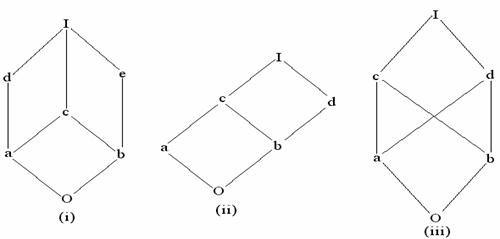
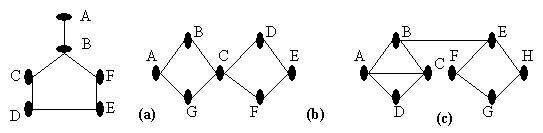
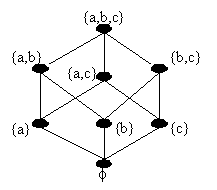
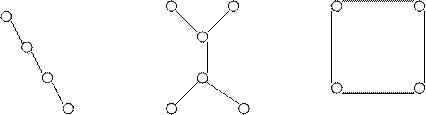
Which of the partially ordered sets in figures (i), (ii) and (iii) are
lattices? Justify your answer. (7)
Ans: Let (L, £) be a poset. If every
subset {x, y} containing any two elements of L, has a glb
(Infimum) and a lub (Supremum), then the poset (L, £) is called a lattice.
The poset in (i) is a
lattice because for every pair of elements in it, there a glb and
lub in the poset. Similarly poset in (ii) is also a lattice. Poset of (iii) is
also a lattice.
Code: AC10
Subject: DISCRETE STRUCTURES
Q.12 Consider the
following productions :

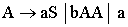
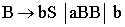
Then, for the string a a a b b a
b b b a, find the
(i)
the leftmost derivation.
(ii)
the rightmost derivation. (7)
Ans:
(i) In the left most derivation, the
left most nonterminal symbol is first replaced with some terminal symbols as
per the production rules. The nonterminal appearing at the right is taken next
and so on. Using the concept, the left most derivation for the string
aaabbabbba is given below:
S ®aB [Apply rule S ® aB]
®aaBB [Apply
rule B ® aBB]
®aaaBBB [Apply
rule B ® aBB]
®aaabBB [Apply
rule B ® b]
®aaabbB [Apply
rule B ® b]
®aaabbaBB [Apply
rule B ® aBB]
®aaabbabB [Apply
rule B ® b]
®aaabbabbS [Apply
rule B ® bS]
®aaabbabbbA [Apply
rule S ® bA]
®a a a b b a b b b a [Apply
rule A ® a]
(ii) In the right most derivation, the right most nonterminal symbol
is first replaced with some terminal symbols as per the production rules. The
nonterminal appearing at the left is taken next and so on. Using the concept,
the right most derivation for the string aaabbabbba is given below:
S ®aB [Apply rule S ® aB]
®aaBB [Apply
rule B ® aBB]
®aaBbS [Apply
rule B ® bS]
®aaBbbA [Apply
rule S ® bA]
®aaBbba [Apply
rule A ® a]
® aaaBBbba [Apply
rule B ® aBB]
® aaa B bbba [Apply
rule B ® b]
® aaa bS bbba [Apply
rule B ® bS]
® aaab bA bbba [Apply
rule S ® bA]
®a a a b b a b b b a [Apply
rule A ® a]
Code: AC10
Subject: DISCRETE STRUCTURES
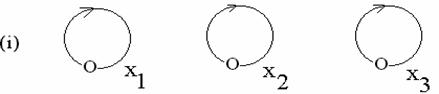
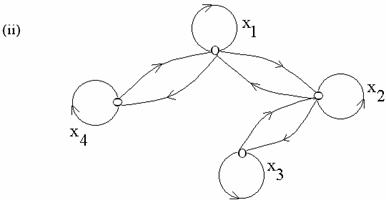
Q.13 Determine the
properties of the relations given by the graphs shown in fig.(i) and (ii) and
also write the corresponding relation matrices. (7)
Ans8. (a) (i) The relation matrix for the relation is : .
.
The relation is reflexive,
Symmetric and transitive. It is in fact antisymmetric as well.
The relation
matrix for the relation is : .
.
The relation is reflexive,
Symmetric but not transitive.
Q.14 If f is a
homomorphism from a commutative semigroup (S, *) onto a semigroup  , then show
that is
also commutative. (7)
, then show
that is
also commutative. (7)
Ans: The function f is said to be a homomorphism
of S into T if
f(a * b) = f(a) *’ f(b)
" a, b Î S
i.e. f preserves
the composition in S and T.
It is given that
(S, *) is commutative, so
a*b = b*a Þ f(a*b) = f(b*a) " a, b Î S
Code: AC10
Subject: DISCRETE STRUCTURES
Þ f(a) *’ f(b) =
f(b)*’ f(a)
Þ (T,*’) is also
commutative.
Q.15 Construct
K-maps and give the minimum DNF for the function whose truth table is shown
below : (9)
|
x
|
y
|
z
|
f(x, y, z)
|
|
0
|
0
|
0
|
1
|
|
0
|
0
|
1
|
1
|
|
0
|
1
|
0
|
0
|
|
0
|
1
|
1
|
0
|
|
1
|
0
|
0
|
1
|
|
1
|
0
|
1
|
0
|
|
1
|
1
|
0
|
1
|
|
1
|
1
|
1
|
0
|
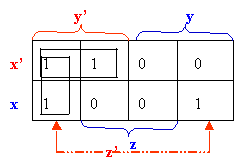
Ans: The K-map for the given function (as per the truth table) is produced
below.
The three duets are: y’z’, x’y’ and xz’. The DNF (Disjunctive
normal form) is the Boolean expression for a Boolean function in which
function is expressed as disjoint of the min terms for which output of function
is 1. The minimum DNF is the sum of prime implicant. Thus the minimum DNF for
the given function is
y’z’+
x’y’ + xz’
Q.16 Define
tautology and contradiction. Show that “If the sky is cloudy then it will rain
and it will not rain”, is not a contradiction. (5)
Ans: If a compound proposition has two
atomic propositions as components, then the truth table for the compound
proposition contains four entries. These four entries may be all T, may be all
F, may be one T and three F and so on. There are in total 16 (24)
possibilities. The possibilities when all entries in the truth table is T,
implies that the compound proposition is always true. This is called tautology.
However when all the entries are F, it implies that the proposition
is never true. This situation is referred as contradiction.
Code: AC10
Subject: DISCRETE STRUCTURES
Let p: “Sky is
cloudy”; q : “It will rain”.
Then the given statement can be written as “(p®q) Ù ~q”. The truth table for the expression is as below:
|
p
|
q
|
p®q
|
(p®q) Ù ~q
|
|
0
|
0
|
1
|
1
|
|
0
|
1
|
1
|
0
|
|
1
|
0
|
0
|
0
|
|
1
|
1
|
1
|
0
|
Obviously, (p®q) Ù ~q is not a
contradiction.
Q.17 How many
words of 4 letters can be formed with the letters a, b, c, d, e, f, g and h,
when
(i)
e and f are not to be included and
(ii)
e and f are to be included. (7)
Ans: There are 8 letters: a, b, c, d, e, f, g and h. In order to form a
word of 4 letters, we have to find the number of ways in which 4 letters can be
selected from 8 letters. Here order is important, so permutation is used.
(i)
When e and f are not to be
included, the available letters are 6 only. Thus we can select 4 out of six to
form a word of length 4 in 6P4 ways =  . Thus 360 words can be
formed.
. Thus 360 words can be
formed.
(ii)
When e and f are to be included,
the available letters are all 8 letters. Thus we can select 4 out of 8 to form
a word of length 4 in 8P4 ways = 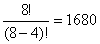 . Thus 1680 words can be
formed.
. Thus 1680 words can be
formed.
Q.18 Explain
chomsky classification of languages with suitable examples. (7)
Ans: Any language is suitable for
communication provided the syntax and semantic of the language is known to the
participating sides. It is made possible by forcing a standard on the way to
make sentences from words of that language. This standard is forced through a
set of rules. This set of rules is called grammar of the
language. According to the Chomsky classification, a grammar G = (N, å, P, S) is said
to be of
Type 0: if there is no restriction on
the production rules i.e., in a®b, where a, bÎ (N È å)*. This type of
grammar is also called an unrestricted grammar and language is
called free language.
Code: AC10
Subject: DISCRETE STRUCTURES
Type 1: if in every production a®b of P, a, b Î (N È å)* and |a| £ |b|. Here |a| and |b| represent number of symbols in string a and b respectively.
This type of grammar is also called a context sensitive grammar
(or CSG) and language is called context sensitive.
Type 2: if in every production a®b of P, a Î N and b Î (N È å)*. Here a is a single non-terminal symbol. This type of grammar is also
called a context free grammar (or CFG) and language
is called context free.
Type 3: if in every production a®b of P, a Î N and b Î (N È å)*. Here a is a single non-terminal symbol and b may consist of at the most
one non-terminal symbol and one or more terminal symbols. The non-terminal
symbol appearing in b must be the extreme right symbol. This type of grammar is also
called a right linear grammar or regular grammar
(or RG) and the corresponding language is called regular
language.
Q.19 Find a generating function to count the number of
integral solutions to 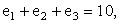 if for each I, 0
  . (7)
. (7)
Ans: According to the given constraints
polynomial for variable e1 can be written as
1+ x + x2 + x3 + …. since
0 £
e1
Similarly
polynomial for variable e2 and e3 can be written as
1+ x + x2 + x3 + …. since
0 £
e2
1+ x + x2 + x3 + …. since
0 £
e3
respectively.
Thus the number of
integral solutions to the given equations under the constraints is equal to the
coefficient of x10 in the expression
(1+ x + x2
+ x3 + …. )( 1+ x + x2 + x3 + ….
)( 1+ x + x2 + x3 + …. )
Thus the
generating function f(x) =  .
.
Q.20. Prove by elimination of cases : if X is a number such that
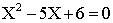 then X = 3 or X = 2.
(7)
then X = 3 or X = 2.
(7)
Ans: Let a and b be two roots of the equation, then
a + b = 5 and a *
b = 6
Now, (a
– b)2 = (a + b)2 – 4a*b
= 25 – 24 = 1
Code: AC10
Subject: DISCRETE STRUCTURES
\ a – b = 1 or -1
Now using the method of elimination (adding) the two equation a + b
= 5 and a – b = 1, we get,
2a = 6, or a = 3.
Using this value in any of the equation, we get b = 2.
It is easy to
verify that, if a – b = -1 is taken then we get a = 2 and b = 3. Thus two root
of the given equations are X = 3 or X = 2.
Q.21 Consider the
following open propositions over the universe 

R(x) : s is a multiple
of 2
Find the truth values
of
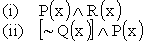 (8)
(8)
Ans: The truth values for each element
of U under the given conditions of propositions is given in the following
table:
|
x
|
P(x)
|
Q(x)
|
R(x)
|
P(x)
Ù
R(x)
|
~Q(x)Ù P(x)
|
|
-4
|
0
|
0
|
1
|
0
|
0
|
|
-2
|
0
|
0
|
1
|
0
|
0
|
|
0
|
0
|
0
|
1
|
0
|
0
|
|
1
|
0
|
0
|
0
|
0
|
0
|
|
3
|
0
|
0
|
0
|
0
|
0
|
|
5
|
1
|
1
|
0
|
0
|
0
|
|
6
|
1
|
0
|
1
|
1
|
1
|
|
8
|
1
|
0
|
1
|
1
|
1
|
|
10
|
1
|
0
|
1
|
1
|
1
|
Q.22 Let  then compute
 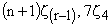 . (6)
. (6)
Ans: It is given that nzr is defined as (n + 1) nPr-1. Then we can
write
(n+1)z(r – 1) = (n + 2) n+1Pr-2 =  , and
, and
7z4 = 8* 7P3 = 
Q.23 Translate
and prove the following in terms of propositional logic
A = B if and
only if A  B
and B A (5)
B
and B A (5)
Code: AC10
Subject: DISCRETE STRUCTURES
Ans: Let SUB(A, B) stands for “A is subset of B” and EQL(A, B) stands
for “A is equal to B”. Then the given statement can be written as
"A, B [SUB(A, B) Ù SUB(B, A)] Û EQL(A, B)
Q.24 Determine
the number of integral solutions of the equation
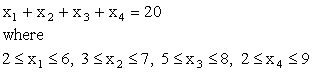 (9)
(9)
Ans: According to the given constraints polynomial for variable x1
can be written as
x2 + x3 + x4 + x5 + x6
since 2 £ x1 £ 6
Similarly
polynomial for variable x2, x3 and x4 can be
written as
x3 + x4 + x5 + x6 + x7
since 3 £ x2 £ 7
x5 + x6 + x7 + x8
since 5 £ x3 £ 8
x2 + x3 + x4 + x5 + x6
+ x7 + x8 + x9 since 2 £ x4 £ 9
respectively.
Thus the number of
integral solutions to the given equations under the constraints is equal to the
coefficient of x20 in the expression
(x2 + x3
+ x4 + x5 + x6)( x3 + x4
+ x5 + x6 + x7)( x5 + x6
+ x7 + x8)( x2 + x3 + x4
+ x5 + x6 + x7 + x8 + x9)
= x12
(x5 – 1)2 (x4 – 1)2(x4 +
1) (x – 1)–4
= x12
[1 – x4 – 2x5 – x8 + 2x9 + x10
+ x12 + 2x13 – x 14 – 2x 17– x 18+
x22] (1 – x)–4
In the coefficient of x20, the terms that can contribute
are from (1 – x4 – 2x5 – x8) only. All other
terms when multiplied with x20, yields higher degree terms.
Therefore coefficients of x20 in the entire expression are equal to
linear combinations of coefficients of x8, x4, x3
and 1 in (1 – x)–4 with respective constant coefficients 1, -1, -2,
-1. This is equal to

Therefore number
of integral solution is 89.
Q.25 Using BNF
notation construct a grammar G to generate the language over an alphabet  with an equal
number of 0’s and 1’s for some integer
with an equal
number of 0’s and 1’s for some integer  (7)
(7)
Ans: The given language is
defined over the alphabet å = {1, 0}. A string in this language contains equal number of 0 and
1. Strings 0011, 0101, 1100, 1010, 1001 and 0110 are all valid strings of
length 4 in this language. Here, order of appearance of 0’s and 1’s is not
fixed. Let S be the start symbol. A string may start with either 0 or 1. So, we
should have productions S ®
Code: AC10
Subject: DISCRETE STRUCTURES
0S1, S ® 1S0, S ® 0A0 and S ® 1B1 to implement this. Next A and B should be replaced in such a
way that it maintains the count of 0’s and 1’s to be equal in a string. This is
achieved by the productions A ® 1S1 and B ® 0S0. The null string is also an acceptable string, as it
contains zero number of 0’s and 1’s. Thus S ® e should also be a
production. In addition to that a few Context sensitive production rules are to
be included.
These are: A ® 0AD0, 0D1 ® 011, 0D0 ® 00D, B® 1BC1, 1C0 ® 100, 1C1 ® 11C. Therefore, the required grammar G can be given by (N, å, P, S), where N
= {S, A, B}, å = (1, 0} and P = {S ® 0S1, S ® 1S0, S ® 0A0, S ® 1B1, A ® 1S1, B ® 0S0, A ® 0AD0, 0D1 ® 011, 0D0 ® 00D, B® 1BC1, 1C0 ® 100, 1C1 ® 11C, S ® e}.
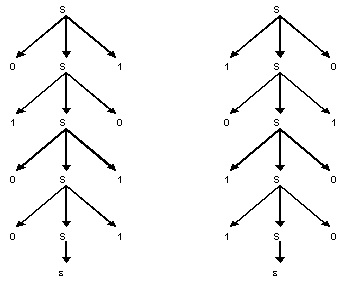
Q.26 Construct the derivation trees for the strings 01001101 and
10110010 for the above grammar. (7)
Ans: The derivation tree for the given
string under the presented grammar is as below.
Q.27 Find the generating function to
represent the number of ways the sum 9 can be obtained when 2 distinguishable
fair dice are tossed and the first shows an even number and the second shows an
odd number. (5)
Ans: Let x1 and x2
be the variable representing the outcomes on the two dice the x1 has
values 2, 4, 6 and x2 has 1, 3, 5. Now polynomial for variable x1
and x2 can be written as (x2 + x4 + x6)
and (x + x3 + x5) respectively.
Thus the number of
ways sum 9 can be obtained is equal to the coefficient of x9 in the
expression (x2 + x4 + x6)(x + x3 +
x5). This is equal to 2.
Code: AC10
Subject: DISCRETE STRUCTURES
Q.28 Prove
that if  are
elements of a lattice
are
elements of a lattice  then
then
 (9)
(9)
Ans:
Let us use b = L1 and a = L2. It is given that aÚb = b. Since aÚb
is an upper bound of a, a £ aÚb. This implies a £ b.
Next,
let a £ b. Since £ is a partial order relation, b £ b. Thus, a£b
and b£b together implies that b is an
upper bound of a and b. We know that aÚb
is least upper bound of a and b, so aÚb
£ b. Also b £ aÚb because aÚb is an upper bound of b. Therefore, aÚb £
b and b £ aÚb Û aÚb = b by the anti-symmetry property of
partial order relation £. Hence, it is
proved that aÚb = b if and only if a £ b.
Q.29 Let  be a semigroup.
Consider a finite state machine M = (S, S F), where
be a semigroup.
Consider a finite state machine M = (S, S F), where  and fx (y) = x * y for
all x, y
and fx (y) = x * y for
all x, y  Consider
the relation R on S, x R y if and only if there is some z such that fz (x) = y.
Show that R is an equivalence relation.
Consider
the relation R on S, x R y if and only if there is some z such that fz (x) = y.
Show that R is an equivalence relation.
(14)
Ans: Let M = (S, I, Á, s0, T) be a FSM where S is the set of states, I is set
of alphabets, Á is transition table, s0 is initial state and T is the
set of final states. Let TC = S – T. Then set S is decomposed into
two disjoint subsets T and TC. Set T contains all the terminal
(acceptance) states of the M and TC contains all the non-terminal
states of M. Let w Î I* be any string. For any state s Î S, fw(s)
belongs to either T or TC. Any two states: s and t are said to be
w-compatible if both fw(s) and fw(t) either
belongs to T or to TC for all wÎ I*.
Now we have to show that if R be a relation defined on S as sRt if
and only if both s and t are w-compatible the R is an equivalence relation.
Let
s be any state in S and w be any string in I*. Then fw(s) is either
in T or in TC. This implies that sRs " sÎ S. Hence R is
reflexive on S. Let s and t be any two states in S such that sRt. Therefore, by
definition of R both s and t w-compatible states. This implies that tRs. Thus,
R is symmetric also. Finally, let s, t and u be any three states in S such that
sRt and tRu. This implies that s t and u are w-compatible states i.e. s and u are
w-compatible. Hence sRu. Thus, R is a transitive relation. Since R is
reflexive, symmetric and transitive, it is an equivalence relation.
Q.30 Represent
each of the following statements into predicate calculus forms :
(i) Not all birds can fly.
(ii) If x is a man, then x is a giant.
(iii)
Some men are not giants.
(iv)
There is a student who likes mathematics but not
history. (9)
Ans:
(i) Let us assume
the following predicates
Code: AC10
Subject: DISCRETE STRUCTURES
bird(x):
“x is bird”
fly(x): “x can fly”.
Then given
statement can be written as: $x bird(x) Ù ~ fly(x)
(ii)
Let us assume the following predicates
man(x): “x is Man”
giant(x): “x is giant”.
Then
given statement can be written as: "x (man(x)® giant(x))
(iii) Using the
predicates defined in (ii), we can write
$x
man(x) Ù ~ giant(x)
(iv) Let us assume
the following predicates
student(x): “x is student.”
likes(x, y): “x likes y”. and ~likes(x, y) Þ “x does not like y”.
Then given
statement can be written as:
$x
[student(x) Ù likes(x, mathematics) Ù~ likes(x, history)]
Q.31 Let X be the
set of all programs of a given programming language. Let R the relation on X
be defined as
 give the same output on all the
inputs for which they terminate.
give the same output on all the
inputs for which they terminate.
Is R an equivalence relation? If
not which property fails? (5)
Ans: R is defined on the set X of all
programs of a given programming language. Now let us test whether R is an
equivalence relation or not
Reflexivity: Let P be any element of
X then obviously P gives same output on all the inputs for which P terminates
i.e. P R P. Thus R is reflexive.
Symmetry: Let P and Q are any two
elements in X such that P R Q. Then P and Q give same output on all the inputs
for which they terminate => Q R P =>R is symmetric.
Transitivity: Let P, Q and S are any
three elements in X such that P R Q and Q R S. It means P and Q gives the same
out for all the inputs for which they terminate. Similar is the case for Q and
S. It implies that there exists a set of common programs from which P, Q and S
give the same output on all the inputs for which they terminate i.e. P R S
=> R is transitive.
Therefore R is an
equivalence relation.
Q.32 Let  and relation
  be partial
order of divisibility on A. Let
be partial
order of divisibility on A. Let 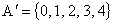 and
and  be the relation “less than or
equal to” on integers. Show that
be the relation “less than or
equal to” on integers. Show that  are isomorphic posets. (7)
Code: AC10
Subject: DISCRETE STRUCTURES
Ans: Any two posets (A, R1) and
(A’, R2) are said to isomorphic to each other if there exists a
function f: A ® A’ such that
·
f is one to one and
onto function; and
·
For any a, b Î A, a R1 b Û f(a) R2 f(b), i.e. images
preserve the order of pre-images.
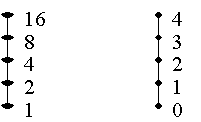
Let f: A ® A’ is defined
as f(1) = 0, f(2) = 1, f(4) = 2, f(8) = 3, f(16) = 4.
It is obvious from the definition that f is one to one and
onto. Regarding preservation of order, it is preserved under the respective
partial order relation. It is shown in the following hasse diagram.
Q.33 Let  be defined as
  , then either
prove or give counter example for the following,
, then either
prove or give counter example for the following,
 (7)
(7)
Ans: Let R = {1, 2, 3, 4}; S = {1, 2, 3,
4, 5, 6} and T = {3, 6, 7}. Obviously R Í S. However RÑ T = {1, 2, 4,
6, 7}and S Ñ T = {1, 2, 4, 5, 7}. Clearly, (RÑ T) Ë (S Ñ T). Hence it is
disproved.
Q.34 Prove or
disprove the following equivalence,
 (9)
(9)
Ans: RHS of the given expression ((p Ù ~q) Ú (q Ù ~p)) can be
written as
~(~((p Ù ~q) Ú (q Ù ~p))) = ~((~(p Ù ~q)) Ù (~(q Ù ~p)))
= ~((~p Ú q) Ù (~q Ú p))
= ~((p ® q) Ù (q ® p))
= ~(p « q)
Q.35 Solve the
following recurrence relation and indicate if it is a linear homogeneous
relation or not. If yes, give its degree and if not justify your answer. 
(5)
Ans: The given equation can be written
in the following form:
tn - tn-1 = n
Code: AC10
Subject: DISCRETE STRUCTURES
Now successively replacing n by (n – 1)
and then by (n – 2) and so on we get a set of equations. The process is
continued till terminating condition. Add these equations in such a way that
all intermediate terms get cancelled. The given equation can be rearranged as
tn – tn–1 = n
tn–1 – tn–2 = n – 1
tn–2 – tn–3 = n – 2.
tn–3 – tn–4 = n – 3
.
t2 – t1 = 2 [we stop here, since t1 = 4 is given ]
Adding all, we get tn – t1 = [n + (n – 1) + (n – 2) + ... + 2]
or, tn = [n + (n – 1) + (n – 2) + ... + 2 + 4]
or, tn = 
The given recurrence equation is linear and non homogeneous. It is
of degree 1.
Q.36 State the
relation between Regular Expression, Transition Diagram and Finite State
Machines. Using a simple example establish your claim. (6)
Ans: For every regular language, we can
find a FSM for this, because a FSM work as recognizer of a regular language.
Whether a language is regular can be determined by finding whether a FSM can be
drawn or not.
A machine contains finite number of states. To determine whether a
string is valid or not, the FSM begins scanning the string from start state and
moving along the transition diagram as per the current input symbol. The table
showing the movement from one state to other for input symbols of the alphabets
is called transition table.
Every machine has a unique transition table. Thus there is one to
one relationship between Regular language and FSM and then between FSM and
transition table.
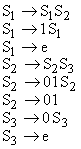
Q.37 Identify the
type and the name of the grammar the following set of production rules belong
to. Also identify the language it can generate. (8)
Code: AC10
Subject: DISCRETE STRUCTURES
Ans: In the left hand side of the
production rules, only single non terminal symbol is use. This implies that the
grammar is either of Type 2 or Type 3. In the RHS of some production rules,
there are more than one non terminal. The null production can be removed by
combining it with the other productions. Thus, according to the Chomsky
hierarchy, the grammar is of type 2, and name of the grammar is Context Free
Grammar(CFG). The language of the grammar can be determined as below:
S1 ® S1S2
® S1S2S3
[Apply rule S2 ® S2S3]
® S1S2 0mS3
[Apply rule S3 ® 0S3 (m
³ 0)
times]
® S1S2 0m
[Apply rule S3 ® e]
® S1 01S2 0m
[Apply rule S2 ® 01S2 ]
® S1 (01)l (0m)k [Apply
rule S2 ® S2S3 and S2 ® 01S2 (k ³ 0,
l
³ 1)
times and then S2 ® 01 once ]
® 1n
[(01)l (0m)k ] t [Apply
rule S1 ® S1S2 , (t ³ 0) times,
S1®1S1 (n ³ 0) time and S2
® e once]
That the language
contains strings of the form 1n [(01)l (0m)k
] t where l ³ 1 and other values like n, m, k and t are ³ 0.
Q.38 For any positive integer n, let 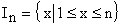 .
Let the relation “divides”
be written as
.
Let the relation “divides”
be written as  iff a divides b or b = ac for some integer c. Draw the
Hasse diagram and determine whether
iff a divides b or b = ac for some integer c. Draw the
Hasse diagram and determine whether  is a lattice. (8)
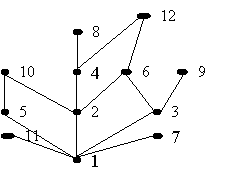
Ans: Hasse diagram for the structure (I12, |) is given below.
Code: AC10
Subject: DISCRETE STRUCTURES
It
is obvious from the Hasse diagram that there are many pairs of element, e.g (7,
11), (8, 10) etc that do not have any join in the set. Hence (I12,
|) is not a lattice.
Q.39 Give the
formula and the Karnaugh map for the minimum DNF,
(Disjunctive Normal Form)
 (6)
(6)
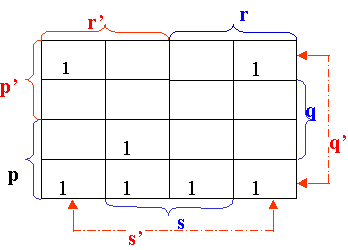
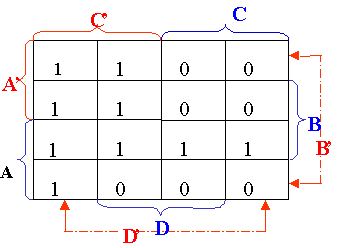
Ans: The K-map for the given DNF is shown below. The formula for the same
is
pq’
+ s’q’ + pr’s
Q.40 If the
product of two integers a and b is even then prove that either a is even or b
is even. (5)
Ans: It is given that product of a and b
is even so let a * b = 2n. Since 2 is a prime number and n is any integer (odd or
even), either a or b is a multiple of 2. This shows that either a is even or b
is even.
Q.41 Using proof
by contradiction, prove that “ is irrational”. Are irrational
numbers countable? (5)
is irrational”. Are irrational
numbers countable? (5)
Code: AC10
Subject: DISCRETE STRUCTURES
Ans:
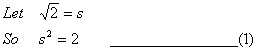
If s were a
rational number, we can write
Where p is an integer and q is any positive integer. We can
further assure that the gcd(p, q) =1 by driving out common factor
between p and q, if any. Now using equation (2), in equation (1), we get
Conclusion: From equation (3), 2
must be a prime factor of p2. Since 2 itself is a
prime, 2 must be a factor of p itself. Therefore, 2*2 is a factor of
p2. This implies that 2*2 is a factor of 2*q2.
Þ 2 is a factor of q2
Þ 2 is a factor of q
Since,
2 is factor of both p and q gcd(p, q) = 2. This is
contrary to our assumption that gcd(p, q) = 1. Therefore, Ö2 is an
irrational number. The set of irrational numbers is uncountable.
Q.42 Use
quantifiers and predicates to express the fact that  does not exist. (4)
Ans: Let P(x, a) : 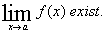 Then the given limit
can be written as
Then the given limit
can be written as
$a ØP(x, a).
Q.43 Minimize the
following Boolean expression using k-map method
 (7)
(7)
Code: AC10
Subject: DISCRETE STRUCTURES
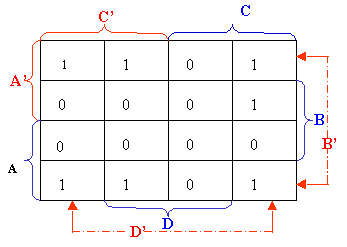
Ans:
The minimized
boolean expression C’D’ + A’C’ + AB
Q.44 Find a recurrence relation for
the number of ways to arrange flags on a flagpole n feet tall using 4 types of
flags: red flags 2 feet high, white, blue and yellow flags each 1 foot high. (7)
Ans: Let An be the number of
ways in which the given flags can be arranged on n feel tall flagpole. The red
color flag is of height 2 feet, and white, blue and yellow color flag is of
height 1 foot. Thus if n =1, flag can be arranged in 3 ways. If n = 2, the
flags can be arranged in either 3x3 ways using 3 flags of 1 foot long each or
in 1 way using 2 feet long red flag. Thus, flags on 2 feet long flagpole can be
arranged in 10 ways. This can be written in recursive form as:
An
= 3An – 1 ; An = 10An – 2 ; Adding them
together, we have
2An
– 3An – 1 – 10An – 2 = 0 and A1 = 3; A2
= 10.
Q.45 What is the
principle of inclusion and exclusion? Determine the number of integers between
1 and 250 that are divisible by any of the integers 2, 3, 5 and 7. (7)
Ans:
This principle is
based on the cardinality of finite sets. Let us begin with the given problem of
finding all integers between 1 and 250 that are divisible by any of the
integers 2, 3, 5 or 7. Let A, B, C and D be two sets defined as:
A
= {x | x is divisible by 2 and 1 £ x £ 250},
B
= {x | x is divisible by 3 and 1 £ x £ 250},
C
= {x | x is divisible by 5 and 1 £ x £ 250} and
D = {x | x is divisible by 7 and 1 £ x £ 250}
Similarly, A Ç B= {x | x is divisible by 2 and 3 and 1 £ x £ 250}
Code: AC10
Subject: DISCRETE STRUCTURES
.
.
C Ç D = {x | x is divisible by 5 and 7 and 1 £ x £ 250}
AÇBÇD = {x | x is divisible by 2, 3 and 7 and 1 £ x £ 250}
Here,
problem is to find the number of elements in AÈBÈCÈD. Also, there are numbers
that are divisible by two or three or all the four numbers taken together. A Ç B, A ÇC, A Ç D, B Ç C, …, C Ç D are not null
set. This implies that while counting the numbers, whenever common elements
have been included more than once, it has to be excluded. Therefore, we can
write
|
A È
B È
C È
D | = |A| + |B| + |C| + |D| – |AÇB| – |AÇC| – |AÇD| – |BÇC| – |BÇD| – |C Ç D| + |AÇBÇC| + |AÇBÇD| + |AÇCÇD| + |BÇCÇD| - |AÇBÇCÇD|
The
required result can be computed as below:
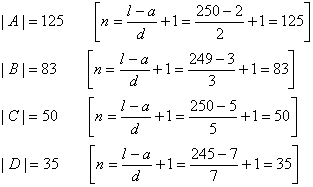
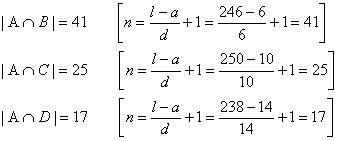
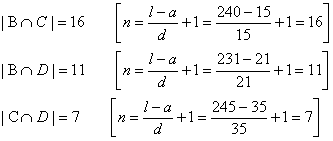
Code: AC10
Subject: DISCRETE STRUCTURES
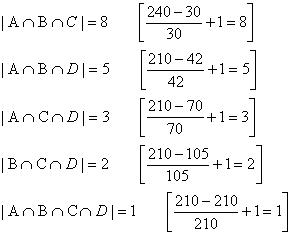
Therefore,
| A È B È C È D | = 125 + 83
+50 + 35 – 41 – 25 – 17 – 16 – 11 – 7 +8 + 5 + 3 + 2 –1
= 311 – 118
= 193.
Q.46 Show that  is tautologically
implied by
is tautologically
implied by  . (7)
. (7)
Ans: Let us find the truth table for [(PÚQ)Ù(P®R)Ù(Q®S)] ® (SÚR).
|
P
|
Q
|
R
|
S
|
(PÚQ)
|
(P®R)
|
(Q®S)
|
(SÚR)
|
[(PÚQ)Ù(P®R)Ù(Q®S)] ® (SÚR)
|
|
0
|
0
|
0
|
0
|
0
|
1
|
1
|
0
|
1
|
|
0
|
0
|
0
|
1
|
0
|
1
|
1
|
1
|
1
|
|
0
|
0
|
1
|
0
|
0
|
1
|
1
|
1
|
1
|
|
0
|
0
|
1
|
1
|
0
|
1
|
1
|
1
|
1
|
|
0
|
1
|
0
|
0
|
1
|
1
|
0
|
0
|
1
|
|
0
|
1
|
0
|
1
|
1
|
1
|
1
|
1
|
1
|
|
0
|
1
|
1
|
0
|
1
|
1
|
0
|
1
|
1
|
|
0
|
1
|
1
|
1
|
1
|
1
|
1
|
1
|
1
|
|
1
|
0
|
0
|
0
|
1
|
0
|
1
|
0
|
1
|
|
1
|
0
|
0
|
1
|
1
|
0
|
1
|
1
|
1
|
|
1
|
0
|
1
|
0
|
1
|
1
|
1
|
1
|
1
|
|
1
|
0
|
1
|
1
|
1
|
1
|
1
|
1
|
1
|
|
1
|
1
|
0
|
0
|
1
|
0
|
0
|
0
|
1
|
|
1
|
1
|
0
|
1
|
1
|
0
|
1
|
1
|
1
|
|
1
|
1
|
1
|
0
|
1
|
1
|
0
|
1
|
1
|
|
1
|
1
|
1
|
1
|
1
|
1
|
1
|
1
|
1
|
Code: AC10
Subject: DISCRETE STRUCTURES
Hence the
implication is a tautology.
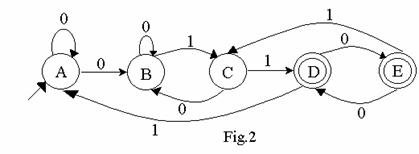
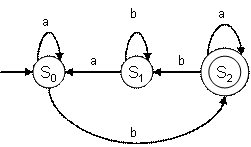
Q.47 Identify the regular set
accepted by the Fig.2 finite state machine and construct the corresponding
state transition table.
(7)
Ans: The transition table for the given FSM is as below:
|
State
|
0
|
1
|
|
A
|
{A,
B}
|
{}
|
|
B
|
{B}
|
{C}
|
|
C
|
{B}
|
{D}
|
|
D
|
{E}
|
{A}
|
|
E
|
{D}
|
{C}
|
The language
(Regular set) accepted by the FSM is any string on the alphabets {0, 1} that
(a)
begins with ‘0’
(b)
contains substring ‘011’ followed by zero or
more 0’s, and
(c)
does not contain 3 consecutive 1’s.
Q.48 Construct
truth tables for the following:
 (7)
(7)
Ans: The required truth table for (pÚq) Ù (Ør) « q is as below:
|
p
|
q
|
r
|
pÚq
|
(pÚq) Ù (Ør)
|
(pÚq) Ù (Ør) « q
|
|
0
|
0
|
0
|
0
|
0
|
1
|
|
0
|
0
|
1
|
0
|
0
|
1
|
|
0
|
1
|
0
|
1
|
1
|
1
|
|
0
|
1
|
1
|
1
|
0
|
0
|
|
1
|
0
|
0
|
1
|
1
|
0
|
|
1
|
0
|
1
|
1
|
0
|
1
|
|
1
|
1
|
0
|
1
|
1
|
1
|
|
1
|
1
|
1
|
1
|
0
|
0
|
Code: AC10
Subject: DISCRETE STRUCTURES
Q.49 Find
the coefficient of  in
in 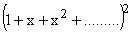 (7)
(7)
Ans: Let the given expression is written as
f(x) = (1 + x +
x2 + x3 +¼+ xn)2 
= (1 – x)–2
The coefficient of x10 is equal to
Q.50 If  is a complemented and
distributive lattice, then the complement
is a complemented and
distributive lattice, then the complement  of any element
  is unique. (7)
Ans:
Let I and 0 are the unit and zero elements of L
respectively. Let b and c be two complements of an element a Î L. Then from
the definition, we have
a
Ù b
= 0 = a Ù c and
a Ú b = I = a Ú c
We can write
b = b Ú 0 = b Ú (a Ù c )
=
(b Ú
a) Ù
(b Ú
c ) [since lattice is distributive ]
= I Ù (b Ú c )
= (b Ú c )
Similarly,
c = c Ú 0 = c Ú (a Ù b )
=
(c Ú
a) Ù
(c Ú
b) [since lattice is distributive ]
= I Ù (b Ú c) [since Ú is a commutative operation]
= (b Ú c)
The above two results show
that b = c.
Q.51 Consider the
following Hasse diagram Fig.3 and the set B= {3, 4, 6}. Find, if they exist,
(i)
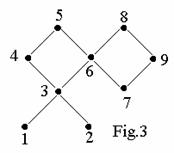 all upper bounds
of B;
all upper bounds
of B;
(ii)
all lower bounds of B;
(iii)
the least upper bound of B;
(iv)
the greatest lower bound of B; (7)
Code: AC10
Subject: DISCRETE STRUCTURES
Ans:
(i) The set of
upper bounds of subset B = {3, 4, 6} in the given lattice is {5}. It is only
element in the lattice that succeeds all the elements of B.
(ii) Set
containing lower bounds is {1, 2, 3}
(iii) The least
upper bound is 5, since it is the only upper bounds.
(iv) The greatest
lower bound is 3, because it is the element in lower bounds that succeeds all
the lower bounds.
Q.52 Solve the
recurrence relation  . (7)
. (7)
Ans:
The general solution, also called homogeneous solution, to
the problem is given by homogeneous part of the given recurrence equation. The
homogeneous part of the given equation is
The characteristic equation of (2) is given as
The homogeneous solution is given by
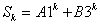 ------------------------(2)
Now, particular solution is given by
Substituting the
value of Sk in the given equation, we get
Code: AC10
Subject: DISCRETE STRUCTURES
The complete,
also called total, solution is obtained by combining the homogeneous
and particular solutions. This is given as
Since no
initial condition is provided, it is not possible to find A and B,
Q.53 Prove that  . (7)
. (7)
Ans: In order to prove this let x be any element of A È B, then
x Î A È B Û x Î A or x Î B
Û (x Î A and x Ï B) or (x Î B and x Ï A) or (x Î A and x Î B)
Û (x Î A – B) or (x Î B – A) or (x Î A Ç B)
Û x Î (A – B) È (B – A) È (A Ç B)
This implies
that
A È B Í
(A – B) È (B – A) È (A Ç B) and
(A – B) È
(B – A) È (A
Ç B) Í A È B
Thus A È B = (A – B) È (B – A) È (A Ç B)
Q.54 There are 15
points in a plane, no three of which are in a straight line except 6 all of
which are in one straight line.
Code: AC10
Subject: DISCRETE STRUCTURES
(i) How many straight lines
can be formed by joining them?
(ii) How many triangles can be
formed by joining them? (7)
Ans: There are 15 points out of which 6 are collinear. A straight can
pass through any two points. Thus
(i) The number straight lines that can be formed is 15C2
– 6C2 +1 = 105 – 15 + 1 = 91. 15C2 is
the number of ways two points can be selected. If the two points are coming
from 6 collinear, then there can be only one straight line. Thus 6C2
is subtracted and 1 is added in the total.
(ii) The number Triangles that can be formed is 15C3
– 6C3 = 455 – 20 = 425. 15C3 is
the number of ways three points can be selected to form a triangle. If the
three points are coming from 6 collinear, then no triangle is formed. Thus 6C3
is subtracted from the total.
Q.55 Prove
the following Boolean expression:
 (7)
(7)
Ans: In the given expression, LHS is equal to:
(xÚy)Ù(xÚ ~y)Ù(~x Ú z) = [xÙ(xÚ ~y)] Ú [yÙ(xÚ ~y)] Ù(~x Ú z)
= [xÙ(xÚ ~y)] Ú [yÙ(xÚ ~y)] Ù(~x Ú z)
= [(xÙx) Ú (xÙ~y)] Ú [(yÙx)Ú (yÙ~y)] Ù(~x Ú z)
= [x Ú (xÙ~y)] Ú [(yÙx)Ú 0] Ù(~x Ú z)
= [x Ú (yÙx)] Ù(~x Ú z) [x Ú (xÙ~y) =x]
= x Ù(~x Ú z) [x
Ú (xÙy) =x]
= [x Ù~x)] Ú (x Ù z) [x Ú (xÙ~y) =x]
= 0 Ú (x Ù z) = (x Ù z) = RHS
Q.56 Find how
many words can be formed out of the letters of the word DAUGHTER such that
(i)
The vowels are always together.
(ii)
The vowels occupy even places. (7)
Ans: In the word DAUGHTER, there are
three vowels: A, E and U. Number of letters in the word is 8.
(i)
When vowels are always together, the number
of ways these letters can be arranged (5 +1)! * 3!. The 5 consonants and one
group of vowels. Within each such arrangement, the three vowels can be arranged
in 3! Ways. The required answer is 4320.
(ii)
When vowel occupy even position, then the
three vowels can be placed at 4 even positions in 3*2*1 ways. The three even
positions can be selected in 4C3 ways. And now the 5
consonants can be arranged in 5! Ways. Therefore the required number is = 3! * 4C3
*5! = 2880
Code: AC10
Subject: DISCRETE STRUCTURES
Q.57 Let R be the
relation on the set of ordered pairs of positive integers such that 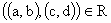 if and only
if ad = bc. Determine whether R is an equivalence relation or a partial
ordering. (8)
if and only
if ad = bc. Determine whether R is an equivalence relation or a partial
ordering. (8)
Ans: R is defined on the set P of cross product of set of positive
integers Z+ as (a, b) R (c, d) iff a*d =b*c. Now let us test whether R is an
equivalence relation or not
Reflexivity: Let (x, x) be any element of P, then since a*a = a*a , we can say
the (a, a) R (a, a).Thus R is reflexive.
Symmetry: Let (a, b) and (c, d) are any two elements in P such that (a, b) R
(c, d). Then we have a*d = b*c => c*b = d*a => (c, d) R (a, b) => R is
symmetric.
Transitivity: Let (a, b), (c, d) and (e, f) are any
three pairs in P such that (a, b) R (c, d) and (c, d) R (e, f). Then we have
a*d = b*c and c*f = d*e => a/e = b/f => a*f = b*e => (a, b) R (e, f)
=> R is transitive.
Therefore R is an
equivalence relation.
Q.58 Prove that
the direct product of any two distributive lattice is a distributive. (6)
Ans:
Let (L1, £1) and (L2, £2) be two
distributive lattices then we have to prove that (L, £) is also a
distributive lattice, where L = L1 ´ L2 and £ is the product
partial order of (L1, £1) and (L2, £2). It will be
sufficient to show that L is lattice, because distributive properties shall be
inherited from the constituent lattices.
Since
(L1, £1) is a lattice, for any two elements
a1 and a2 of L1, a1Úa2 is
join and a1Ùa2 is meet of a1 and a2 and both
exist in L1. Similarly for any two elements b1 and b2
of L2, b1Úb2 is join and b1Ùb2 is meet of b1
and b2 and both exist in L2. Thus, (a1Úa2, b1Úb2)
and (a1Ùa2, b1Ùb2) Î L. Also (a1,
b1) and (a2, b2) Î L for any a1, a2
Î L1
and any b1, b2 Î L2.
Now
if we prove that
(a1,
b1) Ú (a2, b2) = (a1Úa2, b1Úb2)
and
(a1,
b1) Ù (a2, b2) = (a1Ùa2, b1Ùb2)
then
we can conclude that for any two ordered pairs (a1, b1)
and (a2, b2) Î L, its join and meet exist and thence (L, £) is a lattice.
We
know that (a1, b1) Ú (a2, b2)
= lub ({(a1, b1), (a2, b2)
}). Let it be (c1, c2). Then,
(a1,
b1) £ (c1, c2) and (a2, b2) £ (c1,
c2)
Þ a1£1c1, b1 £2 c2; a2 £1c1, b2 £2 c2
Þ a1£1c1, a2 £1c1; b1 £2 c2, b2 £2 c2
Þ a1Ú a2 £1c1; b1Ú b2 £2 c2
Code: AC10
Subject: DISCRETE STRUCTURES
Þ(a1Ú a2 ,
b1Ú b2) £ (c1, c2)
This
shows that (a1Ú a2 , b1Ú b2) is an upper
bound of {(a1, b1), (a2, b2)} and
if there is any other upper bound (c1, c2) then (a1Ú a2 ,
b1Ú b2) £ (c1, c2). Therefore, lub ({(a1,
b1), (a2, b2)}) = (a1Ú a2,
b1Ú b2) i.e.
(a1, b1) Ú (a2, b2) = (a1Úa2, b1Úb2)
Similarly, we can show for the
meet.
Q.59 Given n
pigeons to be distributed among k pigeonholes. What is a necessary and
sufficient condition on n and k that, in every distribution, at least two
pigeonholes must contain the same number of pigeons?
Prove
the proposition that in a room of 13 people, 2 or more people have their
birthday in the same month. (8)
Ans: The situation when all the k
pigeonholes may contain unique number of pigeons out of n pigeons, if n ³ (0 + 1 + 2 + 3
+…+ (k – 1)) =  . Thus, as long as n (number of
pigeons)
. Thus, as long as n (number of
pigeons)
is less than equal to , at least two of the k
pigeonholes shall contain equal number of pigeons.
Let 12 months are pigeonholes and 13
people present in the room are pigeons. Pick a man and make him seated in a
chair marked with month corresponding his birthday. Repeat the process until 12
people are seated. Now even in the best cases, if all the 12 people have
occupied 12 different chairs, the 13th person will have to share
with any one, i.e. there is at least 2 persons having birthday in the same
month.
Q.60 Define a grammar. Differentiate
between machine language and a regular language. Specify the Chowsky’s
classification of languages. (6)
Ans: Any language is suitable for communication provided the syntax and
semantic of the language is known to the participating sides. It is made
possible by forcing a standard on the way to make sentences from words of that
language. This standard is forced through a set of rules. This set of rules is
called grammar of the language. A grammar G = (N, å, P, S) is said
to be of
Type 0: if there is no restriction on
the production rules i.e., in a®b, where a, bÎ (N È å)*. This type of
grammar is also called an unrestricted grammar.
Type 1: if in every production a®b of P, a, b Î (N È å)* and |a| £ |b|. Here |a| and |b| represent number of symbols in string a and b respectively.
This type of grammar is also called a context sensitive grammar
(or CSG).
Code: AC10
Subject: DISCRETE STRUCTURES
Type 2: if in every production a®b of P, a Î N and b Î (N È å)*. Here a is a single non-terminal symbol. This type of grammar is also
called a context free grammar (or CFG).
Type 3: if in every production a®b of P, a Î N and b Î (N È å)*. Here a is a single non-terminal symbol and b may consist of at the most
one non-terminal symbol and one or more terminal symbols. The non-terminal
symbol appearing in b must be the extreme right symbol. This type of grammar is also
called a right linear grammar or regular grammar
(or RG).
For any language
a acceptor (a machine) can be drawn that could be DFA, NFA, PDA, NPDA, TM etc.
Language corresponding to that machine is called machine language. In
particular a language corresponding to Finite automata is called Regular
language.
Q.61 Determine the
closure property of the structure [ ,(·)] with respect to the operations
  and (·). Illustrate using examples and give the identity element, if one exists
for all the binary operations. (9)
and (·). Illustrate using examples and give the identity element, if one exists
for all the binary operations. (9)
Ans: Let A and B are any two 5x5 Boolean
matrices. Boolean operations join (Ú), meet (Ù) and product [(·)] on set of 5x5
Boolean matrix M is defined as
A Ú B = [cij], where cij = max {aij, bij}
for 1 £ i £ 5, 1 £ j £ 5
A Ù B = [cij], where cij = min {aij, bij}
for 1 £ i £ 5, 1 £ j £ 5
A (·) B = [cij], where cij = 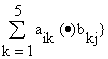 for 1 £ i £ 5, 1 £ j £ 5
It is obvious that
for any two matrices A and B of M, (A Ú B), (A Ù B) and (A (·) B) are also in
M. Hence M closed under Ú, Ù and (·). The identity element for the operations Ú, Ù and (·) are
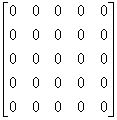 ,
,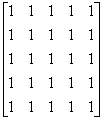 and
and 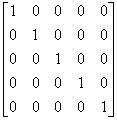 respectively.
Q.62 Prove that
if x is a real number then
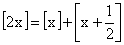 (5)
(5)
Code: AC10
Subject: DISCRETE STRUCTURES
Ans: Let x be any real number. It has two parts: integer and fraction.
Without loss of any generality, fraction part can always be made +ve. For
example, -1.3 can be written as –2 + 0.7. Let us write x = a + b, and [x] = a
(integer part only of the real x). The fraction part b needs to considered in
two cases:
0
< b < 0.5 and 0.5 £ b < 1.
Case 1: 0 < b
< 0.5; In this case [2x] = 2a, and [x] +[x + .5] = a + a = 2a
Case 2: 0.5 £ b < 1; In
this case [2x] = 2a + 1, and [x] +[x + .5] = a + (a + 1) = 2a +1
Hence [2x] = [x]
+ [x + .5]
Q.63 Let  . For n a
positive integer and
. For n a
positive integer and  the
the  Fibonacci number show that
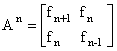 (5)
(5)
Ans: The Fibonacci number is given as 1, 1, 2, 3, 5, 8, ... and so on
and defined as
fn
= fn – 1 + fn – 2
For A =  , we have
 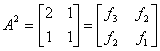 . Let us suppose that it
is true for n = k i.e.
. Let us suppose that it
is true for n = k i.e. 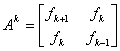 . Then we prove that it is true
for n = k + 1 as well and hence the result shall follow from mathematical
induction.
. Then we prove that it is true
for n = k + 1 as well and hence the result shall follow from mathematical
induction.

Therefore we
have the result, 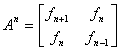
Q.64 Let the
universe of discourse be the set of integers. Then consider the following
predicates:
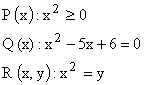
Code: AC10
Subject: DISCRETE STRUCTURES
Identify from the following
expressions ones which are not well formed formulas, if any and determine the truth
value of the well-formed-formulas:
(i) 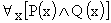
(ii) 
(iii) 
(iv) 
(v) 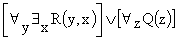 (9)
(9)
Ans:
(i) It is wff and not true for every x. P(x)
is true for all x whereas Q(x) is true only for x = 2, 3 and not for all x.
(ii)
It is not a wff because argument of R is
predicate and not a variable as per the definition.
(iii)
It is true because square of an integer
is always ³ 0 and there are y (= 2, 3) such that Q (y) is true.
(iv) It is false. Because there exists x = 3 and y =5 (there are
infinite many such examples) such that P(3) is true but R(3, 5) is not true.
(v)
"y $x R(y, x) is always true because square of an integer is an integer
so we can always find an x for every y such that R(y, x) is satisfied. However
"zQ(z) is not true. Since two statements are connected with Ú, it is TRUE.
Q.65 What is the
minimum number of students required in a class to be sure that at least 6 will
receive the same grade if there are five possible grades A, B,C, D and F? (4)
Ans: Let us consider 5 pigeonholes
corresponding to five grades. Then, our problem is to find the number of
pigeons (students) so that when placed in holes, one of the holes must contain
at least 6 pigeons (students). In the theorem above, m = 5, then we have to
find n such that
Therefore, at least 26 students are required in the
class.
Q.66 Let n be a positive integer.
Then prove that 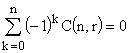 (4)
(4)
Ans: 
Code: AC10
Subject: DISCRETE STRUCTURES
Q.67 Suppose
E is the event that a randomly generated bit string of length 4 begins with a 1
and F is the event that this bit string contains an even number of 1’s. Are E
and F independent if the 16 bit strings of length 4 are equally likely? (6)
Ans: Number of 4 bit strings that begins with 1 is 8, thus P(E) = .5
Number of 4-bit
string having even number of 1’s is also 8 [C(4, 0) + C(4, 2) + C(4, 4)].
Therefore P(F) = .5
Now Number of
4-bit string that begins with 1 and contains even number of 1’s is 4 [1 + C(3,
0)]. Thus P(EÇF) = .25.
Clearly P(EÇF) = P(E)*P(F).
Thus E and F are independent.
Q.68 Find
the sum-of-products expression for following function,
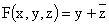 (6)
(6)
Ans: The sum of the product expression
for the given function f is DNF (disjunctive normal form) expression.
The truth table for f is as below.
|
x
|
y
|
z
|
F(x, y, z) = y + z’
|
|
0
|
0
|
0
|
1
|
|
0
|
0
|
1
|
0
|
|
0
|
1
|
0
|
1
|
|
0
|
1
|
1
|
1
|
|
1
|
0
|
0
|
1
|
|
1
|
0
|
1
|
0
|
|
1
|
1
|
0
|
1
|
|
1
|
1
|
1
|
1
|
The required sum
of product (min term) notation is
F(x,
y, z) = x’y’z’ + x’yz’ + x’yz + xy’z’ + xyz’ + xyz
Q.69 Using other identities of
Boolean algebra prove the absorption law,
x + xy = x
Construct
an identity by taking the duals of the above identity and prove it too. (8)
Ans: We have to prove that x + xy = x.
x + xy = x (y +
y’) + xy
Code: AC10
Subject: DISCRETE STRUCTURES
= xy + xy’ + xy
= (xy + xy) +
xy’
= xy + xy’
= x (y + y’) =
x.1 = x
The dual of the
given identity is x(x+ y) = x. Now
x(x + y) = xx + xy
= x + xy
= x [From
above theorem]
Q.70 Define
grammar. Differentiate a context-free grammar from a regular grammar.
(6)
Ans: Any language is suitable for communication provided the syntax and
semantic of the language is known to the participating sides. It is made
possible by forcing a standard on the way to make sentences from words of that
language. This standard is forced through a set of rules. This set of rules is
called grammar of the language.
A
grammar G = (N, å, P, S) is said to be of Context Free if in every production a®b of P, a Î N and b Î (N È å)*. Here a is a single non-terminal symbol.
On
the other hand, in a regular grammar, every production a®b of P, a Î N and b Î (N È å)*. Here a is a single
non-terminal symbol and b may consist of at the most one non-terminal symbol and one or more
terminal symbols. The non-terminal symbol appearing in b must be the extreme right
(or left) symbol. This type of grammar is also called a right linear grammar
or regular grammar.
Q.71 Let L be a language over {0, 1}
such that each string starts with a 0 and ends with a minimum of two subsequent
1’s. Construct,
(i)
the regular expression to specify L.
(ii)
a finite state automata M, such that M (L) = L.
(iii)
a regular grammar G, such that G(L) = L. (8)
Ans:
(i)
The regular expression for the language is 0+(0Ú1) *11.
(ii)
The finite automata M is as below:
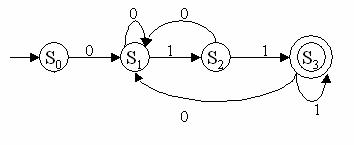
Code: AC10
Subject: DISCRETE STRUCTURES
(iii) Now the
regular grammar G is:
S ® 0A,
A ® 0A |1B,
B ® 1 | 1C | 0A,
C ®1C| 0A |e
Q.72 Define an
ordered rooted tree. Cite any two applications of the tree structure, also
illustrate using an example each the purpose of the usage. (7)
Ans: A tree is a graph such that
it is connected, it has no loop or circuit of any length and number of edges in
it is one less than the number of vertices.
If the downward slop of an arc is taken as the direction of the arc
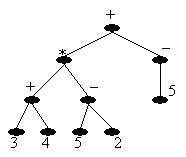
then the above graph can be treated as a directed graph. In degree of node + is
zero and of all other nodes is one. There are nodes like 3, 4, 5, 2 and 5 with
out degree zero and all other nodes have out degree > 0. A node with in
degree zero in a tree is called root of the tree. Every tree
has one and only one root and that is why a directed tree is also called a rooted
tree. The position of every labeled node is fixed, any change in the
position of node will change the meaning of the expression represented by the
tree. Such type of tree is called ordered tree.
A tree structure is used in evaluation of an arithmetic expression
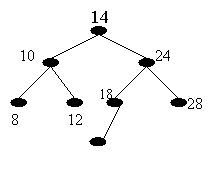
(parsing technique) The other general application is search tree. The tree
presented is an example of expression tree. An example of binary search tree is
shown below.
Code: AC10
Subject: DISCRETE STRUCTURES
Q.73 Determine the values of the
following prefix and postfix expressions. ( is exponentiation.)
(i)
+, -, , 3, 2, , 2, 3, /, 6, –, 4, 2
(ii)
9, 3, /, 5, +, 7, 2, -, *
(7)
Ans:
(i) +, -, , 3, 2, , 2, 3, /, 6, -,
4, 2 Û +, -, , 3, 2, , 2, 3, /, 6, (4 – 2)
Û +, -, , 3, 2, , 2, 3, (6 / 2)
Û +, -, , 3, 2, (23), 3
Û +, -, (3 2), 8, 3
Û +, (9 – 8), 3
Û (1 + 3) = 4
(ii) 9,3, /, 5,
+, 7, 2, -, * Û (9 / 3), 5, +, 7, 2, -, *
Û (3 + 5), 7, 2, -, *
Û 8, (7 – 2), *
Û 8* 5 = 40
Q.74 Let m be a
positive integer with m>1. Determine whether or not the following relation
is an equivalent relation.
 (6)
(6)
Ans: Relation R is defined as ºm (congruence modulo m) on the set of positive integers. Let us check
whether it is an equivalence relation.
Reflexivity: Let x Î Z+ be any integer, then x ºm x since both yields the same remainder when divided by m. Thus, (x,
x) Î
R " x Î Z. \R is a reflexive relation.
Symmetry: Let x and y be any two integers and (x, y) Î R. This shows that x ºm y and hence y ºm x. Thus, (y, x) Î R. \ R is a
symmetric relation.
Transitivity: Let x, y and z be any three elements of Z such that (x, y) and (y,
z) Î
R. Thus, we have x ºm y and y ºm z. It implies that (x–y) and (y–z) are divisible by m. Therefore,
(x – y) + (y – z) = (x – z) is also divisible by m i.e. x ºm z.
\ (x, y) and (y,
z) Î
R Þ
(x, z) Î R. i.e. R is a transitive relation.
Hence R is an
equivalence relation.
Q.75 Let A = {1,
2, 3, 4} and, R = {(1, 1), (1, 4), (2, 1), (2, 2), (3, 3), (4, 4)}.
Use Warshall’s algorithm to find
the transitive closure of R. (6)
Code: AC10
Subject: DISCRETE STRUCTURES
Ans: The matrix for R is MR = 
Step
1: Call this matrix as initial Warshall matrix and
denote it by W0.
Step
2: For K = 1 to 4, compute Wk –called
Warshall’s matrix at kth stage. To compute Wk from Wk–1,
we proceed as follows:
Step 2.1: Transfer all 1’s from Wk–1
to Wk,
Step 2.2: List the
rows in column K of Wk–1 where, the entry in Wk–1 is 1.
Say these rows p1, p2, p3, ¼;
Similarly, list the columns in row K of Wk–1 where, the
entry in Wk–1 is 1. Say these columns q1, q2,
q3, ¼;
Step 2.3: Place 1 at the locations (pi,
qj) in Wk if 1 is not already there.
W1, W2, W3, and W4 are
computed below.
|
|
|
|
|
|
|
|
|
|
|
|
For K = 1.
We have to find W1.
Step 2.1:
Transfer all 1’s from W0 to W1.
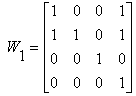
Step 2.2: Here K = 1. Thus in W0, we have ‘1’ in
column 1 at row = 1, 2; and ‘1’ in row 1 at column =1, 4. Therefore, W1
will have an additional ‘1’at (2, 4). The Warshall ‘s matrix W1 is
given in the right side.
|
|
|
|
 |
|
|
|
|
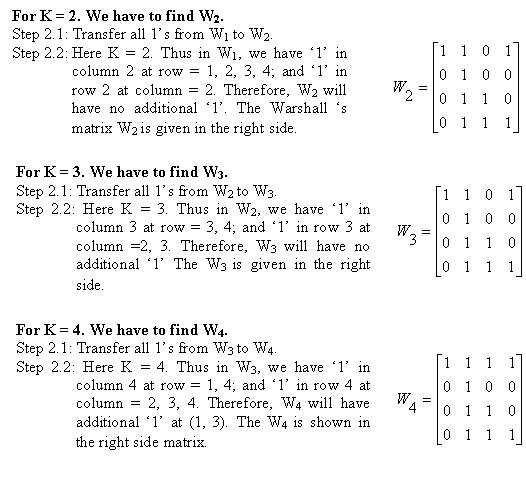
For K = 2. We have to find W2.
Step 2.1: Transfer all 1’s from W1
to W2.
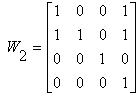
Step 2.2: Here K = 2. Thus in W1, we have ‘1’ in
column 2 at row = 2; and ‘1’ in row 2 at column =1, 2, 4. Therefore, W2
will have no additional ‘1’. The Warshall ‘s matrix W2 is
given in the right side.
|
|
|
|
|
 |
|
|
|
|
For K = 3. We have to find W3.
Step 2.1: Transfer all 1’s from W2
to W3.
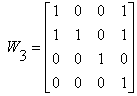
Step 2.2:Here K = 3. Thus in W2, we have ‘1’ in
column 3 at row = 3; and ‘1’ in row 3 at column =3. Therefore, W3 will
have no additional ‘1’ The W3 is given in the right side.
|
|
|
|
|
 |
|
Code: AC10
Subject: DISCRETE STRUCTURES
|
|
|
|
|
For K = 4. We have to find W4.
Step 2.1: Transfer all 1’s from W3
to W4.
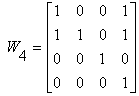
Step Step 2.2: Here K = 4. Thus in W3, we have ‘1’ in
column 4 at row = 1, 2, 4; and ‘1’ in row 4 at column = 4. Therefore, W4
will have no additional ‘1’. The W4 is shown in the right
side matrix.
|
|
|
|
 |
|
Therefore, W4
is the matrix for the transitive closure of the given relation R.
R =
{(1, 1), (1, 4), (2,1), (2, 2), (2, 4), (3, 3), (4, 4)}
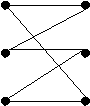
Q.76 The graph Cn,
n  3
consists of n vertices and n edges making a cycle. For what value of n is
Cn a bipartite graph? Draw the bipartite graph of Cn to
justify your answer. (2)
3
consists of n vertices and n edges making a cycle. For what value of n is
Cn a bipartite graph? Draw the bipartite graph of Cn to
justify your answer. (2)
Ans: For n = 2k, k = 2, 3, 4, …, Cn
is a bipartite graph. C6 is drawn below which is bipartite
graph.
Q.77 Give an
account of the two matrix representations for graphs. (4)
Ans:
Two forms of representation used to represent a
graph are: adjacency matrix and incidence matrix.
Let G = (V, E) be a graph, with no loops or multiple edges. Let |V| = m and |E|
= n. An incidence matrix for G is an m´n matrix MI = (aij), such that
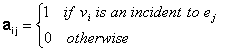
Where
v1, v2, v3, ¼, vm are m
vertices and e1, e2, e3, ¼, en are
n incidents (arcs) of G. An incidence matrix is also called edge incidence
matrix.
Similarly,
an adjacency matrix, also called vertex adjacency matrix, for G is an m´m matrix MA
= (aij), such that
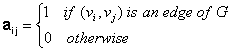
Code: AC10
Subject: DISCRETE STRUCTURES
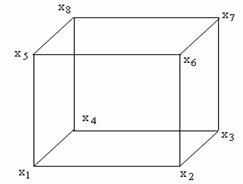
Q.78 Define a Hamilton path. Determine if the following graph has a Hamilton circuit. (4)
Ans: A path is called a Hamiltonian
path if it contains every vertex of the graph exactly once. If a
Hamiltonian path is a circuit, it is called a Hamiltonian circuit.
Starting from node x1, we can go to x2 and
then x3. Proceeding in that way we get a Hamiltonian circuit, x1,
x2, x3, x7, x6, x5, x8,
x4, x1.
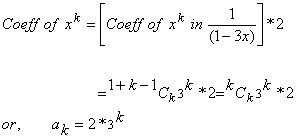
Q.79 Using generating function solve
the recurrence relation

and the initial condition  (6)
(6)
Ans:
Let f(x) be the binomial generating function for the given
recurrence equation, . Then we have
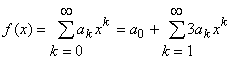 .
.
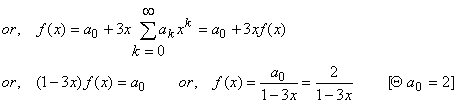
The value of ak
is given by the coefficient of xk in f(x). Therefore,
Code: AC10
Subject: DISCRETE STRUCTURES
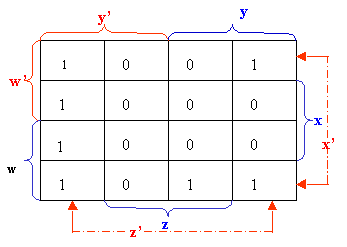
Q.80 Use Karnaugh
map to simplify the following Boolean expression
 (6)
(6)
Ans: The K-map for the given Boolean expression is presented below.
The two duets and
one quad are wx’y, x’yz’ and y’z’ respectively. Thus the simplified Boolean
expression is
wx’y
+ x’yz’ + y’z’
Q.81 Consider the poset  .
.
(i)
Find the maximal
elements.
(ii)
Find the minimal
elements.
(iii)
Is there a least
element.
(iv) Find the least upper bound of  ,
if it exists. (8)
,
if it exists. (8)
Ans:
(i)
Maximal element in a poset is defined as element
that is not succeeded by any other element in the poset. The maximal elements
are {1, 2}, {1, 3, 4} and {2, 3, 4}
Code: AC10
Subject: DISCRETE STRUCTURES
(ii) Maximal element in a poset is defined as element that is not
preceded by any other element in the poset. The minimal elements are {1}, {2}
and {3}
(iii) There is no least element in the poset, as there exist no element x
such that x precede every element of the poset. For example neither {1} precede
{2} nor {2} precede {1}.
(iv) The upper bound of {{2}, {4}} are {2, 4} and {2, 3, 4}. The least
of the upper bounds is {2, 4}.
Q.82 How many permutations of the letters A B
C D E F G H contain string DEF? (3)
Ans: It is the problem of finding number
of words that can be formed with the given 8 letters in which DEF come
together in that order. There will be six letters to be used to form words: A,
B, C, DEF, G, H. They can be permuted in 6! = 720 ways. Thus required
number of words is 720.
Q.83 Determine if the relation represented by the following Boolean
matrix is partially ordered.
(7)

Ans: Let the given relation R is defined
on set A = {x, y, z}. In order to test whether relation R is partially ordered,
we have to test whether R is reflexive, anti symmetric and transitive.
Reflexivity: Since all elements in
the principal diagonal is ‘1’, R is reflexive.
Anti Symmetry: In the given
relation, we do not have any pairs (x, y) & (y, x) such that x ¹ y i.e. for (x,
y) & (y, x) in R, x = y. Thus R is anti symmetric.
Transitivity: The relation is not
transitive because for (y, x) & (x, z) in R, (y, z) is not in R.
Therefore R is not partially ordered.
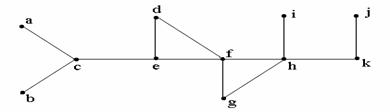
Q.84 Apply depth-first-search to find
the spanning tree for the following graph with vertex d as the starting
vertex. (4)
Code: AC10
Subject: DISCRETE STRUCTURES
Ans: Let us start with node ‘d’. Mark d
as visited. Node ‘d’ has two child ‘e’ and ‘f’. Visit node ‘e’ and mark it as
visited. Select edge (d, e). and add it to spanning tree T. Thus, T = {(d, e)}
Now e has e has
two children: c and f. Visit c, add (e, c) to T, and mark c as visited. Then
visit a and then b. Mark them visited and add arcs (c, a) and (c, b) to T. Up
to here
T =
{(d, e), (e, c), (c, a), (c, b)}
Here c has one
more child e, which is already visited, so exit recursion and go up to e which
one more unvisited child f. Visit it, mark it as visited and we add (e, f) to
T. f has three children: d, g and h. d is visited so leave it. Visit g, and
doing the basic work of marking as visited and adding the arc used to visit the
node in T, we finally get T as
T =
{(d, e), (e, c), (c, a), (c, b), (e, f), (f, g), (g, h), (h, i), (h, k), (k,
j)}
Q.85 A set
contains (2n+1) elements. If the number of subsets of this set which contain
at most n elements is 8192. Find the value of n. (7)
Ans: The given set has (2n + 1)
elements. The number of subsets of this set having at the most n elements is
given by formula
2n + 1C0 + 2n + 1C1
+ 2n + 1C2 + …..2n + 1Cn =  =22n .
This figure is given to be 8192, thus 22n = 8192 Û 22n =
213 Û 2n = 13 Û n = 6.5
Therefore n = 6.5.
Q.86 Solve for  , the recurrence relation
  . (7)
. (7)
Ans: The given recurrence equation is homogeneous recurrence equation.
The
The characteristic equation is given as
The general solution is given by
It is given that a0 = 3 and a1 = 1, so
substituting n =0 and n = 1 in equation (2), we get
3 = A + B, and
1 = -A +3B
Code: AC10
Subject: DISCRETE STRUCTURES
Solving the
simultaneous equation we have A = 2 and B = 1. Therefore the solution to
recurrence equation is
Q.87 Consider an  chess board. It contains
sixty-four
chess board. It contains
sixty-four  squares
and one square.
What is the total number of all the
squares
and one square.
What is the total number of all the  squares for
 , it contains? (6)
Ans: The number of 1x1 square is
obviously 64 = 82. Number of 8x8 square is 1 = 12. If we
now take 2x2 square, then there are 7 squares in taking two rows of square. The
7 squares so formed can be moved upward in 7 ways totaling the number of 2x2
square to 72. Proceeding in the same way, we can find that number of
n x n squares (1 £ n £ 8) is
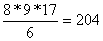
= 12 + 22 + 32 + 42 + 52
+ 62 + 72 + 82 = 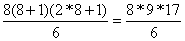
=
Q.88 Show that
the following statements are equivalent:
 n is even integer.
 is an odd integer.
 is an even integer. (8)
Ans: In order to show the equivalence, we proceed to prove
(i)
P1 Þ P2
(ii) P2 Þ P3
(iii) P3 Þ P1
(i)
The statement P1 stand for “n is even
integer” and P2 stands for “n – 1 is an odd integer”. Now
P1 Þ n is an even
integer
Þ $ an integer m such that n = 2m
Þ [(n – 1) = (2m – 1)] is an odd integer Þ P2
(ii)
The statement P2 stand for “(n – 1)
is an odd integer” and P3 stands for “n2 is an even
integer”. Now
P2 Þ (n – 1) is an
odd integer
Þ (n – 1) 2 is an odd integer
Þ (n2 –2n + 1) is an odd integer
Þ n2 is an even integer because (2n
– 1) is odd and once an odd is taken from odd, the result is even.
Þ P3
(iii)
The statement P3 stands for “n2
is an even integer”. and Now
Code: AC10
Subject: DISCRETE STRUCTURES
P3 Þ n2
is an even integer
Þ n2 – 1 is an odd integer
Þ (n – 1)(n + 1) is an odd integer
Þ (n – 1) and (n + 1) are odd integers
Þ (n – 1) + 1 and (n + 1) – 1 are even
integers
Þ n is even integer Þ P1
Q.89 State
DeMorgan’s law. Prove it using the truth table. (4)
Ans: DeMorgan’s law state that
(i)
(x Ú y)’ = x’ Ù y’
(ii)
(x Ù y)’ = x’ Ú y’
Let us draw truth
table for the two statements
|
1
|
2
|
3
|
4
|
5
|
6
|
|
x
|
y
|
(x
Ú
y)’
|
x’
Ù
y’
|
(x
Ù
y)’
|
x’
Ú
y’
|
|
0
|
0
|
1
|
1
|
1
|
1
|
|
0
|
1
|
0
|
0
|
1
|
1
|
|
1
|
0
|
0
|
0
|
1
|
1
|
|
1
|
1
|
0
|
0
|
0
|
0
|
It is obvious
from the truth table that column (3) is equal to column (4). Similarly
column(5) is equal to column (6).
Q.90 Consider the
function  ,
where N is the set of natural numbers, defined by
,
where N is the set of natural numbers, defined by 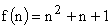 . Show that the function
f is one-one but not onto. (6)
. Show that the function
f is one-one but not onto. (6)
Ans: In order to prove that f is one to
one, it is required to prove that for any two integers n and m, if f(n) = f(m)
then n = m.
f(n) = f(m) Û n2 + n + 1 = m2 + m + 1
Û n2 +
n = m2 + m
Û n(n + 1) = m(m +
1)
Û n = m. Because product of consecutive natural numbers
starting from m and n are equal iff m = n.
Next f is not
onto because for any n (odd or even) n2 + n + 1 is odd. This
implies that there are even elements in N that are not image of any element in
N.
Code: AC10
Subject: DISCRETE STRUCTURES
Q.91 Let T be a binary tree with n
vertices. Determine the number of leaf nodes in tree. (4)
Ans: Let the height of the tree be r.
The number of leave nodes will maximum 2r. Total of nodes are then
given by [1+ 2 + 22 + … + 2r – 1 + 2r]. And
this is equal to n. i.e.

Therefore maximum
number of leaf node is 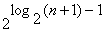 .
.
Q.92 Construct the grammar G that
generates the language over an alphabet {0, 1, 2},  and prove that L(G) =
  . (10)
Ans: The production rule of the grammar for the language L012
is as below:
1. S ® 0SA2
2. S ® e
3. 0A ® 01
4. 1A ® 11
5. 2A ® A2
Now let us show
that the grammar produces the language L012.
S ® 0SA2 [Apply
rule 1 once]
® 0n S (A2)n [Apply
rule 1 optionally n – 1 time]
® 0n (A2)n [Apply
rule 2 once]
® 0n – 1 (0A) 2
(A2)n – 1 [rearrangement]
® 0n – 1 (01) 2
(A2)n – 1 [Apply rule 3 once]
® 0n 1 2 (A2)
(A2)n – 2 [rearrangement]
® 0n 1A 2 2
(A2)n – 2 [Apply rule 5 once]
® 0n 12
2 2 (A2)n – 2 [Apply rule 4 once]
…
® 0n 1n
2 n
Therefore, L(G)
= L012.
Q.93 Let Q(x,y) denote x + y = 0. Determine the truth values
of  . (4)
. (4)
Ans: The statement "x $y Q(x, y) Þ For every x,
there exists y such that x + y = 0. The statement is true for the universe
where 0 is identity element for the binary operation ‘+’ and inverse for every
element exist in the universe for every element x. The universe is not defined
in the question, hence truth ness shall vary from universe to universe.
Next the statement $x "y Q(x, y) Þ there exists x such that for every x, x + y = 0. The statement is cannot
be true for the universe where 0 is identity element for the binary
operation
Code: AC10
Subject: DISCRETE STRUCTURES
‘+’ and inverse for every element exist in the universe for every
element x. Even if the universe is not defined in the question, the statement
is false.
Q.94 Let  and
and  be a one-one
function where Z is a set of integers and N is a set of natural numbers. Let R
be a relation on A defined as under:
be a one-one
function where Z is a set of integers and N is a set of natural numbers. Let R
be a relation on A defined as under:
 if
and only if f (y) = k f (x) where
if
and only if f (y) = k f (x) where 
Prove that R is a
partial order relation on A. (8)
Ans: R is defined on the subset A of all
integers. In order to show that R is partial order relation, it is to be shown
that R is reflexive, anti-symmetric and transitive.
Reflexivity: Let x be any element of
A then f(x) = 1.f(x) Þ (x, x) Î R. Thus R is reflexive.
Anti-symmetry: Let x, y Î A, such that
(x, y) and (y, x) Î R.
Now
(x, y) Î R Þ there exists a natural number k such that f(y) = kf(x)
Similarly,
(y, x) Î R Þ there exists a natural number m such that f(x) = mf(y).
From
the above two result, we can write f(x) = mk f(x). This implies that mk = 1,
and product of any two natural numbers is 1 iff both are 1. Thus m = k = 1.
Hence f(x) = f(y). Since f is one to one, we can conclude that x = y.
Therefore, R is anti symmetric.
Transitivity: Let x, y, z Î A, such that
(x, y) and (y, z) Î R.
Now
(x, y) Î R Þ there exists a natural number k such that f(y) = kf(x)
Similarly,
(y, z) Î R Þ there exists a natural number m such that f(z) = mf(y).
From
the above two result, we can write f(z) = mk f(x). => (x, z) Î R. R is
transitive.
Therefore R is a
partial order relation.
Q.95 A speaks truth in 60% of the
cases and B in 90% of the cases. Find the percentage of cases when they are
likely to contradict each other in stating the same fact. (6)
Ans:
Probability
that A speaks Truth: P(A=T)= .6
Probability that
A speaks False: P(A=F) = .4
Probability that
B speaks Truth: P(B=T)= .9
Probability that
A speaks False: P(B =f) = .1
Now probability
that A and B likely to contradict is
P(A=T) x P(B =F) + P(B=T) x P(A
=F)
= .6 x .1 + .9 x
.4 = .06 + .36 = .42
Code: AC10
Subject: DISCRETE STRUCTURES
Q.96 Give the
regular expression of the set of all even strings over the alphabet {a, b} with
at least one of the two substrings aa or bb. Also construct the finite automata
that can accept the above language. (8)
Ans: Let us first draw the finite automata that accepts
set of all even strings over alphabets {a, b}. The regular expression for
class of strings accepted by the automata is
(aa
+ bb + abba + abab + baba + baab)*
Q.97 Compute A (2,
1) when  ,
where N is the set of natural numbers, is defined by
,
where N is the set of natural numbers, is defined by


 (3)
(3)
Ans:
A(2, 1) = A(1+1,
0+1)
= A(1+1, 0)
= A(1, 1)
= A(1, 0)
= A(0, 1) = 1 + 1
= 2.
Q.98 Express the
following statement as a disjunction (in DNF) also using quantifiers:
There does not exit a woman
who has taken a flight on every airline in the world. (3)
Ans: Let us define propositions.
Woman (x): “x is
woman”
Flight (x, y): “x
has taken flight on every airline y in world”.
Now the given
statement can be written as
~[$x Woman (x) Ù "y Flight
(x, y)]
= ~"y $x [Woman (x) Ù Flight (x, y)]
= $y "x [~Woman
(x) Ú ~Flight (x, y)]
Code: AC10
Subject: DISCRETE STRUCTURES
Q.99 Let L be a
bounded distributive lattice. Show that if a complement exists it is unique. (7)
Ans: Let I and 0 are the unit and zero elements of B respectively. Let b
and c be two complements of an element a Î B. Then from the
definition, we have
a
Ù b
= 0 = a Ù c and
a Ú b = I = a Ú c
We can write b = b Ú 0 = b Ú
(a Ù c )
= (b Ú a) Ù
(b Ú c ) [since
lattice is distributive ]
= I Ù (b Ú c )
= (b Ú c )
Similarly, c = c Ú 0 = c Ú (a Ù b )
=
(c Ú
a) Ù
(c Ú
b) [since lattice is distributive]
= I Ù (b Ú c) [since Ú is a commutative
operation]
= (b Ú c)
The above two results show
that b = c.
Q.100 Find the least
number of cables required to connect 100 computers to 20 printers to guarantee
that 20 computers can directly access 20 different printers. Justify your
answer. (7)
Ans: The 100 computers and 20 printers
can be connected using concept of a complete bipartite graph K100, 20
to ensure that using minimum number of cable requirement. This arrangement will
require 2000 cables and will ensure that at any time 20 computers can directly
access the 20 computers.
Q.101 Prove that a
simple graph is connected if and only if it has a spanning tree. (7)
Ans: First suppose that a simple graph G
has a spanning tree T. T contains every node of G. By the definition of a
tree, there is a path between any two nodes of T. Since T is a subgraph of G,
there is a path between every pair of nodes in G. Therefore G is connected.
Now let G is
connected. If G is a tree then nothing to prove. If G is not a tree, it must
contain a simple circuit. Let G has n nodes. We can select (n – 1) arcs from G
in such a way that they not form a circuit. It results into a subgraph having
all nodes and only (n – 1) arcs. Thus by definition this subgraph is a spanning
tree.
Code: AC10
Subject: DISCRETE STRUCTURES
Q.102 Let  and let R and
S be the relations on A described by
and let R and
S be the relations on A described by 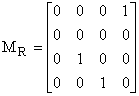 and
and 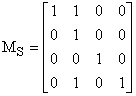
Use
Warshall’s algorithm to compute the transitive closure of  . (7)
. (7)
Ans: The matrix for R È S is MR + MS = 
Step
1: Call this matrix as initial Warshall matrix and
denote it by W0.
W0 =
Step
2: For K = 1 to 4, compute Wk –called
Warshall’s matrix at kth stage. To compute Wk from Wk–1,
we proceed as follows:
Step 2.1: Transfer all 1’s from Wk–1
to Wk,
Step 2.2: List the
rows in column K of Wk–1 where, the entry in Wk–1 is 1.
Say these rows p1, p2, p3, ¼;
Similarly, list the columns in row K of Wk–1 where, the
entry in Wk–1 is 1. Say these columns q1, q2,
q3, ¼;
Step 2.3: Place 1 at the locations (pi,
qj) in Wk if 1 is not already there.
W1, W2, W3, and W4 are
computed below..
|
|
|
|
|
For K = 1. We have to find W1.
Step 2.1: Transfer all 1’s from W0
to W1.
Step 2.2: Here K = 1. Thus in W0, we
have ‘1’ in column 1 at row = 1; and ‘1’ in row 1 at column =1, 2, 4.
Therefore, W1 will have no additional ‘1’. The Warshall ‘s
matrix W1 is given in the right side.
|
|
|
|
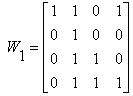 |
|
Code: AC10
Subject: DISCRETE STRUCTURES
Therefore, W4
is the matrix for the transitive closure of the given relation.
Q.103 Express the
negation of the statement  so that no negation precedes a
quantifier. (3)
so that no negation precedes a
quantifier. (3)
Ans: The negation of the given statement is written as ~["x $y (xy = 1)]. And
~["x $y (xy = 1)] = $x [~$y (xy = 1)]
= $x "y [~(xy =
1)]
= $x "y (xy ¹ 1)
Q.104 Let P(n) be
the statement  is an odd number for
  . Is P (n) true
for all n? Explain. (3)
. Is P (n) true
for all n? Explain. (3)
Ans: Sum of two even positive integers
is even. Sum of two odd positive integers is even. Square of even is even and
that of odd is odd. Thus for any positive integer n, n2 +n is always
an even positive integer. Therefore the statement P(n) is never true.
Code: AC10
Subject: DISCRETE STRUCTURES
Q.105 Draw the Hasse
diagram for the poset  where and
  is the power set of A. (8)
Ans: The Hasse diagram for the poset is as below.

Q.106 Show that a positive logic NAND gate is
equivalent to negative logic NOR gate. (4)
Ans:
·
Positive logic
represents True or 1 with a high voltage and False or 0 with a low voltage.
·
Negative logic represents
True or 1 with a low voltage and False or 0 with a high voltage.
The problem is equivalent to proving the DeMorgan’s rule of
complementation i.e.
(x .
y)’ = x’ + y’
Let us find now
truth table for positive NAND and negative NOR.
|
Negative NOR
|
|
x
|
y
|
x’
|
y’
|
(x’+y’)’
|
((x’+y’)’)’
|
|
0
|
0
|
1
|
1
|
0
|
1
|
|
0
|
1
|
1
|
0
|
0
|
1
|
|
1
|
0
|
0
|
1
|
0
|
1
|
|
1
|
1
|
0
|
0
|
1
|
0
|
Code: AC10
Subject: DISCRETE STRUCTURES
|
Positive NAND
|
|
x
|
y
|
(x . y)’
|
|
0
|
0
|
1
|
|
0
|
1
|
1
|
|
1
|
0
|
1
|
|
1
|
1
|
0
|
Obviously,
positive NAND gate is equivalent to negative NOR gate.
Q.107 Suppose  (5)
(5)
Ans: Let f and g are functions whose
domains are subsets of Z+. We say f is O(g) if there exists
constants c and k such that |f(n)| £ c. |g(n)| " n ³ k. Now,
P(n) = a0 + a1n + a2n2 +
… + amnm
£ a0nm
+ a1nm + a2nm + … + amnm
" n ³ 1
= [a0 + a1 + a2 + … + am]
nm " n ³ 1
\ P(n) = O(nm)
Q.108 Show that
among any n+1 positive integers whose value does not exceed 2n, there must be
an integer that divides one of the other integers. (5)
Ans: Every possible integer n can be
written as n = 2k * m, where m is odd part and k ³ 0. Here m is
called odd part of n. In any two numbers having same odd part, one is multiple
of other (and hence one divides other).
Mark 1, 3, 5, … 2n –1 (all (n – 1) odd numbers) as pigeonholes. Take
a number and place it according to its odd part. There are n + 1 numbers and n
pigeonholes, so one of the pigeonhole will have at least two numbers i.e. there
is at least two integers having same odd parts. Hence one will divide the
other.
Q.109 If A and B are two subsets of
a universal set then prove that A-B= AÇ . (8)
. (8)
Ans: In order to prove this let x be any element of (A – B) then
x Î A – B Û x Î A and x Ï B
Û x Î A and x Î BC
Û x Î A Ç BC
This implies that
A – B Í
A Ç BC and
Code: AC10
Subject: DISCRETE STRUCTURES
A Ç BC
Í A – B
Thus A – B = A Ç BC
Q.110 In a
class of 60 boys, 45 boys play cards and 30 boys play carrom. How many boys
play both games? How many play cards only and how many play carrom only? (8)
Ans: Let A and B be the set of boys who play cards and carom
respectively, then as per the information available
|A| = 45, |B| = 30
and |AÈB| = 60. Now |AÇB| = |A| +|B| - |AÈB| = 45 + 30 – 60 = 15.
i.e. Number of
boys who play both the games = 15.
Number of boys who
plays cards only = |A| - |AÇB| = 45 – 15 = 30.
Number of boys who
plays carrom only = |B| - |AÇB| = 30 – 15 = 15.
Q.111 How
many words can be obtained by arranging the letters of the word ‘UNIVERSAL’ in
different way? In how many of them
(i)
E,R,S occur together
(ii)
No two of the letters E,R,S occur together. (10)
Ans: There are nine letters in the word ‘UNIVERSAL’ and none is
repeated. Thus they are permuted in 9! ways.
(i)
When E, R, S occur together, there will be 6
other letters and one (ERS). They are permuted in 7! ways and so there will be
7! *
3! words having E,R,S together.
(ii)
Any two letters of E, R, S can come together in 3P2
= 6 ways. When two letters (out of 9) come together then 7 +1 = 8 letters can
be arranged in 8! ways. Thus there will be 8!* 6 words in which any two of E, R, S come
together.
\Number of words
in which no two of E,R,S come together = 9! - 8!*6
Q.112 Define
symmetric, asymmetric and antisymmetric relations. (6)
Ans:
Symmetric Relation
A relation R defined on a set A is said to be a symmetric
relation if for any x, y Î A, if (x, y) Î R then (y, x) Î R An examples of a symmetric relation is:
Let
A = {1, 2, 3} be a set and R be a relation on A defined as {(1, 2),
(2, 1), (3, 1), (1, 3)} then R is a symmetric relation.
Code: AC10
Subject: DISCRETE STRUCTURES
Asymmetric Relation
A relation R on a set A is called an asymmetric relation
if (x, y) Î R Þ (y, x) Ï R for x ¹ y
i.e. presence of pair (x, y) in R excludes the possibility of
presence of (y, x) in R.
Anti-Symmetric Relation
A relation R on a set A is called an anti-symmetric
relation if for x, yÎA
(x, y) and (y, x) Î R Û x = y
i.e. x ¹ y Þ either x ~R y or y ~R x or both.
Q.113 Prove
by mathematical induction that if a set A has n elements, then P(A) has 2n
elements. (8)
Ans: We have to show that for a set A
having n elements, its power set P(A) contains 2n elements.
For n = 1, the result is obvious as P(A) = {f, A}
Suppose the result is true for n = k i.e. when |A| = k then |P(A)| =
2k . Include one more element x to A. Now |A È{x}| = k +1. All
the subsets of A are now subsets of |A È{x}|. In addition to this
there will be 2k subsets that will contain element x. i.e.
|P(A È{x})| = 2k + 2k = 2k+1.
This shows that
result is true for n = k+1, whenever it is true for n = k.
Q.114 Let L be a lattice then for every a and b in L
 if and
only if a<=b (8)
if and
only if a<=b (8)
Ans:
Let aÚb = b. Since aÚb is an upper bound of a, a £ aÚb.
This implies a£b.
Next, let a £ b. Since £
is a partial order relation, b £ b.
Thus, a£b and b£b together implies that b is an upper bound of a and b. We know
that aÚb is least upper bound of a and
b, so aÚb £ b. Also b £ aÚb because aÚb
is an upper bound of b. Therefore, aÚb
£ b and b £ aÚb Û aÚb
= b by the anti-symmetry property of partial order relation £. Hence, it is proved that aÚb = b if and only if a £ b.
Q.115 Using
Boolean algebra show that
abc +  +
+
 +
+  = ab +
ac + bc (8)
= ab +
ac + bc (8)
Code: AC10
Subject: DISCRETE STRUCTURES
Ans: Let us consider the LHS of the given expression.
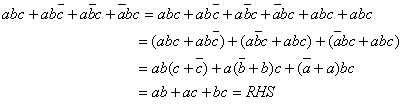
Q.116 Explain extended
pigeonhole principle and show that if 7 colors are used to paint 50 bicycles ,
at least 8 bicycles will be the same color. (4,
4)
Ans: The extended or generalized
pigeonhole principle states that “If n objects (pigeons) are placed in m
places (pigeonholes) for m < n, then one of the places (pigeonholes) must
contains at least  objects (pigeons).
It
can be proved in very simple way. Let us assume that none of the places
(pigeonholes) contains more than floor((n – 1)/m) objects (pigeons).
Then there are at the most m * floor((n – 1)/m) £ m * (n – 1)/m =
n-1 objects. This is contrary to the given fact that there are n
objects. This contradiction is because of our assumption that “none of the
places contains more than floor((n – 1)/m) objects”. Thus our assumption
is wrong. Therefore, one of the pigeonholes must contain at least objects.
Let m = 7 colors are pigeonholes and n = 50 bicycles are pigeon,
then one of the color (pigeonhole) has at least 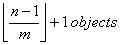 . Thus at least
 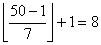 bicycles will
have same color.
bicycles will
have same color.
Q.117 If a graph G has more
than two vertices of odd degree, then prove that there can be no Euler path in
G. (8)
Ans: If G is not connected then result is obvious. Let us
suppose that G is a connected graph and there are three vertices a, b and c of
odd degrees. We know that if G has exactly two vertices of odd degree then G
has an Euler path in which one of the odd degree node is starting node and
other is end node. Let us assume that these two nodes are a and b. Let c has
degree 2n + 1. Then starting from a or b, c can be reached in along n arcs and
reached out along another n arcs. Next either the (2n + 1)th arc is
left not travelled or in the process of travelling this arc, path is trapped at
c. In either case no Euler path is possible.
Q.118 Show
that
ù ( P  Q) ® (ù
P
Q) ® (ù
P  (ù P Q ) Û (ù
P Q) (8)
(ù P Q ) Û (ù
P Q) (8)
Code: AC10
Subject: DISCRETE STRUCTURES
Ans: Let us consider the LHS of the given equivalent expression
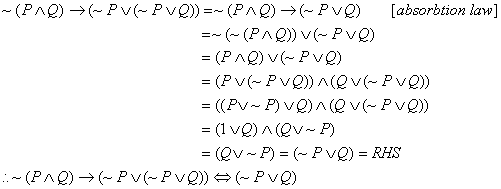
Q.119 What is
minimum spanning tree of a graph? Write down Prim’s and Kruskal’s algorithms
and execute them by taking a suitable example. (2,7,7)
Ans: Let G = (V, E) be a connected
graph. Any connected spanning subgraph H = (V, E1) of G is called spanning
tree if H is a tree i.e. |E1| = |V| - 1. The concept of a
spanning tree is used basically in communication network design for remote
switch installation” Where to place all the required remote switches so that
total cables requirement (cost) should be minimum”. This requires finding of
minimum spanning tree in a weighted graph. A spanning tree of a weighted graph
is called minimum spanning tree if the sum of edges in the
spanning tree is minimum.
The stepwise Prim’s algorithm to find a minimum spanning tree in a
weighted graph is given below. Let G = (V, E) be graph and S = (VS,
ES) be the spanning tree to be found from G.
Step
1: Select a vertex v1 of V and
initialize
VS
= {v1} and
ES = {}
Step
2: Select a nearest neighbor of vi from
V that is adjacent to some vjÎVS and that edge
(vi, vj) does not form a cycle with members edge of ES.
Set
VS
= VS È{vi} and
ES = ES È{(vi, vj)}
Step 3: Repeat step2 until |ES|
= |V| – 1.
 Let us consider
the following graph for example.
Let us consider
the following graph for example.
Code: AC10
Subject: DISCRETE STRUCTURES
Let
us begin with the node A of the graph. Initialize VS = {A} and ES
= {}. There are eight nodes so the spanning tree will have seven arcs.
The iterations of algorithm applied on the graph are given below. The number
indicates iteration number.
1.
Nodes B and C are neighbors of A. Since node C
is nearest to the node A we select C. Thus, we have VS = {A, C} and
ES = {(A, C)}.
2.
Now node B is neighbor of both A and C and C has
nodes E and F as its neighbor. We have AB = 3, CB = 3, CE = 5 and CF = 5. Thus,
the nearest neighbor is B. We can select either AB or CB. We select CB.
Therefore, VS = {A, C, B} and ES = {(A, C), (C, B)}.
3.
Now D, E, F are neighbor of nodes in VS.
An arc AB is still to be considered. This arc forms cycle with arcs AC and CB
already in ES so it cannot be selected. Thus we have to select from
BD = 6, CE = 5, CF = 5. We may take either CE or CF. We select CF. Therefore, VS
= {A, C, B, F} and ES = {(A, C), (C, B), (C, F)}.
4.
Now we have to select an arc from BD = 6, CE =
5, FE = 4, FG = 4. We select FE. Therefore, VS = {A, C, B, F, E} and
ES = {(A, C), (C, B), (C, F), (F, E)}.
5.
The selection of arc CE is ruled out as it forms
a cycle with the edges CF and FE. Thus, we have to select an arc from BD = 6,
ED = 2, FG = 4. We select ED. Therefore, VS = {A, C, B, F, E, D} and
ES = {(A, C), (C, B), (C, F), (F, E), (E, D)}.
6.
Now BD is ruled out as it forms cycle with CB,
CF, FE and ED. Thus we have to consider DH = 2, EG = 3, FG = 4. We select DH.
Therefore, VS = {A, C, B, F, E, D, H} and ES = {(A, C),
(C, B), (C, F), (F, E), (E, D), (D, H)}.
7.
Now left over arcs are EG = 3, HG = 6, FG = 4.
We select EG. Therefore, VS = {A, C, B, F, E, D, H, G} and ES =
{(A, C), (C, B), (C, F), (F, E), (E, D), (D, H), (E, G)}.
Since number of edges in ES is seven process terminates
here. The spanning tree so obtained is shown below.
Kruskal’s Algorithm
Let
G = (V, E, g) be graph and S = (VS, ES, gS) be the spanning tree to be found from G. Let |V| = n and E = {e1,
e2, e3, ¼, em}. The stepwise algorithm is given below.
Step
1: Select an edge e1 from E such that e1
has least weight. Replace
E =
E -
{e1} and
Code: AC10
Subject: DISCRETE STRUCTURES
ES = {e1}
Step 2: Select an edge ei
from E such that ei has least weight and that it does not form a
cycle with members of ES. Set
E =
E -
{ei} and
ES = ES È{ei}
Step 3: Repeat step2 until |ES|
= |V| – 1.
Let us consider
the same graph to demonstrate the algorithm.
1.
Since arcs AC, ED and DH have minimum weight
2. Since they do not form a cycle, we select all of them and set ES
= {(A, C), (E, D), (D, H)} and E = E - {(A, C), (E, D), (D, H)}.
2.
Next arcs with minimum weights 3 are AB, BC
and EG. We can select only one of the AB and BC. Also we can select EG. Therefore,
ES = {(A, C), (E, D), (D, H), (B, C), (E, G)} and E = E - {(B, C), (E,
G)}.
3.
Next arcs with minimum weights 4 are EF and
FG. We can select only one of them. Therefore, ES = {(A, C), (E, D),
(D, H), (B, C), (E, G), (F, G)} and E = E - {(F, G)}.
4.
Next arcs with minimum weights 5 are CE and
CF. We can select only one of them. Therefore, ES = {(A, C), (E, D),
(D, H), (B, C), (E, G), (F, G),(C, E)} and E = E - {(C, E)}.
Since number of edges in ES is seven process terminates
here. The spanning tree so obtained is as below.
Q.120 Show that is  and
and  are equivalence relations on A,
then
are equivalence relations on A,
then  is
an equivalence relation. (8)
is
an equivalence relation. (8)
Ans: It is given that R1 and
R2 are equivalence relation on set A. In order to prove that R1ÇR2 is
an equivalence relation on A, it is required to prove that R1ÇR2 is
reflexive, symmetric and transitive on A.
Reflexivity: Let xÎA be any
element, then pairs "x (x, x) are in R1 and R2 and so all such
pairs are in R1ÇR2 also. Hence R1ÇR2 is reflexive.
Code: AC10
Subject: DISCRETE STRUCTURES
Symmetry: Let (x, y) be any pair in
R1ÇR2. Then (x, y) is in R1 and in R2.
Since both the relations are symmetric Pair (y, x) is in Both R1and
R2. This implies that (y, x) is R1ÇR2 and
therefore it is symmetric as well.
Transitivity: Let (x, y) and (y, z) be any two pairs in R1ÇR2.
Therefore both these pairs are also in R1 and R2. Since
both are transitive relation so (x, z) is in both R1 and R2.
Hence (x, z) is in R1ÇR2 and it is transitive. This shows
that R1ÇR2 is an equivalence relation.
Q.121 Prove
that the Digraph of a partial order has no cycle of length greater than 1. (8)
Ans: Suppose that there exists a cycle
of length n ³ 2 in the digraph of a partial order £ on a set A. This implies
that there are n distinct elements a1, a2, a3,
¼, an
such that a1 £ a2, a2 £ a3, ¼, an–1
£ an
and an £ a1. Applying the transitivity n–1 times on a1
£ a2,
a2 £ a3, ¼, an–1 £ an, we get a1 £ an. Since
relation £ is anti-symmetric a1 £ an and an
£ a1
together implies that a1 = an. This is contrary to the
fact that all a1, a2, a3, ¼, an are
distinct. Thus, our assumption that there is a cycle of length n ³ 2 in the
digraph of a partial order relation is wrong.
Q.122 How do
you traverse a Binary Tree? Explain Preorder, Inorder and Postorder traversals
with example. (10)
Ans: Traversal of tree means tree
searching for a purpose. The purpose may be for searching or sorting of the
items contained in a tree. A tree may contain an item at its node as a label.
Traversing a tree is a recursive procedure.
To implement this, a tree is considered to have three components:
root, left subtree and right subtree. These three components can be arranged in
six different ways: (left, root, right), (root, left, right), (left,
right, root), (right, left, root), (right, root, left) and (root, right, left).
The first three are used whereas the last three combinations are of no use
as it alters the positions of a node in a positional tree.
Code: AC10
Subject: DISCRETE STRUCTURES
Inorder
Traversal: In this form of traversal, a tree is
traversed in the sequence: Left subtree, Root, Right subtree.
In the above expression, begin at the root node marked, +. Since
first we have to traverse its left subtree, so move to the root of left subtree
i.e. node marked, *. Again it has a left subtree with root node marked +, visit
it. This subtree has a node labeled 3, which has no left subtree, so out put 3.
Then root of this subtree i.e. ‘+’ and then right subtree which is again a node
labeled with 4, so output it. Thus we have expression obtained till here is 3 +
4. Proceeding this way we get (3+4)*(5–2)+(-5). Parentheses signify both
precedence and portion of the sub tree to which this sub-expression
corresponds.
Preorder
Traversal: In this form of traversal a tree is
traversed in the sequence: Root, Left subtree, Right subtree. Apply the
algorithm recursively till all nodes have been visited, we get + * + 3 4 – 5
2 –5.
Postorder
Traversal: In this form of traversal a tree is
traversed in the sequence: Left subtree, Right subtree, Root. We get 3 4 + 5
2 – * 5 – +.
Q.123 Consider
the finite state machine whose state transition table is :
|
|
a
|
b
|
|
S0
|
S0
|
S1
|
|
S1
|
S1
|
S2
|
|
S2
|
S2
|
S3
|
|
S3
|
S3
|
S0
|
Draw the graph for
it. (6)
Ans: The graph for the automata as per
the transition table is drawn below. Since no start state and no final state is
specifies, using the convention, first state S0 is shown as start
state and last state S3 is shown as final state.
Code: AC10
Subject: DISCRETE STRUCTURES
Q.124 Simplify
the Boolean function:
 (8)
(8)
Ans: The K-map for the given Boolean function:  is as below.
The simplified
expression is sum of expressions for to two quads and one duet i.e.
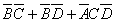
Q.125 Is the following argument
valid? If valid, construct a formal proof, if not explain why.
“If
wages increases, then there will be inflation. The cost of living will not
increase if there is no inflation. Wages will increase. Therefore, the cost
of living will increase.
(Let p = wages increase, q =
inflation, r = cost of living will increase) (8)
Ans: The given statement can be represented using propositions and
connectives as
p ® q, Øq ® Ør and p.
Now, p ® q
p
---------------
q
And, contra
positive statement corresponding to Øq ® Ør is r ® q. Here r ® q and q does
not imply truthness of r. ‘r’ may be true or false for “r ® q and q” to be
true. Therefore it can not be said that “the cost of living will increase”.
Q.126 A
speaks truth in 80% of the cases and B speaks truth in 60% of the cases. Find
the probability of the cases of which they are likely to contradict each other
in stating the same fact. (8)
Code: AC10
Subject: DISCRETE STRUCTURES
Ans:
Probability that A speaks Truth: P(A=T)= .8
Probability that
A speaks False: P(A=F) = .2
Probability that
B speaks Truth: P(B=T)= .6
Probability that
A speaks False: P(B =f) = .4
Now probability
that A and B likely to contradict is
P(A=T) x P(B =F) + P(B=T) x P(A
=F)
=.8 x .4 + .6 x
.2 = 32 + .12 = .44
Q.127 Let  and
and  is defined as
  is a
function. If so find that whether it is one to one or bijection? (8)
is a
function. If so find that whether it is one to one or bijection? (8)
Ans: For defined function f: A®B defined as f(x) = x2 elements -2 and 2 have same image
4 in B. Similarly elements -1 and 1 of A has same image 1 in B. Thus f is not
one to one. Next each element y of B is image of some element x of A hence f is
onto function. Therefore f is neither one-to-one nor bijection but it is a
surjective.
Q.128 Prove by induction
1.1!
+ 2.2! + …….+n.n! = (n+1)! – 1 (8)
Ans: The result is obvious for n = 1. When n = 1, we have 1.1! = 2! -1
Next suppose that
the given result is true for n = k. i.e.
1.1! + 2.2! + 3.3! +…..+ k.k! = (k+1)! – 1
Now when n = k + 1, we get
1.1! + 2.2! + 3.3!
+…..+ k.k! + (k + 1).(k+1)! = (k+1)! – 1+(k + 1).(k+1)!
= (k+1)!{1 + k
+1} – 1
= (k+2)! – 1
This shows that whenever result is true for n = k, it is true for n
= k + 1 as well. Hence by induction it true for all n.
Q.129 In the word ‘MANORAMA’
(i) Find the number
of permutations formed taking all letters.
(ii)
Out of these the number of permutations with all
A’s together.
(iii)
Find the number of permutations which start with
A and end with M. (8)
Ans: In the word MANORAMA, M appears 2 times and A appears 3 times. All
other character appears only once.
1.
Number of permutations formed taking all letters
=  .
.
Code: AC10
Subject: DISCRETE STRUCTURES
2.
When all A’s are taken together, the three A’s
are counted as one. This results into total number of 6 letters to be permuted.
Number of permutations formed in this case =  .
.
3.
When permutations start with A and end in M, the
six left over places are to be filled with 6 letters in which A has count 2.
Number of permutations formed in this case = .
Q.130 Prove that a graph
G is a tree iff G has no cycles and  . (8)
. (8)
Ans: Let G is tree then we have to prove that G has no cycle and it has
|V| - 1 edge. Let |V| = n.
From
the definition of a tree a root has indegree zero and all other nodes have
indegree one. There must be (n – 1) incoming arcs to the (n – 1) non-root
nodes. If there is any other arc, this arc must be terminating at any of the
nodes. If the node is root, then its indegree will become one and that is in
contradiction with the fact that root always has indegree zero. If the end
point of this extra edge is any non-root node then its indegree will be two,
which is again a contradiction. Hence there cannot be more arcs. Therefore, a
tree of n vertices will have exactly (n – 1) edges and no cycle.
Next
suppose that G has no cycle and it has n – 1 edge. Then we have to show that G
is a tree.
A
connected graph in n nodes having (n-1) edge is a tree.We prove that G is
connected, then work is done.We prove it by induction.
For
n=2 & |E| =1, the graph is connected if it is acyclic.
Let
Gk be an acyclic graph with n=k & |E| = k-1 and it is connected.
We add one node and arc e to Gk. If e is added between any two nodes
of Gk, then it introduces a cycle in Gk. Thus to preserve
the cyclic property of Gk & Gk+1 e is added between
any node of Gk to the new node. The modified graph Gk+1
has k+1 nodes & k arcs.Thus Gn having n nodes & n-1 arcs is connected
if it is acyclic.
Q.131 If
A and B are two subsets of a universal set then prove that
A – B = A Ç BC
Ans: In order to prove this let x be any element of (A – B) then
x Î A – B Û x Î A and x Ï B
Û x Î A and x Î BC
Û x Î A Ç BC
This implies
that
A – B Í
A Ç BC
and
A Ç BC Í
A – B
Thus A – B = A Ç BC
Q.132 A man has four
friends. In how many ways can he invite one or more friends to tea party? (8)
Code: AC10
Subject: DISCRETE STRUCTURES
Ans: A friend may be called or may not
be called. There are two possibilities for each friend. Since one or more
friends are to be invited, so total possible number of ways in which they can
be invited = 24 – 1 = 15. 1 is subtracted from the possible way to
remove the possibilities when none is invited.
Q.133 If R is a relation  defined by
  iff a + d = b
+ c, show that R is an equivalence relation. (8)
iff a + d = b
+ c, show that R is an equivalence relation. (8)
Ans: A relation is said to be an
equivalence relation if it is reflexive, symmetric and transitive. In order to
prove that R is an equivalence relation, it needs to be proved that R is
reflexive, symmetric and transitive.
Reflexivity: Let (a, b) be any pair in N x N, then obviously a + b = b + a. This
implies that
(a, b)R(a, b) "(a, b) Î N x N. R is reflexive.
Symmetry: For any pair (a, b) and (c, d) in N x N, if (a, b)R(c, d) then
a + d = b + c Û c + b = d + a Û (c, d)R(a, b) .
R is symmetric as well.
Transitivity:For any three pairs (a, b), (c, d) and (e, f) in N x N, if (a, b)R(c, d) and (c,d)R(e,f) then
a + d = b + c, and
c + f = d + e Û d + e = c + f
Subtracting second from first, we get,
a – e = b – f Û a + f = b + e Û (a, b)R(e, f) .
R is transitive
also. Hence R is an equivalence relation.
Q.134 Minimize
the Boolean expression (by algebraic method)
 and
then draw the circuit diagram using only NAND gate. (8)
and
then draw the circuit diagram using only NAND gate. (8)
Ans: The given expression can be minimized by algebraic method as
follows:
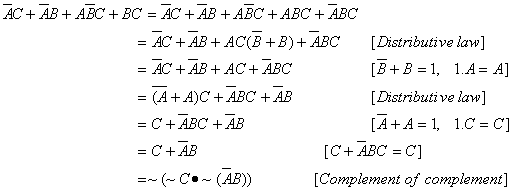
Now the circuit
diagram using the NAND gate only is as below:
Code: AC10
Subject: DISCRETE STRUCTURES

Q.135 Design an
automaton which accepts only even numbers of 0s and even number of 1’s. (8)
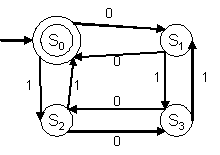 Ans: The
required automata that accepts even number of 0’s and even number of 1’s is
given below.
Ans: The
required automata that accepts even number of 0’s and even number of 1’s is
given below.
Q.136 Consider the context free
grammar
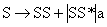
(i) Show how the string aa +
a* can be generated by this grammar.
(ii) Construct a parse tree for
this string.
(iii) What language is
generated by this grammar. (8)
Ans: The production rule of the grammar can be numbered as
1.
S ® SS+ 2. S ® SS* 3. S
® a
(i) S ® SS* [Apply
rule 2]
® Sa*
[Apply rule 3]
® SS + a* [Apply
rule 1]
® Sa + a* [Apply
rule 3]
® aa + a* [Apply
rule 3]
(ii) The parse
tree for the above expression is drawn below.
Code: AC10
Subject: DISCRETE STRUCTURES
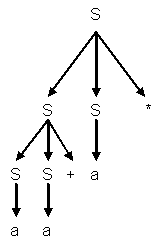
(iii) Language
generated by the grammar is L = {w | w = an(+ Ú a Ú *)n
(+ Ú *)}
Q.137 For any relation R in a set A,
we can define the inverse relation  by
by  iff
iff  . Prove that
(i)
As a subset of A x A, =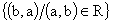 .
.
(ii)
R is symmetric iff R = . (8)
Ans: As per the definition of the inverse of the relation (b, a) Î R–1
iff (a, b) Î R. Let (b, a) be any element of R–1 then (a, b) Î R. This implies
that a, b Î A Þ (b, a) Î A x A and hence R–1 is subset of A x A i.e. R–1 Í A x A and R–1
= {(b, a) | (a, b) Î R}
(ii) Let R is symmetric. For any pair (a, b) Î R–1,
(b, a) Î R. since R is symmetric, (b, a) Î R Þ (b, a) Î R. Thus, R–1
Í R. Conversely let (a, b) be any element in R, then by symmetry (b,
a) Î
R and this Þ (a, b) Î R–1 . i.e. (a, b) Î RÞ (a, b) Î R–1.
Thus, RÍ R–1. Taken together it implies that R = R–1 .
Next let R = R–1 . By definition of inverse of relation
then, for any pair (a, b) Î R, we have (b, a) Î R. Thus R is symmetric.
Q.138 Write Prim’s Algorithm. (6)
Ans: Prim’s algorithm to find a minimum
spanning tree from a weighted graph in stepwise form is given below.
Let G = (V, E) be graph and S = (VS, ES) be
the spanning tree to be found from G.
Step
1: Select a vertex v1 of V and
initialize
VS
= {v1} and
ES = {}
Code: AC10
Subject: DISCRETE STRUCTURES
Step 2: Select a nearest neighbor of vi
from V that is adjacent to some vjÎVS and that edge
(vi, vj) does not form a cycle with members edge of ES.
Set
VS
= VS È{vi} and
ES = ES È{(vi, vj)}
Step 3: Repeat step2 until |ES|
= |V| – 1.
Q.139 Prove that A tree with n
vertices has (n – 1) edges. (6)
Ans: From the definition of a tree a
root has indegree zero and all other nodes have indegree one. There must be (n
– 1) incoming arcs to the (n – 1) non-root nodes. If there is any other arc,
this arc must be terminating at any of the nodes. If the node is root, then its
indegree will become one and that is in contradiction with the fact that root always
has indegree zero. If the end point of this extra edge is any non-root node
then its indegree will be two, which is again a contradiction. Hence there
cannot be more arcs. Therefore, a tree of n vertices will have exactly (n – 1)
edges.
Q.140 Prove the De
Morgan’s Law by algebraic method
For every pair of elements x and y in A
(i) 
(ii)  (10)
(10)
Ans:
(i) For any two variables a and b,
whenever a .b’ = 0 and a + b’ = 1, we say that a and b are equal.
Substituting b with (x + y)’ and a with x’.y’ in the LHS of the
equation a .b’ = 0, we get,
(x’.y’).
((x + y)’)’
=(x’.y’).(x
+ y) [Double Negation]
=((x’.y’).x) + ((x’.y’).y) [Distribution law]
=(x’.x.y’) + (x’.y’.y) [Associative and
commutative law]
=(0.y’)+(x’.0) [Complementation]
=0 + 0 = 0
Similarly, substituting b with (x + y)’ and a with
x’.y’ in the LHS of the equation a + b’ = 1, we get
(x’.y’)
+ ((x + y)’)’
=(x’.y’)
+ (x + y) [Double Negation]
Code: AC10
Subject: DISCRETE STRUCTURES
=((x’.y’)
+ x) + ((x’.y’) + y) [Distribution law]
=((x’+x).(y’+
x)) + ((x’+y).(y’+ y)) [Distribution law]
=(1.(y’+
x)) + ((x’+y).1)) [Complementation]
=(y’ + y) +(x’ + x) [Associative and
commutative law]
=1 + 1 [Complementation]
=1
Therefore (x +y)’ = x’.y’
(ii) This can also be proved by substituting b with (x.y)’ and a with x’ + y’
in the LHS of the equation a .b’ = 0 and a + b’ = 1.
Q.141 Find
the equivalent formula for  that contains only. (6)
Ans: The
binary connective corresponding to NAND is called the Sheffer stroke, and
written with a vertical bar | or vertical arrow ↑. Since it is complete
on its own, all other connectives can be expressed using only the stroke. For
example,:
P → Q ≡ P~Q
P V Q ≡ ~P~Q
P & Q ≡ ~(PQ)
Using the concept, the given formula:
(P → Q) Ú R, can be written using Sheffer stroke , as
(P → Q) Ú R = (P~Q) Ú R
= ~ (P~Q) ~ R
Q.142 Find the number of
ways in which 5 prizes can be distributed among 5 students such that
(i) Each student may get a prize.
(ii) There is no restriction to the
number of prizes a student gets. (8)
Ans :
(i)
Number of ways in which 5 prizes can be
distributed among 5 students in such a way that each one may get a prize is
5*4*3*2*1 = 5! ways.
(ii)
When no restriction on the number of prizes
a student may get, then a student may get either 0 or 1 or 2 or…upto 5 prizes.
It shows that a student have six possible ways in which it may get a prize.
Therefore the number of ways in which prizes can be distributed is 65.
Q.143 What is equivalence relation? Prove that
relation ‘congruence modulo’ (  mod m) is an equivalence
relation. (8)
mod m) is an equivalence
relation. (8)
Ans: A relation R defined on a nonempty set A is said to be an
equivalence relation if R is Reflexive, Symmetric and Transitive on A.
Any
integer x is said to ‘congruence modulo m’ another integer y,
if both x and y yield the same remainder when divided by m. Let R
be the relation ‘congruence modulo m’ over set of integers Z.
Code: AC10
Subject: DISCRETE STRUCTURES
Reflexivity: Let x Î Z be any integer, then x ºm x since
both yield the same remainder when divided by m. Thus, (x, x) Î R " x Î Z. This proves
that R is a reflexive relation.
Symmetry: Let x and y be any two integers and (x, y) Î R. This shows that x ºm y and hence y ºm x. Thus, (y, x) Î R. Hence R is a
symmetric relation also.
Transitivity: Let x, y and z be any three elements of Z such that (x, y) and (y,
z) Î
R. Thus, we have x º3y and y ºm z. It implies that (x–y) and (y–z) are divisible by m. Therefore,
(x – y) + (y – z) = (x – z) is also divisible by m i.e. x ºm z. Hence, (x, y) and (y, z) Î R Þ (x, z) Î R. So R is a
transitive relation.
Therefore, R is an equivalence relation.
Q.144 Show that  is
divisible by (x - y) for all positive integral values of n. (8)
is
divisible by (x - y) for all positive integral values of n. (8)
Ans: For n = 1, the result is obvious. Let it is true for n = k i.e. (xk
– yk) is divisible by (x – y). Now for n = k + 1, we have
(xk+1
– yk+1) = (x – y)( (xk + xk-1y +
xk-2y2 + … + yk)
Since (x – y) is a
factor in (xk+1 – yk+1), it is divisible by (x –
y).
Q.145 Specify the
transition function of the DFA shown below and describe the language. (8)
Ans: The transition state table for the
given DFA is:
|
State
|
0
|
1
|
|
S0
|
S1
|
S1
|
|
S1
|
S1
|
S0
|
The language accepted by this DFA is all strings w in (0, 1)* of the
form
[(0Ú1)0*1]
*(0Ú1) 0*
Code: AC10
Subject: DISCRETE STRUCTURES
Q.146 Simplify the given expression
 (8)
(8)
Ans: The given Boolean expression is AB
+ (AC)’ + AB’C(AB + C). Let us use the algebraic method to simplify it.
AB + (AC)’ + AB’C(AB + C)
= AB + (AC)’ + AB’CAB +AB’C C [Distributive law]
= AB + (AC)’ + AB’BC +AB’C [Associative &Absorption law]
=
AB + (AC)’ + AB’C [AB’BC = 0]
=
ABC’ + ABC + (AC)’ + AB’C [AB = AB(C’ + C)]
= ABC’ + (AC)’ + AC (B’ + B) [Distributive law]
= ABC’ + (AC)’ + AC
= ABC’ + 1
= 1
Q.147 A fair six sided die is tossed
three times and the resulting sequence of numbers is recorded. What is the
probability of the event E that either all three numbers are equal or none of
them is a 4? (8)
Ans: Let us first count the possible number of ways of getting all three
number equal or none of them is four. The ways in which we can get all three
numbers equal is
6x1x1
= 6
And the number of ways in which we can get numbers such that none of
them is four is
5x5x5
= 125
Thus the required probability is = 
Q.148 Define Euler Circuit and Euler
Path. Which of the following graphs have an Euler circuit and Euler path. (8)
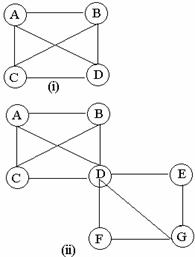
Code: AC10
Subject: DISCRETE STRUCTURES
Ans: In a graph G, a path is called an Euler path if it
contains every edge of the graph exactly once. An Euler path that is circuit is
called an Euler circuit. In the following, for example, (a) has
an Euler path but no Euler circuit, (b) has both Euler circuit and Euler path
whereas (c) has none.
A graph G, having more than two vertices of odd degrees, does not
possess an Euler path. Since the given graph (i) and (ii) both contains more
than two nodes of odd degree, neither (i) nor (ii) has any Euler path or Euler
circuit.
Q.149 Prove that if a set A contains n elements, then
P(A) contains  elements. Also find the number of
proper subsets of the set of letters UTTAR PRADESH. (6+2=8)
elements. Also find the number of
proper subsets of the set of letters UTTAR PRADESH. (6+2=8)
Ans: Let |A| =n. In an subset of the
set A, either an element x is present or absent. Then in any subset an element
can be selected in 2 ways and therefore there can be total of 2n
possible ways of selecting n element from the set A. Each such selection forms
a subset of A. Therefore there can be 2n possible subsets of A i.e.
P(A) has 2n elements.
The set containing letters from UTTARPRADESH is {U, T, A, R, P, D,
E, S, H} and it has 9 elements. The number of proper subsets is equal to total
number of subsets except the set itself and NULL set. Thus required number is =
29 – 2 = 510.
Q.150 Prove that Prim’s algorithm
produces a minimum spanning tree of a connected weighted graph. (8)
Ans:
Let
G be a connected, weighted graph. At every iteration of Prim's
algorithm, an edge must be found that connects a vertex in a subgraph to a
vertex outside the subgraph. Since G is connected, there will always be
a path to every vertex. The output T of Prim's algorithm is a tree,
because the edge and vertex added to T are connected. Let T1
be a minimum spanning tree of G.
If T1=T
then T is a minimum spanning tree. Otherwise, let e be the first
edge added during the construction of T that is not in T1,
and V be the set of vertices connected by the edges added before e.
Then one endpoint of e is in V and the other is not. Since T1
is a spanning tree of G, there is a path in T1 joining
the two endpoints. As one travels along the path, one must encounter an edge f
joining a vertex in V to one that is not in V. Now, at the
iteration when e was added to T, f could also have been
added and it would be added instead of e if its weight was less than e.
Since f was not added, we conclude that
w(f) ≥ w(e).
Code: AC10
Subject: DISCRETE STRUCTURES
Let
T2 be the graph obtained by removing f and adding e
from T1. It is easy to show that T2 is
connected, has the same number of edges as T1, and the total
weights of its edges is not larger than that of T1, therefore
it is also a minimum spanning tree of G and it contains e and all
the edges added before it during the construction of V. Repeat the steps
above and we will eventually obtain a minimum spanning tree of G that is
identical to T. This shows T is a minimum spanning tree.
Q.151 Prove that, the complement of
every element in a Boolean algebra B is unique. (8)
Ans:
Proof: Let I and 0 are the unit and zero
elements of B respectively. Let b and c be two complements of an element a Î B. Then from
the definition, we have
a
Ù b
= 0 = a Ù c and
a Ú b = I = a Ú c
We can write b =
b Ú 0 = b Ú (a Ù c )
= (b Ú a) Ù
(b Ú c ) [since lattice is
distributive ]
= I Ù (b Ú c )
= (b Ú c )
Similarly, c = c
Ú 0 = c Ú
(a Ù b )
=
(c Ú
a) Ù
(c Ú
b) [since lattice is distributive]
= I Ù (b Ú c) [since Ú is a commutative operation]
= (b Ú c)
The above two results show
that b = c.
Q.152 Prove
that  . (8)
. (8)
Ans: In order to prove this let x be any element of A – (BÇC), then
x Î A – (BÇC) Û x Î A and x Ï (BÇC)
Û x Î A and [x Ï B or x Ï C]
Û (x Î A and x Ï B) or (x Î A and x Ï C)
Û (x Î A – B) or (x Î A – C)
Û x Î (A – B) È (A – C)
This implies
that
A – (BÇC)
Í (A – B) È (A – C) and
(A – B) È
(A – C) Í A – (BÇC)
Thus A – (BÇC) = (A – B) È (A – C)
Q.153 Test the validity
of argument:
“If it rains
tomorrow, I will carry my umbrella, if its cloth is mended. It will rain
tomorrow and the cloth will not be mended. Therefore I will not carry my
umbrella” (8)
Code: AC10
Subject: DISCRETE STRUCTURES
Ans: Let p : ‘It will rain
tomorrow’ ; q : ‘I will carry my umbrella’; r : ‘Cloth of
umbrella is mended’ Now the given statement “If it rain tomorrow, I will carry
my umbrella, if its cloth is mended” can be written as (p Ù r)® q. “It will
rain tomorrow” is written as p and “ cloth will not be mended” is written Ør. Thus, we have
(p Ù r)® q
p and
Ør together Þ (p Ù r)® q , p , Ør
Þ [Ø(p Ù r)Ú q ], p , Ør
[(Øp
Ú Ør) Ú q), p Þ (r ® q)]
Þ (r ® q) , Ør [(r ® q), Ør Þ Øq®Ør, Ør Þ Øq]
Þ Øq
That is “I will not carry my umbrella” is valid.
Q.154 A valid identifier in the programming language
FORTAN consists of a string of one to six alphanumeric characters (the 36
characters A,B,….,Z,0,1,…9) beginning with a letter. How many valid FORTRAN
identifiers are there? (8)
Ans: There are 26 letters and 10 digits
a total of 36 characters. It is restricted that an identifier can be of 1 to 6
character long only, and first character must be a letter. Thus, Total number
of identifiers of length 1 = 26
Total number of
identifier of length 2 = 26*36
Total number of
identifier of length 3 = 26*362
Total number of
identifier of length 4 = 26*363
Total number of
identifier of length 5 = 26*364
Total number of
identifier of length 6 = 26*365
Thus number of
valid identifiers = 26*[1 + 36 + 362 + 363 + 364 +
365] = 1617038306.
Q.155 Let R be a
relation on a set A. Then prove that is the transitive
closure of R. (8)
is the transitive
closure of R. (8)
Ans: Transitive closure
of a relation R is the smallest transitive relation S that contains R.
Transitive closure of R is denoted by R¥.
R¥ is defined as the union
of different powers of R i.e. R¥ =
 ,
where are distinct powers of R such that none of them are repeated and W = {x
: Rxis distinct power of R}. It is to prove that the
relation R¥ is transitive and contains R. Furthermore, any transitive
relation containing R must also contain R¥.
,
where are distinct powers of R such that none of them are repeated and W = {x
: Rxis distinct power of R}. It is to prove that the
relation R¥ is transitive and contains R. Furthermore, any transitive
relation containing R must also contain R¥.
Let A be any set of elements. Suppose $ S transitive
relations such that R Í S and R¥Ë S. So, $ (a, b)Ï S and
(a, b) Î R¥. It means that
particular (a, b) ÏR.
Now,
by definition of R¥, we know that $ nÎW such that (a, b)Î Rn.
Then,"i, i < n Þ ei ÎA and, there is a path from a to b like this: aRe1 R...Re(n-1)
Rb.
Code: AC10
Subject: DISCRETE STRUCTURES
But,
by transitivity of S on R, "iÎ W, i < n Þ (a, ei)
Î S, …. (a, e(n-1))
Î S
and (e(n-1),b) ÎS. By transitivity
of S, we get (a, b) Î S. A Contradiction
of (a, b) Ï S.
Therefore,"(a, b) Î AxA, (a, b)Î R¥ Þ (a, b) Î S. This means that R¥ Í S, for any transitive S containing R.
So, R¥ is the smallest transitive
relation containing R.
Q.156 Show that is
divisible by (x - y) for all positive integral values of n. (8)
Ans: For n = 1, the result is obvious. Let it is true for n = k i.e. (xk
– yk) is divisible by (x – y). Now for n = k + 1, we have
(xk+1
– yk+1) = (x – y)( (xk + xk-1y +
xk-2y2 + … + yk )
Since (x – y) is a
factor in (xk+1 – yk+1), it is divisible by (x –
y).
Q.157 Build a Fine
Automaton that accept all words that have different first and last letters
(i.e. if the word begins with an “a” to be accepted it must end with “b” and
vice versa.) (8)
Ans: The Finite state automata for the specified string is as below.
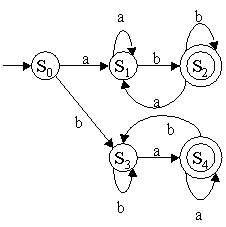
Q.158 How many relations are possible
from a set A of ‘m’ elements to another set B of ‘n’ elements? (8)
Ans: A relation R from a set A to
another set B is defined as any subset of A x B. If |A| = m and |B| = n,
then |A x B| =mn and so number of possible subsets of A x B = 2mn.
Each subset is a relation from A to B. Thus there are 2mn
different types of relations from A to B.
Q.159 What is Partially Ordered Set?
Let  and
and  . Draw the Hasse diagram of the
poset A with the partial order (set inclusion). (8)
. Draw the Hasse diagram of the
poset A with the partial order (set inclusion). (8)
Ans:Let R be a relation defined on a
non-empty set A. The mathematical structure (A, R) is set
to be a Partial order set or poset if the relation R
is a partial order relation on A.
Any relation R defined on a non-empty set A is said to be a Partial
Order Relation, if R is
·
Reflexive on A i.e., xRx " xÎ A
Code: AC10
Subject: DISCRETE STRUCTURES
·
Anti-symmetric on A i.e., xRy and yRx Þ x = y and
·
Transitive on A i.e., xRy and yRz Þ xRz for x, y, z
Î A.
A
partial order relation is denoted by the symbol ‘£’. A general notation for
a poset is (A, £), where A is any non-empty set and ‘£’ is any partial order
relation defined on the set A. The Hasse diagram for the poset (P(S), Í) is as below.
The poset has 8 elements – 8 possible subsets of S. Null set is the minimum
element and S itself is the maximal element..
Q.160 Write short note on:
(i) Pigeonhole Principle
(ii) Graph Isomorphism
(iii)
Tree Traversal
(iv)
Types of Grammar (4
 4 =
16)
4 =
16)
Ans:
(i)
“If five men (pigeonholes) are married to six
women (pigeons) then at least one men has more than one wife.”
Or
“If five men (pigeons) are married to four women
(pigeonholes) then at least one woman has more than one husband”
Or
“If we have six pigeons in five pigeonholes then at
least one pigeonhole would have more than one pigeons”
Arguments
of this kind are used in solution to many mathematical problems and quite a few
beautiful theorems have been proven with their help. All these arguments share
the name “Pigeonhole Principle”. In general
If n objects (pigeons) are placed in m places
(pigeonholes) for m < n, then one of the places (pigeonholes) must contains
at least
objects
(pigeons).This so called ‘pigeonhole principle’ is very simple. Its
application, however, is very intelligence intensive. It needs skill, to
identify the pigeons, pigeonholes and their respective numbers. Once you have
these figures, you have almost found the solution to the problem.
Code: AC10
Subject: DISCRETE STRUCTURES
(ii)
Two graphs G1= (V1, E1)
and G2= (V2, E2) are said to be isomorphic
graphs iff $ functions f: V1® V2 and g: E1® E2 such
that both f and g are bijection and the incidences are preserved i.e. if there
is an edge e between nodes u and v of V1 then g(e)
should be an edge between f(u) and f(v) of V2. The following two
graphs are isomorphic graphs.
|
|
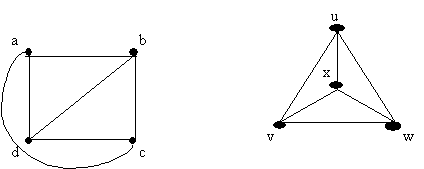 |
Testing
of graph isomorphism, in most of the time, is quite simple contrary to the
theoretical difficulties involved. It is practically not possible to check for
all possible functions f: V1® V2. For
example, if there are 20 vertices in a graph then there are 20! such functions.
The easiest way is to look for the fixed parameters like number of nodes,
number of edges and degree spectrum of graphs. A degree spectrum
is defined as the list of degrees of all nodes in a graph. Two graphs cannot be
isomorphic if any of these parameters are not matching. However, it cannot be
said that two graphs will always be isomorphic if these parameters are
matching.
(iii) Traversal of tree means tree
searching for a purpose. The purpose may be for searching or sorting of the
items contained in a tree. A tree may contain an item at its node as a label.
Traversing a tree is a recursive procedure. To implement this, a tree is
considered to have three components: root, left subtree and right subtree.
These three components can be arranged in six different ways: (left, root,
right), (root, left, right), (left, right, root), (right, left, root),
(right, root, left) and (root, right, left). The first three are used
whereas the last three combinations are of no use as it alters the positions of
a node in a positional tree.
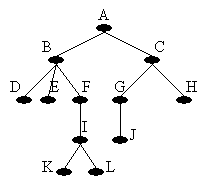 There are other
two important types of tree traversal: Breadth First Search (BFS) and Depth
First Search (DFS). These traversal methods we can use for both tree and graph.
Consider the following labeled tree.
There are other
two important types of tree traversal: Breadth First Search (BFS) and Depth
First Search (DFS). These traversal methods we can use for both tree and graph.
Consider the following labeled tree.
Code: AC10
Subject: DISCRETE STRUCTURES
In
the BFS traversal a tree is traversed in the order of level of nodes. At a
particular level, nodes are traversed from left to right. First visit the root
node. Then go to the first level nodes and visit all nodes from left to right.
Then go to the second level and visit all nodes from left to right and so on
until all nodes have been visited. The algorithm is stated as “visit all
successors of a visited node before visiting any successors of any of those
successors. The sequence of node is A B C D E F G H I J K L. A DFS
traversal of a tree is similar to the preorder traversal of a tree.
(iv)
Any language is suitable for communication provided
the syntax and semantic of the language is known to the participating sides.
It is made possible by forcing a standard on the way to make sentences from
words of that language. This standard is forced through a set of rules. This set
of rules is called grammar of the language. A grammar G = (N, å, P, S) is said
to be of
Type
0: if there is no restriction on the production
rules i.e., in a®b, where a, bÎ (N È å)*. This type of
grammar is also called an unrestricted grammar.
Type
1: if in every production a®b of P, a, b Î (N È å)* and |a| £ |b|. Here |a| and |b| represent
number of symbols in string a and b respectively. This type of grammar is also called a context
sensitive grammar (or CSG).
Type
2: if in every production a®b of P, a Î N and b Î (N È å)*. Here a is a single
non-terminal symbol. This type of grammar is also called a context free
grammar (or CFG).
Type
3: if in every production a®b of P, a Î N and b Î (N È å)*. Here a is a single
non-terminal symbol and b may consist of at the most one non-terminal symbol and one or more
terminal symbols. The non-terminal symbol appearing in b must be the extreme right
symbol. This type of grammar is also called a right linear grammar
or regular grammar (or RG).
Q.161 Shirts numbered consecutively
from 1 to 20 are worn by 20 members of a bowling league. When any three of
these members are chosen to be a team, the league proposes to use the sum of
their shirt numbers as the code number for the team. Show that if any eight of the
20 are selected, then from these eight one may form at least two different
teams having the same code number. (8)
Ans: When a team consisting of three
persons is selected and number inscribed on the shirt is added, the possible
minimum number is (1+ 2 + 3 =) 6 and the maximum number is (18 + 19 + 20 =)
57. Thus a team of three can have a code number from the possible range of 52
codes from 6 to 57 both inclusive. Now after selecting 8 from 20 members, any
three out of 8 can be selected in 8C3 = 56.
Now using the Pigeon Hole principle, let 56 pigeons are placed into
52 holes marked with codes between 6 and 57, then there are at least two teams
will be in the same hole, implying that these two teams will have the same code
number.
Code: AC10
Subject: DISCRETE STRUCTURES
Q.162 In a group of
athletic teams in a certain institute, 21 are in the basket ball team, 26 in
the hockey team, 29 in the foot ball team. If 14 play hockey and basketball, 12
play foot ball and basket ball, 15 play hockey and foot ball, 8 play all the
three games.
(i) How many players are there in
all?
(ii) How many play only foot
ball? (4+4)
Ans: Let A, B and C is set of players
who play Basket ball, Hockey and Foot ball respectively. Thus
|A| = 21, |B| =26, |C|
= 29,
|AÇB| = 14, |AÇC| = 12, |BÇC| = 15, and
|AÇBÇC| = 8.
Now for part (i), we have to find |AÈBÈC|. This can be computed
using the formula
|AÈBÈC| = |A| + |B| + |C| - | AÇB| - |AÇC| - |BÇC| + |AÇBÇC|
= 21 + 26 + 29 – 14 – 12 – 15 + 8 = 84 – 41 = 43.
For part (ii) we have to find number of players playing only
football. This is
= |C| - |AÇC| - |BÇC| + |AÇBÇC| = 29 – 12 –
15 + 8 = 10.
Q.163 Let A =
{a,b,c,d,e} and R={(a,a), (a,b), (b,c), (c,e), (c,d), (d,e)}
Compute
(i) R2 and (ii) R¥ (8)
Ans: The given relation can be
represented by 5x5 Boolean matrix as below:
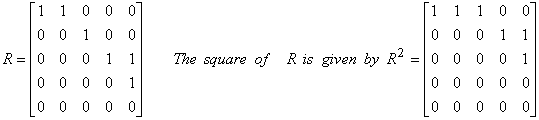
(ii)
Rµ is called transitive closure of relation R and is obtained by
finding the successive powers of R. the process terminates when two consecutive
powers of R become equal i.e. Rn = Rn+1. Let us find the
successive powers of R.
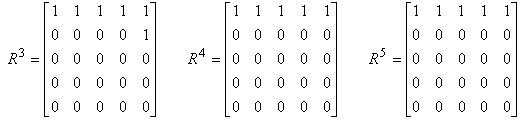
Code: AC10
Subject: DISCRETE STRUCTURES
Since
R4 = R5, The process is stopped and Rµ is obtained by adding all distinct matrices obtained so far
including R. Thus Rµ = R + R2 + R3 + R4 i.e.
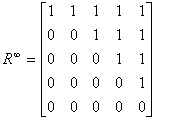
When translated into set of ordered
pairs, it is
{(a, a), (a, b), (a, c), (a, d), (a,
e), (b, c), (b, d), (b, e), (c, d), (c, e), (d, e)}
Q.164 Simplify
the Boolean function:
F(w,x,y,z) = å (0, 1, 2, 3, 4, 6, 8, 9, 12, 13, 14) (8)
Ans:
f(w, x, y, z) = å(0, 1, 2, 3, 4, 6, 8, 9, 12, 13, 14)
The function is of four Boolean variables. The K-Map for this
function is given as in figure below. Minterms of four variables having decimal
equivalent 0, 1, 2, 3, 4, 6, 8, 9, 12, 13 and 14 produce 1 as output for
the function, so squares corresponding to minterms 0000, 0001, 0010, 0011,
01000, 0110, 1000, 1001, 1100, 1101 and 1110 contain an entry 1. The remaining
squares contain 0 as an entry.
Code: AC10
Subject: DISCRETE STRUCTURES
There is five quads: three marked with closed rectangles and one
wrapped around w’ and z’ and of four corners. Therefore the given function can
be expressed in simplified form as
f(w, x, y, z) = y’z’ + w’x’ + wy’ + w’z’ + xz’
Q.165 Use Kruskal’s
algorithm to find a minimal spanning tree for the following graph. (10)
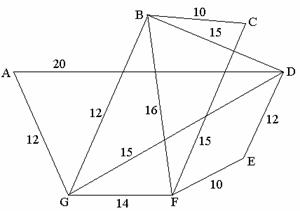
Ans: Let G = (V, E) be graph and S = (VS, ES) be the
spanning tree to be found from G. Let |V| = n and E = {e1, e2,
e3, ¼, em}.
The stepwise Kruskal’s Algorithm to find minimum spanning tree is outlined
below.
Step
1: Select an edge e1 from E such that e1
has least weight. Replace
E =
E -
{e1} and
ES = {e1}
Step 2: Select an edge ei
from E such that ei has least weight and that it does not form a
cycle with members of ES. Set
E =
E -
{ei} and
ES = ES È{ei}
Step 3: Repeat step2 until |ES|
= |V| – 1.
In the given
graph there are 7 nodes so 6 minimum weight edges are to be selected so that
they do not form a cycle. There are 2 edges of weight 10, 3 of 12 and one of
14. They do not form cycle within themselves. Thus, edges in spanning tree
are:{(F, E), (B, C), (E, D), (B, G), (A, G), (F, G)}.
Q.166 How do you find the second
minimum spanning tree of a graph? Find the second minimum spanning tree of the
above graph. (6)
Code: AC10
Subject: DISCRETE STRUCTURES
Ans: The second minimum spanning tree is
obtained by replacing the maximum weight edge in the first minimum spanning
tree with next highest weight edge in the graph. In the given graph, the second
minimum spanning tree is obtained by replacing (F, G) with any one of the edge
(C, F), (B, D), (D, G). Thus one of the second minimum spanning tree is {(F,
E), (B, C), (E, D), (B, G), (A, G), (C, F)}.
Q.167 Prove
that for every pair of elements x and y in A (using algebraic method).
(i)
(x+y)' = x'.y'
(ii) (x.y)' = x'+y' (10)
Ans:
(i) For any two variables a and b,
whenever a .b’ = 0 and a + b’ = 1, we say that a and b are equal.
Substituting b with (x + y)’ and a with x’.y’ in the LHS of the
equation a .b’ = 0, we get,
(x’.y’). ((x + y)’)’
=(x’.y’).(x + y) [Double Negation]
=((x’.y’).x) + ((x’.y’).y) [Distribution law]
=(x’.x.y’) + (x’.y’.y) [Associative and
commutative law]
=(0.y’)+(x’.0) [Complementation]
=0 + 0 = 0
Similarly, substituting b with (x + y)’ and a with
x’.y’ in the LHS of the equation a + b’ = 1, we get
(x’.y’) + ((x + y)’)’
=(x’.y’) + (x + y) [Double Negation]
=((x’.y’) + x) + ((x’.y’) + y) [Distribution law]
=((x’+x).(y’+ x)) + ((x’+y).(y’+ y)) [Distribution law]
=(1.(y’+ x)) + ((x’+y).1)) [Complementation]
=(y’ + y) +(x’ + x) [Associative and
commutative law]
=1 + 1 [Complementation]
=1
Therefore (x +y)’ = x’.y’
(ii) This can also be proved by substituting b with (x.y)’ and a with x’ + y’
in the LHS of the equation a .b’ = 0 and a + b’ = 1.
Code: AC10
Subject: DISCRETE STRUCTURES
Q.168 Prove that (p « q) «
r = p « (q « r) (6)
Ans: This can also be proved using
algebraic method. Here one other way using the truth table is provided. Since
the given expression is a tautology, it is proved that LHS is RHS.
|
p
|
q
|
r
|
p«q
|
(p«q)«r
|
q«r
|
p«(q«r)
|
(p«q)«r = p«(q«r)
|
|
0
|
0
|
0
|
1
|
0
|
1
|
0
|
1
|
|
0
|
0
|
1
|
1
|
1
|
0
|
1
|
1
|
|
0
|
1
|
0
|
0
|
1
|
0
|
1
|
1
|
|
0
|
1
|
1
|
0
|
0
|
1
|
0
|
1
|
|
1
|
0
|
0
|
0
|
1
|
1
|
1
|
1
|
|
1
|
0
|
1
|
0
|
0
|
0
|
0
|
1
|
|
1
|
1
|
0
|
1
|
0
|
0
|
0
|
1
|
|
1
|
1
|
1
|
1
|
1
|
1
|
1
|
1
|
Q.169 Find the number of
ways in which 5 prizes can be distributed among 5 students such that
(i) Each student may get a prize
(ii) There is no
restriction to the number of prizes a student gets. (8)
Ans :
(i)
Number of ways in which 5 prizes can be
distributed among 5 students in such a way that each one may get a prize is
5*4*3*2*1 = 5! ways.
(ii)
When no restriction on the number of prizes a
student may get, then a student may get either 0 or 1 or 2 or…upto 5 prizes. It
shows that a student have six possible ways in which it may get a prize.
Therefore the number of ways in which prizes can be distributed is 65.
Q.170 For the given
graph, find the minimal spanning tree using Prim’s algorithm. (8)
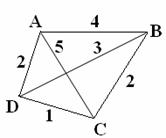
Ans: Let G = (V, E) be graph and S = (VS,
ES,) be the spanning tree to be found from G. The Prim’s algorithm
is given as below:
Step
1: Select a vertex v1 from V and
initialize
Code: AC10
Subject: DISCRETE STRUCTURES
VS
= {v1} and
ES = {}
Step
2: Select a nearest neighbor of vi from
V that is adjacent to some vjÎVS and that edge
(vi, vj) does not form a cycle with members edge of ES.
Set
VS
= VS È{vi} and
ES = ES È{(vi, vj)}
Step 3: Repeat step2 until |ES|
= |V| – 1.
Using the algorithm and starting from node A, we get the
following edges (A, C), (C, D), (D, B) for minimum spanning tree.
Q.171 Show that  is
divisible by 3. (8)
is
divisible by 3. (8)
Ans: Let us prove this using
mathematical induction. For n =1, the result is obvious as n3 + 2n =
3 and it is divisible by 3.
Let us assume that it is true for n = k, i.e. (k3 + 2k)
is divisible by 3. We now show that it is true for n = k + 1 i.e. ((k +1)3
+ 2(k + 1)) is divisible by 3.
(k +1)3 + 2(k + 1) = (k3 + 3k2 + 3k
+1) + 2k + 2
= (k3 + 2k) +3(k2 +
k +1)
Since both term are individually divisible by 3, sum is also
divisible by 3.
Q.172 Find the state
table for the NFA with the state diagram given below. Find the language
recognized by it. (8)
Ans: The transition state table for the
given NFA is:
Code: AC10
Subject: DISCRETE STRUCTURES
|
State
|
0
|
1
|
|
S0
|
{ S0, S2}
|
{ S1}
|
|
S1
|
{ S3}
|
{ S4}
|
|
S2
|
{ }
|
{ S4}
|
|
S3
|
{ S3, S4}
|
{ S4}
|
|
S4
|
{ }
|
{ }
|
The language accepted by this NFA is all strings w except ‘10’ in
(0, 1)* that contains at the most two 1’s.
Q.173 Find the number of ways in which
we can put n distinct objects into two identical boxes so that no box
remains empty. (8)
Ans: This problem of counting can be
solved using generating function concept, Let x and y be the number of count of
objects in two boxes such that
x + y = n where 1 £ x £ n – 1 & 1 £ y £ n – 1
Therefore, the number of ways in which n objects can be put into two
boxes under the condition, is equal to the coefficient of xn in the
expression
(x + x2 + x3 + …+ xn – 1) (x + x2
+ x3 + …+ xn – 1)
i.e. in  . This is equal to the coefficient
of xn – 2 in (1 –x) – 2 i.e. 2 + n – 2 –1Cn
– 2 = n – 1.
. This is equal to the coefficient
of xn – 2 in (1 –x) – 2 i.e. 2 + n – 2 –1Cn
– 2 = n – 1.
Q.174 Let L, be
distributive Lattice, for any a,b,c Î L, then show that
a Ù b = a Ù c and a Ú b = a Ú c imply b = c (8)
Ans: In any distributive lattice L, for
any three elements a, b, c of L, we can write
b = bÚ (a Ù b)
= (bÚ a) Ù (bÚb) [Distributive law]
= (aÚ b) Ù b [Commutative and Idempotent law]
= (aÚ c) Ù b [Given that (aÚ b) = (aÚ c)]
Code: AC10
Subject: DISCRETE STRUCTURES
= (a Ù b) Ú (c Ù b) [Distributive law]
= (a Ù c) Ú (c Ù b) [Given that (a Ù b) = (a Ù c)]
= (c Ù a) Ú (c Ù b) [Commutative law]
= c Ù (a Ú b) [Distributive law]
= c Ù (a Ú c) [Given that (aÚ b) = (aÚ c)]
= c
Q.175 Which of the
following sets are equal?
S1 = {1, 2, 2, 3}, S2 = {x | x2 – 2x + 1
= 0},
S3 = {1, 2, 3}, S4
= {x | x3 – 6x2 + 11x – 6 = 0}, (8)
Ans: The elements of S2 and S4
is given as below:
S2 = {1, 1} and S4 =
{1, 2, 3}
Two sets are said to be equal if both contain same elements and the
multiplicity of every element is same in both the sets. This implies that S3
and S4 are equal. Though S1 has same elements as in S3
and S4 , it not equal because multiplicity of 2 in S1 is
2 whereas that in S3 and S4 is 1.
Q.176 A graph G has 21 Edges, 3 vertices of degree 4 and
other vertices are of degree 3. Find the number of vertices in
G. (8)
Ans: It is given that graph G has 21
edges, thus total degree of graph is 42. it is also given that three vertices
are of degree 4 and other vertices are degree 3. Let number of vertices of degree
3 is y. Then
3y + 4x3 = 42
Þ y = (42 – 12) /
3 = 10.
Thus total number of vertices in the graph G is 10 + 3 = 13.
Q.177 Write the
negation of each of the following in good English sentence.
(i) Jack did not eat fat, but
he did eat broccoli.
(ii) The weather is bad and I
will not go to work.
(iii) Mary lost her lamb or the
wolf ate the lamb.
(iv) I will not win the game or
I will not enter the contest. (2 x 4)
Ans: The negation of statement is written using concept of propositional
rules. For example the negation of “p AND q” is “not p OR not q”; the negation
of “ p implies q” is “not q implies not q”.
(i)
If Jack did not eat broccoli then he did ate
fat.
(ii)
The weather is not bad or I will go to work.
(iii)
Mary did not loss her lamb and the wolf did not
eat the lamb.
(iv)
I will win the game and I will enter the
contest.
Code: AC10
Subject: DISCRETE STRUCTURES
Q.178 Simplify the
logical expression  . (8)
. (8)
Ans: The K-Map for the given Boolean
expression is given by the following diagram. The optimized expression then
obtained is given below.
x’y’ + zw’ + yz
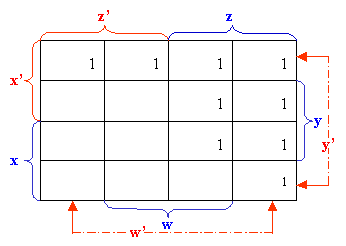
Q.179 How many
different sub-committees can be formed each containing three women from an
available set of 20 women and four men from an available set of 30 men? (8)
Ans: The number of subcommittee that can be formed is equal to the number
of ways the members of committee can be selected from the given group of
people. The number of ways in which three women members from 20 women and four
men members from 30 men is

Q.180 A box contains
six red balls and four green balls. Four balls are selected at random from the
box. What is the probability that two of the selected balls will be red and two
will be green? (8)
Ans: Total number of ways in which 4
balls can be selected out of 10 is  . The number of ways in which 2
red balls out of six and 2 green balls can be selected is
. The number of ways in which 2
red balls out of six and 2 green balls can be selected is  Therefore the
probability of selecting 2 red and 2 green balls is
Therefore the
probability of selecting 2 red and 2 green balls is 
Q.181 What is a
partition on a set? Let A = {1,2,3,4,5} and a relation R defined on A is
R={(1,1), (1,2), (2,1), (2,2), (3,3), (4,4), (4,5), (5,4), (5,5)}. Obtain the
cells of the partition. (8)
Ans:
A partition of a non-empty set A is defined
as a collection of subsets Ai‘s of A such that
· Union of all such subsets Ai is equal to A i.e. ÈAi = A
Code: AC10
Subject: DISCRETE STRUCTURES
· All such
subsets are mutually disjoint i.e. Ai Ç Aj = f.for i ¹ j and
· All subsets Ai‘s
are non-empty i.e. | Ai | ¹ f.
See the figure shown above. Let A be a non-empty set and A1,
A2, A3, A4, A5, A6 and A7
be subsets of A. It is obvious from the figure that
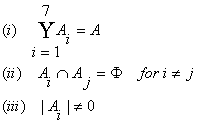
A partition is represented by P. Each subset of A in P is
called block or cell. A partition of
a set is also called quotient Set.
The Cells of
partitions are {1, 2}, {3} and {4,5}.
Q.182 What is a
lattice? Which of the following graphs are lattice and why? (8)
(a) (b)
(c)
Ans: Let (L, £) be a poset. If every subset {x, y} containing any two elements of
L, has a glb (Infimum) and a lub (Supremum), then the poset (L, £) is called a lattice.
A glb ({x, y}) is represented by xÙy and it is called meet
of x and y. Similarly, lub ({x, y}) is represented by xÚy and it is
called join of x and y. Therefore, lattice is a
mathematical structure equipped with two binary operations meet and join.
Code: AC10
Subject: DISCRETE STRUCTURES
In the given
examples, (a) is a lattice because every pair of elements has a meet and join
in the set under the relation represented by the graph. Graph in (b) does not
represent a lattice because bottom two elements have no meet and top two
elements have no join.
In the case of
(c), the relation represented is not even anti symmetric because two bottoms
and two top level elements are at the same level and represented as related to
each other (symmetric) without being the same element (equal).
Q.183 In a survey of
85 people it is found that 31 like to drink milk 43 like coffee and 39 like
tea. Also 13 like both milk and tea, 15 like milk and coffee, 20 like tea and
coffee and 12 like none of the three drinks. Find the number of people who
like all the three drinks. Display the answer using Venn Diagram. (8)
Ans: Let A, B and C is set of people who like to drink
milk, take coffee and take tea respectively. Thus |A| = 31, |B| = 43, |C| = 39,
|AÇB|
= 15, |AÇC| = 13, |BÇC| = 20, |AÈBÈC| = 85 – 12 = 73. Therefore, |AÇBÇC| = 73 + (15 + 13 + 20) –
(31 + 43 + 39) = 8.
Q.184 Obtain
the incidence and the adjacency matrix of the graph given below. (8)
Code: AC10
Subject: DISCRETE STRUCTURES
Ans: The adjacency matrix MA
and incidence matrix MI for the graph is given as shown below. The
adjacency matrix is of order 4 x 4 because there are 4 nodes in the graph.
Since the graph is undirected, we have used numbers to represent number of arc
between the node I and node J at the (I, J) the location in the matrix. For
example ‘0’ stand for no edge between them, ‘2’ stands for two nodes between
them and so on..
The incidence matrix is Boolean matrix of order N x E where N is the
number of nodes and E is the number of edges in the graph. An edge joins two
nodes. The presence of ‘1’in the matrix represents the nodes for that edge.
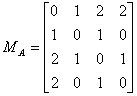
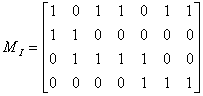
Q.185 What are the
possible ways to combine two automatons? Explain with an example. (8)
Ans:
A finite automaton is
drawn for a regular language. A regular language is closed under the operation
of Union, Concatenation, Negation, Kleene Star, Reverse, Intersection, Set
difference and Homomorphism. If L1 and L2 are two regular
languages having M1 and M2 corresponding automata then M1
and M2 can be combined for the above operations. The General
Approach is outlined below.
·
Build automata (dfas or nfas) for each of the
languages involved.
·
Show how to combine the automata to create a new
automaton that recognizes the desired language.
·
Since the language is represented by an nfa or
dfa, conclude that the language is regular.
In order to demonstrate the working method, let us take intersection
of languages as an example. Let us construct DFA for L = L1 ÇL2 over alphabet
{a, b}.Where
L1 = All strings of even length.
L2 = All strings starting with b.
.
Code: AC10
Subject: DISCRETE STRUCTURES
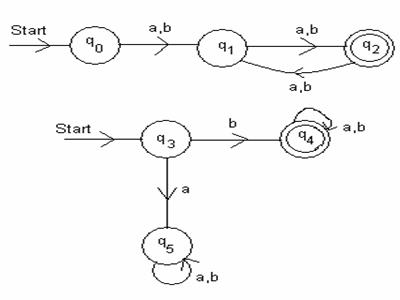
DFA M1(top) and M2( bottom) for
languages L1 and L2 are shown above. They are respectively
defined as M1 = ({q0, q1, q2} ,{a, b},
d1, q0 ,{q2})
where d1 is state transition as per the
diagram. M2 = ({q3, q4, q5}, {a, b},
d2, q3 ,{q4})
where d2 is state transition function. So M =
{[q0,q3], [q1,q4],q1,q5],[q2,q4],[q2,q5],}, {a,b}, d, [q0,q3], {q2,q4]}) where d is state
transition as shown below.
Transition diagram for M is shown below.
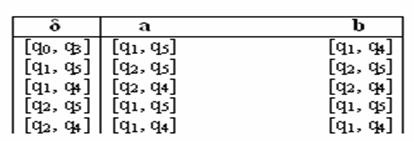
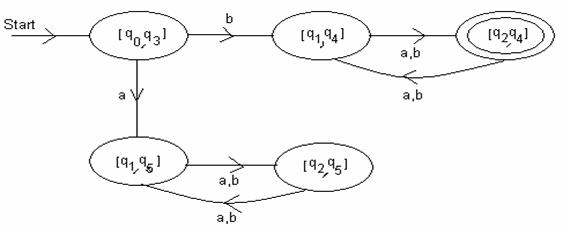
Q.186 Construct the
finite automaton for the state transition table given below. (8)
Code: AC10
Subject: DISCRETE STRUCTURES
 a b
a b

start s0 s0 s2
s1
s0 s1
s2* s2
s1
Ans: The finite automata is shown below. The initial state is marked
with arrow sign and the final state within double circle.
Q.187 Prove that if
 has a
least element, then has a unique
least element. (8)
has a
least element, then has a unique
least element. (8)
Ans: Let (A, £) be a poset. Suppose the
poset A has two least elements x and y. Since x is the least element, it
implies that x £ y. Using the same argument, we can say that y £ x, since y is
supposed to be another least element of the same poset. £ is an
anti-symmetric relation, so x £ y and y £ x Þ x = y. Thus, there is at most one least element in any poset.
Q.188 Show that in
a Boolean algebra, for any a and b, (a Λ b) V (a Λ b' ) = a. (8)
Ans: This can be proved either using the distributive property of join
over meet (or of meet over join) or using a truth table for the expression. Let
us use the truth table.
|
a
|
b
|
aÙb
|
aÙb’
|
(aÙb)Ú (aÙb’)
|
|
0
|
0
|
0
|
0
|
0
|
|
0
|
1
|
0
|
0
|
0
|
|
1
|
0
|
0
|
1
|
1
|
|
1
|
1
|
1
|
0
|
1
|
From the truth table, it is obvious that entries for the expression
and that for ‘a’ are the same and hence the result.
Code: AC10
Subject: DISCRETE STRUCTURES
Q.189 What is minimum spanning tree?
Determine a railway network of minimal cost for the cities in the following graph
using Kruskal’s algorithm.
(10)
Ans: A minimum spanning tree in a
connected weighted graph is spanning tree that has the smallest
possible sum of weights of its edges.
We collect the edges in sorted
order as:
|
Edge
|
Cost
|
|
(B,C )
|
3
|
|
(D,F )
|
4
|
|
(A,G)
|
5
|
|
(C,D)
|
5
|
|
(C,E)
|
5
|
|
(A,B)
|
15
|
|
(A,D)
|
15
|
|
(F,H)
|
15
|
|
(G,H)
|
15
|
|
(E,F)
|
15
|
|
(F,G)
|
18
|
Choose the edges
(B,C),(D,F),(A,G),(C,D),(C,E).
Code: AC10
Subject: DISCRETE STRUCTURES
Then we have option we may choose
only one of (A,B) and (A,D), because selection of both makes a circuit. Suppose
we choose (A,B).
Likewise we may choose only one
of (G,H) and (F,H).Suppose we choose (F,H).
We have a spanning tree as :
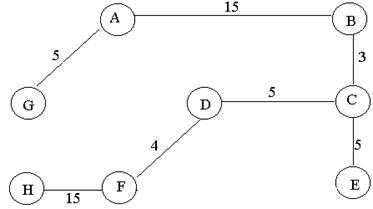
Q.190 Draw a diagraph for each of the
following relation
(i)
Let  and let
(ii)
Let  and Let
  , wherever y is
divisible by x.
, wherever y is
divisible by x.
(iii) Determine which of the relations are
reflexive, which are transitive, which are symmetric and which are anti
symmetric. (4, 4, 2)
Ans: The diagraphs for the defined relation is shown below:
(i)
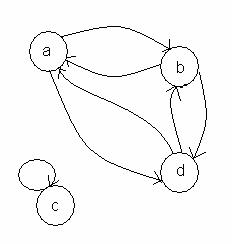
(ii) The R={
(1,1),(1,2),(1,3),(1,4),(1,5),(1,6),(1,7),(1,8),(2,2),(2,4),(2,6),(2,8),(3,3),
Code: AC10
Subject: DISCRETE STRUCTURES
(3,6),(4,4),(4,8),(5,5),(6,6),(7,7),(8,8) }
(iii)
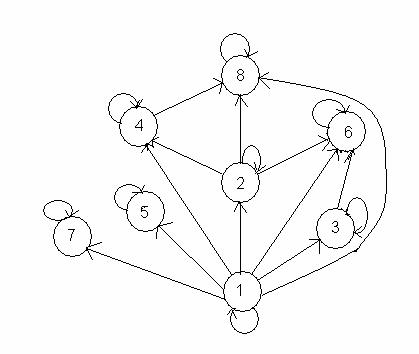
Relation (ii) is
reflexive, (i) is not.
Symmetry:
Relation (i) is symmetrc whereas (ii) is not.
Transitivity:
Relation (ii) is trasitive whereas (i) is not
Antisymmetry: Relation (ii)
is anti-symmetrc whereas (i) is not
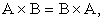 (where
A and B are general matrices) then
(where
A and B are general matrices) then . (B)
A = B’.
. (B)
A = B’. . (B)
. (B)
 .
. . (D)
. (D)
 .
. )
transition function
)
transition function  is a function which maps
  . (B)
. (B)
 .
.  . (D)
. (D)
 .
.
 and
and  , then
 is
is
 . (B)
cos 3 x.
. (B)
cos 3 x. . (D)
. (D)
 .
. is logically
equivalent to
is logically
equivalent to  (B)
(B)

 (D)
(D)



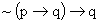

 . (B)
. (B)
 .
. . (D)
L1 = L2.
. (D)
L1 = L2. is,
is, is
is  . (B)
. (B)  .
. . (D)
C.
. (D)
C. where F =
  is defined by the
following transition table. Let for any
is defined by the
following transition table. Let for any 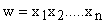 , let fw =
  . List the values of
the transition function,
. List the values of
the transition function,  .
.


 .
. 


 if
if  and 0 otherwise, be the matrix of
relation R. If
and 0 otherwise, be the matrix of
relation R. If  =
= then R is,

 = u + v (ii)
  = y + z
  a tautology
or a fallacy?
a tautology
or a fallacy?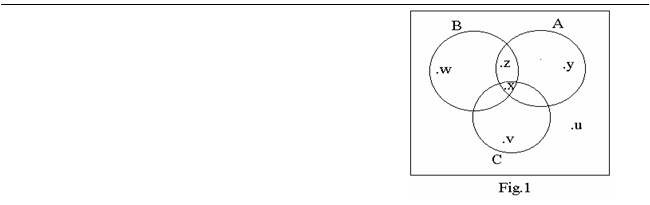

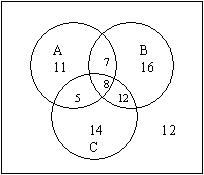
 b if and only if a
divides b. Give the Hasse diagram for the poset (A,
b if and only if a
divides b. Give the Hasse diagram for the poset (A, 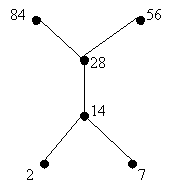
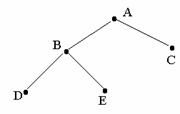
 Q.30 Consider
a grammar G = ({S, A, B}, {a, b}, P, S). Let L (G)=
Q.30 Consider
a grammar G = ({S, A, B}, {a, b}, P, S). Let L (G)=  then if P be the set of
production rules and P includes S aB, give the remaining production rules.
then if P be the set of
production rules and P includes S aB, give the remaining production rules.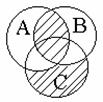




 matrix
 has
an inverse if and only if,
has
an inverse if and only if,  0
0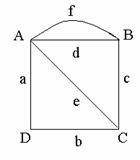
 Z+ such that a = bk. Which one of the
following belongs to R?
Z+ such that a = bk. Which one of the
following belongs to R? , the explicit formula for Tn
is
, the explicit formula for Tn
is  (B)
(B)

 (D)
(D)

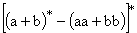 (B)
(B) 
 (D)
(D)
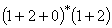
 (B)
(B) 
 (D)
(D) 
 is equivalent to
 (B)
a+c
(B)
a+c q
q (B)
(B)

 (D)
(D) 
 then:
then:  (B)
(B)

 (D)
(D)

 (B)
(B)

 (D)
(D) 
 (B)
(B)

 (D)
(D) 
 , then A*A is:
  (B)
(B)

 (D)
(D)

 is independent of the Boolean
variable:
is independent of the Boolean
variable: denotes the set of all
strings not containing 100 as sub string
denotes the set of all
strings not containing 100 as sub string . (B)
. (B)  .
. . (D)
. (D)
 .
. (B)
(B) 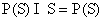
 (D)
(D) 
 ?
? (B)
(B)

 (D)
None of these
(D)
None of these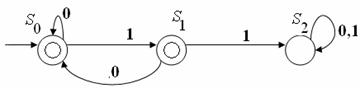
 is
independent to
is
independent to (B)
(B)

 (D)
(D)


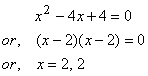

 is
is