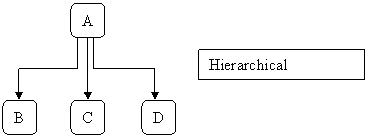
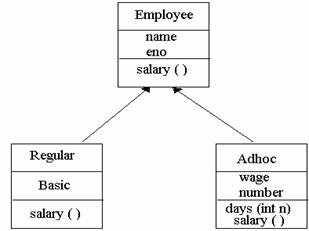
Code: AC-11
Subject:OBJECT ORIENTED PROGRAMMING PART –
II, VOL – I
DESCRIPTIVES
Q.1 Explain the following. (16)
(i) Conversion from Class to Basic Type.
(ii) File Pointers.
(iii) Function Prototyping.
(iv) Overload resolution.
Ans:(i) Conversion from
Class to Basic Type: We know that conversion from a basic to class type can
be easily done with the help of constructors. The conversion from class to
basic type is indeed not that easy as it cannot be done using constructors. for
this conversion we need to define an overloaded casting operator. This is
usually referred to as a conversion function. The syntax for this is as
follows:
The
above function shall convert a class type data to typename.
A
conversion function must follow the following 3 rules:
a.
It
cannot have a return type
b.
It
has to be declared inside a class.
c.
It
cannot have any arguments.
(ii)File pointers: we need to have file
pointers viz. input pointer and output pointer. File pointers are required in
order to navigate through the file while reading or writing. There are certain
default actions of the input and the output pointer. When we open a file in
read only mode, the input pointer is by default set at the beginning. When we
open a file in write only mode, the existing contents are deleted and the file
pointer is attached in the beginning.
C++ also provides us with the facility to control the file pointer
by ourselves. For this, the following functions are supported by stream
classes: seekg(), seekp(), tellg(), tellp().
(iii) Function prototyping is used to
describe the details of the function. It tells the compiler about the number of
arguments, the type of arguments, and the type of the return values. It some
what provides the compiler with a template that is used when declaring and
defining a function. When a function is invoked, the compiler carries out the
matching process in which it matches the declaration of the function with the
arguments passed and the return type. In C++, function prototype was made
compulsory but ANSI C makes it optional. The syntax is as follows:
type function-name(argument-list);
example int func(int a, int b, int c);
(iv)Overload resolution: When we overload
a function, the function prototypes are matched by the compiler. The best match
is found using the following steps.
a. The compiler first matches that prototype
which has the exactly same types of actual arguments.
b. If an exact match is not found by the first
resolution, the integral promotions to the actual arguments are used like char
to int, float to double.
c. When both the above methods fail, the built
in conversions to the actual arguments are used like long square (long n).
d. If all the above steps do not help the
compiler find a unique match, then the compiler uses the user defined
convergence, in combination with integral promotions and built in conversions.
Code: AC11
Subject: OBJECT ORIENTED PROGRAMMING

Q.2 Write a C++ program that prints (6)
|
1
|
1.0000e+00
|
1.000
|
|
2
|
5.0000e-01
|
1.500
|
|
3
|
3.3333e-01
|
1.833
|
Ans:
#include<iostream.h>
#include<iomanip.h>
void main()
{
float x,y,z;
x=1.0000e+00;
y=5.0000e-01;
z=3.3333e-01;
cout.setf(ios::showpoint);
cout.precision(3);
cout.setf(ios::fixed,ios::floatfield);
cout<<x<<'\n';
cout<<y<<'\n';
cout<<z<<'\n';
}
Q.3 What are friend functions? Explain there characteristics with a
suitable example. (6)
Ans: We generally have a belief that a non member
function cannot access the private data member of the class. But this is made
possible using a friend function. A friend function is that which does not belong
to the class still has complete access to the private data members of the
class. We simply need to declare the function inside the class using the
keyword “friend”. The syntax for declaring the friend function is as follows:
class demo
{
public:
friend void func
(void);
}
The characteristics of a friend function are as follows.
·
It
can be declared both in the private and the public part of the class without
altering the meaning.
·
It
is not called using the object of the class.
·
To
access the data members of the class, it needs to use the object name, the dot
operator and the data member’s name. example obj.xyz
·
It
is invoked like a normal function.
·
It
does not belong to the class
An example program
is as follows:
#include<iostream.h>
using namespace
std;
class one;
Code: AC11
Subject: OBJECT ORIENTED PROGRAMMING
class two
{
int a;
public:
void
setvalue(int n){a=n;}
friend void
max(two,one);
};
class one
{
int b;
public:
void
setvalue(int n){b=n;}
friend void
max(two,one);
};
void max(two s,one
t)
{
if(s.a>=t.b)
cout<<s.a;
else
cout<<t.b;
}
int main()
{
one obj1;
obj1.setvalue(5);
two obj2;
obj2.setvalue(10);
max(obj2,obj1);
return 0;
}
Q.4 write a
program to overload the operator ‘+’ for complex numbers. (7)
Ans:
To perform complex number addition using
operator overloading.
# include <iostream.h>
# include <conio.h>
class
complex
{
Code: AC11
Subject: OBJECT ORIENTED PROGRAMMING
float r, i;
public:
complex()
{
r=i=0;
}
void getdata()
{
cout<<”R.P”;
cin>>r;
cout<<”I.P”;
cin>>i;
}
void outdata (char*msg)
{
cout<<endl<,msg;
cout<<”(“<<r;
cout<<”+j” <<i<<”)”;
}
Complex operator+(Complex);
};
Complex complex::Operator+(Complex(2))
{
complex temp;
temp.r=r+c2.r;
temp.i=I=c2.i;
return(temp);
}
void main()
{
clrscr();
complex c1, c2, c3;
cout<<”Enter 2 complex no: “<<endl;
cl.getdta();
c2.getdata();
c3=c1+c2;
c3.outdata (“The result is :”);
getch();
}
OUTPUT
Enter 2 complex no: R.P: 2 I.P: 2 R.p: 2
I.P:2
The result is:
4+j4
RESULT
Thus
the complex number addition has been done using operator overloading
Q.5 Write a complete C++ program
to do the following :
(i)
‘Student’ is a base class, having two data members: entryno and name;
Code: AC11
Subject: OBJECT ORIENTED PROGRAMMING
entryno
is integer and name of 20 characters long. The value of
entryno is 1 for Science
student and 2 for Arts student, otherwise it is
an error.
(ii) ‘Science’ and ‘Arts’ are
two derived classes, having respectively data
items marks for Physics,
Chemistry, Mathematics and marks for
English, History,
Economics.
(iii) Read appropriate data from
the screen for 3 science and 2 arts
students.
(iv) Display entryno, name, marks
for science students first and then for
arts students. (14)
Ans:
#include<iostream.h>
class student
{
protected:
int entryno;
char name[20];
public:
void getdata()
{
cout<<"enter name of
the student"<<endl;
cin>>name;
}
void display()
{
cout<<"Name of the student
is"<<name<<endl;
}
};
class science:public student
{
int pcm[3];
public:
void getdata()
{
student::getdata();
cout<<"Enter
marks for Physics,Chemistry and Mathematics"<<endl;
for(int j=0;j<3;j++)
{
cin>>pcm[j];
}
}
void display()
Code: AC11
Subject: OBJECT ORIENTED PROGRAMMING
{
entryno=1;
cout<<"entry no for
Science student is"<<entryno<<endl;
student::display();
cout<<"Marks
in Physics,Chemistry and Mathematics are"<<endl;
for(int j=0;j<3;j++)
{
cout<<pcm[j]<<endl;;
}
}
};
class arts:public student
{
int ehe[3];
public:
void getdata()
{
student::getdata();
cout<<"Enter
marks for English,History and Economics"<<endl;
for(int j=0;j<3;j++)
{
cin>>ehe[j];
}
}
void display()
{
entryno=2;
cout<<"entry no for Arts student
is"<<entryno<<endl;;
student::display();
cout<<"Marks
in English,History and Economics are"<<endl;
for(int j=0;j<3;j++)
{
cout<<ehe[j]<<endl;;
}
}
};
void main()
{
science s1[3];
arts a1[3];
int i,j,k,l;
cout<<"Entry for Science
students"<<endl;
for(i=0;i<3;i++)
Code: AC11
Subject: OBJECT ORIENTED PROGRAMMING
{
s1[i].getdata();
}
cout<<"Details of three Science
students are"<<endl;
for(j=0;j<3;j++)
{
s1[j].display();
}
cout<<"Entry for Arts
students"<<endl;
for(k=0;k<3;k++)
{
a1[k].getdata();
}
cout<<"Details of three Arts
students are"<<endl;
for(l=0;l<3;l++)
{
a1[l].display();
}
}
Q.6 An
electricity board charges the following rates to domestic users to discourage
large consumption of energy :
For the first 100 units - 50 P per unit
Beyond 300 units - 60 P per unit
If the total cost is more than Rs.250.00 then an
additional surcharge of
15% is added on the difference. Define a class
Electricity in which the
function Bill computes the cost. Define a
derived class More_Electricity
and override Bill to add the surcharge. (8)
Ans:
#include<iostream.h>
class electricity
{
protected:
float unit;
float cost;
public:
void bill()
{
cout<<"\n enter the no. of
units"<<endl;
cin>>unit;
if(unit<=100)
{
cost=0.50*unit;
Code: AC11
Subject: OBJECT ORIENTED PROGRAMMING
cout<<"cost up to 100 unit
is Rs."<<cost<<endl;
}
else
{
if(unit>300)
{
cost=0.60*unit;
cout<<"Beyond
300 units is Rs"<<cost;
}
}
}
};
class more_electricity:public electricity
{
float surcharge,diff,total_cost;
public:
void bill()
{
electricity::bill();
if(cost>250.00)
{
diff=cost-250;
surcharge=diff*0.15;
total_cost=cost+surcharge;
cout<<" Bill amount with
surcharge is Rs"<<total_cost;
}
else
{
cout<<"Bill amout is
Rs."<<cost;
}}};
void main()
{
more_electricity me;
me.bill();
}
Q.7 Write a program to open a file in C++ “Hello.dat” and write
“This is
only a test”
“Nothing
can go wrong”
“All
things are fine…”
into the file. Read the file and display the contents. (6)
Ans:
#include<iostream.h>
#include<fstream.h>
void main()
Code: AC11
Subject: OBJECT ORIENTED PROGRAMMING
{
ofstream fout;
fout.open("Hello.dat");
fout<<"This is only a test\n";
fout<<"Nothing can go wrong\n";
fout<<"All things are fine....\n";
fout.close();
const int N=100;
char line[N];
ifstream fin;
fin.open("Hello.dat");
cout<<"Contents of the Hello.dat file\n";
while(fin)
{
fin.getline(line,N);
cout<<line;
}
fin.close();}
Q.8 Develop a
program in C++ to create a database of the following items of the derived
class.
Name of the patient, sex, age, ward number, bed number,
nature of illness, date of admission.
Design a base class consisting of data members : name of
the patient, sex and age ; and another base class consisting of the data
members : bed number and nature of the illness. The derived class consists of
the data member ,date of admission.
Program should carry out the following methods
(i) Add a new entry.
(ii) List the complete record. (10)
Ans:. #include<conio.h>
#include<iostream.h>
class A{
public:
char name[20];
char sex[10];
int age;
void get_data();
void disp_data();
};
void A::get_data(){
cout<<"enter
d name:";
cin>>name;
cout<<"enter
d age:";
cin>>age;
cout<<"enter
d sex:";
cin>>sex;}
void A::disp_data(){
cout<<"name:"<<name<<'\n';
Code: AC11
Subject: OBJECT ORIENTED PROGRAMMING
cout<<"age:"<<age<<'\n';
cout<<"sex:"<<sex<<'\n';}
class B{
public:
int bed_number;
char
nature_illness[40];
void get_data();
void disp_data();
};
void B::get_data(){
cout<<"enter
d bed_number:";
cin>>bed_number;
cout<<"enter
d nature_illness:";
cin>>nature_illness;
}
void B::disp_data(){
cout<<"bed_number:"<<bed_number<<'\n';
cout<<"nature_illness:"<<nature_illness<<'\n';
}
class C:public A,public
B{
int date_admission;
public:
void get_data();
void disp_data();
void record();
};
void C::get_data(){
A::get_data();
B::get_data();
cout<<endl<<"Enter
Data of Admission:-> ";
cin>>date_admission;
}
void C::disp_data(){
A::disp_data();
B::disp_data();
cout<<endl<<"Date
of Admission\t"<<date_admission;
}
void main(){
clrscr(); C c1;
cout<<endl<<"Adding
a new record to database\n";
getch();
c1.get_data();
cout<<endl<<"Displaying
the added record to database\n";
c1.disp_data();
getch();
}
Code: AC11
Subject: OBJECT ORIENTED PROGRAMMING
Q.9 How many times is the copy constructor
called in the following code? (4)
Apple
func(Apple u)
{
Apple w=v;
Return w;
}
void main()
{
Apple x;
Apple y = func (x);
Apple z = func (y);
}
Ans: 2 times
Q.10 Write a program code which throws an exception of type char* and
another of type int. Write a try ---- catch block which can catch both the
exception. (5)
Ans:#include <iostream>
using namespace std;
int main()
{
double Operand1, Operand2, Result;
// Request two numbers from the user
cout << "This program allows you to perform a division
of two numbers\n";
cout << "To proceed, enter two numbers: ";
try {
cout << "First Number: ";
cin >> Operand1;
cout << "Second Number: ";
cin >> Operand2;
// Find out if the denominator is 0
if( Operand2 == 0 )
throw "Division by zero not
allowed";
// Perform a division and display the result
Result = Operand1 / Operand2;
Code: AC11
Subject: OBJECT ORIENTED PROGRAMMING
cout << "\n" << Operand1
<< " / " << Operand2 << " = " <<
Result << "\n\n";
}
catch(const char* Str) // Catch an exception
{
// Display a string message accordingly
cout << "\nBad Operator: " <<
Str;
}
return 0;
#include <iostream.h>
int main()
{
double Operand1, Operand2, Result;
const char Operator = '/';
// Request two numbers from the user
cout << "This program allows you to perform a division
of two numbers\n";
cout << "To proceed, enter two numbers\n";
try {
cout << "First Number: ";
cin >> Operand1;
cout << "Second Number: ";
cin >> Operand2;
// Find out if the denominator is 0
if( Operand2 == 0 )
throw 0;
// Perform a division and display the result
Result = Operand1 / Operand2;
cout << "\n" << Operand1
<< " / " << Operand2 << " = " <<
Result << "\n\n";
}
catch(const int n) // Catch an exception
{
// Display a string message accordingly
cout << "\nBad Operator: Division by
" << n << " not allowed\n\n";
}
return 0;
}
Q.11 Create a class Time that has
separate int member data for hours, minutes and seconds. One constructor
should initialize this data to zero and another constructor initialize it to
fixed values. Write member function to display time in 12 hour as well as 24
hour format. The final member function should add two objects of class Time.
A main() program should create
three objects of class time, of which two are initialized to specific values
and third object initialized to zero. Then it should add the two
Code: AC11
Subject: OBJECT ORIENTED PROGRAMMING
initialized values together, leaving
the result in the third. Finally it should display the value of all three
objects with appropriate headings. (14)
Ans:
#include<iostream.h>
#include<string.h>
class time24
{
int hours,minutes,seconds;
public:
time24()
{
hours=minutes=seconds=0;
}
time24(int h,int m,int s)
{
hours=h;
minutes=m;
seconds=s;
}
void display()
{
if(hours<10)
cout<<'0';
cout<<hours<<":";
if(minutes<10)
cout<<'0';
cout<<minutes<<":";
if(seconds<10)
cout<<'0';
cout<<seconds;
}
};
class time12
{
bool pm;
int hour,minute;
public:
time12()
{
pm=true;
Code: AC11
Subject: OBJECT ORIENTED PROGRAMMING
hour=minute=0;
}
time12(bool ap,int h,int m)
{
pm=ap;
hour=h;
minute=m;
}
time12(time 24);
void display()
{
cout<<hour<<":";
if(minute<10)
cout<<'0';
cout<<minute<<" ";
char *am_pm=pm ? "p.m." : "a.m.";
cout<<am_pm;
}
};
time12::time12(time24 t24)
{
int hrs24=hours;
bool pm=hours<12 ? false:true;
int min=seconds<30 ? minutes:minutes+1;
if(min==60)
{
min=0;
++hrs24;
if(hrs24==12 || hrs24==24)
pm=(pm==true)? false:true;
}
int hrs12=(hrs24<13) ? hrs24 : hrs24-12;
if(hrs12==0)
{
hrs12=12;
pm=false;
}
return time12(pm,hrs12,min);
}
int main()
{
int h1,m1,s1;
Code: AC11
Subject: OBJECT ORIENTED PROGRAMMING
while(true)
{
cout<<"enter 24-hour time:\n";
cout<<"Hours(0-23):";
cin>>h1;
if(h1>23)
return(1);
cout<<"Minutes:";
cin>>m1;
cout<<"Seconds:";
cin>>s1;
time24 t24(h1,m1,s1);
cout<<"you entered:";
t24.display();
cout<<endl;
time12 t12=t24;
cout<<"\n12-hour time:";
t12.display();
cout<<endl;
}
return 0;
}
Q.12 In the following
output, the following flag constants are used with the stream member function
setf. What effect does each have
(i)
ios::fixed
(ii)
ios::scientific
(iii)
ios::showpoint
(iv)
ios::showpos
(v)
ios::right
(vi)
ios::left (6)
Ans: A two
argument version of setf() is used to set flag which is a member of a group of flags. The
second argument specifies the group and is a bitwise OR of all the flags in the
group. The setfO, a member function of the ios class, can provide answers to
these and other formatting questions. The setfO (setf stands for set
flags) function can be us follows:
cout.setf(argl,arg2)
The argl is one of the formatting flags
defined in the class ios. The formatting flag Spi the format action
required for the output. Another ios constant, arg2, known as bi
specifies the group to which the formatting flag belongs.
There are three bit and each has a group of format flags which are
mutually exclusive Examples:
Code: AC11
Subject: OBJECT ORIENTED PROGRAMMING
cout.setf(ios::1eft, ios::adjustfied);
cout.setf(ios::scientific,
ios::floatfield);
Note that the first argument should be
one of the group members of the second argument.
The Setf() can be used with the flag
ios::showpoint as a single argument to achieve this form of output. For example
Cout.setf(ios::showpoint);
Would cause cout to display trailing
zeros and trailing decimal point.
Similarly, a plus sign can be printed a
positive number using the following statement:
Cout.setf(ios::showpos);set to selection
selection ios::ingroup Meaning
-----------------------------------------------------------
ios::left ios::adjustfield left alignment
ios::right ios::adjustfield right alignment
ios::fixed ios::floatfield fixed form of floating point
ios::scientific ios::floatfield
force exponential format
ios::showpoint // Always show a point
ios::showpos
// If positive still show sign
Q.13 Define
a class Distance with feet and inch and with a print function to print the
distance. Write a non-member function max which returns the larger of two
distance objects, which are arguments. Write a main program that accepts two
distance objects from the user, compare them and display the larger. (8)
Ans:
#include<iostream.h>
class distance
{
int feet;
float inches;
public:
distance()
{
feet=0;
inches=0.0;
}
void getdist()
{
cout<<"Enter
feet:"<<endl;
cin>>feet;
cout<<"Enter
inches:"<<endl;
cin>>inches;
}
void showdist()
{
cout<<feet<<endl<<inches<<endl;
}
friend void maxdist(distance
d1, distance d2)
{
d1.feet=d1.feet+
d1.inches/12;
Code: AC11
Subject: OBJECT ORIENTED PROGRAMMING
d2.feet=d2.feet+
d2.inches/12;
if(d1.feet>d2.feet)
{
cout<<"first
distance is greater";
}
else
{
cout<<"second
distance is greater";
}
}
};
void main()
{
distance d3,d4;
d3.getdist();
d3.showdist();
d4.getdist();
d4.showdist();
maxdist(d3,d4);
}
Q.14 a) Define
the class Person which has name (char*) and age (int). Define the following
constructors
a.
default
b.
with name as argument (assume age is 18)
c.
with name and age as argument
Also
define the copy constructor. (7)
Ans:
#include<iostream.h>
#include<string.h>
class person
{
char *name;
int age;
public:
person()
{
name=NULL;
//strcpy(name,NULL);
age=0;
}
person(char *n)
{
strcpy(name,n);
age=18;
}
person(char *n1,int
a)
Code: AC11
Subject: OBJECT ORIENTED PROGRAMMING
{
strcpy(name,n1);
age=a;
}
person(person &p)
{
strcpy(name,p.name);
age=p.age;
}
void disp()
{
cout<<"name
is"<<name;
cout<<"age
is"<<age;
}
};
void main()
{
person
p1("ram"),p2("sita",20),p3=p2;
cout<<"hello";
p1.disp();
p2.disp();
p3.disp();
}
Q.14 b).Using the
class above, define two subclasses Student and Professor. Student subclass
displays the name and CGPA (grade points in float) and Professor subclass
displays the name and number of publications (int). Write a main program using
polymorphism to display the data of one student and one professor. (7)
Ans:
#include<iostream.h>
class person
{
protected:
char name[40];
public:
void getname()
{
cout<<"Enter
name:";
cin>>name;
}
void disp()
{
cout<<"Name
is:"<<name<<endl;
}
virtual void
getdata()=0;
virtual bool
outstanding()=0;
};
Code: AC11
Subject: OBJECT ORIENTED PROGRAMMING
class student:public
person
{
float gpa;
public:
void getdata()
{
person::getname();
cout<<"Enter
student's GPA:";
cin>>gpa;
}
bool outstanding()
{
return(gpa>3.5)
? true:false;
}
};
class
professor:public person
{
int numpubs;
public:
void getdata()
{
person::getname();
cout<<"enter
number of professor's publication:";
cin>>numpubs;
}
bool
outstanding()
{
return(numpubs>100)
? true:false;
}
};
void main()
{
person *perptr[10];
int n=0;
char choice;
do
{
cout<<"
Enter student or professor(s/p):";
cin>>choice;
if(choice=='s')
perptr[n]=new student;
else
perptr[n]=new
professor;
perptr[n++]->getdata();
cout<<"enter
another(y/n)?";
cin>>choice;
}while
(choice=='y');
for(int
j=0;j<n;j++)
{
perptr[j]->disp();
if(perptr[j]->outstanding())
Code: AC11
Subject: OBJECT ORIENTED PROGRAMMING
cout<<"this
person is outstanding\n";
}
}
Q.15 Write a global
function which uses the above operator and prints the number and the number of
times it appears (frequency) .
Ans:
void
frequency_calc()
{
bag
b;
for(int
j=0;j<50;j++)
{
int
temp;
cin>>temp;
b[j]=temp;
}
for(int i=0;i<50;i++)
{
int k=0;
for(j=j+1;j<50;j++)
{
if (b[i]==b[j])
k++;
}
cout<<b[i]<<”occurred”<<k<<”times”;
}
}
Q.16 How are template
functions overloaded? Explain with a suitable example. (8)
Ans:
A
template function can be overloaded using a template functions. It can also be
overloaded using ordinary functions of its name. The matching of the overloaded
function is done in the following manner.
a.
The
ordinary function that has an exact match is called.
b.
A
template function that could be created with an exact match is called.
c.
The
normal matching process for overloaded ordinary functions is followed and the
one that matches is called.
If no match is found, an error message is
generated. Automatic conversion facility is not available for the arguments on
the template functions. The following example illustrates an overloaded
template function:
Code: AC11
Subject: OBJECT ORIENTED PROGRAMMING
#include<iostream.h>
#include<string.h>
using
namespace std;
template<class
T>
void
display(T x)
{
cout<<"Template
display: "<<x<<"\n";
}
void
display(int x)
{
cout<<"Explicit
display: "<<x<<"\n";
}
int
main()
{
display(20);
display(3.6);
display('A');
return
0;
}
Q.17 Give
a function template SEARCH that can be used to search an array of elements of
any type and returns the index of the element, if found. Give both the
function prototype and the function definition for the template. Assume a
class template Array <T> is available. (5)
Ans:
#include<iostream.h>
template<class atype>
//function returns index number of item, or -1
if not found
int find(atype *array,atype value,int size)
{
for(int j=0;j<size;j++)
if(array[j]==value)
return j;
return -1;
Code: AC11
Subject: OBJECT ORIENTED PROGRAMMING
}
char chrarr[]={1,3,5,9,11,13};
char ch=5;
int intarr[]={1,3,5,9,11,13};
int in=6;
long lonarr[]={1L,3L,5L,9L,11L,13L};
long lo=11L;
double dubarr[]={1.0,3.0,5.0,9.0,11.0,13.0};
double db=4.0;
int main()
{
cout<<"\n 5 in chrarr:
index="<<find(chrarr,ch,6);
cout<<"\n 6 in intarr:
index="<<find(intarr,in,6);
cout<<"\n 11 in lonarr:
index="<<find(lonarr,lo,6);
cout<<"\n 4 in dubarr:
index="<<find(dubarr,db,6);
cout<<endl;
return 0;
}
Q.18 Answer
briefly :
(i) What happens in
a while loop if the control condition is false initially ?
(ii) What is wrong with the following loop
while (n <= 100)
Sum += n*n;
(iii) What is wrong with the following program
int main( )
{
const double PI;
int n;
PI
= 3.14159265358979;
n = 22;
}
(iv) When a multidimensional array is passed to a
function, why does C++ require all but the first dimension to be specified in
parameter list?
(v) Why can’t ** be overloaded as an exponentiation operator?
(vi) How many constructors can a class have,
and how should they be distinguished.
(2x6=12)
Ans:
i)
If the condition in
while loop initially false the loop does not enter into the statements inside
the loop and terminates initially.
ii)
In the given statement
of while loop n is not initialized. Although there is no initialization
expression, the loop variable n must be initialized before the loop begins.
Code: AC11
Subject: OBJECT ORIENTED PROGRAMMING
iii)
The given program code
is wrong as const declared PI must be initialized at the time of declaration.
Whereas initialization of int n is correct the correct code is
Int main()
{Const double PI=3.1459265358979;
Int n=22;}
iv)
Multidimensional array
is an array of arrays the function first take the argument as an array of
parameter first. It does not need to know how many values in parameter there
are, but it does need to know how big each parameter element is, so it can
calculate where particular element is. So we must tell it the size of each
element but not how many there are.
v) Only existing operator symbols may be overloaded. New symbols, such
as ** for exponentiation, cannot be defined.
vi) A class can have Default constructor, constructor with an
argument, constructor with two argument and copy constructor.
Q.19 What are the various ways of handling exceptions? Which one is the
best? Explain.
(6)
Ans: Exception handling is a mechanism that finds
errors at run time. It detects an error and reports so that an appropriate
action can be taken. It adopts the following ways:
a.
Hit
the exception
b.
Throw
the exception
c.
Catch
the exception
d.
Handle
the exception
The three blocks that is used in exception handling are try throw
and catch. A further advancement that is made is of multiple catch handlers.
A program may have more than one condition to throw an exception.
For this we can use more than one catch block in a program. An example is shown
below illustrate the concept:
#include<iostream.h>
using namespace
std;
void test(int x){
try {
if(x==1)
throw x;
else
if(x==0)
throw 'x';
else
if(x==-1)
throw 1.0;
cout<<"End
of try-block\n";
}
catch(char c) {
cout<<"Caught
a character \n";
}
catch(int m) {
cout<<"Caught
an integer\n";
}
catch(double d) {
cout<<"Caught
a double\n";
}
cout<<""End
of try-catch system\n\n;}
Code: AC11
Subject: OBJECT ORIENTED PROGRAMMING
int main(){
cout<<"Testing
multiple catches\n";
cout<<"x==1\n";
test(1);
cout<<"x==0\n";
test(0);
cout<<"x==-1\n";
test(-1);
cout<<"x==2\n";
test(2); return
0;}
Q.20 Describe, in
brief, the steps involved in object oriented analysis. (6)
Ans: The steps involved in object oriented analysis.
Object-oriented analysis provides us with
a simple, yet powerful, mechanism for identifying objects, the building block
of the software to be developed. The analysis is basically concerned with the
decomposition of a problem into its component parts and establishing a logical
model to describe the system functions.
The object-oriented analysis (OOA)
approach consists of the following steps:
1. Understanding the problem.
2. Drawing the specifications of
requirements of the user and the software.
3. Identifying the objects and their
attributes.
4. Identifying the services that each
object is expected to provide (interface).
5.
Establishing inter-connections (collaborations) between the objects in terms of
services required and services rendered.

Requirement specification
|
|



Code: AC11
Subject: OBJECT ORIENTED PROGRAMMING
Problem Understanding
The first step in the analysis process is
to understand the problem of the user. The problem statement should be refined
and redefined in terms of computer system engineering that could suggest a
computer-based solution. The problem statement should be stated, as far as
possible, in a single, grammatically correct sentence. This will enable the
software engineers to have a highly focused attention on the solution of the
problem. The problem statement provides the basis for drawing the requirements
specification of both the user and the software.
Requirements Specification
Once the problem is clearly defined, the
next step is to understand what the proposed. System is required to do. It is
important at this stage to generate a list of user requirement A clear
understanding should exist between the user and the developer of what is
require Based on the user requirements, the specifications for the software
should be drawn. Developer should state clearly
What outputs are required?
What processes are involved to produce
these outputs?
What inputs are necessary?
What resources are required?
These specifications often serve as a
reference to test the final product for its performance the intended tasks.
Identification of Objects
Objects can often be identified in terms of the real-world objects
as well as the abstra~
objects. Therefore, the best place to look for objects is the
application itself. The application
may be analyzed by using one of the
following two approaches:
1.Data flow diagrams (DFD)
2.Textual analysis (TA)
Identification of Services
Once the objects in the
solution space have been identified, the next step is to identify set services
that each object should offer. Services are identified by examining all the
verbs are verb phrases in the problem description statement. Doing verbs and
compare verbs usually give rise to services (which we call as functions
C++). Being verbs indicate the existence of the classification structure
while having verbs' rise to the composition structures.
Establishing interconnection
This step identifies the services that
objects provide and receive. We may use an information flow diagram(IED) or an
entity-relationship (ER) diagram to enlist this information.
Q.21 Write a program in C++ which calculates the factorial
of a given number. (6)
Ans: Program to calculate factorial of a
given number
#include <iostream.h>
long factorial (long a)
{ if (a > 1)
return (a * factorial (a-1));
else
return (1);
Code: AC11
Subject: OBJECT ORIENTED PROGRAMMING
}
int main ()
{ long ln;
cout << "Type a number: ";
cin >> ln;
cout << "!" << ln << " = " << factorial (ln);
return 0;
}
Q.22 Define a class Queue with the following data members
(i) An array of numbers
that the Queue can hold
(ii) Indices ‘front’ and
‘rear’ to specify the positions in Queue.
Initially set
front = rear = -1
and the following
member functions
(i) Delete –
Remove front element.
(ii) Add –
Add an element at rear. (8)
Ans:
#include<iostream.h>
#include<conio.h>
#include<process.h>
struct Node{
int data;
Node *next;
}*rear,*front;
void Create();
void AddItem();
void DeleteItem();
void Display();
void main(){
int ch=0;
Create();
clrscr();
while(ch!=4){
cout<<"\n1. Add item";
cout<<"\n2. Delete item";
cout<<"\n3. Display";
cout<<"\n4. Quit";
cout<<"\n Enter choice";
cin>>ch;
switch(ch){
case 1:
AddItem();
break;
case 2:
Code: AC11
Subject: OBJECT ORIENTED PROGRAMMING
DeleteItem();
break;
case 3:
Display();
break;
}
}
}
void Create(){
front=rear=NULL;
}
void AddItem(){
Node *p=new Node;
cout<<"\n Enter the data:";
cin>>p->data;
p->next=NULL;
if(front==NULL){
front=rear=p;
}
else{
rear->next=p;
rear=p;
}
}
void DeleteItem(){
if(front==NULL){
cout<<"\nQueue is empty";
return;
}
if(front==rear){
cout<<endl<<front->data<<" is
deleted";
delete front;
front=rear=NULL;
}
else{
Node *p=front;
cout<<endl<<front->data<<" is
deleted";
front=front->next;
delete p;
}
}
void Display(){
Node *p=front;
while(p!=NULL){
cout<<"\n"<<p->data;
p=p->next;
}}
Code: AC11
Subject: OBJECT ORIENTED PROGRAMMING
Q.23 What are the two methods of opening a file? Explain with examples.
What is the difference between the two methods?
(10)
Ans: For opening a file, we first create a file
stream which we can link to the file name. we can define a file stream using 3
classes namely ifstream, ofstream and fstream that are all contained in the
header file fstream. Which class to use shall depend upon the mode in which we
want to open the file viz, read or write. There are 2 modes to open a file.
·
Using
the constructor function of the class
·
Using
the member function “open()” of the class.
When using the first method that is constructor function of the
class, we initialize the file stream object by file name. for example the
following statement opens a file named “results” for input.
ifstream infile (“results”);
When using the second method of function “open()”, multiple files
can be opened that use the same stream object for example when we wish to
process a number of files in sequential manner, we shall create a single stream
object and use it to open each file in turn. The syntax is as follows:
file-stream-class stream-object;
stream-object.open(“filename”);
The basic difference between the two methods is that the constructor
function of the class is used when we wish to open just one file in the stream.
The open function is used when we wish to open multiple files using one stream.
Q.24 What is
containership? How does it differ from inheritance? (4)
Ans: Inheritance, one of the major features of OOP,
is to derive certain properties of the base class in the derived class. A
derived class can make use of all the public data members of its base classes.
Containership is different from Inheritance. When
one class is defined inside another class, it is known as containership or
nesting. We can thus imply that one object can be a collection of many different
objects. Both the concepts i.e. inheritance and containership have a vast
difference. Creating an object that contains many objects is different from
creating an independent object. First the member objects are created in the
order in which their constructors occur in the body. Then the constructor of
the main body is executed. An initialization list of the nested class is
provided in the constructor.
Example:
class
alpha{....};
class
beta{....};
class
gamma
{
alpha
a;
beta
b;
public:
Code: AC11 Subject:
OBJECT ORIENTED PROGRAMMING
gamma(arglist):
a(arglist1), b(arglist2) {
//constructor
body
}};
Q.25. How do the
properties of following two derived classes differ?
(i)
class X : public A{//..}
(ii)
class Y : private A{//..} (5)
Ans: The properties of the following two derived class
differ:-
(i)
class X:public
A{//..}
In this class A is publicly derived from class
X. the keyword public specifies that objects of derived class are able to
access public member function of the base class.
i)
class Y:private
A{//..}
In this class A is privately derived from class
Y. the keyword private specifies that objects of derived class cannot access
public member function of the base class. Since object can never access private
members of a class.
Q.26 Identify and remove error from the following, if any :-
array_ptr
= new int [10] [10] [10];
array_ptr = new int [20] [ ] [ ]; (2)
Ans: There is an
error we cannot assign more than one block sizes to one variable.
Correct array_ptr new int[10];
Q.27 What is the
task of the following code :-
cout << setw (4) << XYZ << endl (2)
Ans: The task of the given code is to display the value of XYZ
after setting field width 4 (3) if XYZ=3; set causes the number or string that
follows it in the stream to be printed within a field n characters wide.
Q.28 What is dynamic initialization of objects? Why is it needed?
How is it accomplished in C++? Illustrate. (8)
Ans: Dynamic initialization of objects means to
provide the initial values to an object at run time.
Using dynamic initialization of objects we can
provide different initialization formats of data for an object at run time. We
can use various data types like int, float or char depending upon our need for
the same object created. This provides the flexibility of using different
format of data at run time depending upon the situation.
It can be accomplished using the concept of
constructor overloading. For example:
#include<iostream.h>
class loan
{ long principle;
int year;
Code: AC11
Subject: OBJECT ORIENTED PROGRAMMING
float rate;
public:
loan(){}
loan(long p,int y,float r=0.15);
loan(long p,int y,int r);
};
This class uses three overloaded constructors. The parameter values
to these constructors are provided at run time. One can input in any of the
form to create object of this class.
Q.29 State, with
reason, whether the following statement is true or false
 is equal to false (2)
Ans: The following statement is true as condition
!(4<5)||(6>7) is equal to false.
Q.30 The
following macro is invoked as  . What is the output when x = 5
 (3)
(3)
Ans: The output is 21. when the macro #define f(x)
x*x-3 as f(x+3) when x=5
Q.31 List at least three C++
operators which cannot be overloaded. (3)
Ans: The operators ::,
.*, . and ?: cannot be overloaded.
Q.32
Write a
template function that swaps the values of two arguments passed to it. In
main( ), use the function with integers and characters. (4)
Ans:
#include<iostream.h>
using
namespace std;
template
<class T>
void
swap(T &a,T &b)
{
T
temp=a;
a=b;
b=temp;
}
void
func(int x,int y,char w,char z)
{
cout<<"x
and y before swap: "<<x<<y<<"\n";
swap(x,y)
cout<<"x
and y after swap: "<<x<<y<<"\n";
cout<<"w
and z before swap: "<<w<<z<<"\n";
swap(w,z)
cout<<"w
and z after swap: "<<w<<z<<"\n";
Code: AC11
Subject: OBJECT ORIENTED PROGRAMMING
}
int
main()
{
fun(10,20,’s’,’S’);
return
0;
}
Q.33 What is multiple inheritance? Discuss the syntax and rules of
multiple inheritance in C++. How can you pass parameters to the constructors of
base classes in multiple inheritance? Explain with suitable example.
(12)
Ans:
C++
provides us with a very advantageous feature of multiple inheritance in which a
derived class can inherit the properties of more than one base class. The
syntax for a derived class having multiple base classes is as follows:
Class
D: public visibility base1, public visibility base2
{
Body of D;
}
Visibility
may be either ‘public’ or ‘private’.
In case of multiple inheritance, the base
classes are constructed in the order in which they appear in the declaration of
the derived class. However the constructors for virtual base classes are
invoked before any non-virtual base classes. If there are multiple virtual base
classes, they are invoked in the order in which they are declared. An example program
illustrates the statement.
#include<iostream.h>
using namespace std;
class M
{
protected:
int
m;
public:
M(int
x)
{
m=x;
cout<<
“M initialized\n”;
}
};
class N
{
protected:
int
n;
public:
N(int
y)
{
Code: AC11
Subject: OBJECT ORIENTED PROGRAMMING
n=y;
cout<<
“N initialized\n”;
}
};
class P: public N,
public M
{ int p,r;
public:
P(int a,int
b,int c, int d):M(a),N(b)
{
p=c;
r=d;
cout<< “P initialized\n”;
}
};
void main()
{
P p(10,20,30,40);
}
Output
of the program will be:
N
initialized
M
initialized
P initialized
Q.34 Write a program in C++ to sort a list of given numbers in
nondecreasing order. (7)
Ans:
#include<iostream.h>
void main()
{ int *num,i,j,temp,n,flag;
num=new int[10];
cout<<"how many number to
sort(limit)"<<endl;
cin>>n;
cout<<"enter numbers to sort in nondecreasing
order"<<endl;
for(i=0;i<n;i++)
{
cin>>num[i];
}
for(i=0;i<n-1;i++)
{
flag=1;
for(j=0;j<(n-1-i);j++)
{
Code: AC11
Subject: OBJECT ORIENTED PROGRAMMING
if(num[j]>num[j+1])
{
flag=0;
temp=num[j];
num[j]=num[j+1];
num[j+1]=temp;
}
}
if(flag)
break;
}
for(i=0;i<n;i++)
{
cout<<num[i]<<endl;
}
}
Q.35 What
do you mean by static class members? Explain the characteristics of static
class members with suitable examples. (8)
Ans: Static class member variables are used
commonly by the entire class. It stores values. No different copies of a static
variable are made for each object. It is shared by all the objects. It is just
like the C static variables.
It
has the following characteristics:
·
On
the creation of the first object of the class a static variable is always
initialized by zero.
·
All
the objects share the single copy of a static variable.
·
The
scope is only within the class but its lifetime is through out the program.
An example is
given below:
#include<iostream.h>
using namespace
std;
class num
{
static int c;
int n;
public:
void getd(int x)
{
n
=x;
c++;
}
void getc(void)
{
cout<<"count:
"<<c<<"\n";
}
};
int num :: c;
Code: AC11
Subject: OBJECT ORIENTED PROGRAMMING
int main()
{
num o1,o2,o3;
o1.getc();
o2.getc();
o3.getc();
o1.getd(1);
o2.getd(2);
o3.getd(3);
cout<<"After
reading data"<<"\n";
o1.getc();
o2.getc();
o3.getc();
return 0;
}
Q.36 Create a class Patient that stores the patient name (a string)
and the disease (a string) of the patient. From this class derive two classes
: In_patient which has a data member roomrent (type float) and Out_patient
which has a data member OPD_charges (float). Each of these three classes should
have a nondefault constructor and a putdata() function to display its data.
Write a main() program to test In_ patient and Out_patient classes by creating
instances of them and then displaying the data with putdata(). (10)
Ans:
#include<iostream.h>
class patient
{
protected:
char *name,*disease;
public:
patient(char *n,char *d)
{
name=n;
disease=d;
}
void putdata()
{
cout<<"patient's name
is"<<name<<endl;
cout<<"Disease
is"<<disease<<endl;
}
};
class in_patient:public patient
{
float roomrent;
public:
in_patient(char *n,char *d,float
rr):patient(n,d)
Code: AC11
Subject: OBJECT ORIENTED PROGRAMMING
{
roomrent=rr;
}
void putdata()
{
patient::putdata();
cout<<"Room rent
is"<<roomrent;
cout<<endl;
}
};
class out_patient:public patient
{
float opd_charges;
public:
out_patient(char *n,char *d,float
opd):patient(n,d)
{
opd_charges=opd;
}
void putdata()
{
patient::putdata();
cout<<"OPD charges
is"<<opd_charges;
}
};
void main()
{
char *nm,*dis;
float rr1,op1;
nm=new char;
dis=new char;
cout<<"Enter patient's
name"<<endl;
cin>>nm;
cout<<"Enter
disease"<<endl;
cin>>dis;
cout<<"Enter room
rent"<<endl;
cin>>rr1;
cout<<"Enter opd
charges"<<endl;
cin>>op1;
in_patient ip(nm,dis,rr1);
out_patient op(nm,dis,op1);
cout<<"Details of
In_patient"<<endl;
ip.putdata();
cout<<"Details of
Out_patient"<<endl;
op.putdata();
}
Code: AC11
Subject: OBJECT ORIENTED PROGRAMMING
Q.37 Consider the following specifications: (8)
Structure name data type size
Name First array
of characters 40
Mid array
of characters 40
Last array
of characters 60
Phone Area array
of characters 4
Exch array
of characters 4
Numb array
of characters 6
Class name data type
N_rec Name Name
Phone Phone
(i) Declare structures in C++ for Name and Phone.
(ii) Declare a class N_rec with the following members.
1. Define the constructor (outside the class N_rec) that
gathers the information from the user for Name and Phone.
2. Define the display_rec(outside the class N_rec) that
shows the current values of the data members.
Ans:
#include<iostream.h>
#include<conio.h>
#include<string.h>
struct
Name
{
char
First[40], Mid[40], Last[60];
};
struct
Phone
{
char
Area[4], Exch[4], Numb[6];
};
class
N_Rec
{
struct
Name name;
struct
Phone phone;
public:
N_Rec();
Display_Rec();
};
N_Rec
:: N_Rec()
{
strcpy(name.First,"Shailesh");
Code: AC11
Subject: OBJECT ORIENTED PROGRAMMING
strcpy(name.Mid,"
");
strcpy(name.Last,"Saurabh");
strcpy(phone.Area,"011");
strcpy(phone.Exch,"64");
strcpy(phone.Numb,"608284");
}
N_Rec
:: Display_Rec()
{
cout<<name.First<<"
" <<name.Mid<<" "<<name.Last;
cout<<endl<<phone.Area<<"
"<<phone.Exch<<" "<<phone.Numb;
};
main()
{
clrscr();
N_Rec
obj1;
obj1.Display_Rec();
getch();
}
Q.38 When do we use multi catch handlers? Explain with an example. (8)
Ans: Multiple Catch handlers:
Just like we use conditions in a switch statement, we can use multi
catch statements with one try block when a program has to throw an exception
based on more than one condition.
The multi handlers are searched in sequence of which they occur. The
first match that is found is executed.If no match is found then the program
terminates.
An example program is given below:
#include<iostream.h>
using namespace std;
void test(int x)
{
try
{
if(x==1) throw x;
else
if(x==0) throw 'x';
else
if(x==-1) throw 1.0;
cout<<"End of try-block\n";
}
catch(char c)
{
cout<<"Caught a character \n";
}
Code: AC11
Subject: OBJECT ORIENTED PROGRAMMING
catch(int m) {
cout<<"Caught an integer\n";
}
catch(double d) {
cout<<"Caught a double\n";
}
cout<<""End of try-catch system\n\n;
}
int main()
{
cout<<"Testing multiple catches\n";
cout<<"x==1\n";
test(1);
cout<<"x==0\n";
test(0);
cout<<"x==-1\n";
test(-1);
cout<<"x==2\n";
test(2);
return 0;}
The output:
Testing Multiple Catches
x==1
Caught an integer
End of try-catch system
x==0
Caught a character
End of try-catch system
x==-1
Caught a double
End of try-catch system
x==2
End of try-block
End of try-catch system
Q.39 Find errors
in the following code: (6)
#include<iostream.h>
class
A { int a1;
public:
int a2;
protected
: int a3; };
class
B :public A
{
public:
void
func( )
{
int b1, b2, b3;
b1 = a1;
Code: AC11
Subject: OBJECT ORIENTED PROGRAMMING
b2
= a2;
b3
= a3; } };
class
C : A
{
public:
void
f( )
{
int c1, c2, c3;
c1
= a1;
c2
= a2;
c3
= a3; } };
int
main( )
{
int p, q, r, i, j, k;
B
O1;
C
O2;
p
= O1.a1;
q
= O1.a2;
r
= O1.a3;
i
= O2.a1;
j
= O2.a2;
k
= O2.a3;
}
Ans:
In the given code:
·
Class
B cannot have access over the private variable a1 of class A as a private
variable is never inherited. Thus b1=a1 cannot be used.
·
Class
C also cannot have access over the private member a1 of class A as C inherits
class B which does not contain a1 as its inherited member. Thus c1=a1 cannot be
used.
·
Inside
main() function, object O1 of class B cannot access a1. Thus the statement
O1.a1 is not valid.
·
Similarly
object O2 of class C also cannot access a1. Thus statement O2.a1 is also not
valid.
Inside main() function, the protected member a3 of class B is not
accessible.So the statements “r = O1.a3; and k =
O2.a3; “ is invalid
Q.40 Write short notes on any TWO :-
(i) Procedure oriented vs object oriented programming.
(ii)
Object oriented design.
(iii)
User defined data types in C++. (2
x 7)
Ans:
(i) Procedure oriented vs object oriented
programming
Procedure-oriented programming basically consists of writing a list
of instructions (or actions) for the computer to follow, and organizing these
instructions into groups known as functions . We normally use a flowchart
to organize these actions and represent the flow of control from one action
to another. While we concentrate on the development of functions, very little
Code: AC11
Subject: OBJECT ORIENTED PROGRAMMING
attention is given to the data that are being used by various
functions. What happens to the data? How are they affected by the functions
that work on them? In a multi-function program, many important data items are
placed as global so that they may be accessed by all the functions. Each
function may have its own local data. Global data are more vulnerable to
an inadvertent change by a function. In a large program it is very
difficult to identify what data is used by which function. In case we need to
revise an external data structure, we also need to revise all functions that
access the data. This provides an opportunity for bugs to creep in.
Another serious drawback with the procedural approach is that it
does not model real world problems very well. This is because functions are
action-oriented and do not really correspond to the elements of the problem.
Some characteristics exhibited by procedure-oriented programming
are:
·
Emphasis is on doing things (algorithms).
·
Large programs are divided into smaller programs
known as functions. Most of the functions share global data.
·
Data move openly around the system from function
to function.
·
Functions transform data from one form to
another.
·
Employs top-down approach in program
design.
Object-Oriented programming
The major motivating factor in the invention of object-oriented
approach is to remove some of the flaws encountered in the procedural approach.
OOP treats data as a critical element in the program development and does not
allow it to flow freely around the system. It ties data more closely to the
functions that operate on it, and protects it from accidental modification from
outside functions. OOP allows decomposition of a problem into a number of
entities called objects and then builds data and functions around these
objects. The data of an object can be accessed only by the functions associated
with that object. However, functions of one object can access the functions of
other objects.
Some of the striking features of object-oriented programming are:
·
Emphasis is on data rather than procedure.
·
Programs are divided into what are known as
objects.
·
Data structures are designed such that they
characterize the objects.
·
Functions that operate on the data of an object
are tied together in the data structure.
·
Data is hidden and cannot be accessed by
external functions. .
·
Objects may communicate with each other through
functions.
·
New data and functions can be easily added
whenever necessary.
·
Follows bottom-up approach in program design.
Object-oriented programming is the most recent concept among
programming paradigms and still means different things to different people. It
is therefore important to have a working definition of object-oriented
programming before we proceed further. We define "object-oriented
programming as an approach that provides a way of modularizing programs by creating
partitioned memory area for both data and functions that can be used as
templates for creating copies of such modules on demand." Thus, an
object is considered to be a partitioned area of computer memory that stores
data and set of operations that can access that data. Since
Code: AC11
Subject: OBJECT ORIENTED PROGRAMMING
the memory partitions are independent, the objects can be used in a
variety of different programs without modifications.
ii) Object oriented design
Design is concerned with the mapping of
objects in the problem space into objects in the solution space, and creating
an overall structure (architectural model) and computational models of the
system. This stage normally uses the bottom-up approach to build the structure
of the system and the top-down functional decomposition approach to design :the
class member functions that provide services. It is particularly important to
construct structured hierarchies, to identify abstract classes, and to simplify
the inter-object communications. Reusability of classes from the previous
designs, classification of the objects into subsystems and determination of
appropriate protocols are some of the 'considerations of the design stage. The
object oriented design (OOD) approach may involve the following steps:
1. Review of objects created in the analysis phase.
2. Specification of class dependencies.
3. Organization of class
hierarchies.
4. Design of classes.
5. Design of member functions.
6.
Design of driver program.
Review of Problem Space Objects
The main objective of this review
exercise is to refine the objects in terms of their attributes and operations
and to identify other objects that are solution specific. Some guidelines that
might help the review process are:
1. If only one object
is necessary for a service (or operation), then it operates only on that
object.
2. If two or
more objects are required for an operation to occur, then it is necessary to identify
which object's private part should be known to the operation.
3. If an
operation requires knowledge of more than one type of objects, then the operation
is not functionally cohesive and should be rejected.
Class Dependencies
It is important to identify appropriate classes to represent the
objects in the solution space and establish their relationships. The major
relationships that are important in the context of design are:
1.
Inheritance relationship
2.
Containment relationship.
3.
Use relationships
Organization of Class Hierarchies
This involves identification of common attributes and functions
among a group of related classes and then combining them to form new class. The
new class serves as the super class and the other as a subordinate classes.
Design of Class
Given below are some guidelines which
should be considered while designing a class:
1. The public interface of a class
should have only functions of the class.
2. An object of one class should not
send a message directly to a member of another class.
3. A function
should be declared public only when it is required to be used by the objects of
the class.
4. Each function either accesses or modifies some data of the class it
represents.
Code: AC11
Subject: OBJECT ORIENTED PROGRAMMING
5. A class should be dependent on as
few (other) classes as possible.
6. Interactions between two classes
must be explicit.
7. Each subordinate class should be designed as a specialization of the
base class with the
sole purpose of adding additional
features.
8. The top class of a structure
should represent the abstract model of the target concept.
Design of Member Functions
The member functions define the
operations that are performed on the object's data.
These functions behave like any other C
function and therefore we can use the top-down functional decomposition
technique to design them.
Design of the Driver Program
The driver program is mainly responsible for:
1. Receiving data values from the user
2
Creating objects from the class definitions
3.
Arranging communication between the objects as
a sequence of messages for invoking the member functions, and
4.
Displaying output results in the form required
by the user.
(iii) User defined data types in C++
Structure and Classes
Data types such as struct and class is user defined data type in c++
example
struct{ char title[50];
char author[50];
} book;
class student{char title[50];
char author[50];
public:
void get()}
student s1;
Enumerated
data type
The enum keyword automatically enumerates
a list of words by assigning them values 0,1,2 and so on enum colors_t {black,
blue, green, cyan, red, purple, yellow, white};
Q.41 When does ambiguity arise in multiple inheritance? How can one
resolve it? Develop a program in C++ to create a derived class having following
items: name, age, rollno, marks, empcode and designation. Design a base
class student having data members as rollno, marks and the another base class
is employee having data members as empcode and designation. These both base
classes are inherited from a single base class person with data members name
and age. The program should carry out the required input( ) and output( )
member functions for all. (12)
Ans:
A class can be derived such that it inherits the properties of two
or more base classes. This is called multiple inheritance.
Code: AC11
Subject: OBJECT ORIENTED PROGRAMMING
Ambiguity occurs when the base classes have functions with same
name. for example if two base classes have the function get_data().then which
function will be used by the derived class?
This problem can be solved be defining a named instance with the
derived class, using the class resolution operator with the function name.
Program:
#include<conio.h>
#include<iostream.h>
class person{
public:
char name[20];
int age;
void get_details();
void disp_details();
};
void person::get_details() {
cout<<"enter name:";
cin>>name;
cout<<"enter age:";
cin>>age;
}
void person::disp_details() {
cout<<"name:"<<name;
cout<<'\n';
cout<<"age:"<<age;
cout<<'\n';
}
class student: public person {
public:
int roll_no;
int marks;
void get_details(int a,int b) {
roll_no = a;
marks = b;
}
void disp_data()
{
cout<<"roll_no:"<<roll_no;
cout<<'\n';
cout<<"marks:"<<marks; }
};
class employee:public person {
public:
int emp_code;
char desig[20];
void get_details(int a,char *d) {
emp_code = a;
strcpy(design, d); }
Code: AC11
Subject: OBJECT ORIENTED PROGRAMMING
void disp_data() {
cout<<"emp_code:"<<emp_code;
cout<<'\n';
cout<<"designation:"<<desig; }
};
void main(){
int r,m,c;char d[20];
cout<<"\n Enter roll_no. and marks :";
cin>>r,m
cout<<"\n Enter employee code:";
cin>>c;
cout<<"\n Enter designation: ";
getline(d);
student ob1;
employee ob2;
ob1.get_details(r,m);
ob2.get_details(c,d);
ob1.disp_data();
ob2.disp_data();getch();
}
Q.42 Write
two advantages of using include compiler directive. (4)
Ans: The include compiler directive is a
preprocessor directive. Means, it is a command to the preprocessor. A preprocessor
is a program that performs the preliminary processing with the purpose of
expanding macro code templates to produce a C++ code. By including this header
file, the function that we are using is replaced by the entire function
definition. This is very helpful in case of small modules which are to be
called several times in a program. It reduces the overhead cost of calling the
function each time.
Q.43 Explain the
difference between macro & function. (5)
Ans:Difference between macro and
function macro
Start of pre-processor directive
|
|
The preprocessor will replace all
the macro function used in the program by their function body before the
compilation. The distinguishing feature of macro function are that there will
be no explicit function call during execution, since the body is substituted at
the point of macro call during compilation. Thereby the runtime overhead for
the function linking or context-switch time is reduced. The directive # define
indicates the start of a macro function as shown in the figure.


#define MacroFuncName (parameters) Single
line function body
Code: AC11
Subject: OBJECT ORIENTED PROGRAMMING
Examples:
#define inc(a) a+1
#define add(a, b) (a+b)
Function:A function
is a set of program statements that can be processed independer.tly. A function
can be invoked which behaves as though its code is inserted at the point of the
function call. The communication between a caller (calling function)
and callee (called function) takes place through parameters. The
functions can be designed, developed, and implemented independently by
different programmers. The independent functions can be grouped to form a
software library. Functions are independent because variable names and labels
defined within its body are local to it.
The use of functions offers flexibility
in the design, development, and implementation of the program to solve complex
problems. The advantages of functions includes the following:
·
Modular programming
·
Reduction in the amount of work and development
time
·
Program and function debugging is easier
·
Division of work is simplitied due to the use of
divide-and-conquer principle .
·
Reduction in size of the program due to code
reusability
·
Functions can be accessed repeatedly without
redevelopment, which in turn promotes reuse of code .
·
Library of functions can be implemented by combining well designed, tested and proven
function.
Function
Components
Every function has the
following elements associated with it:
1. Function declaration or prototype.
2. Function parameters (formal parameters)
3. Combination of function declaration and its
definition.
4. Function definition (function declaration
and a function body).
5. return statement.
6. Function call.
A function can be executed
using a function call in the program. The various components associated
with the function are shown in Figure
Void func(int a, int b); Function
declaration
Prototype
parameter

 …………
…………
void func(int a, int b) {
Function definition
……
Body
}
func(x,y); Function
Call
Q.44 Write a C++ program to find the sum of digits of a number
reducing it to one digit. (10)
Ans: #include<iostream.h>
void main(){
int num,n,s,s1,limit;s=s1=0;
cout<<"enter limit of no. of digits you want to
enter";
Code: AC11
Subject: OBJECT ORIENTED PROGRAMMING
cin>>limit;
cout<<"Enter (limit)digit number";
cin>>num;
for(int i=0;i<limit;i++)
{
n=num%10;
s=s+n;
num=num/10;
}
cout<<"sum of digits is"<<s;
if(s>1)
{
while(s>0)
{
n=s%10;
s1=s1+n;
s=s/10;
}
cout<<"reduced to one digit is"<<s1;
}
}
Q.45 Explain the use of break and continue statements in switch case
statements. (4)
Ans: The switch Statement
The switch and case statements help control complex
conditional and branching operations. The switch statement transfers
control to a statement within its body.
Syntax
selection-statement :
switch ( expression ) statement
labeled-statement :
case constant-expression
: statement
default : statement
Control passes to the statement whose case constant-expression
matches the value of switch ( expression ). The switch
statement can include any number of case instances, but no two case
constants within the same switch statement can have the same value.
Execution of the statement body begins at the selected statement and proceeds
until the end of the body or until a break statement transfers control
out of the body.
Use of the switch statement usually looks something like
this:
switch ( expression )
{
declarations
.
. .
case constant-expression :
statements executed if the expression equals the
Code: AC11
Subject: OBJECT ORIENTED PROGRAMMING
value
of this constant-expression
.
.
. break;
default :
statements executed if expression does not equal
any case constant-expression
}
We can use the break statement to end processing of a
particular case within the switch statement and to branch to the end of
the switch statement. Without break, the program continues to the
next case, executing the statements until a break or the end of the
statement is reached. In some situations, this continuation may be desirable.
The default statement is executed if no case constant-expression
is equal to the value of switch ( expression ). If the default
statement is omitted, and no case match is found, none of the statements
in the switch body are executed. There can be at most one default
statement. The
default statement need not come at the
end; it can appear anywhere in the body of the switch statement. In fact
it is often more efficient if it appears at the beginning of the switch
statement. A case or default label can only appear inside a switch
statement.
The type of switch expression and case constant-expression
must be integral. The value of each case constant-expression must
be unique within the statement body.
The case and default labels of the switch
statement body are significant only in the initial test that determines where
execution starts in the statement body. Switch statements can be nested. Any
static variables are initialized before executing into any switch
statements.
The following examples illustrate
switch statements:
switch( c )
{ case 'A':
capa++;
case 'a':
lettera++;
default :
total++;
}
All three statements of the switch body in this example are
executed if c is
equal to 'A' since
a break statement does not appear before the following case. Execution
control is transferred to the first statement (capa++;) and continues in order through the rest of the body. If c is equal to 'a', lettera and total are incremented. Only total is incremented if c is not equal to 'A' or 'a'.
switch( i )
{ case -1:
n++;
Code: AC11
Subject: OBJECT ORIENTED PROGRAMMING
break;
case 0 :
z++;
break;
case 1 :
p++;
break;
}
In this example, a break statement follows each statement of
the switch body. The break statement forces an exit from the
statement body after one statement is executed. If i is equal to 1, only n is incremented. The break
following the statement n++; causes execution control to pass out of the statement body,
bypassing the remaining statements. Similarly, if i is equal to 0, only z is incremented; if i is equal to 1, only p is incremented. The final break
statement is not strictly necessary, since control passes out of the body at
the end of the compound statement, but it is included for consistency.
Q.46 What
is Object Oriented Programming (OOP)? What are the advantages of Object
Oriented Programming? (6)
Ans:
Ans: Object Oriented Programming (OOP) is an
approach that provides a way of modulating programs by creating partitioned
memory area for both data and functions that can be used as templates for
creating copies of such modules on demand.
The advantages of OOP are as follows:
·
Function
and data both are tied together in a single unit.
·
Data
is not accessible by external functions as it is hidden.
·
Objects
may communicate with each other only through functions.
·
It
is easy to add new data and functions whenever required.
·
It
can model real world problems very well.
Q.47 Differentiate
between recursion and iteration. (4)
Ans: Difference between recursion and iteration
Recursion and
iteration are two very commonly used, powerful methods of solving complex
problems, directly harnessing the power of the computer to calculate things
very quickly. Both methods rely on breaking up the complex problems into
smaller, simpler steps that can be solved easily, but the two methods are
subtlety different. Iteration, perhaps, is the simpler of the two. In
iteration, a problem is converted into a train of steps that are finished one
at a time, one after another. For instance, if you want to add up all the
whole numbers less than 5, you would start with 1 (in the 1st step), then (in
step 2) add 2, then (step 3) add 3, and so on. In
Code: AC11
Subject: OBJECT ORIENTED PROGRAMMING
each step, you add
another number (which is the same number as the number of the step you are on).
This is called "iterating through the problem." The only part that
really changes from step to step is the number of the step, since you can
figure out all the other information (like the number you need to add) from
that step number. This is the key to iteration: using the step number to find
all of your other information. The classic example of iteration in languages
like BASIC or C++, of course, is the for
loop.
If iteration is a bunch of steps leading to a solution, recursion
is like piling all of those steps on top of each other and then quashing them
all into the solution. Recursion is like holding a mirror up to another
mirror: in each image, there is another, smaller image that's basically the
same.
Example: recursion
int factorial(int number)
{
if (number
< 0)
{
cout
<< "\nError - negative argument to factorial\n";
exit(1);
}
else if
(number == 0)
return
1;
else
return
(number * factorial(number - 1));
}
Iteration : int factorial(int
number)
{
int product =
1;
if (number
< 0)
{
cout
<< "\nError - negative argument to factorial\n";
exit(1);
}
else if
(number == 0)
return
1;
else
{
for
( ; number > 0 ; number--)
Code: AC11
Subject: OBJECT ORIENTED PROGRAMMING
product
*= number;
return
product;
}
}
So, the difference between iteration and recursion is that with
iteration, each step clearly leads onto the next, like stepping stones across a
river, while in recursion, each step replicates itself at a smaller
scale, so that all of them combined together eventually solve the problem.
These two basic methods are very important to understand fully, since they
appear in almost every computer algorithm ever made.
Q.48 What are the
different storage classes in C++. (5)
Ans: STORAGE CLASSES
C++ provides 4
storage class specifiers:
AUTO, REGISTER, EXTERN, and STATIC
An identifier's storage class specifier helps determine its storage class,
scope, and linkage.
Storage class - determines the period during which that identifier
exists in memory
Scope - determines if the identifier can be referenced in a program
Linkage - determines for a mulitple-source-file program whether an
identifier is known only in the current source file or in any source file with
proper declarations.
Automatic storage class
The auto and register keywords are used to declare
variables of the automatic storage class. Such variables are created when the
block in which they are declared is entered, they exist while the block is
active, and they are destroyed when the block is exited.
Example:
auto float x, y;
declares that float variables x and y are local variables
of automatic storage class, they exist only in the body of the function in
which the definition appears.
register int
counter = 1;
declares that the integer variable counter be placed in one of the
computer's register and be initialized to 1.
Either write auto or register but not both to an
identifier.
Static Storage Class
The keywords extern and static are used to declare
identifiers for variables and functions of the static storage class. Such
variables exist from the point at which the program begins execution.
Code: AC11
Subject: OBJECT ORIENTED PROGRAMMING
There are two types of identifiers with static storage class:
external identifiers (such as global variables and function names) and local
variables declared with the storage class specifier static. Global
variables and function names default to storage class specifier extern.
Global variables are created by placing variable declarations outside any
function definition. They retain their values throughout the execution of the
program.
Q.49 Write a program to overload the unary
minus operator using friend function. (8)
Ans:
#inlcude<iostream.h>
using namespace std;
class space{
int x;
int y;
int z;
public:
void getdata(int a,int b.int c);
void display(void);
friend void operator-(space &s);
};
void space :: getdata(int a,int b,int c){
x=a;
y=b;
z=c;
}
void space :: display(void){
cout<<x<<" ";
cout<<y<<" ";
cout<<z<<"\n";
}
void operator-( space &s){
s.x=-s.x;
s.y=-s.y;
s.z=-s.z;
}
int main(){
space s;
s.getdata(10,-20,30);
cout<<"S : ";
s.display();
-s;
cout<<"S :";
s.display();
return 0;
}
Code: AC11
Subject: OBJECT ORIENTED PROGRAMMING
Q.50 Write a
program in which a class has three data members: name, roll no, marks of 5
subjects and a member function Assign() to assign the streams on the basis of
table given below: (9)
|
Avg. Marks
|
Stream
|
|
90% or more
|
Computers
|
|
80% - 89%
|
Electronics
|
|
75% - 79%
|
Mechanical
|
|
70% - 74%
|
Electrical
|
Ans:
#include<iostream.h>
class student
{
char name[10];
int rollno,marks[5],sum,avg;
public:
void assign()
{
cout<<"enter name of the student";
cin>>name;
cout<<"enter rollno";
cin>>rollno;
cout<<"enter marks of five subjects";
for(int i=0;i<5;i++)
{
cin>>marks[i];
}
sum=avg=0;
for(int j=0;j<5;j++)
{
sum=sum+marks[j];
}
//cout<<sum;
avg=sum/5;
cout<<"Average marks is"<<avg;
cout<<endl;
if(avg>=90)
{
cout<<"stream is
Computer"<<endl;
}
else
{
if(avg>=80 && avg<=89)
{
cout<<"stream
is Electronics";
Code: AC11
Subject: OBJECT ORIENTED PROGRAMMING
}
if(avg>=75 && avg<=79)
{
cout<<"stream
is Mechanical";
}
if(avg>=70 && avg<=74)
{
cout<<"stream
is Electrical";
}
}
}
};
void main()
{
student s1;
s1.assign();
}
Q.51 Write a program to convert the
polar co-ordinates into rectangular coordinates. (hint: polar
co-ordinates(radius, angle) and rectangular co-ordinates(x,y) where x =
r*cos(angle) and
y = r*sin(angle)). (8)
Ans:
#include<iostream.h>
#include<math.h>
using namespace std;
class coord
{
float radius,angle,x,y;
public:
polar(float r, float a);
void rectangular(float x, float y);
void display();
}
void coord :: polar(float r,float a)
{
cout<<"\n Enter the radius and angle : ";
cin>>radius>>angle;
}
void coord :: rectangular(float x,float y)
{
x=radius*cos(angle);
y=radius*sin(angle);
}
Code: AC11
Subject: OBJECT ORIENTED PROGRAMMING
void display()
{
cout<<"\n The rectangular coordinates are :
"<<x<<" and "<<y;
}
void main()
{
coord obj;
obj.polar();
obj.rectangular();
obj.display();
}
Q.52 Is the following code correct?
Justify your answer
int intvar = 333;
int * intptr;
cout << *intptr; (3)
Ans: The following code is not correct
as it will display nothing the given code is
int intvar=333;
int *intptr;
cout<<*intptr;
since the pointer variable is not assigned any address so it will
display nothing. But if we add one more line that is intptr=&intvar; then
it will display 333.
Q.53 What is multilevel inheritance? How is it different from
multiple inheritance? (5)
Ans: Multilevel Inheritance
We can built hierarchies that contain as many
layers of inheritance as we like. For example, given three classes called A,
B and C, C can be derived from B, which can be
derived from A. When this type of situation occurs, each derived class
inherits all of the traits found in all of its base classes. In this case, C
inherits all aspects of B and A.
class A{…….}; //Base class
class B: public A{…..}; // B derived from A
class C:public B{……}; // C derived from B
This process can be extended to any numbers of
levels
Code: AC11
Subject: OBJECT ORIENTED PROGRAMMING
Multiple
Inheritance.
When the number of base classes Inherited exceeds one then the type of
inheritance is known as Multiple Inheritance.
For example in C++, The syntax:
Class D: public A, public B
{
//code
}
Indicates that D inherits the attributes of the two classes A and
B.
Though Multiple Inheritance sounds exciting and very useful it has its own
drawbacks, owing to which most OOP languages deny support for this feature.
These drawbacks include complexities involved when inheriting from many classes
and the difficulty in managing such codes.
Q.54 Write a C++
program to prepare the mark sheet of an university examination with the
following items from the keyboard :
Name of the student
Roll no.
Subject name
Subject code
Internal marks
External marks
Design a base class consisting of
data members Name of the student and Roll no. The derived class consists of the
data members Subject name, Subject code, Internal marks and External marks. (9)
Ans:
#include<iostream.h>
class student
{
char name[10];
int rollno;
public:
void get()
{
cout<<"enter student's
name"<<endl;
cin>>name;
cout<<"enter student's
rollno"<<endl;
cin>>rollno;
}
void disp()
{
Code: AC11
Subject: OBJECT ORIENTED PROGRAMMING
cout<<"Name of the student is :
"<<name<<endl;
cout<<"Rollno is :
"<<rollno<<endl;
}
};
class marks:public student
{
char subjectname[15];
int subcode,intmarks,extmarks;
public:
void get()
{
student::get();
cout<<"enter subject name";
cin>>subjectname;
cout<<"enter subject code";
cin>>subcode;
cout<<"enter Internal marks";
cin>>intmarks;
cout<<"enter External marks";
cin>>extmarks;
}
void disp()
{
student::disp();
cout<<"Subject name is :
"<<subjectname<<endl;
cout<<"Subject code is :
"<<subcode<<endl;
cout<<"Internal marks :
"<<intmarks<<endl;
cout<<"External marks :
"<<extmarks<<endl;
}
};
void main()
{
marks m;
m.get();
m.disp();
}
Code: AC11
Subject: OBJECT ORIENTED PROGRAMMING
Q.55 Explain
the following:
(i)
Non public constructors
(ii) Inline function
(iii) Virtual functions
(iv) Types of Inheritance. (4x4=16)
Ans:
i.) Non-public constructors: If a constructor is protected
or private, it is called non-public constructor. We cannot create objects of a
class that have non-public constructors. Only member function and friend
function can create objects in this case.
ii.) Inline functions: A function which is expanded in line
is called an inline function. Whenever we write there are certain costs
associated with it such as jumping to the function, saving registers, pushing
arguments into the stack and returning to the calling function. To remove this
overhead we write an inline function. It is a sort of request from the
compiler. If we declare and define a function within the class definition then
it is automatically inline.
Advantage of inline functions:
·
They
have no overhead associated with function cal or return mechanism
Disadvantage of inline functions:
·
If
the function made inline is too large and called regularly our program grows
larger.
There are certain restrictions in which the compiler may apply
like:- some compilers will not inline a function if it contains a static
variable or if the function contains a loop, a switch , etc..
iii.) Virtual function: virtual functions are important
because they support polymorphism at run time. A virtual function is a member
function that is declared within the base class but redefined inside the
derived class. To create a virtual function we precede the function declaration
with the keyword virtual. Thus we can assume the model of “one interface
multiple method”. The virtual function within the base class defines the form
of interface to that function. It happens when a virtual function is called
through a pointer.
The following is an example that illustrates the
use of a virtual function:
#include<iostream.h>
using namespace std;
class base
{
Code: AC11
Subject: OBJECT ORIENTED PROGRAMMING
public:
int i;
base(int x)
{
i=x;
}
virtual void func()
{
cout<<"\n using
base version of function";
cout<<i<<endl;
}
};
class derived: public base
{
public:
derived(int x):base(x){}
void func()
{
cout<<"\n sing
derived version";
cout<<i*i<<endl;
}
};
class derived1: public base
{
public:
derived1(int x): base(x){}
void func()
{
cout<<"\n using
derived1 version";
cout<<i+i<<endl;
}
Code: AC11
Subject: OBJECT ORIENTED PROGRAMMING
};
int main()
{
base *p;
base ob(10);
derived d_ob(10);
derived1 d_ob1(10);
p=&ob;
p->func();
p=&d_ob;
p->func();
p=&d_ob1;
p->func();
return 0;
}
iv.) Inheritance: the mechanism of deriving a new class from
an old one is called inheritance. The old class is called the base class and
the new one is known as the derived class or sub class.
Types of inheritance
a.
A
derived class with only one base class is called single inheritance
b.
A
derived class with several base classes is called multiple inheritance.
c.
When
one base class is inherited by more than one class is called hierarchical
inheritance.
d.
When
one derived class inherits another derived class, it is called multilevel
inheritance.
Code: AC11
Subject: OBJECT ORIENTED PROGRAMMING
Q.56 Write a program that shows the
use of read() and write() to handle file I/O involving objects. (8)
Ans:
#include<iostream.h>
#include<fstream.h>
#include<iomanip.h>
class INVENTORY
{
char name[10];
int code;
float cost;
public:
void readdata(void);
void writedata(void);
};
void INVENTORY :: readdata(void)
{
cout<<"\n Enter name:";cin>>name;
cout<<"\n Enter code:";cin>>code;
cout<<"\n Enter cost:";cin>>cost;
}
void INVENTORY :: writedata(void)
{
cout<<setiosflags(ios::left)
<<setw(10)<<name
<<setiosflags(ios::right)
<<setw(10<<code)
<<setprecision(2)
<<setw(10)<<cost<<endl;
}
Code: AC11
Subject: OBJECT ORIENTED PROGRAMMING
int main()
{
INVENTORY item[3];
fstream file;
file.open("Stock.dat",ios::in|ios::out);
cout<<"\n Enter details for three items \n";
for(int i=0;i<3;i++)
{
item[i].readdata();
file.write((char *) & item[i],sizeof(item[i]));
}
file.seekg(0);
cout<<"\nOutput\n";
for(i=0;i<3;i++)
{
file.readdata((char *) &item[i],sizeof(item[i]));
item[i].writedata();
}
file.close();
return 0;
}
Q.57 Define a function area() to compute the area of objects of
different classes – triangle, rectangle, square. Invoke these in the main
program. Comment on the binding (static or dynamic) that takes place in your
program. (10)
Ans:
#include
<iostream.h> // For input/output
class
triangle
{
float
base, height, areat;
public:
void
area()
{
cout << "Enter the base of the triangle: ";
cin >> base;
Code: AC11
Subject: OBJECT ORIENTED PROGRAMMING
cout << endl; // Go to a new line
cout << "Enter the height of the triangle: ";
cin >> height;
cout << endl; // Go to a new line
areat = 0.5 * base * height;
cout << "\n\n\n\n\n\n\n\n\n"; // What is this line doing?
cout << base << " is the base length of the triangle.
\n\n";
cout << height << " is the height of the triangle. \n\n";
cout << areat << " is the area of the triangle. \n\n";
}
};
class
rectangle
{
float
breadth, length, arear;
public:
void
area()
{
cout << "Enter the breadth of the rectangle: ";
cin >> breadth;
cout << endl; // Go to a new line
cout << "Enter the length of the rectangle: ";
cin >> length;
cout << endl; // Go to a new line
arear = breadth * length;
cout << "\n\n\n\n\n\n\n\n\n"; // What is this line doing?
cout << breadth << " is the length of the rectangle.
\n\n";
cout << length << " is the height of the rectangle.
\n\n";
cout << arear << " is the area of the rectangle. \n\n";
}
};
class
square
{
float
side,areas;
public:
void
area()
{
cout << "Enter the height of the square: ";
cin >> side;
Code: AC11
Subject: OBJECT ORIENTED PROGRAMMING
cout << endl; // Go to a new line
areas = side * side;
cout << "\n\n\n\n\n\n\n\n\n"; // What is this line doing?
cout << side << " is the side of the square:. \n\n";
cout << areas << " is the area of the square:. \n\n";
}
};
main()
{
triangle
t;
rectangle
r;
square
s;
t.area();
r.area();
s.area();
return(0);
}
Q.58 What are
the basic differences between manipulators and ios member functions in
implementation? Give examples. (8)
Ans:
The basic difference between manipulators and ios member functions
in implementation is as follows:
The ios member function returns the previous format state which can
be of use later on but the manipulator does not return the previous format
state. Whenever we need to save the old format states, we must use the ios
member functions rather then the manipulators. Example: an example program
illustrating the formatting of the output values using both manipulators and
ios functions is given below.
#include<iostream.h>
#include<iomanip.h>
using namespace std;
int main()
{
cout.setf(ios::showpoint);
cout<<setw(5)<<"\n"
<<setw(15)<<"Inverse_of_n"
<<setw(15)<<"Sum_of_terms\n\n";
Code: AC11
Subject: OBJECT ORIENTED PROGRAMMING
double term,sum=0;
for(int n=1;n<=10;n++)
{
term=1.0/float(n);
sum+=term;
cout<<setw(5)<<n
<<setw(14)<<setprecision(4)
<<setiosflags(ios::scientific)<<term
<<setw(13)<<resetiosflags(ios::scientific)
<<sum<<endl;
}
return 0;
}
Q.59 Class
Y has been derived from class X. The class Y does not contain any data members
of its own. Does the class Y require constructor. If yes, why? (4)
Ans:Yes, it is mandatory for class Y to
have a constructor. It is the responsibility of the derived class constructor
to invoke the base class constructor by passing required arguments to it.Unless
the constructor of class Y is invoked the data members of class X that have
been inherited by class Y will not be given any values. Although class Y does
not have any data member of its own, yet to use the data members inherited from
X, Y needs a constructor.
Y(type1 x, type2 y,…):
Q.60 Write a
program using function template to find the cube of a given integer, float and
double number. (6)
Ans:
//Using a function template
#include <iostream.h>
template < class T >
T cube( T value1)
{
Code: AC11
Subject: OBJECT ORIENTED PROGRAMMING
return value1*value1*value1;
}
int main()
{
int int1;
cout <<"Input integer value: ";
cin >> int1;
cout << "The cube of integer value is: "<<
cube( int1);
double double1;
cout << "\nInput double
value; ";
cin >> double1;
cout << "The cube of double value is: "<<
cube( double1);
float float1;
cout << "\nInput float value";
cin >> float1;
cout << "The cube of float value is:
"<< cube(float1);
cout<< endl;
return 0;
}
Q.61 Write a C++
program to insert and delete a node from the double linked list. The list must
be arranged in ascending order. Structure of node is (14)
Ans:
#include<iostream.h>
#include<conio.h>
#include<process.h>
struct Node{
int data;
Node *next;
}*start;
void Create();
void AddItem();
void DeleteItem();
Code: AC11
Subject: OBJECT ORIENTED PROGRAMMING
void Display();
main(){
int ch=0;
Create();
clrscr();
while(ch!=4){
cout<<"\n1. Add item";
cout<<"\n2. Delete item";
cout<<"\n3. Display";
cout<<"\n4. Quit";
cout<<"\n Enter choice";
cin>>ch;
switch(ch){
case 1:
AddItem();
break;
case 2:
DeleteItem();
break;
case 3:
Display();
break;
}
}
}
void Create(){
Node *h=new Node;
h->data=9999;
h->next=NULL;
start=h;
}
void AddItem(){
Node *p=new Node;
Node *loc, *old;
cout<<"Enter the Item :";
cin>>p->data;
old=start;
loc=start->next;
while(loc!=NULL){
if(loc->data>p->data){
p->next=old->next;
old->next=p;
Code: AC11
Subject: OBJECT ORIENTED PROGRAMMING
return;
}else{
old=loc;
loc=loc->next;
}
}//End while\
//Insert at end
p->next=NULL;
old->next=p;
}
void DeleteItem(){
Node *p;
Node *loc,*old;
int item;
if(start->next==NULL){
cout<<"\nList is empty";
return;
}
cout<<"\nEnter the item to delete :";
cin>>item;
old=start;
loc=start->next;
while(loc!=NULL){
if(loc->data==item){
old->next=loc->next;
cout<<"\n"<<loc->data<<"
is deleted";
delete loc;
return;
}else{
old=loc;
loc=loc->next;
}
}
cout<<"\n Item not found";
}
void Display(){
Node *p=start;
while(p!=NULL){
cout<<"\n"<<p->data;
p=p->next;
}
}
Code: AC11
Subject: OBJECT ORIENTED PROGRAMMING
Q.62 How can a common friend
function to two different classes be declared? (4)
Ans:
Friend functions are not considered class members; they are normal
external functions that are given special access privileges. Friends are not in
the classs scope, and they are not called using the member-selection operators
(. and >) unless they are members of another class.
Any data which is declared private inside a class is not
accessible from outside the class. A function which is not a member or an
external class can never access such private data. But there may be some cases,
where a programmer will need need access to the private data from non-member
functions and external classes. C++ offers some exceptions in such cases.
A class can allow non-member functions and other classes to access
its own private data, by making them as friends. This part of C++
tutorial essentially gives two important points.
Once a non-member function is declared as a friend, it can access
the private data of the class
similarly when a class is declared as a friend, the friend class can
have access to the private data of the class which made this a friend.
Q.63 Write a C++
program that copies the contents of a text file (i.e. any CPP file) to
another file. Invoke the program with two command line arguments-the source
file and the destination file – like this. (10)
C> ccopy scfile.cpp dstfile.cpp
Ans:
#include<iostream.h>
#include<fstream.h>
#include<process.h>
void main(int argc,char *argv[])
{
if(argc!=3)
{ cout<<"\n argument is not
passed";
exit(-1);
}
char ch;
ifstream inf;
ofstream otf;
inf.open(argv[1]);
otf.open(argv[2]);
if(!inf)
{ cout<<"\n can't
open"<<argv[1];
exit(-1);
}
while(inf)
{ inf.get(ch);
otf<<ch;
}}
Code: AC11
Subject: OBJECT ORIENTED PROGRAMMING
Q.64 Explain any
three drawbacks of procedure oriented languages. Give an example each in C
language to highlight the drawback.
(6)
Ans: Drawbacks of procedure oriented languages.
Previously, programs were written in a procedural
fashion i.e. the statements were written in the form of a batch. But as the
requirements grew, it was seen that the programs were getting larger and larger
and it became difficult to debug. So functions were introduced to reduce the
size of the programs and improve readability in them. Still that was not
enough.
One of the major problems with the “Procedural
Paradigm” was that data was treated as a stepson and functions were given more
priority. Where as, it is the other way. In this procedure the original data
could easily get corrupted, as it was accessible to all the functions, even to
those which do not have any right to access them. Before OOP, the programmer
was restricted to use the predefined data types such as integer, float and
character. If any program required handling of the x-y coordinates of some
point then it is quite a headache for the programmer. Where as, in OOP this can
be handled very easily as the programmer can define his own data types and the
corresponding functions.
Q.65 Write a C++
program which reads in a line of text and counts the number of occurrences of
the word ‘the’ in it. It outputs the line of text on one line, ‘The number of
times the appears is’ and the count on the next line using a single cout
statement. (8)
Ans:
#include <iostream.h>
#include <conio.h>
void main()
{
clrscr();
int countch=0;
int countwd=1;
cout << "Enter your sentence in lowercase: "
<< endl;
char ch='a';
while(ch!='\r')
{
ch=getche();
if(ch==' ')
countwd++;
else
countch++;
}
cout << "\n Words = " << countwd <<
endl;
cout << "Characters = " << countch-1 <<
endl;
getch();
}
This program takes in a sentence
as a screen input from the user.
Code: AC11
Subject: OBJECT ORIENTED PROGRAMMING
Q.66 Explain the
difference between constructor and copy constructor in C++. Which of these is
invoked in the following statement
Date D1 (D2); where D2 is also an object of class Date. (3)
Ans: Constructors are special `member functions' of which exactly one is called
automatically at creation time of an object. Which one depends on the form of
the variable declaration. Symmetrically, there exists a destructor, which is
automatically called at destruction time of an object. Three
types of constructors are distinguished: default constructor, copy constructor,
and all others (user defined). A constructor has the same name as the class and
it has no return type. The parameter list for the default and the copy
constructor are fixed. The user-defined constructors can have arbitrary
parameter lists following C++ overloading rules.
class A { int i; // private
public:
A(); // default constructor
A( const A& a); // copy constructor
A( int n); // user defined
~A(); // destructor
};
int main() {
A a1; // calls the default constructor
A a2 = a1; // calls the copy constructor (not the assignment
operator)
A a3(a1); // calls the copy constructor (usual constructor
call syntax)
A a4(1); // calls the user defined constructor
} // automatic destructor calls for a4, a3, a2, a1 at the end of
the block
The compiler generates a missing default constructor, copy
constructor, or destructor automatically. The default implementation of the
default constructor calls the default constructors of all class member
variables. The default constructor is not automatically generated if
other constructors are explicitly declared in the class (except an explicit
declared copy constructor). The default copy constructor calls the copy
constructor of all class member variables, which performs a bitwise copy for
built-in data types. The default destructor does nothing. All default
implementations can be explicitly inhibited by declaring the respective
constructor/destructor in the private part of the class.
Constructors initialize member variables. A new syntax, which
resembles constructor calls, allows to call the respective constructors of the
member variables (instead of assigning new values). The constructor call syntax
extends also to built-in types. The order of the initializations should follow
the order of the declarations, multiple initializations are separated by comma.
class A {
int i; // private
public:
A() : i(0) {} // default constructor
A( const A& a) : i(a.i) {} // copy constructor, equal to the
compiler default
A( int n) : i(n) {} // user defined
Code: AC11
Subject: OBJECT ORIENTED PROGRAMMING
~A() {} // destructor, equal to the compiler
default
};
Usually, only the default constructor (if the semantics are
reasonable), and some user defined constructors are defined for a class. As
soon as the class manages some external resources, e.g., dynamically allocated
memory, the following four implementations have to work together to avoid
resource allocation errors: default constructor, copy constructor, assignment
operator, and destructor. Note that the compiler would create a default
implementation for the assignment operator if it is not defined explicitly
Q.67 Define a
class Rectangle which has a length and a breadth. Define the constructors and
the destructor and member functions to get the length and the breadth. Write a
global function which creates an instance of the class Rectangle and computes
the area using the member functions. (8)
Ans:
#include <iostream.h>
class CRectangle {
int width, height;
public:
CRectangle (int,int);
~CRectangle ();
friend int area(CRectangle);
};
CRectangle::CRectangle (int a, int b) {
width = a;
height = b;
}
CRectangle::~CRectangle () {
// delete width;
//delete height;
}
int area(CRectangle r)
{
return r.height * r.width;
}
int main () {
int h,w;
cout<<"enter length and breadth of rectangle";
cin>>h>>w;
CRectangle rect (h,w);
cout << "area: " <<area(rect)<< endl;
return 0;
}
Code: AC11
Subject: OBJECT ORIENTED PROGRAMMING
Q.68 Why is destructor function required in class? What are the special
characteristics of destructors? Can a destructor accept arguments? (8)
Ans: Destructor: A destructor is
used to destroy the objects that have been created by a constructor. It has the
same name as that of the class but is preceded by a tilde. For example, ~integer
() {}
Characteristics:
·
A destructor is invoked implicitly by the
compiler when we exit from the program or block. It releases memory space for
future use.
·
A destructor never accepts any argument nor does
it return any value.
·
It is not possible to take the address of a
destructor.
·
Destructors can not be inherited.
·
They cannot be overloaded
For example, the destructor for the matrix class will defined as
follows:
matrix :: ~matrix()
{
for(int i=0;i<d1;i++)
delete p[i];
delete p;
}
Q.69 Define a
class Deposit which has a principal, a rate of interest which is fixed for all
deposits and a period in terms of years. Write member functions to
(i) alter(float) which can
change the rate of interest.
(ii) interest() which computes
the interest and returns it.
(iii) print() which prints data
as shown below. Note that the width of each column is 20. (10)
|
Principal
|
Year
|
Interest
|
|
1100.00
|
1
|
100.00
|
Ans:
#include<iostream.h>
class deposit
Code: AC11
Subject: OBJECT ORIENTED PROGRAMMING
{
float p,r,t,i;
public:
float interest()
{
cout << "Enter the principal, rate & time : "
<< endl;
cin>>p>>r>>t;
i=(p*r*t)/100;
return i;
}
void print()
{
cout << "Principal = Rs" << p << endl;
cout << "Rate = " << r << "%"
<< endl;
cout << "Time = " << t << "
years" << endl;
cout << "Simple Interest = Rs" << i <<
endl;
}
};
void main()
{
deposit d;
d.interest();
d.print();
}
Q.70 Differentiate
and give examples to bring out the difference between
(i) private and public inheritance.
(ii) instantiation and specialization of a template class.
(iii) static and dynamic binding.
(i)
a class and a struct. (3.5
x 4)
Ans:
i) private and public inheritance
In private inheritence the public members of the base class become
private members of the derived class. Therefore the object of derived class
cannot have access to the public member function of base class.
In public inheritance the derived class inherit all the public
members of the base class and retains their visibility. Thus the public member
of the base class is also the public member of the derived class.
Class a
{
int x;
public:
Code: AC11
Subject: OBJECT ORIENTED PROGRAMMING
void disp()
{
}
};
class y : private a
{
int c;
public:
void disp()
{
}
};
so when d.disp() // disp() is private;
ii) instantiation and specialization of template class
A template specialization allows a template to make specific
implementations when the pattern is of a determined type. For example, suppose
that our class template pair included a function to return the result of the module operation
between the objects contained in it, but we only want it to work when the
contained type is int. For the rest of the types we want this function to return 0. This
can be done the following way:
// Template specialization
#include <iostream.h>
template <class T>
class pair {
T value1, value2;
public:
pair (T first, T second)
{value1=first; value2=second;}
T module () {return 0;}
};
template <>
class pair <int> {
int value1, value2;
public:
pair (int first, int second)
{value1=first; value2=second;}
int module ();
};
template <>
int pair<int>::module() {
return value1%value2;
}
int main () {
pair <int> myints (100,75);
pair <float> myfloats (100.0,75.0);
cout << myints.module() << '\n';
Code: AC11
Subject: OBJECT ORIENTED PROGRAMMING
cout << myfloats.module() << '\n';
return 0;
}
the process of creating a specific classs from a class template is
called instantiation. The compiler will perform the error analysis only when an
instantiation takes place.
// class templates
#include <iostream.h>
template <class T>
class pair {
T value1, value2;
public:
pair (T first, T second)
{value1=first; value2=second;}
T getmax ();
};
template <class T>
T pair<T>::getmax ()
{
T retval;
retval = value1>value2? value1 : value2;
return retval;
}
int main () {
pair <int> myobject (100, 75);
cout << myobject.getmax();
return 0;
}
iii) Static and Dynamic binding
The information is known to the compiler at the compile time and,
therefore compiler is able to select the appropriate function for a particular
call at the compile time itself. This is called early binding or static
binding.
The linking of function with a class much later after the
compilation, this process is termed as late binding or dynamic binding because
the selection of the appropriate function is done dynamically at run time. This
requires the use of pointers to objects.
iv)a class and a struct
A class is a logical method to organize data and functions in the
same structure. They are declared using keyword class, whose functionality is
similar to that of the C keyword struct, but with the possibility of including
functions as members, instead of only data.
Its form is:
class class_name {
permission_label_1:
member1;
permission_label_2:
member2;
Code: AC11
Subject: OBJECT ORIENTED PROGRAMMING
... } object_name;
where class_name is a name for the class (user defined type) and the optional
field object_name is one, or several, valid object identifiers. The body of the
declaration can contain members, that can be
either data or function declarations, and optionally permission labels, that can be any of these three keywords:
private:, public: or protected:
In struct all members
declared are public by default.
Struct student{ char name[10]; int age;}stud;
Both struct and class is used as user defined data type.
Q.71 Explain the
order in which constructors are invoked when there is multiple inheritance. (4)
Ans: The order in which constructor is
invoked when there is multiple inheritance is order in which the class is
derived that is constructor of base class will invoke first and then the
constructor of derived class and so on. The destructor will invoke in reverse
order than constructor. That is destructor of derived class will invoke first
and then base class. Example
Class a
{
a()
{
cout<<”constructor a”;
}
~a()
{
cout<<”destructor a”;
}
};
class b : public a
{
b()
{
cout<<”constructor b”;
}
~b()
{
cout<<”destructor b”;
}
};
void main()
{
b b1;
}
Code: AC11
Subject: OBJECT ORIENTED PROGRAMMING
output
constructor a
constructor b
destructor b
destructor a
Q.72 Define a class Publication which
has a title. Derive two classes from it – a class Book which has an accession
number and a class Magazine which has volume number. With these two as bases,
derive the class Journal. Define a function print() in each of these classes.
Ensure that the derived class function always invokes the base(s) class
function. In main() create a Journal called IEEEOOP with an accession number
681.3 and a volume number 1. Invoke the print() function for this object. (10)
Ans:
#include<iostream.h>
class publication
{
char title[40];
float price;
public:
void getdata()
{
cout<<"Enter publication:";
cin>>title;
cout<<"Enter price";
cin>>price;
}
void print()
{
cout<<"\tPublication
="<<title<<endl;
cout<<"\tPrice="<<price<<endl;
}
};
class book:public publication
{
int accessionno;
public:
void getdata()
{
publication::getdata();
cout<<"Enter Accession number";
cin>>accessionno;
}
Code: AC11
Subject: OBJECT ORIENTED PROGRAMMING
void print()
{
publication::print();
cout<<"Accession number
is"<<accessionno;
}
};
class magazine:public publication
{
int volumeno;
public:
void getdata()
{
publication::getdata();
cout<<"Enter Volume number of
magazine";
cin>>volumeno;
}
void print()
{
publication::print();
cout<<"Volume number
is"<<volumeno<<endl;
}
};
class journal:public book,public magazine
{
char name[20];
public:
void getdata()
{
book::getdata();
magazine::getdata();
cout<<"enter name of
journal";
cin>>name;
}
void print()
{
cout<<"name of journal
is"<<name<<endl;
book::print();
magazine::print();
}
};
void main()
{
journal j;
j.getdata();
j.print();
}
Code: AC11
Subject: OBJECT ORIENTED PROGRAMMING
Q.73 With
an example highlight the benefit of operator overloading. (2)
Ans:
The operator facilitates overloading of the c++ operators. The c++
operator overloaded to operate on member of its class.
Q.74 Explain the difference
between operator member functions and operator non member functions. (2)
Ans:
The operator overloaded in a class is known as operator member
function. Using friend functions in operator overloading then it becomes
operator non member function.
Q.75 Define a
class Date. Overload the operators += and <<. (10)
Ans:
Date class
#include<iostream.h>
#include<conio.h>
class time
{
private: int hr,min,sec;
public:
void getdata();
void operator +=(time a1);
friend ostream & operator << (ostream &out,time
&t)
{
out<<t.hr<<":";
out<<t.min<<":";
out<<t.sec;
return out;
}
};
void time::getdata()
{
cout<<"ENTER THE HOURS"<<endl;
cin>>hr;
cout<<"ENTER THE MINUTES"<<endl;
cin>>min;
cout<<"ENTER THE SECONDS"<<endl;
cin>>sec;
}
Code: AC11
Subject: OBJECT ORIENTED PROGRAMMING
void time::operator +=(time a1)
{
hr=hr+a1.min;
min=min+a1.min;
sec=sec+a1.sec;
if(sec>=60)
{
min++;
sec=sec-60;
}
if(min>=60)
{
hr++;
min-=60;
}
}
void main()
{
clrscr();
time t1,t2;
t1.getdata();
t2.getdata();
t1+=t2;
cout<<"\n RESULT OF ADDITION"<<endl;
cout<<t1;
getch();
}
Q.76 What
are abstract classes? How do you define one and how is it useful in a typical
library? (4)
Ans: A class that contains at least one
pure virtual function is considered an abstract class. Classes derived from the
abstract class must implement the pure virtual function or they, too, are
abstract classes. class Account
{
public:
Account( double d ); // Constructor.
virtual double GetBalance(); // Obtain balance.
virtual void PrintBalance() = 0; // Pure virtual function.
Code: AC11
Subject: OBJECT ORIENTED PROGRAMMING
private:
double _balance;
};
Abstract classes act as expressions of general
concepts from which more specific classes can be derived. You cannot create an
object of an abstract class type; however, you can use pointers and references
to abstract class types.
Q.77 Define a
class City which has name and pincode. Define another class Address which has
house no and city of type City. Define the constructor, the destructor and a
function print() which prints the address. Create an object of type Address in
main() and print it. (10)
Ans:
#include<iostream.h>
class city
{
public:
char *name;
int pin;
public:
city()
{
}
city(char nm[],int pn)
{
name=nm;
pin=pn;
}
};
class address
{
public:
city houseno,cty;
address(char ct[],int hn)
{
cty.name=ct;
houseno.pin=hn;
}
void print()
{
cout<<"city name is"<<cty.name;
cout<<"pincode is"<<houseno.pin;
}
};
Code: AC11
Subject: OBJECT ORIENTED PROGRAMMING
void main()
{
address ad("delhi",23),ad1("Rohini",85);
ad.print();
ad1.print();
}
Q.78 a. Define
a class template Queue with put() and get() operations. Using this create a
Queue of integers in main() and add two elements to the queue. (7)
b. Implement
exception handling for handling both when the queue is empty and when the queue
is full. (7)
Ans:
#include<iostream.h>
const int max=3;
template<class type>
class queue
{
type qu[max];
int head,tail,count;
public:
class full
{
};
class empty
{
};
queue()
{
head=-1;
tail=-1;
count=0;
}
void put(type var)
{
if(count>=max)
throw full();
qu[++tail]=var;
++count;
if(tail>=max-1)
tail=-1;
}
Code: AC11
Subject: OBJECT ORIENTED PROGRAMMING
type get()
{
if(count<=0)
throw empty();
type temp=qu[++head];
--count;
if(head>=max-1)
head=-1;
return temp;
}
};
int main()
{
queue<float> q1;
float data;
char choice='p';
do
{
try
{
cout<<"\enter 'x' to exit,
'p'for put,'g'for get:";
cin>>choice;
if(choice=='p')
{
cout<<"Enter
data value:";
cin>>data;
q1.put(data);
}
if(choice=='g')
cout<<"Data="<<q1.get()<<endl;
}
catch(queue<float>::full)
{
cout<<"Error:queue is
full."<<endl;
}
catch(queue<float>::empty)
{
cout<<"Error: queue is
empty"<<endl;
}
}while(choice!='x');
return 0;
}
Code: AC11
Subject: OBJECT ORIENTED PROGRAMMING
Q.79 Describe the
different modes in which files can be opened in C++. (4)
Ans: Different modes in which files can
be opened in C++.
|
ios::in
|
Open file for reading
|
|
ios::out
|
Open file for writing
|
|
ios::ate
|
Initial position: end of file
|
|
ios::app
|
Every output is appended at the end of file
|
|
ios::trunc
|
If the file already existed it is erased
|
|
ios::binary
|
Binary mode
|
Q.80 Define
a class Car which has model and cost as data members. Write functions
(i) to read the model and cost of a car from the
keyboard and store it a file CARS.
(ii) to read from the file CARS and display it on the screen. (10)
Ans:
#include<iostream.h>
#include<fstream.h>
class car
{
char model[10];
float cost;
public:
void read()
{
cout<<"\n Enter model of car";
cin>>model;
cout<<"\n Enter cost of car";
cin>>cost;
ofstream
of("car.dat",ios::app);
of<<model;
of<<cost;
of.close(); }
void read_file()
{
ifstream ifs("car.dat");
while(ifs)
{ ifs>>model>>cost;
}
ifs.close();
cout<<"Model"<<model<<endl;
Code: AC11
Subject: OBJECT ORIENTED PROGRAMMING
cout<<"Cost"<<cost;
}};
void main()
{ car c;
c.read();
c.read_file();}
Q.81 What is the output of
the following program segment?
float pi =
3.14167234; int i=1, j=2;
cout.fill(‘$’);
cout.ios::precision(5); cout.ios::width(10);
cout<<i*j*pi<<‘\n’; (2)
Ans: The output is $$$$6.2833.
Q.82 Given
the following definition
class X { public: int a; };
class Y1 : public X { };
class Y2 : protected X { };
class Y3 : private X { };
Point out the errors
void f(Y1* py1, Y2* py2, Y3* py3)
{
X* px = py1;
py1->a = 7;
px = py2;
py2->a = 7;
px = py3;
py3->a = 7;
} (2)
Ans:
There ia an error class y3 derived privately from X so it
cannot access the public or private members;
Q.83 Given
class Confusion { };
What is the difference between Confusion C; and
Confusion C( ); (2)
Ans:
The difference between Confusion C; and Confusion C() is that
Confusion C() invoke constructor with an argument whereas Confusion C invoke
default constructor;
Code: AC11
Subject: OBJECT ORIENTED PROGRAMMING
Q.84 What
are the shortcomings of procedure oriented approach? (8)
Ans: Programming, using languages such as COBOL,
FORTRAN and C is known as procedure oriented programming (POP).The problem with
POP is that in this approach things are done in a sequential manner. A number
of functions are written for this. The drawbacks of POP are as follows:
i.
In
POP groups of instructions are written which are executed by the compiler in a
serial manner.
ii.
POP
contains many functions, and important data items are made global so that they
are easily accessible by all the functions. Global data are more prone to
undesirable changes which can be accidently made by a function
iii.
Another
drawback is that it “does not model real world problems” very well.
iv.
In
POP, data moves openly around the system from one function to another.
Functions can transform data into
different forms.
Q.85 Given
const char *s = “This”;
char * const ptr = “That”;
Point out the errors, if any in the following
statements
*s = ‘A’;
*ptr = ‘A’;
ptr++;
s++; (2)
Ans: the error is l-value specifies const object
Q.86 The output of the following piece of code is
for (x=6,y=3; x && x!=y; x--)
y++;
cout<< “x = “<< x
<< “y = “<< y; (2)
Ans:
The output is z=3,y=3
Q.87 Write expressions to represent the following:
(i)
p is a function whose argument is a pointer to
an array of characters and which returns a pointer to an integer.
(ii)
p is a function whose argument is a pointer to
character and which returns a pointer to an array of ten integers. (2)
Ans:
i) int *p(char **arr[])
ii) int *p(char *ch)
Code: AC11
Subject: OBJECT ORIENTED PROGRAMMING
Q88 What is
encapsulation? What are its advantages? How can encapsulation be enforced in
C++? (6)
Ans: Encapsulation: The wrapping
up of data and functions into a single unit is called encapsulation. The data
can only be accessed by the function with which they have been tied up and not
by the outside world. It creates an interface between the object’s data and the
program.
A common use of information hiding is to hide the physical storage
layout for data so that if it is changed, the change is restricted to a small
subset of the total program. For example, if a three-dimensional point (x, y, z)
is represented in a program with three floating point scalar
variables and later, the representation is changed to a single array variable of size three, a module designed
with information hiding in mind would protect the remainder of the program from
such a change.
In object-oriented programming, information hiding reduces
software development risk by shifting the code's dependency on an uncertain implementation (design decision)
onto a well-defined interface. Through encapsulation, we can provide security to
our data function.
Encapsulation can be enforced in C++ using the concept of classes
which binds data and function together. Private data and member functions will
not be visible to outside world. For example, in the following class two
members x, y declared as private can be accessed only by the member functions,
not even in main( ) we can call these data members.
class
XY
{
int
x,y;
public:
void
getdata();
void dispdata();
};
void XY::getdata()
{ cout<< “Enter two values\n”;
cin>>a>>b;
}
void XY::dispdata()
{ cout<<a<<b;
}
void main()
{
XY xy1,xy2;
xy1.getdata();
xy2.dispdata();
}
Q.89 Write
a C++ program which reads in a line of text word by word in a loop using cin
statement and outputs on the screen the words in the reverse order using cout
statement. For example, if the input is ‘Jack Prat could eat no fat’, then
the output is ‘fat no eat could prat Jack’. (8)
Code: AC11
Subject: OBJECT ORIENTED PROGRAMMING
Ans: A C++ program to read a text and
output words of the text in reverse order:
#include<iostream.h>
#include<conio.h>
#include<stdio.h>
#include<string.h>
#include<stdlib.h>
void main()
{
char words[25][15],wo[15];
int len=0,i=0;
cout<<endl<<"\nEnter words separated by space and
type XXX to terminate \n";
while (1)
{
cin>>wo;
if (strcmp(wo,"XXX")==0)
break;
strcpy(words[i++],wo);
if (i==24)break;
}
cout<<endl<<"Output in Reverse order\n";
while (1)
{
cout<<words[--i]<<' ';
if (i==0)break;
}
getch();
}
Q 90 How
are member functions different from other global functions? (2)
Ans: A member function and a non –member
function are entirely different from each other.
A member function has full access to the private data members of a
class. A member function can directly access the data members without taking
the help of an object. For calling member function in main(), dot operator is
required along with an object. A member function cannot be called without an
object outside the class.
A non member function cannot access the private members of a class.
Non-member function are called in main( ) without using an object of a class.
Q.91 Define a class Word which can
hold a word where the length of the word is specified in the constructor.
Implement the constructor and the destructor. (6)
Ans:
#include<iostream.h>
#include<conio.h>
#include<stdio.h>
#include<string.h>
class Word
Code: AC11
Subject: OBJECT ORIENTED PROGRAMMING
{
char *word;
int length;
public:
Word()
{
length=0;
word=new char[length+1];
}
Word(char
*s)
{
length=strlen(s);
word=new
char[length+1];
strcpy(word,s);
}
void
display()
{
cout<<word<<"\n";
}
};
void main()
{
char
*w1="Girl";
Word
word1(w1);
Word
word2("Good");
word1.display();
word2.display();
}
Q.92 Differentiate
and give examples to bring out the difference between
(i) function overloading and function overriding
(ii) function template and inline functions
(iii) default constructor and copy constructor
(iv) public and private access
specifiers (3.5 x 4 = 14)
Ans:
(i). Function overloading and function overriding:
Function overloading means the use of the same function name to
create functions that perform a variety of different tasks. The functions would
perform different operations depending on the argument list in the function
call. The correct function to be invoked is selected by seeing the number and
type of the arguments but not the function type. For example an overloaded
function volume() handles different types of data as shown below:
int volume(int s);
double volume(double r, int h);
long volume(long l, long b,int h);
Code: AC11
Subject: OBJECT ORIENTED PROGRAMMING
Function overridding is used to describe virtual function
redefinition by a derived class. This is useful when we want to have multiple
derived classes implementing a base class function. We can put the common code
to all of the derived classes in the base class function, and then in each of
the derived class functions we can add the code specific to each one, and then
just invoke the parent method. It differs from function overloading in the
sense that all aspects of the parameters should be same when a overridden function
is redefined in derived class.
(ii)Function template and inline functions
Function templates are those functions which can handle different
data types without separate code for each of them. For a similar operation on
several kinds of data types, a programmer need not write different versions by
overloading a function. It is enough if he writes a C++ template based
function. This will take care of all the data types. An example that finds the
maximum value of an array using template is given below:
#include<iostream.h>
template<class
T>
void max(T a[],T
&m,int n)
{
for(int
i=0;i<n;i++)
if(a[i]>m)
m=a[i];
}
int main()
{
int
x[5]={10,50,30,40,20};
int m=x[0];
max(x,m,5);
cout<<"\n
The maximum value is : "<<m;
return 0;
}
Inline Functions: An
inline function is one for which the compiler copies the code from the function
definition directly into the code of the calling function rather than creating
a separate set of instructions in memory. Instead of transferring control to
and from the function code segment, a copy of the function body may be
substituted directly for the function call. In this way, the performance
overhead of a function call is avoided. A function is declared inline by using
the inline function specifier or by defining a member function within a class
or structure definition. The inline specifier is only a suggestion to the
compiler that an inline expansion can be performed; the compiler is free to
ignore the suggestion.
The following code fragment
shows an inline function definition.
inline
int add(int i, int j) { return i + j;}
Code: AC11
Subject: OBJECT ORIENTED PROGRAMMING
(iii) Default
constructor and copy constructor
Dafault constructor: A constructor that accepts no argument is called
default constructor. This default constructor takes no parameters, or has
default values for all parameters. The default constructor for the class A is
A::A(). If no such constructor is defined, then the compiler supplies a default
constructor. A default parameter is one where the parameter value is supplied
in the definition. For example in the class A defined below 5 is the default
value parameter.
Class A
{ int value;
Public:
A(int
param=5)
{
value = param;
}
};
A copy constructor is a special constructor in the C++ programming language used to create a new object as a
copy of an existing object. This constructor takes a single
argument: a reference to the object to be copied. Normally the compiler automatically
creates a copy constructor for each class (known as an implicit copy constructor) but for special
cases the programmer creates the
copy constructor, known as an explicit copy constructor. In such cases, the
compiler doesn't create one.
For example the following will
be valid copy constructors for class A.
A(A const&);
A(A&);
A(A const volatile&);
A(A volatile&);
(iv)Public and Private access specifiers:
The keywords public and private are visibility labels. When the data
members of a class are declared as private, then they will be visible only
within the class. If we declare the class members as public then it can be
accessed from the outside world also. Private specifier is used in data hiding
which is the key feature of object oriented programming. The use of the keyword
private is optional. When no specifier is used the data member is private by
default. If all the data members of a class are declared as private then such a
class is completely hidden from the outside world and does not serve any
purpose.
class class-name
{
private:
int x,y;//No
entry to private area
Code: AC11
Subject: OBJECT ORIENTED PROGRAMMING
private:
int a,b;//entry
allowed to public area
}
Q.93 The
keyword ‘virtual’ can be used for functions as well as classes in C++. Explain
the two different uses. Give an example each. (6)
Ans: Virtual function: virtual
functions are important because they support polymorphism at run time. A
virtual function is a member function that is declared within the base class
but redefined inside the derived class. To create a virtual function we precede
the function declaration with the keyword virtual. Thus we can assume the model
of “one interface multiple method”. The virtual function within the base class
defines the form of interface to that function. It happens when a virtual
function is called through a pointer.The following example illustrates the use
of a virtual function:
#include<iostream.h>
using namespace std;
class base
{
public:
int i;
base(int x)
{
i=x;
}
virtual void func()
{
cout<<"\n
using base version of function";
cout<<i<<endl;
}
};
class derived: public
base
{
public:
derived(int
x):base(x){}
void func()
{
cout<<"\n
using derived version";
cout<<i*i<<endl;
}
};
class derived1: public
base
{
public:
derived1(int x):
base(x){}
void func()
Code: AC11
Subject: OBJECT ORIENTED PROGRAMMING
{
cout<<"\n
using derived1 version";
cout<<i+i<<endl;
}
};
int main()
{
base *p;
base ob(10);
derived d_ob(10);
derived1 d_ob1(10);
p=&ob;
p->func();
p=&d_ob;
p->func();
p=&d_ob1;
p->func();
return 0;
}
Virtual class: The concept of virtual class is very
important as far as inheritance is concerned. Basically, the need for a making
a class virtual arises when all the three basic types of inheritance exist in
the same program- Multiple, multilevel and hierarchical inheritance.
For instance suppose we create a class child which inherit the
properties of two other classes parent1 and parent2 and these two parent
classes are inherited from a grandparent class. The grandfather class is the
indirect base class for child class. Now the class child will have properties
of the grandfather class but inherited twice, once through both the parents.
The child can also inherit the properties straight from its indirect base class
grandfather. To avoid the ambiguity caused due to the duplicate sets of
inherited data we declare the common base class as virtual. Those classes that
directly inherit the virtual class will be declared as follows:
class
grandparents
{
....
....
};
class parent1:
virtual public grandparents
{
....
....
};
class parent2:
public virtual grandparents
{
....
....
};
class child:
public parent1,public parent2
{
Code: AC11
Subject: OBJECT ORIENTED PROGRAMMING
....//only one
copy of grandparents
....//will be
inherited.
};
Q.94 Define
a class Array which can hold 10 elements of type int. Define a member function
int Get(int index);
which
returns the indexth element of the array if index is between 0 to 9
and throws an exception if index is out of bounds. Catch the exception in the
main program and print an error. (8)
Ans:
#include<iostream.h>
#include<conio.h>
#include<stdio.h>
class Array
{
int no[10],i;
public:
Array();
void
getdata();
int get
(int index)
{
if
(index>=0 && index<10)
return no[index];
else
throw index;
}
};
Array::Array()
{
for
(i=0;i<10;i++)
no[i]=0;
}
void
Array::getdata()
{
cout<<endl<<"Accepting
Input from User"<<endl;
for
(i=0;i<10;i++)
{
cout<<"please
enter an element:-> ";
cin>>no[i];
}
}
void main()
Code: AC11
Subject: OBJECT ORIENTED PROGRAMMING
{
class Array obj;
obj.getdata();
//char ch='y';
try
{
cout<<endl<<"Enter
the index;-> ";
int
ind,value=0;
cin>>ind;
value=obj.get(ind);
cout<<endl<<"Value
at that index = "<<value;
getch();
}
catch(int m)
{
cout<<endl<<"U
have opted for wrong index";
getch();
}
}
Q 95 Define
a class Bag(duplicate values permitted) of 50 integers. The values of the
integers is between 1 and 10. Overload the subscript operator[]. (6)
Ans:
#include
<iostream.h>
class Bag
{
int val[50];
int size;
public:
Bag();
Bag(int *x);
int
&operator[](int i)
{ return
val[i];
}
};
Bag::Bag()
{ size=50;
for(int
i=0;i<50;i++)
val[i]=0;
}
Bag::Bag(int *x)
{ int
size=sizeof(x);
for(int
i=0;i<size;i++)
val[i]=x[i];
}
Code: AC11
Subject: OBJECT ORIENTED PROGRAMMING
void main()
{ Bag b1;
int x[50],n;
cout<<"How many values u want to put in bag";
cin>>n;
cout<<"Enter values between 1 to 10";
for(int
i=0;i<n;i++)
cin>>x[i];
b1=x;
cout<<"values in the bags\n";
for(i=0;i<n;i++)
cout<<x[i]<<"\n";
}
Q.96 What
is the output of the following program segment?
void
main(){
char buffer[80];
cout<< “Enter a line with *: ”<<endl;
cin.get(buffer, 8, ‘*’);
cout << “The buffer
contains ” << buffer << endl;}
Input : Hello World*
Ans: output:- The buffer contains HELLO W
Q.97 What does
the poem.txt contain?
void
main()
{
ofstream outfile(“poem.txt”);
outfile << “Mary had a
lamb”;
outfile.seekp(11, ios::beg);
outfile << “little”;
}
Ans: poem.txt contain : Mary had a little lamb
Q.98 Given
int * entry = new int [10];
Write code to fill the array with
10 numbers entered through the keyboard.
Ans:
#include<iostream.h>
#include<conio.h>
void main()
{
clrscr();
int *entry=new
int[10];
cout<<"\n
Enter ten numbers; ";
Code: AC11
Subject: OBJECT ORIENTED PROGRAMMING
for(int
i=0;i<10;i++)
cin>>
entry[i];
for(i=0;i<10;i++)
cout<<entry[i]<<”\n”;
getch();
}
Q.99 What is the
output of the following program segment?
void
main() {
int i = 6;
double d = 3.0;
char * str = “OOP”;
cout.setf(ios::left);cout.setf(ios::fixed);
cout << setfill(‘#’)
<< setw(5) << str;
cout << setprecision(1)
<< i + d;
}
Ans: output:- OOP##9
Q.100 What is the
output of the following program segment?
void main ( )
{ int xyz = 333;
cout << endl
<<
“The output is \n”
<< endl
; cout <<
“x\
y\
z\
= ”
<< xyz;
}
Ans: output:- the output is
xyz=333
Q.101 When do you
rethrow any (caught) exception? Give the syntax.
Ans: An exception handler can rethrow an
exception that it has caught without even processing it. It simply invokes the
throw without passing any arguments.
throw;
This exception is then thrown to the next try/catch and is caught by
a catch statement listed after that enclosing try block.
Q.102 Point out the
error and correct it
class X( static int a; char
b; int star() {return a * b } }; (2 x 7)
Ans: the error in:
class X( static
int a; char b;int star{return a*b;}};
Code: AC11
Subject: OBJECT ORIENTED PROGRAMMING
is that class X
should be followed by an opening curly bracket and not a curve bracket.
Q.103 Assume that
the cell users are two kinds – those with a post paid option and those with a
prepaid option. Post paid gives a fixed free talk time and the rest is
computed at the rate of Rs.1.90 per pulse. Prepaid cards have a fixed talk
time.
Define a class Cell_user as a base class and derive the hierarchy of
classes. Define member functions and override them wherever necessary to
(i)
retrieve the talk time left for each user.
(ii)
print the bill in a proper format containing all
the information for the post paid user. (14)
Ans:
class Cell_User
{ protected:
char cellno[15];
char name[25],
add[50];
public:
char plan;
void getdata();
void
showdata();
};
void
Cell_User::getdata()
{
cout<<endl<<"Enter
your Name:-> ";
cin.getline(name,25);
cout<<endl<<"Enter
your Address:-> ";
cin.getline(add,50);
cout<<endl<<"Enter
Cell Number:-> ";
cin>>cellno;
cout<<endl<<"Enter
Plan ('O' for Post Paid and 'R' for Pre Paid:-> ";
cin>>plan;
}
void
Cell_User::showdata()
{
cout<<"\nName:"<<'\t'<<name;
cout<<"\nCellno:"<<'\t'<<cellno;
cout<<"\nAddress:"<<'\t'<<add<<"\n\n";
cout<<"Plan:"<<'\t'<<plan;
}
class post :
public Cell_User
{
int freepulse,
usedpulse,extra;
public:
post()
{
freepulse=50;
usedpulse=0;
Code: AC11
Subject: OBJECT ORIENTED PROGRAMMING
}
void getdata()
{cout<<"\nEnter
used Time for this user in Pulses:-> ";
cin>>usedpulse;
}
void
showdata();
};
void
post::showdata()
{
cout<<"\nPostpaid
User\n";
cout<<"\nFreepulse="<<freepulse;
cout<<"\nUsedpulse="<<usedpulse;
extra=usedpulse-freepulse;
cout<<"\n
Extra pulses:"<<'\t'<<extra;
if
(extra>0)
{
cout<<"\nMonthly Rent="<<600;
cout<<"\nCall
charges="<<extra*1.90;
cout<<"\nTotal="<<600+extra*1.90;
}
else
{ cout<<"\nMonthly Rent="<<600;
cout<<"\nNo extra charges\n";
}
}
class pre : public
Cell_User
{
int talktime,
usedtime,lefttime;
public:
pre()
{
talktime=50;
usedtime=0;
}
void
getdata()
{
cout<<"\nEnter
used Time for this user in Pulses:-> ";
cin>>usedtime;
}
void
showdata()
{
cout<<"\nFree
talk time="<<talktime;
cout<<"\nUsed
talk time"<<usedtime;
lefttime=talktime-usedtime;
if(lefttime>0)
Code: AC11
Subject: OBJECT ORIENTED PROGRAMMING
cout<<"\n
Time left:"<<'\t'<<lefttime;
else
cout<<"\n
Please recharge your coupan\n";
}
};
void main()
{ clrscr();
Cell_User
c;
c.getdata();
if(c.plan=='O')
{
post obj1;
obj1.getdata();
c.showdata();
obj1.showdata();
}
if(c.plan=='R')
{ pre obj2;
obj2.getdata();
c.showdata();
obj2.showdata();
}
getch();
}
Q.104 Explain the
I/O stream hierarchy in C++. (4)
Ans:
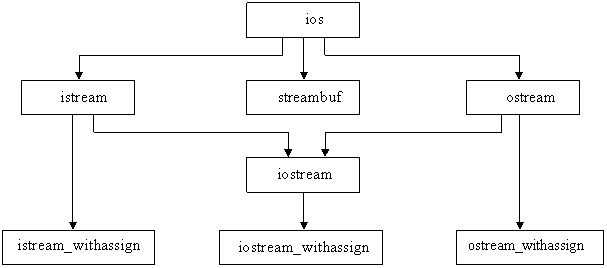
The above hierarchies of classes are used to define various streams
which deal with both the console and disc files. These classes are declared in
the header file iostream. ios is the base for istream, ostream and iostream
base classes. ios is declared as a virtual base class so that only one copy of
its members are inherited by the iostream. The three classes
istream_withassign,
Code: AC11
Subject: OBJECT ORIENTED PROGRAMMING
ostream_withassign and iostream_withassign are used to add
assignment operators to these classes.
Q.105 Define a class
License that has a driving license number, name and address. Define
constructors that take on parameter that is just the number and another where
all parameters are present. (6)
Ans:
#include<iostream.h>
#include<conio.h>
#include<stdio.h>
#include<string.h>
#include<fstream.h>
#include<stdlib.h>
class License
{
long dlno;
char
name[25],add[50];
public:
License()
{
dlno=0;
strcpy(name,
" ");
strcpy(add,
" ");
}
License(long
no)
{
dlno=no;
strcpy(name,"
");
strcpy(add,
" ");
}
License(long
no, char n[25], char ad[50])
{
dlno=no;
strcpy(name,n);
strcpy(add,ad);
}
void
getdata()
{
cout<<endl<<"Enter
your name:-> ";
cin>>name;
cin.get();
cout<<endl<<"Enter
your address:-> ";
cin.getline(add,50);
Code: AC11
Subject: OBJECT ORIENTED PROGRAMMING
cout<<endl<<"Enter
License Number:-> ";
cin>>dlno;
}
void
showdata()
{
cout<<endl<<dlno<<'\t'<<name<<'\t'<<add;
}
};
Q.106 Create a file
and store the License information. (4)
Ans:
void main()
{
class License
obj1(101),obj2(102,"Ramesh","Laxminagar");
fstream file;
file.open("List.TXT",ios::in
| ios::out);
if (file==NULL)
{
cout<<endl<<"Memory
Allocation Problem.";
getch();
exit(1);
}
class License
obj;
obj.getdata();
file.write((char
*) & obj, sizeof(obj));
file.seekg(0);
cout<<endl<<"Following
informations are stored in the file:\n";
while(1)
{
file.read((char
*) &obj, sizeof(obj));
if
(file)
obj.showdata();
else
break;
}
}
Q.107 Define a class
template Pair which can have a pair of values. The type of the values is the
parameter of the template. Define a member function Add() which adds the two
values and returns the sum. (10)
Ans:
#include<iostream.h>
#include<conio.h>
#include<stdio.h>
template <class
T>
Code: AC11
Subject: OBJECT ORIENTED PROGRAMMING
class pair
{
T val1, val2,
val3;
public:
void
Add()
{
val3=val1
+ val2;
}
void
getdata()
{
cout<<endl<<"Enter
two input:-> ";
cin>>val1>>val2;
}
void
showdata()
{
cout<<val3;
}
};
void main()
{
pair <int>
obj1;
cout<<endl<<"Enter
two integer input.\n";
obj1.getdata();
obj1.Add();
obj1.showdata();
pair
<float> obj2;
cout<<endl<<"Enter
two float input.\n";
obj2.getdata();
obj2.Add();
obj2.showdata();
getch();
}
Q.108 Check if the
template works for char* where Add() must concatenate the two strings. If not
find a solution.
(4)
Ans:
It will not work
for char * where Add() must concatenate the two strings.
This can be done
by overloading the function add() as
void Add(char *str1, char *str2)
{
char *str3;
strcpy(str3,str1);
strcat(str3,str2);
cout<<str3;
}
Code: AC11 Subject:
OBJECT ORIENTED PROGRAMMING
Q.109 Write short notes on
(i) Constructor
(ii) Stream
(iii) Access
control.
(iv) Friend. (3.5
x4 )
Ans:
i) Constructor:
A constructor is a member function which has the same name as at
that of the class. It is used to initialize the data members of the class. A
constructor is automatically invoked by the compiler when an object is created.
A constructor which does not take any arguments is called default constructor.
The restrictions applied to a constructor are:
·
A
constructor cannot have any return type as it does not return any value.
·
A
constructor should be declared in the public part of the class.
·
A
derived class can call the constructor of the base class but a constructor is
never inherited.
·
A
constructor function cannot be made virtual.
·
That
object which has a constructor cannot be used as a member of the union.
C++ provides us with very helpful feature i.e.,
copy constructor. It is the mechanism in which we can declare and initialize an
object from another both belonging to the same class. For example, the
following statement will create an object obj2 and also initialize it by taking
values from obj1.
integer obj2(obj1);
We can also use the following instead the above
for the same purpose.
integer obj2=obj1;
This process of initializing objects using copy
constructor is known as “copy initialization”.
Another statement obj2=obj1 will not assign the
values using the copy constructor. Although the statement is valid this can be done
using operator overloading.
A copy constructor accepts a reference to an
object of the same class as an argument. We cannot pass an argument by value to
a copy constructor.
The following is an example program:
#include<iostream.h>
class item
{
int code;
public:
item(){}
item(int
n){code=n;}
Code: AC11
Subject: OBJECT ORIENTED PROGRAMMING
item(item & a)
{
code=a.code;
}
void show(void)
{cout<<code;}
};
int main()
{
item obj(12);
item obj2(obj1);
item obj3=obj1;
item obj4;
obj4=obj1;//copy
constructor not called
cout<<"\n
code of obj1 : ";
obj1.show();
cout<<"\n
code of obj2 : ";
obj2.show();
cout<<"\n
code of obj3 : ";
obj3.show();
cout<<"\n
code of obj4 : ";
obj4.show();
}
ii) Stream: Stream is
defined as an interface supplied by the I/O system to the programmer and that
which is independent of the actual device being used. Stream is actually a
sequence of bytes. These are basically of two types: one is when it is a source
through which input can be taken and the other is when it acts as a destination
to which output can be sent. The source stream is called the input stream and
the destination stream is called the output stream. There are several streams
likewise cin is an input stream which extracts input from the keyboard and cout
is the output stream which inserts the ouput to the screen. The three streams
used are:-
·
istream(input
stream).this stream inherits the properties of ios and declares input functions
such get(), getline() and read().the extraction operator used for this >>
·
ostream(output
stream). This also inherits properties from ios and declared output functions
such as put() and write(). It uses the insertion operator <<.
·
Iostream(input/output
stream). This inherits properties from ios istream and ostream and through
multiple inheritance contains all the input output functions.
Code: AC11
Subject: OBJECT ORIENTED PROGRAMMING
iii). Access control: This is done using three keywords
public, private and protected. These keywords are visibility labels. When the
data members of a class are declared as private, then they will be visible only
within the class. If we declare the class members as public then it can be
accessed from the outside world also. Private specifier is used in data hiding
which is the key feature of object oriented programming. The use of the keyword
private is optional. When no specifier is used the data member is private by
default. If all the data members of a class are declared as private then such a
class is completely hidden from the outside world and does not serve any
purpose.
class class-name
{
private:
int x,y;//No
entry to private area
private:
int
a,b;//entry allowed to public area
}
These access specifiers determine how elements of the base class are
inherited by the derived class. When the access specifier for the inherited
base class is public, all public members of the base class become public
members of the derived class. If the access specifier is private, all public
members of the base class become private members for the derived class. Access
specifier is optional. In case of a derived ‘class’ it is private by default.
In case of a derived ‘structure’ it is public by default.
The protected specifier is equivalent to the private specifier with
the exception that protected members of a base class are accessible to members
of any class derived from the base. Outside the base or derived class,
protected members are not accessible. The protected specifier can appear
anywhere in the class.
When a protected member of a base class is inherited as public by
the derived class, it becomes protected member of the derived class. If the
base is inherited a private, the protected member of the base becomes private
member of the derived class.
Code: AC11
Subject: OBJECT ORIENTED PROGRAMMING
iv) Friend:
Friend is keyword in C++ which is used to declare friend function
and friend classes. It can access the private data members of the class it has
to take the help of the object of that class. A friend function is not the
member of the class. When we create an object memory is not located for the
friend function. It is defined like a normal function. While calling a friend
function we not use object as friend function is not the part of the object.
Thus is called like any normal non member function. It also helps in operator
overloading.
The following is
an example program:
#include<iostream.h>
using namespace
std;
class one;
class two
{
int a;
public:
void
setvalue(int n){a=n;}
friend void
max(two,one);
};
class one
{
int b;
public:
void
setvalue(int n){b=n;}
friend void
max(two,one);
};
void max(two
s,one t)
{
if(s.a>=t.b)
cout<<s.a;
else
cout<<t.b;
}
int main()
{
one obj1;
obj1.setvalue(5);
two obj2;
obj2.setvalue(10);
max(obj2,obj1);
return 0;
}
When we declare
all the member functions of a class as friend functions of another then such a
class is known as a friend class.
Code: AC11 Subject:
OBJECT ORIENTED PROGRAMMING
class Z
{
friend class X;//all member functions af X are
friends of Z
}
Q.110 What is the
difference between passing a parameter by reference and constant reference? (2)
Ans: By passing a parameter by
reference, the formal argument in the function becomes alias to the actual
argument in the calling function. Thus the function actually works on the
original data. For example:
void swap(int &a, int &b) //a and b are reference
variables
{
int t=a;
a=b;
b=t;
}
The calling function would be:
swap(m,n);
the values of m and n integers will be swapped using
aliases.
Constant Reference: A function may also return a constant
reference. Example:
int & max(int &x,int &y)
{
If((x+y)!=0)
return x;
return y;
}
The above function shall return a reference to x or y.
Q.111 Define the
following terms and give an example to show its realization in C++
(i) Encapsulation (ii) Class
variables and class functions
(iii) Repeated inheritance (iv) Overloading (3.5
x 4)
Ans:
(i) Encapsulation: The term encapsulation
is often used interchangeably with information hiding. Not all agree on the
distinctions between the two though; one may think of information hiding as
being the principle and encapsulation being the technique. A software module
hides information by encapsulating the information into a module or other
construct which presents an interface.
Code: AC11
Subject: OBJECT ORIENTED PROGRAMMING
A common use of information hiding is to hide the physical storage
layout for data so that if it is changed, the change is restricted to a small
subset of the total program. For example, if a three-dimensional point (x,y,z)
is represented in a program with three floating point scalar
variables and later, the representation is changed to a single array variable of size three, a module
designed with information hiding in mind would protect the remainder of the
program from such a change.
(ii) Class variables and class functions: Static
variables are associated with the class rather than any class objects, so they
are known as class variables. The type and scope of each class variable must be
defined outside the class definition as they are stored separately rather than
as a part of an object.
Static functions can have access to only other
static members (functions and variables) declared in the same class. These
functions are known as class functions. A class function is called by using the
class name instead of its objects like
Class-name:: function-name;
(iii)Repeated Inheritance: C++ requires
that the programmer state which parent class the feature to use should come
from. C++ does not support explicit repeated inheritance since there would be
no way to qualify which superclass to use. Repeated inheritance means not being
able to explicitly inherit multiple times from a single class. Multiple
Inheritance usually corresponds to this-a relationship. It is a common mistake
to use multiple inheritance for has-a relationship. For example, a Filter
circuit may consist of Resistors, Capacitors and Inductors. It'll be a mistake
to declare Filter as a subclass of resistor, capacitor and inductor (multiple
inheritance). Instead, it is better to declare component objects of resistors,
capacitors, and inductors within the new Filter class, and reference the
component methods indirectly through these component objects.
(iv)Overloading: The process of making a function or
an operator behave in different manners is known as overloading. Function
overloading means the use of same function name to perform a variety of
different tasks. The correct function to be invoked is selected by seeing the
number and type of the arguments but not the function type.
Operator overloading refers to adding a special meaning to
an operator. The operator doesn’t lose its original meaning but the new meaning
is added for that particular class. For example, we can add two strings as:
String1+String2=string3;
“good”+ “girl”= “goodgirl”;
An
example program of function overloading:
//Function
volume is overloaded three times.
#include<iostream.h>
using
namespace std;
int
vol(int);
double
vol(double,int);
long
vol(int,int,int);
Code: AC11
Subject: OBJECT ORIENTED PROGRAMMING
int
main()
{
cout<<volume(2)<<"\n";
cout<<volume(2.5,8)<<"\n";
cout<<volume(2,3,5)<<"\n";
return
0;
}
int
volume(int s)
{
return(s*s*s);
}
double
volume(double r,int h)
{
return(3.14519*r*r*h);
}
long
volume(int l,int b,int h)
{
return(l*b*h);
}
The
output would be:
8
157.26
30
Q.112 Define a class
Point which is a three dimensional point having x, y and z coordinates. Define
a constructor which assigns 0 if any of the coordinates is not passed.
(6)
Ans:
#include
<iostream.h>
#include<conio.h>
class
Point {
int
X;
int
Y;
int
Z;
public:
Code: AC11
Subject: OBJECT ORIENTED PROGRAMMING
Point() {X=Y=Z=0;}
Point(int x, int y, int z)
{
X=x; Y=y;Z=z;}
int
getX(){ return X;}
int
getY(){return Y;}
int
getZ(){return Z;}
};
Q.113 Define a class Sphere
which has a radius and a center. Use the class Point defined in (Q 112) to
define the center. Define the constructor. Define a member function Volume
(which is given as  ) which computes the volume. Use the
class in main() to create an instance of sphere. Compute the volume and print
it. (10)
) which computes the volume. Use the
class in main() to create an instance of sphere. Compute the volume and print
it. (10)
Ans:
class
Sphere
{
int
radius;
Point center;
public:
Sphere(){}
Sphere(int rad,Point &p)
{
radius=rad;
center=p;
}
void showdata()
{
cout<<"Radius="<<radius;
cout<<"\nCenter="<<"("<<center.getX()<<","<<center.getY()<<","<<center.getZ()<<")";
}
float volume()
{
return (3.14*radius*radius*radius);
}
};
void
main()
{
clrscr();
Point YourPoint();
Point p(3,4,5);
Sphere s1(1,p);
Code: AC11
Subject: OBJECT ORIENTED PROGRAMMING
s1.showdata();
float f=s1.volume();
cout<<"\nVolume="<<f;
getch();
}
Q.114 What is the
access specification that should precede a friend function? (2)
Ans: The access specifier that
should precede a friend function can be either public or private. The meaning
and working of the friend function is not altered by using any of the two
access specifiers.
Q.115 Define a class
Vector which can hold 20 elements of type int. Write a member function
read() which reads the values from the input stream and assigns them to the
Vector object. (6)
Ans:
#include<conio.h>
#include<iostream.h>
const
size = 20;
class
vector
{
int
v[size];
public:
vector();
void
read();
vector(int
*x);
friend
vector operator +(vector a, vector b);
friend
istream & operator >> (istream &, vector &);
friend
ostream & operator << (ostream &, vector &);
};
vector
:: vector()
{
for(int
i=0; i<size ; i++)
v[i] = 0;
}
vector
:: vector(int *x)
{
for(int
i=0; i<size; i++)
v[i] = x[i];
}
void
vector :: read()
{
int
x[20];
cout<<"\nEnter
20 values";
Code: AC11
Subject: OBJECT ORIENTED PROGRAMMING
for(int
i=0;i<size;i++)
cin>>x[i];
for(i=0;
i<size; i++)
v[i] = x[i];
}
Q.116 Overload the operator + for the class Vector
defined in Q115 above which adds two vectors. Define the addition operator as
a friend function. The result must be returned as an object of
the class Vector. (8)
Ans:
vector
operator +(vector a, vector b)
{
vector
c;
for(int
i=0;i<size;i++)
c.v[i] = a.v[i] + b.v[i];
return
c;
}
istream
& operator >> (istream&x, vector&b)
{
for(int
i=0;i<size;i++)
x >> b.v[i];
return(x);
}
ostream
& operator << (ostream&dout, vector&b)
{
dout<<"("<<b.v[0];
for(int
i=1;i<size;i++)
dout << " , " << b.v[i];
dout <<" ) ";
return(dout);
}
void
main()
{
clrscr();
vector
m;
m.read();
vector
n;
cout<<
"enter elements of vector n"<<'\n';
cin>>n;
cout<<'\n';
cout<<"m
= "<<m<<'\n';
cout<<"\nn="<<n<<'\n';
Code: AC11
Subject: OBJECT ORIENTED PROGRAMMING
vector
p;
p
= m+n;
cout<<'\n';
cout<<"p
= "<<p<<'\n';
getch();
}
Q.117 An organization has two types of
employees: regular and adhoc. Regular employees get a salary which is basic +
DA + HRA where DA is 10% of basic and HRA is 30% of basic. Adhoc employees are
daily wagers who get a salary which is equal to Number * Wage.
(i) Define the classes shown in the following class hierarchy
diagram:
(ii) Define the
constructors. When a regular employee is created, basic must be a parameter.
When adhoc employee is created wage must be a parameter.
(iii) Define the
destructors.
(iv) Define the
member functions for each class. The member function days ( ) updates number
of the Adhoc employee.
(v) Write a test
program to test the classes. (4+4+2+4+2)
Ans:
#include<iostream.h>
#include<conio.h>
#include<stdio.h>
#include<stdlib.h>
#include<string.h>
class Employee
{
char name[25];
int eno;
public:
Code: AC11
Subject: OBJECT ORIENTED PROGRAMMING
Employee()
{
strcpy(name, " ");
eno=0;
}
void getdata()
{
cout<<endl<<"Name
of Employee:-> ";
cin>>name;
cout<<endl<<"Employee
Number:-> ";
cin>>eno;
}
void salary()
{
cout<<endl<<eno<<'\t'<<name;
}
~Employee()
{
}
};
class Regular : public Employee
{
float Basic;
public:
Regular(float bs)
{
Basic=bs;
}
void getdata()
{
Employee::getdata();
}
void salary()
{
//call Base
showdata();
Employee::salary();
cout<<endl<<"Basic
= "<<Basic;
cout<<endl<<"DA
= "<<Basic*0.1;
cout<<endl<<"HRA
= "<<Basic*0.3;
cout<<endl<<"Total
Payble = "<<(Basic + (Basic*0.1) + (Basic*0.3));
}
Code: AC11
Subject: OBJECT ORIENTED PROGRAMMING
~Regular()
{
}
};
class Adhoc : public Employee
{
float wage;
int number;
public:
Adhoc(float wg)
{
wage=wg;
number=0;
}
void days(int n)
{
number+=n;
}
void salary()
{
//call Base class
Showdata
Employee::salary();
cout<<endl<<"Total
Payble = "<<wage*number;
}
void getdata()
{
Employee::getdata();
}
~Adhoc()
{
}
};
void main()
{
class Regular robj(5000);
class Adhoc aobj(65);
robj.getdata();
aobj.getdata();
aobj.days(25);
cout<<endl<<"Details of
Regular Employee1\n";
robj.salary();
cout<<endl<<"Details of Adhoc
Employee1\n";
aobj.salary();
getch();
}
Code: AC11
Subject: OBJECT ORIENTED PROGRAMMING
Q.118 Write a function template for
the function Power ( ) which has two parameters base and exp and returns  . The type of
base is the parameter to the template and exp is int. If exp is
negative then it must be converted to its positive equivalent. For example,
. The type of
base is the parameter to the template and exp is int. If exp is
negative then it must be converted to its positive equivalent. For example,  and
and  must both
return 8. (6)
must both
return 8. (6)
Ans:
#include<iostream.h>
#include<conio.h>
#include<stdio.h>
#include<math.h>
template
<class T>
class
math
{
int
exp;
T
base,s;
public:
math(T
x, int y)
{
exp=abs(y);
base=x;
s=1;
}
T
Power()
{
s=pow(base,exp);
return s;
}
};
Q.119 Instantiate
the template function defined above for int type. (2)
Ans:
void
main()
{
clrscr();
math <int>obj1(10,-2);
cout<<endl<<"Value= "<<obj1.Power();
getch();
}
Q.120 What is
exception handling? (2)
Ans: Exception Handling:
Code: AC11
Subject: OBJECT ORIENTED PROGRAMMING
Using exception handling we can more easily manage and
respond to run time errors. It helps us in coping up with the unusual
predictable problems that arise while executing a program.
Q.121 What are the
keywords on which exception handling is built? Explain each one of them. Give
an example. (6)
Ans: C++ exception handling is built
upon 3 keywords: try, catch and throw.
·
The
‘try’ block contains program statements that we want to monitor for exceptions.
·
The
‘throw’ block throws an exception to the ‘catch’ block if it occurs within the
try block.
·
The
‘catch’ blocks proceeds on the exception thrown by the ‘throw’ block.
When an exception is thrown, it is caught by its corresponding catch
statement which processes the exception. There can be more that one catch
statement associated with a try. The catch statement that is used is determined
by the type of the exception. An example illustrates the working of the three
blocks.
#include<iostream.h>
using namespace std;
int main()
{
cout<<"\n Start "<<endl;
try
{
cout<<"\n Inside try block
"<<endl;
throw 10;
cout<<"\n this will not execute ";
}
catch(int i)
{
cout<<"\n catch number "<<endl;
cout<<i<<endl;
}
cout<<"End";
return 0;
}
Q.122 Explain the
following:
(i) ios class (ii)
setf( ) function
(iii) rdstate() function (iv)
writing of objects to files (8)
Ans:
i.
ios
class:
ios is the base class meant for istream(input sream), ostream(output stream)
and iostream(input/output stream).ios is declared as the virtual base class so
that only one copy of its members are inherited by the iostream.
ii.
setf()
function:
This function is used to specify format flags that can control the form of
output display ( such as left-justification) and (right justification). The
syntax is:
setf(arg1,arg2);
Code: AC11
Subject: OBJECT ORIENTED PROGRAMMING
where arg1 is a formatted flag and arg2 is a bit
field.
iii.
rdstate()
function:
ios::rdstate() const;
This function returns the current internal error
state flags of the stream. The internal error state flags are automatically set
by calls to input/output functions to signal certain types of errors that
happened during their execution. It does not contain any parameter.
iv.
Writing
objects to a file:
C++ allows us to read from and write to the disk files objects directly. The
binary function write() is used to write object to files. The function write
copies a class object from memory byte to byte with no conversion. It writes
only the data members and the member functions.
Q.123 Write a
program which asks for a file name from the keyboard, opens a file with that
name for output, reads a line from the keyboard character by character and
writes the line onto the file. (8)
Ans:
#include<iostream.h>
#include<stdio.h>
#include<conio.h>
#include<fstream.h>
#include<stdlib.h>
void main()
{
cout<<endl<<"Enter the file
name for output:-> ";
char name[25];
cin>>name;
ofstream out(name);
if (out==NULL)
{
cout<<endl<<"\nUnable
to open file.";
getch();
exit(1);
}
char ch;
cout<<endl<<"Press 'T' to
terminate input.\n";
while(1)
{
cin.get(ch);
if (ch=='T')break;
out.put(ch);
}
Code: AC11
Subject: OBJECT ORIENTED PROGRAMMING
out.close();
ifstream in(name);
if (in==NULL)
{
cout<<endl<<"\nUnexpected
Error.";
getch();
exit(1);
}
cout<<endl<<"U have entered
following\n";
while(in)
{
in>>ch;
cout<<ch;
}
in.close();
cout<<endl<<"Thanks";
getch();
}
Q.124 Differentiate
between
(i)
int* q = p; and n = *p;
(ii)
Constructor and destructor
(iii)
Interface and implementation of a class
(iv)
public and private
member of a class
(v)
Overloaded pre-increment operator and overloaded
post increment operator
(vi)
Abstract and concrete class
(vii)
get ( ) and getline
( ) function
(viii)
Composition and inheritance (16)
Ans:
(i)
int*
q=p;
the value of p will be assigned to pointer q
which will be treated as an address.
int n=*p;
in this an integer variable n is initialized
with the value stored at the address to which the pointer p points.
(ii)
A
constructor is a member function which is used to initialize the data members
of a class. It has the same name as that of the class. It does not have any
return type and is invoked automatically on the creation of an object.
test() //constructor for the
class test
A destructor is a member function that is used
to destroy the objects that’s have been created by the constructor. It frees
the memory space for future use. It also has no return type but its declaration
is preceded by a tilde.
~test(); //destructor function
Code: AC11
Subject: OBJECT ORIENTED PROGRAMMING
(iii) The keywords public and private are
visibility labels. When the data members of a class are declared as private,
then they will be visible only within the class. If we declare the class
members as public then it can be accessed from the outside world also. Private
specifier is used in data hiding which is the key feature of object oriented
programming. The use of the keyword private is optional. When no specifier is
used the data member is private by default. If all the data members of a class
are declared as private then such a class is completely hidden from the outside
world and does not serve any purpose.
(iv)
In earlier version of C++ when an increment operator was overloaded there was
no way of knowing whether the operator precedes or follows its operand. That is
assuming that the two statement ob++ and ++ob had identical meanings. However
the modern specification for C++ has defined a way through which compiler distinguishes
between these operator. For this two versions were used. One defined as
return-type class-name :: operator #( ) and the
second is defined as
rerurn-type class-name :: operator #(int
notinuse). In (int notinuse) zero value is passed.
(v)
In
C++ an abstract class is one which defines an interface, but does not
necessarily provide implementations for all its member functions. An abstract
class is meant to be used as the base class from which other classes are
derived. The derived class is expected to provide implementations for the
member functions that are not implemented in the base class. A derived class
that implements all the missing functionality is called a concrete class.
(vi) get() function extracts a character from
the stream and returns its value (casted to an integer).The C++ string class
defines the global function getline() to read strings from an I/O stream. The
getline() function reads a line from is
and stores it into s. If a
character delimiter is
specified, then getline() will use delimiter
to decide when to stop reading data. Example: getline(cin, s);
(vii)The difference between inheritance and
composition is the difference between “is-a” and “has-a”. For example, we would
not design a “car” object to be inherited from “engine”, “chassis”, “transmission”,
and so on (“car is-a engine” makes no sense). We would “compose” the car object
from its constituent parts (“car has-a engine” makes a lot of sense). Once we
start thinking in terms of “is-a” versus "has-a", it's a lot easier
to do proper design.
Q.125 What is
the wrong with the following program?
#include
<iostream.h>
void main ( )
{
class Test {
Code: AC11
Subject: OBJECT ORIENTED PROGRAMMING
int x;
public: int getX ( ) {return
x;}
void setX ( int
a) { x = a;}
void showX{ cout
<< getX ( ) << endl;}
};
}
Ans:
Parameter names are used with function body.
Q.126 What is the
output of the following program, if any?
#include <iostream.h>
class A {
int a;
public: A( int aa) { a = aa;}
void print ( ) {
cout << “ A = “ << a; }
};
class B : public A {
int b;
public: B ( int aa, int bb) : A
(aa) { b = bb;}
void print ( ) { cout
<< “ B = “ << b; }
};
void main ( )
{ A objA(10);
B objB(30, 20);
objA = obj B;
objA.print ( );
}
Ans: A=30
Q.127 What is wrong
with the following code?
int *p = new int;
int *p = new int;
cout << “p = ” << p
<< “, q = “ << q << “, p+q = “ << p+q << endl;
Ans: p and q both the variables are not declared or initialized.
Q.128 How many
times is the copy constructor called in the following code?
class
copy_const{
};
copy_const f(copy_const u)
{ copy_const v(u);
copy_const w = v;
return w;
Code: AC11
Subject: OBJECT ORIENTED PROGRAMMING
}
main ( )
{
copy_const x;
copy_const y = f (f (x));
} (4
x 4)
Ans: Copy constructor is not called in the given
function.
Q.129 Discuss the role of inheritance in
object-oriented programming. What is public, private and protected derivation? (8)
Ans:
Inheritance: it is the property by which
one class can be derived from another class such that it acquires the
properties of its base class. Just like a child inherits the properties of its
parents in the same way OOP allows us to reuse the members and functions of
class to be derived by another class. There are many different kinds of
inheritance like multiple inheritance, multilevel inheritance and hierarchical
inheritance.
The visibility mode specified while declaring a derived class plays
a very important role in the access control of the data members of the class.
The visibility mode is one of the three keywords: public, private and
protected. These access specifiers determine how elements of the base class are
inherited by the derived class. When the access specifier for the inherited
base class is public, all public members of the base class become public
members of the derived class. If the access specifier is private, all public
members of the base class become private members for the derived class. Access
specifier is optional. In case of a derived ‘class’ it is private by default.
In case of a derived ‘structure’ it is public by default.
The protected specifier is equivalent to the private specifier with
the exception that protected members of a base class are accessible to members
of any class derived from the base. Outside the base or derived class,
protected members are not accessible. The protected specifier can appear
anywhere in the class.
When a protected member of a base class is inherited as public by
the derived class, it becomes protected member of the derived class. If the
base is inherited a private, the protected member of the base becomes private
member of the derived class.
Code: AC11
Subject: OBJECT ORIENTED PROGRAMMING
Q.130 Explain the
meaning of polymorphism. Describe how polymorphism is accomplished in C++
taking a suitable example? (8)
Ans:
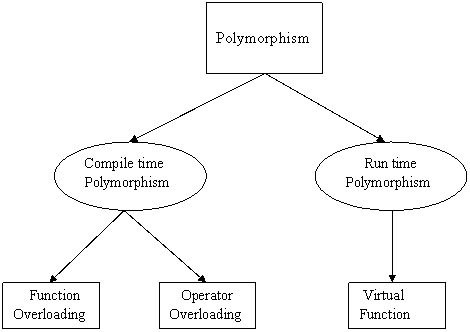
Polymorphism is the property of representing one operation into many
different forms. One operation may express different in different situations.
The process of making a function or an operator behave in different manners is
known as overloading the function or the operator.
Polymorphism is one of the most useful features of object oriented programming.
It can be achieved both at run time and at compile time. At compile time
polymorphism is achieved using function overloading and operator overloading. At
the time of compilation the compiler knows about the exact matching as to which
function to call or invoke. This is known as compile time polymorphism or early
binding.
Polymorphism can also be achieved at run time. This is done using
the concept of virtual functions. Which class function is to be invoked is
decided at run time and then the corresponding object of that class is created
accordingly. This is also called as late binding.
The following example program explains how polymorphism can be
accomplished using function overloading.
//Function volume is overloaded three times.
#include<iostream.h>
int volume(int);
double volume(double,int);
long volume(long,int,int);
Code: AC11
Subject: OBJECT ORIENTED PROGRAMMING
int main()
{
cout<<volume(10)<<"\n";
cout<<volume(2.5,8)<<"\n";
cout<<volume(100L,75,15)<<"\n";
return 0;
}
int volume(int s)
{
return(s*s*s);
}
double volume(double r,int h)
{
return(3.14519*r*r*h);
}
long volume(long l,int b,int h)
{
return(l*b*h);
}
The output would be:
1000
157.26
112500
Q.131 Define a class
Fraction whose objects represent rational numbers (i.e. fractions).
Include integer data members num and den for storing the
numerator and denominator respectively.
a. Write the following functions for fraction:
(i)
parameterised constructors with one and two
arguments.
(ii) copy constructors.
(iii) a function, eval-fract() for evaluating the value of the
rational number.
(iv) a function, invert() for inverting the given rational
number.
Ans:
a.
#include<conio.h>
#include<iostream.h>
class fract
{
int num;
Code: AC11
Subject: OBJECT ORIENTED PROGRAMMING
int den;
public:
fract(int a);
fract(int a,int b);
fract(fract &);
float eval_fract();
void invert();
void display();
};
fract::fract(int a)
{
num=den=a;
}
fract :: fract(int a,int b)
{
num=a;
den=b;
}
fract :: fract(fract &f)
{
cout<<"copy constructor called\n";
num=f.num;
den=f.den;
}
float fract :: eval_fract()
{
float res;
res=(float)num/den;
return res;
}
void
fract ::invert()
{
int t=num;
num=den;
den=t;
}
Code: AC11
Subject: OBJECT ORIENTED PROGRAMMING
void fract ::display()
{
cout<<num<<"/"<<den;
}
void main()
{
clrscr();
fract f1(2);
f1.display();
cout<<"\n";
fract f3(2,3);
fract f2=f3;
float f=f2.eval_fract();
cout<<"The value of fraction
is:"<<f<<"\n";
f2.invert();
f2.display();
getch();
}
b. Overload
>> and << operators for reading and printing the fraction object
from the keyboard. (2+8+6)
Ans: Function declared inside the class fract for overloading <<
and >> operator:
friend istream & operator >> (istream &, fract &);
friend ostream & operator << (ostream &, fract &);
Functions defined outside the class:
istream & operator >> (istream&x, fract&b)
{
x >> b.num>>b.den;
return(x);
}
ostream & operator << (ostream&dout, fract&b)
{ dout << b.num;
dout <<" / "<<b.den;
return(dout);
}
Statements in main() to invoke overloading of << and >>
are:
cout<< "enter num and den of the fraction f"<<'\n';
cin>>f;
cout<<'\n';
cout<<"fraction = "<<f<<'\n';
Code: AC11
Subject: OBJECT ORIENTED PROGRAMMING
Q.132 What do you mean by static variable and static function? Give
an example? (5)
Ans: Static class member variables are
used commonly by the entire class. It stores values. No different copy of a
static variable is made for each object. It is shared by all the objects. It is
just like the C static variables.
·
It has the following characteristics:
·
On
the creation of the first object of the class a static variable is always
initialized by zero.
·
All
the objects share the single copy of a static variable.
·
The
scope is only within the class but its lifetime is through out the program.
A static function is just like a static variable. a static function
has the following properties:
·
A
function can access only the static variable where both belong to the same
class.
·
A
static function is called using the class name directly and not the object like
class-name :: function-name;
The example given below demonstrates the use of static variable
‘count’ and static function ‘display()’:
#include<iostream.h>
using namespace std;
class demo
{
int num;
static int count;
public:
void set(void)
{
num=++count;
}
void show(void)
{
cout<<"Number : "<<
num<<"\n";
}
static void display(void)
{
cout<<"count :
"<<count<<"\n";
}
};
int demo::count;
int main()
{
demo d1,d2;
d1.set();
d2.set();
demo::display();//accessing static function
demo d3;
d3.set();
d1.show();
Code: AC11
Subject: OBJECT ORIENTED PROGRAMMING
d2.show();
d3.show();
return 0;
}
Q.133 Write a
template function to find the maximum number from a template array of size N. (8)
Ans:
using namespace std;
template<class T>
void max(T a[],T &m, int n)
{
for(int i=0;i<n;i++)
if(a[i]>m)
m=a[i];
}
int main()
{
int x[5]={10,50,30,40,20};
int m=x[0];
max(x,m,5);
cout<<"\n The maximum value is : "<<m;
return 0;
}
Q.134 Describe the
basic characteristics object-oriented programming. (3)
Ans: Object Oriented Programming (OOP)
is an approach that provides a way of modularizing programs by creating
partitioned memory area for both data and functions that can be used as
templates for creating copies of such modules on demand.
Following are the basic characteristics of Object Oriented
Programming:
·
Encapsulation:
The wrapping up of data and functions into a single unit is called
encapsulation. The data can only be accessed by the function with which they
have been tied up and not by the outside world. It creates an interface between
the object’s data and the program.
·
Inheritance:
It is the property by which one class can be derived from another class such
that it acquires the properties of its base class. Just like a child inherits
the properties of its parents in the same way OOP allows us to reuse the
members and functions of class to be derived by another class. There are many
different kinds of inheritance like multiple inheritance, multilevel
inheritance and hierarchical inheritance.
Code: AC11
Subject: OBJECT ORIENTED PROGRAMMING
·
Polymorphism:
Polymorphism is the property of representing one operation into many different
forms. One operation may express different in different situations. The process
of making a function or an operator behave in different manners is known as
overloading the function or the operator.
·
Data
Abstraction: Abstraction is the method of representing only the essential
features and only which is necessarily required by the user. The important and
crucial data is encapsulated.
Q.135 What is meant by exceptions?
How an exception is handled in C++? Explain with the help of an example. (4)
Ans:
Exception Handling: Using exception handling we can more easily manage
and respond to run time errors. C++ exception handling is built upon 3
keywords: try, catch and throw.
·
The
‘try’ block contains program statements that we want to monitor for exceptions.
·
The
‘throw’ block throws an exception to the ‘catch’ block if it occurs within the
try block.
·
The
‘catch’ blocks proceeds on the exception thrown by the ‘throw’ block.
When an exception is thrown, it is caught by its corresponding catch
statement which processes the exception. There can be more that one catch
statement associated with a try. The catch statement that is used is determined
by the type of the exception. An example below illustrates the working of the
three blocks.
#include<iostream.h>
using namespace std;
int main()
{
cout<<"\n Start "<<endl;
try
{
cout<<"\n Inside try block
"<<endl;
throw 10;
cout<<"\n this will not execute ";
}
catch(int i)
{
cout<<"\n catch number
"<<endl;
cout<<i<<endl;
}
cout<<"End";
return 0;
}
Code: AC11
Subject: OBJECT ORIENTED PROGRAMMING
Q.136 What
do you mean by operator overloading? How unary and binary operators are
implemented using the member and friend functions? (8)
Ans: When an operator is overloaded it
doesn’t lose its original meaning but it gains an additional meaning relative
to the class for which it is defined. We can overload unary and binary
operators using member and friend functions.
When a member operator function overloads a binary operator the
function will have only one parameter. This parameter will receive the object
that is on right of the operator. The object on the left side is the object
that generates the call to the operator function and is passed implicitly by
“this”.
Overloading a unary operator is similar to overloading a binary
operator except that there is only one operand to deal with. When you overload
a unary operator using a member function the function has no parameter. Since
there is only one operand, it is this operand that generates the call to the
operator function.
Overloading operator using a friend function: as we know that a
friend function does not have a ‘this’ pointer. Thus in case of overloading a
binary operator two arguments are passed to a friend operator function. For
unary operator, single operand is passed explicitly. We cannot use a friend
function to overload an assignment operator(=).
Q.137 Explain the importance of using
friend function in operator overloading with the help of an example. (4)
Ans: We can overload operators using
both member function and friend functions. There are certain cases when we
prefer using a friend function more than a member function. For examples
suppose we wish to pass two different types of operands to the operator
function, one of the operands may be an object and the other may be an integer.
In case of overloading a binary operator:
A = ob + 4; or A = ob * 2;
The above statement is valid for both a member function and a friend
function. But the opposite is not valid for a member function:
A = 4 + ob; or A = 2 * ob;
This statement is valid only in case of a friend function. This is
because the left hand operand should be an object as it is used to invoke a
member operator function.
The following program illustrates the use of a friend function:
#include<iostream.h>
class coord
{
int x,y;
public:
coord()
{
x=0;y=0;
}
Code: AC11
Subject: OBJECT ORIENTED PROGRAMMING
coord(int i,int j)
{
x=i;y=j;
}
void get_xy(int &i,int &j)
{
i=x;j=y;
}
friend coord operator +(int n,coord ob);
}
coord operator +(int n,coord ob)
{
coord temp;
temp.x= n + ob.x;
temp.y= n + ob.y;
return temp;
}
int main()
{
coord ob(5,3),obj;
int x,y,n;
obj
= n + obj;
obj.get_xy(x,y);
cout<<"\n x = "<<x<<"\n y =
"<<y;
return 0;
}
Q.138 Define
a class Date with three variables for day, month and year.
a. Write the default and parameterised constructors,
b. Overload the operators
<<,>> to read and print Date object,
c.
Overload > to compare two dates.
d. Write the destructor that sets values to zero for all three
variables. Define object of the class in main and call the above defined
functions. (2+2+3+3+4+2)
Ans:
#include<iostream.h>
#include<conio.h>
class Date
{ int day,month,year;
public:
a. Date()
{ day=month=year=0;
}
Date(int d,int m,int y)
{ day=d;
Code: AC11
Subject: OBJECT ORIENTED PROGRAMMING
month=m;
year=y;
}
Date(Date &d1)
{ day=d1.day;
month=d1.month;
year=d1.year;
}
b. friend istream & operator
>> (istream &, Date &);
friend ostream & operator << (ostream &, Date
&);
c. friend int operator
>(Date &, Date &);
d.
~Date(){day=month=year=0;}
};
istream & operator >> (istream&x, Date&b)
{
x >> b.day>>b.month>>b.year;
return(x);
}
ostream & operator << (ostream&dout, Date&b)
{
dout<<b.day<<"/"<<b.month<<"/"<<b.year;
return(dout);
}
int operator>(Date &d1, Date&d2)
{ if(d1.year>d2.year)
return 1;
else if(d1.year<d2.year)
return 0;
else
{ if(d1.month>d2.month)
return 1;
else
if(d1.month<d2.month)
return 0;
else
{if(d1.day>d2.day)
return 1;
else
return 0;
}
}
}
Code: AC11
Subject: OBJECT ORIENTED PROGRAMMING
void main()
{ clrscr();
Date d1(3,4,2005);
cout<<d1;
Date d2;
cout<<"\n Enter day, month and year:\n";
cin>>d2;
cout<<d2;
if(d1>d2)
cout<<"\nBigger date is:"<<d1;
else
cout<<"\nBigger date is:"<<d2;
getch();
}
Q.139 Define the
class Student which has name (char name[20]) and age(int). Define the
default constructor, member functions get_data() for taking the name and
age of the Student, print() for displaying the data of Student. (5)
Ans:
include<iostream.h>
#include<conio.h>
#include<string.h>
#include<fstream.h>
class Student
{
char name[20];
int age;
public:
Student()
{
strcpy(name,"");
age=0;
}
void getdata()
{
cout<<endl<<"Enter Name:->
";
cin>>name;
cout<<endl<<"Enter Age:-> ";
cin>>age;
}
Code: AC11
Subject: OBJECT ORIENTED PROGRAMMING
void print()
{
cout<<endl<<name<<'\t'<<age;
}
friend void sort(Student *s1,int N);
};
Q.140 For the above
defined class (of Q139) create an array of students of size N and write the
friend function sort(Student arr[N]) which sorts the array of Students
according to their age. (6)
Ans: void sort(Student
*s1, int N)
{
Student temp;
for(int i=0;i<N-1;i++)
for(int j=N-1;j>i;j--)
{
if (s1[j].age < s1[j-1].age)
{ temp=s1[j];
s1[j]=s1[j-1];
s1[j-1]=temp;
}
}
cout<<"\n Sorted Data is:\n";
for(i=0;i<N;i++)
s1[i].print();
}
Q.141 Create a file
namely “STUDENT.DAT” for storing the above objects in sorted order. (5)
Ans:
void main()
{ Student obj[100];
int N,i,j;
clrscr();
cout<<endl<<"Enter maximum number of records u
want to enter:-> ";
cin>>N;
for (i=0;i<N;i++)
obj[i].getdata();
cout<<endl<<"U have entered following
records:";
for (i=0;i<N;i++)
obj[i].print();
sort(obj,N);
fstream inoutfile;
inoutfile.open("STUDENT1.DAT",ios::ate|ios::in|ios::out|ios::binary);
Code: AC11
Subject: OBJECT ORIENTED PROGRAMMING
inoutfile.seekg(0,ios::beg);
for(i=0;i<N;i++)
inoutfile.write((char *) &obj,sizeof obj);
getch();
}
Q.142 Consider a
publishing company that markets both book and audio cassette version to its
works. Create a class Publication that stores the title (a string) and
price(type float) of a publication. Derive the following two classes from the
above Publication class: Book which adds a page count (int) and Tape
which adds a playing time in minutes(float). Each class should have get_data()
function to get its data from the user at the keyboard.
Write the main() function to test the Book and Tape classes by
creating instances of them asking the user to fill in data with get_data() and
then displaying it using put_data(). (16)
Ans:
#include<conio.h>
#include<iostream.h>
#include<string.h>
class Publication
{
protected:
char title[20];
float price;
public:
virtual void get_data(){}
virtual void put_data(){}
};
class Book:public Publication
{
int page_count;
public:
void get_data();
void put_data();
};
class Tape:public Publication
{
float play_time;
public:
void get_data();
void put_data();
};
Code: AC11
Subject: OBJECT ORIENTED PROGRAMMING
void Book::get_data()
{
cout<<"\nTitle? ";
cin.getline(title,20);
cout<<"\nPrice? ";
cin>>price;
cout<<"\nPage_count";
cin>>page_count;
}
void Book::put_data()
{
cout<<"\nTitle: "<<title;
cout<<"\nPrice: "<<price;
cout<<"\nPage_count: "<<page_count;
}
void Tape::get_data()
{ cin.get();
cout<<"\nTitle? ";
cin.getline(title,20);
cout<<"\nPrice? ";
cin>>price;
cout<<"\nPlay_time?";
cin>>play_time;
}
void Tape::put_data()
{
cout<<"\nTitle: "<<title;
cout<<"\nPrice: "<<price;
cout<<"\nPlay_time:"<<play_time;
}
void main()
{
clrscr();
Book book1;
cout<<"Please enter book details:\n";
book1.get_data();
Tape tape1;
cout<<"Please enter Tape details:\n";
tape1.get_data();
Publication* list[2];
list[0]=&book1;
list[1]=&tape1;
cout<<"\n Book details:\n";
list[0]->put_data();
Code: AC11
Subject: OBJECT ORIENTED PROGRAMMING
cout<<"\n\n Tape Details:\n";
list[1]->put_data();
getch();
}
Q.143 Write short
notes on the following:
(i)
Nested class.
(ii)
Scope resolution operator.
(iii)
this pointer. (4*3=12)
Ans:
(i) Nested class:
Inheritance, one of the major features of OOP, is
to derive certain properties of the base class in the derived class. A derived
class can make use of all the public data members of its base classes.
When one class is defined inside another class,
it is known as containership or nesting. It is also one of the inheriting
properties. We can thus imply that one object can be a collection of many
different objects. Both the concepts i.e. inheritance and containership have a
vast difference. Creating an object that contains many objects is different
from creating an independent object. First the member objects are created in
the order in which their constructors occur in the body. Then the constructor
of the main body is executed. An initialization list of the nested class is
provided in the constructor. In the following example the arglist is the list
of arguments that is to be supplied when a gamma object is defined. These
parameters are used to define the members of gamma. The arglist1 and arglist2
are meant for the constructors a and b respectively.
class
alpha{....};
class
beta{....};
class
gamma
{
alpha
a;
beta
b;
public:
gamma(arglist):
a(arglist1), b(arglist2)
{
//constructor
body
}
};
(ii). Scope Resolution Operator:
The :: (scope resolution) operator is used to qualify
hidden names so that we can use them. We can use the unary scope operator if a
namespace scope or global scope name is hidden by an explicit declaration of
the same name in a block or class. For example:
int count = 0;
Code: AC11
Subject: OBJECT ORIENTED PROGRAMMING
int main(void) {
int count = 0;
::count = 1; // set global count
to 1
count = 2; // set local count
to 2
return 0;
}
The declaration of count declared in the main()
function hides the integer named count declared in global namespace scope. The
statement ::count = 1 accesses the variable named count declared in global
namespace scope.
We also use the class scope operator to qualify
class names or class member names. If a class member name is hidden, we can use
it by qualifying it with its class name and the class scope operator.
In the following example, the declaration of the
variable X hides the class type X, but you can still use the static class
member count by qualifying it with the class type X and the scope resolution
operator.
#include <iostream>
using namespace std;
class X
{
public:
static int count;
};
int X::count = 10;
// define static data member
int main ()
{
int X = 0; //
hides class type X
cout <<
X::count << endl; // use static member of class X
}
(iii) this pointer:
C++ contains a special pointer that is called ‘this’. ‘this’ is a
pointer that is automatically passed to any member function when it is called
and it is a pointer to the object that generates the call.
#include<iostream.h>
#include<string.h>
class inventory
{
char item[20];
double cost;
int on_hand;
public:
inventory(char *i,double c,int o)
{
strcpy(this→item, i);
Code: AC11
Subject: OBJECT ORIENTED PROGRAMMING
this->cost=c;
this->on_hand=o;
}
void show()
};
void inventory::show()
{
cout<<this->item;
cout<<this->cost;
cout<<this->on_hand;
}
int main()
{
inventory ob("Wrench",495,4);
ob.show();
return 0;
}
Q.144 Define the
following terms related to Object Oriented Paradigm:
Encapsulation,
Inheritance, Polymorphism, Data Abstraction (12)
Ans: The following are the features of
Object Oriented Programming:
·
Encapsulation: The wrapping up of data and
functions into a single unit is called encapsulation. The data can only be
accessed by the function with which they have been tied up and not by the
outside world. It creates an interface between the object’s data and the
program.
·
Inheritance: It is the property by which
one class can be derived from another class such that it acquires the
properties of its base class. Just like a child inherits the properties of its
parents in the same way OOP allows us to reuse the members and functions of
class to be derived by another class. There are many different kinds of
inheritance like multiple inheritance, multilevel inheritance and hierarchical
inheritance.
Code: AC11
Subject: OBJECT ORIENTED PROGRAMMING
·
Polymorphism: polymorphism is the
property of representing one operation into many different forms. One operation
may express different in different situations. The process of making a function
or an operator behave in different manners is known as overloading the function
or the operator.
·
Data
Abstraction:
Abstraction is the method of representing only the essential features and only
which is necessarily required by the user. The important and crucial data is
encapsulated.
Q.145 Identify the
errors in the following code fragment (4)
...
char ch; int vowels = 0, others =
0;
cout<<”enter character”;
while((ch>=’a’
&&ch<=z)  (ch>=A && ch<=Z))
{
switch(ch)
{
case a:case A:case e:case E:case
I:case I:case e:case O:case u:case U:++vowels:
break;
default:++others;
}}
cout<<”vowels
are:”<<vowels;
cout<<”others
are:”<<others;
….
Ans: In the given code, there is no cin statement to read the character
input ‘ch’ from the user.
The char constants should be enclosed in ‘’ (single quotes).
Q.146 Declare a
class to represent bank account of customers with the following data
members:Name of the depositor, Account number, Type of account(S for saving and
C for Current), balance amount. The class also contains member functions to do
the following:
(i) To initialise the data member (ii)
To deposit money (iii) To withdraw money after checking the balance (minimum
balance is Rs.1000) (iv) To display the data members. (6)
Ans:
#include<iostream.h>
#include<conio.h>
#include<stdio.h>
#include<string.h>
#include<stdlib.h>
class bank
{
char
name[25],type;
long ac_no;
float bal,amt;
public:
class bank
*next;
Code: AC11
Subject: OBJECT ORIENTED PROGRAMMING
bank()
{
strcpy(name,”
“);
type=’
‘ ;
ac_no=0;
bal=0;
next=NULL;
}
void
deposit()
{
cout<<endl<<”Amount
to be deposited:-> “;
cin>>amt;
bal+=amt;
cout<<endl<<”Amount
deposited successfully”;
}
void
withdraw()
{
cout<<endl<<”How
much u want to withdraw:-> “;
cin>>amt;
if
(bal-amt>=1000)
{
bal-=amt;
cout<<endl<<”Withdraw
Done”;
}
else
{
cout<<endl<<”Amount
exceeds the Available I”;
getch();
}
}
void
showdata()
{
cout<<endl<<name<<’\t’<<ac_no<<’\t’;;
if
(type==’S’)cout<<”Saving”;
else
if (type==’C’)cout<<”Current”;
cout<<’\t’<<bal;
}
int
search(long x)
{
if
(ac_no==x)
return
1;
else
return
0;
}
Code: AC11
Subject: OBJECT ORIENTED PROGRAMMING
void
getdata();
};
void
bank::getdata()
{
cout<<endl<<”Enter
name of Account Holder:-> “;
cin>>name;
cout<<endl<<”Enter
Account Number:-> “;
cin>>ac_no;
rep:
cout<<endl<<”Enter
type of Account S=Saving, C=Current):-> “;
cin>>type;
if
(type!=’S’ && type!=’C’)
{
cout<<endl<<”Wrong
Input”;
getch();
goto
rep;
}
cout<<endl<<”Enter
Amount:-> “;
cin>>bal;
next=NULL;
}
void main()
{
class bank
*bptr=NULL,*tmp=NULL,*counter=NULL;
int
i=0,found=0,ch=0;
long acno=0;
while (1)
{
clrscr();
cout<<endl<<”1.Add
a new customer”;
cout<<endl<<”2.View
Customer Details”;
cout<<endl<<”3.Deposite
Amount”;
cout<<endl<<”4.Withdraw
Amount”;
cout<<endl<<”5.Exit”;
cout<<endl<<”Enter
your choice:-> “;
cin>>ch;
switch
(ch)
{
case
1: if (bptr==NULL)
{
bptr=
new bank;
if
(bptr==NULL)
Code: AC11
Subject: OBJECT ORIENTED PROGRAMMING
{
cout<<endl<<”Memory
Allocation Problem”;
getch();
exit(1);
}
bptr->getdata();
}
else
{
tmp=new
bank;
if
(tmp==NULL)
{
cout<<endl<<”Memory
Allocation problem”;
getch();
exit(1);
}
tmp->getdata();
for
(counter=bptr;counter->next!=NULL;counter=counter->next);
counter->next=tmp;
}
break;
case
2:
cout<<endl<<”Name\tAc.
No.\tType\tBalance\n”;
for
(counter=bptr;counter!=NULL;counter=counter->next)
counter->showdata();
getch();
break;
case
3: cout<<endl<<”Enter the Account Number to
Deposite:-> “;
long
acno;
cin>>acno;
for
(counter=bptr;counter!=NULL;counter=counter->next)
{
found=counter->search(acno);
if
(found==1)
{
counter->deposit();
getch();
break;
}
}
if
(found==0)
{
cout<<endl<<”Account
not exists”;
getch();
}
break;
Code: AC11
Subject: OBJECT ORIENTED PROGRAMMING
case
4: cout<<endl<<”Enter the Account Number to Withdraw:-> “;
cin>>acno;
for
(counter=bptr;counter!=NULL;counter=counter->next)
{
found=counter->search(acno);
if
(found==1)
{
counter->withdraw();
break;
}
}
if
(found==0)
{
cout<<endl<<”Account
not exists”;
getch();
}
break;
case
5: exit(1);
default: cout<<endl<<”Wrong
Choice”;
}
}
getch();
}
Q.147 How is the working of member function different from friend function
and a non member function? (6)
Ans: A member function, a non –member
function and a friend function, all the three are entirely different from each
other.
A member function is that which is declared and defined inside the
class. It has full access to the private data members of a class. We can
directly access the data members without taking the help of the object. It is
not the case with a friend function. Although it can access the private data
members of the class it has to take the help of the object of that class. A
friend function is not the member of the class. When we create an object of a
class, memory is not allocated for the friend function. It is defined like a
normal function. While calling a friend function we not use object as friend
function is not the part of the object. Thus is called like any normal non
member function.
A non member function cannot access the private members of a class.
It is not declared inside the class definition.
Code: AC11
Subject: OBJECT ORIENTED PROGRAMMING
Q.148 Explain a
pure virtual function with an example. (4)
Ans: A pure virtual function has no definition related to the base class.
Only the function prototype is included. To make a pure virtual function the
following syntax is used:
virtual
return_type function_name(par_list) = 0;
when a class
contains atleast one pure virtual function then it is called an abstract class.
The following is
an example program:
#include<iostream.h>
using namespace
std;
class area
{
double
dim1,dim2;
public:
void
set_area(int d1,int d2)
{
dim1=d1;
dim2=d2;
}
void
get_dim(double &d1,double &d2)
{
d1=dim1;
d2=dim2;
}
virtual
double get_area()=0;
};
class rectangle:
public area
{
public:
double
get_area()
{
double
d1,d2;
get_dim(d1,d2);
return
d1*d2;
}
};
class triangle:
public area
{
public:
double
get_area()
{
double
d1,d2;
get_dim(d1,d2);
return
0.5*d1*d2;
}
};
Code: AC11
Subject: OBJECT ORIENTED PROGRAMMING
int main()
{
area *p
rectangle r;
triangle t;
r.set_area(3.3,4.5);
t.set_area(4.0,5.0);
p=&r;
cout<<"\n
the area of rectangle is "<<p->get_area()<<endl;
p=&t;
cout<<"\n
area of triangle is "<<p->get_area()<<endl;
return 0;
}
Q.149 Discuss the
various situations when a copy constructor is automatically invoked. (6)
Ans:
A
copy constructor is invoked in many situations:
·
When
an object is used to initialize another in a declaration statement.
·
When
an object is passed as a parameter to a function.
·
When
a temporary object is created for use as a return value of a function.
A copy constructor
only applies to initialization. It does not apply to assignment.
Class-name(const
class name ob)
{
//body
of copy constructor
}
When an object is passed to a function a bitwise copy of that objet
is made and given to the function parameter that receives the object. However
there are cases in which this identical copy is not desired. For example, if
the object contains a pointer to allocated memory. The copy will point to same
memory as does the original object. Therefore, if the copy makes a change to
the content of this memory it will be changed for the original object too. Also
when the function terminates the copy will be destroyed causing its destructor
to be called.
Q.150 What are the
advantages and disadvantages of inline functions? (6)
Ans: Inline functions:
Advantage of an inline function is that they
have no overhead associated with function call and return statements. This
means that inline function can be executed much faster than the normal
function.
The disadvantage of an inline function is that
if they are too large and called regularly, program grows larger. For this
reason, only short functions are declared as inline.
Code: AC11
Subject: OBJECT ORIENTED PROGRAMMING
Q.151 Define Rules for operator
Overloading. Write a program to overload the subscript operator ‘[ ]’. (8)
Ans:
The rules for operator overloading are as follows:
·
New
operators are not created. Only the current operators are overloaded.
·
The
overloaded operator must have at least one operand of user defined type.
·
We
cannot alter the basic meaning of the operator.
·
When
binary operators are overloaded through a member function then the left hand
operand is implicitly passed as and thus it must be an object.
·
Unary
operators when overloaded through member functions will not take any explicit
argument.
The subscript operator
can be overloaded only by means of a member function:
#include<iostream.h>
const int size=5;
class arrtype
{
int a[size];
public:
arrtype()
{
int i;
for(i=0;i<size;i++)
a[i]=i;
}
int operator [](int
i)
{
return
a[i];
}
};
int main()
{
arrtype ob;
int i;
for(i=0;i<size;i++)
cout<<ob[i]<<"
";
return 0;
}
Q.152 How
is a class converted into another class? Explain with one example. (8)
Ans: C++ allows us to
convert one class type to another class type. For example
obj1
= obj2;
Code: AC11
Subject: OBJECT ORIENTED PROGRAMMING
The conversion of one class to another is implemented using a
constructor or a conversion function. The compiler treats both of them in the
same manner. To decide which form to use depends upon where we want the type
conversion function to be located in the source file or in the destination
class.
#include<iostream.h>
using namespace std;
class invent2;
class invent1;
{
int code;
int items;
float price;
public:
invent1(int a,int b,float c)
{
code=a;
items=b;
price=c;
}
void putdata()
{
cout<<"Code :
"<<code<<"\n";
cout<<"Items :
"<<items<<"\n";
cout<<"Price :
"<<price<<"\n";
}
int getcode(){return code;}
int getitems(){return items;}
float getprice(){return price;}
operator float(){return (items*price);}
/*operator invent2()
{
invent2 temp;
temp.code=code;
temp.value=price*items;
return temp;
}*/
};
class invent2
{
int code;
float value;
public:
invent2()
{
code=0;
value=0;
Code: AC11
Subject: OBJECT ORIENTED PROGRAMMING
}
invent2(int x,float y)
{
code=x;
value=y;
}
void putdata()
{
cout<<"Code :
"<<code<<"\n";
cout<<"Value :
"<<value<<"\n\n";
}
invent2(invent1
p)
{
code=p.getcode();
value=p.getitems()*p.getprice();
}
};
int main()
{
invent1 s1(115,9,178.6);
invent2 d1;
float total_value;
total_value=s1;
d1=s1;
cout<<"\n Product details - invent1
type"<<"\n";
s1.putdata();
cout<<"\n Stock
Value"<<"\n";
cout<<"\n Value =
"<<total_value<<"\n";
cout<<"\n Protype details - invent2
type"<<"\n";
d1.putdata();
return 0;
}
Q.153 How does visibility mode control
the access of members in the derived class? Explain with an example. (6)
Ans:
The visibility mode specified while declaring a derived class plays
a very important role in the access control of the data members of the class.
The visibility mode is one of the three keywords: public, private and
protected. These access specifiers determine how elements of the base class are
inherited by the derived class. When the access specifier for the inherited
base class is public, all public members of the base class become public
members of the derived class. If the access specifier is private, all public
members of the base class become private members for the derived class. Access
specifier is optional. In case of a derived ‘class’ it is private by default.
In case of a derived ‘structure’ it is public by default.
Code: AC11
Subject: OBJECT ORIENTED PROGRAMMING
The protected specifier is equivalent to the private specifier with
the exception that protected members of a base class are accessible to members
of any class derived from the base. Outside the base or derived class,
protected members are not accessible. The protected specifier can appear
anywhere in the class.
When a protected member of a base class is inherited as public by
the derived class, it becomes protected member of the derived class. If the
base is inherited a private, the protected member of the base becomes private
member of the derived class.
Example:
#include<iostream.h>
using namespace std;
class one
{
int x;
public:
int y;
void get_xy();
int get_x(void);
void dis_x(void);
};
class two: public one
{
int z;
public:
void prod(void);
void display(void);
};
void one:: get_xy(void)
{
x=7;
y=9;
}
int one:: get_x()
{
return x;
}
void one::dis_x()
{
cout<<"x= "<<x<<"\n";
}
void two::prod()
{
z=y*get_x;
}
void two::display()
{
cout<<"x=
"<<get_x()<<"\n";
Code: AC11
Subject: OBJECT ORIENTED PROGRAMMING
cout<<"y=
"<<y<<"\n";
cout<<"z=
"<<z<<"\n";
}
int main()
{
two m;
m.get_xy();
m.prod();
m.dis_x();
m.display();
d.prod();
d.display();
return 0;
}
Q.154 What
is run time polymorphism? How it is achieved? Explain with an example? (4)
Ans: Polymorphism is one of the most
useful features of object oriented programming. Polymorphism means to have many
forms of one name. it can be achieved both at run time and at compile time.
Polymorphism can also be achieved at run time. This is done using
the concept of virtual functions. Which class’ function is to be invoked is
decided at run time. And then the corresponding object of that class is created
accordingly. This is also called as late binding. For this concept we
always need to make use of pointers to objects.
The example
illustrates the concept of virtual functions:
#include<iostream.h>
using namespace
std;
class base
{
public:
int
i;
base(int
x)
{
i=x;
}
virtual
void func()
{
cout<<"\n
using base version of function";
cout<<i<<endl;
}
};
Code: AC11
Subject: OBJECT ORIENTED PROGRAMMING
class
derived: public base
{
public:
derived(int
x):base(x){}
void
func()
{
cout<<"\n
using derived version";
cout<<i*i<<endl;
}
};
class
derived1: public base
{
public:
derived1(int
x): base(x){}
void
func()
{
cout<<"\n
using derived1 version";
cout<<i+i<<endl;
}
};
int
main()
{
base
*p;
base
ob(10);
derived
d_ob(10);
derived1 d_ob1(10);
p=&ob;
p->func();
p=&d_ob;
Code: AC11
Subject: OBJECT ORIENTED PROGRAMMING
p->func();
p=&d_ob1;
p->func();
return
0;
}
Q.155 Define a class loan with
Principle, Period and Rate as data members. Incr (float) is a member function,
which increases the rate of interest by the parameter value. If rate of
interest is same for all loans, use appropriate declarations and implement the
class. (6)
Ans:
#include<iostream.h>
#include<conio.h>
class loan
{
float principle,rate;
int period;
public:
loan(float f,int p)
{ principle=f;
rate=0.15;
period=p;
}
void Incr(int N)
{
rate=rate+N;
}
float
calculatevalue(loan &l)
{
int year=1;
float
sum=l.principle;
if(l.principle>5000)
l.Incr(1);
while(year<=period)
{ sum=sum*(1+rate);
year=year+1;
}
return sum;
}
};
Code: AC11
Subject: OBJECT ORIENTED PROGRAMMING
void main()
{ float amount;
loan l1(6000,5);
amount=l1.calculatevalue(l1);
cout<<"\nAmount="<<amount;
getch();
}
Q.156 Write a
program having a base class Student with data member rollno and member
functions getnum() to input rollno and putnum() to display rollno.
A class Test is derived from class Student with data member marks
and member functions getmarks() to input marks and putmarks() to display marks.
Class Sports is also derived from class Student with data member score and
member functions getscore() to input score and putscore() to display score. The
class Result is inherited from two base classes, class Test and class Sports with
data member total and a member function display() to display rollno, marks,
score and the total(marks + score). (12)
Ans:
#include<iostream.h>
#include<conio.h>
using
namespace std;
class
student
{
protected:
int
roll_num;
public:
void
get_num(int a)
{
roll_num=a;
}
void
put_num(void)
{
cout<<"Roll
number: "<<roll_num<<"\n";
}
};
class
test: public student
{
protected:
float
marks;
public:
Code: AC11
Subject: OBJECT ORIENTED PROGRAMMING
void
get_marks(float m)
{
marks=m;
}
void
put_marks(void)
{
cout<<"Marks
obtained: "<<marks<<"\n";
}
};
class
sports
{
protected:
float
score;
public:
void
get_score(float s)
{
score=s;
}
void
put_score(void)
{
cout<<"Score:
"<<score<<"\n";
}
};
class
result: public test,public sports
{
float
total;
public:
void
display(void)
{
total=marks+score;
put_num();
put_marks();
put_score();
cout<<"Total
score: "<<total<<"\n";
}
};
void
main()
{
result
stu;
stu.get_num(12);
stu.get_marks(87.6);
stu.get_score(5.5);
stu.display();
getch();
}
Code: AC11
Subject: OBJECT ORIENTED PROGRAMMING
Q.157 What will be
the result of following expressions when they are executed in sequence? (4)
…
…
int a = 10;
int b = 20;
c = ++a + ++a + ++a;
b=b++ + b++;
e=a++ + --a + b--;
f=b-- & ++a + b++;
cout<<c<<d<<e<<f;
…
…
Ans:
The
variables c,d,e,f are not declared. If these variables are declared as int then
output of statements will be
39
40 46 1
c=++a
+ ++a + ++a=13+13+13=39
d=b++
+b++=20+20=40
e=a++
+ --a + b--=13+12+21=46
f=b--
& ++a + b++ =1
Q.158 What are
generic classes? Why are they useful? Explain with an example how these are
implemented in c++. (8)
Ans:
Generic class:
When we declare a generic class we are able to define all algorithms
used by that class but the actual type data being manipulated will be specified
as a parameter when object of that class is created. Generic classes are useful
when a class contains generalised logic. For example the algorithm that is used
to maintain a queue of integer can also be used for a queue of character. The
compiler will automatically generate the correct type of object based upon the
type you specify when the object is created. General form generic class:
template <class
type> class class-name
{
//body;
}
Here the type is place holder type-name that will be specified when
the object of the class is created. We can define more than one generic
data-type by using comma separated list.
To create an object
Class-name <type> ob;
Member functions of a generic class are themselves automatically
generic. They need not be explicitly specified by using template.
Code: AC11
Subject: OBJECT ORIENTED PROGRAMMING
Q.159 Explain the
following functions(with example) for manipulating file pointers:
seekg(),seekp(),tellg(),tellp(). (8)
Ans: A file pointer is used to navigate
through a file. We can control this movement of the file pointer by ourselves.
The file stream class supports the following functions to manage such
situations.
·
seekg ():moves get pointer (input) to a
specified location.
·
seekp ():moves put pointer (output) to a
specified location.
·
tellg ():gives the current position of
the get pointer.
·
tellp (): gives the current position of
the put pointer.
For
example:
infile.seekg
(10);will move the file pointer to the byte number 10.
ofstream
fileout;
fileout.open(“morning”,
ios::app);
int
p = fileout.tellp();
the
above statements will move the output pointer to the end of the file morning
and the value of p will represent the number of bytes in the file.
seekg
and seekp can also be used with two arguments as follows.
seekg
(offset, ref position);
seekp
(offset, ref position);
where offset referes to the number of bytes the file pointer is to
be moved from the location specified by the parameter ref position.
Code: AC11
Subject: OBJECT ORIENTED PROGRAMMING
Q.160 Explain the
following:
i) Stream class hierarchy.
ii) Exception handling.
iii) Abstract class (4*4=16)
Ans:
(i)
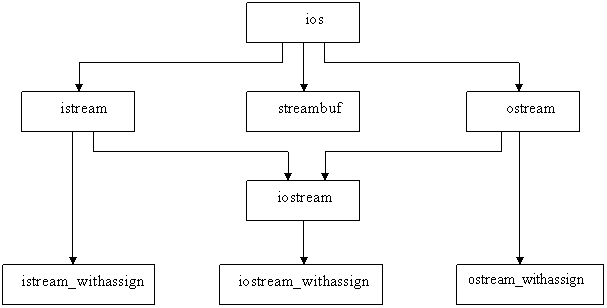
The above hierarchy of classes are used to define various streams
which deals with both the console and disc files. These classes are declared in
the header file iostream. Ios is the base for istream, ostream and iostream
base classes. Ios is declared as a virtual base class so that only one copy of
its members are inherited by the iostream. The three classes
istream_withassign, ostream_withassign and iostream_withassign are used to add
assignment operators to these classes.
ii) Exception Handling:
using exception handling we can more easily manage and respond to
run time errors. C++ exception handling is built upon 3 keywords: try, catch
and throw.
·
The
‘try’ block contains program statements that we want to monitor for exceptions.
·
The
‘throw’ block throws an exception to the ‘catch’ block if it occurs within the
try block.
·
The
‘catch’ block proceeds on the exception thrown by the ‘throw’ block.
When an exception is thrown, it is caught by its corresponding catch
statement which processes the exception. there can be more that one catch
statement associated with a try. The catch statement that is used is determined
by the type of the exception. An example illustrates the working of the three
blocks.
Code: AC11
Subject: OBJECT ORIENTED PROGRAMMING
#include<iostream.h>
using
namespace std;
int
main()
{
cout<<"\n
Start "<<endl;
try
{
cout<<"\n
Inside try block "<<endl;
throw
10;
cout<<"\n
this will not execute ";
}
catch(int
i)
{
cout<<"\n
catch number "<<endl;
cout<<i<<endl;
}
cout<<"End";
return
0;
}
Code: AC11
Subject: OBJECT ORIENTED PROGRAMMING
(iii) Abstract
class:
When a class contains at least one pure virtual function, it is
referred to as an abstract class. An abstract class is something which is to be
hidden by people and on which modifications can be done in future. Since an
abstract class contains at least one function for which no body exists,
technically it can be considered as incomplete and therefore no object is
created. Thus we can also define an abstract class as a class for which no
object is created. We may conclude that an abstract class exists only to be
inherited. We may still create pointer to an abstract class. In the following
example, class area is an abstract class because it has a pure virtual function
get_area().
#include<iostream.h>
using namespace
std;
class area
{
double
dim1,dim2;
public:
void
set_area(int d1,int d2)
{
dim1=d1;
dim2=d2;
}
void
get_dim(double &d1,double &d2)
{
d1=dim1;
d2=dim2;
}
virtual
double get_area()=0;
};
Q.161 What are the
benefits of object oriented programming? Explain. (8)
Ans:
Object Oriented Programming (OOP) is an
approach that provides a way of modulating programs by creating partitioned
memory area for both data and functions that can be used as templates for
creating copies of such modules on demand.
The advantages of OOP are as follows:
·
Function
and data both are tied together in a single unit.
·
Data
is not accessible by external functions as it is hidden.
·
Objects
may communicate with each other only through functions.
·
It
is easy to add new data and functions whenever required.
·
It
can model real world problems very well.
Code: AC11
Subject: OBJECT ORIENTED PROGRAMMING
·
Though
inheritance we can eliminate redundant code and extend the use of existing
classes.
·
The
principle of data hiding helps the programmer to build secure programs that
cannot be invaded by code in other parts of the program.
·
It
is possible to have multiple instances of an object to co-exist without any
interference.
·
The
data centric design approach enables us to capture more details of a model in
implemented form.
·
It
is possible to map objects in the problem domain to those in the program.
·
Message
passing techniques for communication between objects makes the interface
descriptions with external systems much simpler.
·
Software
complexity can be managed.
Q.162 Explain
Inline functions and the situations where inline expansion may not work and
why? (8)
Ans: Inline functions: Whenever
we write functions, there are certain costs associated with it such as jumping
to the function, saving registers, pushing arguments into the stack and
returning to the calling function. To remove this overhead we write an inline
function. It is a sort of request to the compiler. If we declare and define a
function within the class definition then it is automatically inline. We do not
need to sue the term inline.
Advantage of inline functions is that they have no overhead
associated with function call or return mechanism.
The disadvantage is that if the function made inline is too large
and called regularly our program grows larger.
There are certain conditions in which an inline function may not
work:
· If a function is
returning some value and it contains a loop, a switch or a goto statement.
· If a function is not
returning a value and it contains a return statement.
·
If a
function contains a static variable.
·
If
the inline function is made recursive.
Q.163 Define a class Coord having two members
type int as x and y. Use this class to define another class Rectangle which has
two members of type Coord as UpperLeftCoord and BottomRightCoord. Define the
constructors and member functions to get the length and breadth of rectangle.
Write a global function which creates an instance of the class Rectangle and
computes the area using the member functions. (10)
Ans:
#include <iostream.h>
#include<conio.h>
#include<math.h>
class coord {
int X;
int Y;
public:
coord() {X=Y=0;}
coord(int x, int y)
Code: AC11
Subject: OBJECT ORIENTED PROGRAMMING
{ X=x; Y=y;}
int getX(){ return X;}
int getY(){return Y;}
//int getZ(){return Z;}
};
class rectangle
{
coord UpperLeftCoord;
coord BottomRightCoord;
public:
rectangle(){}
rectangle(coord &p1,coord &p2)
{ UpperLeftCoord=p1;
BottomRightCoord=p2;
}
void showdata()
{
cout<<"UpperLeftCoordinate="<<"("<<UpperLeftCoord.getX()<<","<<UpperLeftCoord.getY()<<")";
cout<<"\nBottomLeftCoordinate="<<"("<<BottomRightCoord.getX()<<","<<BottomRightCoord.getY()<<")";
}
int getLength()
{ return(abs(UpperLeftCoord.getX()- BottomRightCoord.getX()));
}
int getBreath()
{ return(abs(UpperLeftCoord.getY()- BottomRightCoord.getY()));
}
int Area()
{ return (getLength()*getBreath());
}
};
void main()
{ clrscr();
coord c1(2,4);
coord c2(6,2);
rectangle r1(c1,c2);
r1.showdata();
int f=r1.Area();
cout<<"\nArea="<<f;
getch();
}
Code: AC11 Subject:
OBJECT ORIENTED PROGRAMMING
Q.164 What is the
output of following codes:
(i) void main()
{
int a[] = {10,20,30,40,50};
int i;
for (i=0;i<5;i++)
{
cout<<”\nelement is
“<<*(i+a)<<” “<<*(a+i)<<” “<<i[a]<<”
“<<a[i];
}
}
(ii) void main()
{
char *ptr = “xyzw”;
char ch;
ch = ++ *ptr ++;
cout <<ch;
cout << ch++;
} (4+4)
Ans:
(i) output:
element is10 10 10 10
element is20 20 20 20
element is30 30 30 30
element is40 40 40 40
element is50 50 50 50
(ii) output:
yy
Q.165 Write a C++
program using classes and objects to simulate result preparation system for 20
students. (8)
The data available for each
student includes:
Name (includes first, mid and
last name each of size 20 characters),
Rollno,
Marks in 3 subjects.
The percentage marks and grade
are to be calculated from the following information
Percentage marks grade
<50 ‘F’
 50<60 ‘D’
60<75 ‘C’
75<90 ‘B’
90<100 ‘A’
Code: AC11
Subject: OBJECT ORIENTED PROGRAMMING
Ans:
#include<iostream.h>
#include<conio.h>
#include<string.h>
#include<process.h>
class students
{ struct
name
{
char
first[20],mid[20],last[20];
};
struct
name e[20];
int
rollno[20],marks[20][3],counter;
int
per[20];
char
grade[20];
public:
students();
void
getdata();
void
calculate();
void
showdata();
};
students :: students()
{ counter=0;
for
(int i=0;i<20;i++)
{ strcpy(e[i].first,"");
strcpy(e[i].mid,"");
strcpy(e[i].last,"");
rollno[i]=0;
for
(int j=0;j<3;j++)
marks[i][j]=0;
per[i]=0;
grade[i]='
';
}}
Code: AC11
Subject: OBJECT ORIENTED PROGRAMMING
void students :: getdata()
{
cout<<endl<<"Enter
First Name of the Student:-> ";
cin>>e[counter].first;
cout<<endl<<"Enter
Middle Name of the Student:-> ";
cin>>e[counter].mid;
cout<<endl<<"Enter
Last Name of the Student:-> ";
cin>>e[counter].last;
cout<<endl<<"Enter
Roll Number of the student:-> ";
cin>>rollno[counter];
cout<<endl<<"Enter
the Marks in Subject 1;-> ";
cin>>marks[counter][0];
cout<<endl<<"Enter
the Marks in Subject 2;-> ";
cin>>marks[counter][1];
cout<<endl<<"Enter
the Marks in Subject 3;-> ";
cin>>marks[counter][2];
per[counter]=(marks[counter][0]+marks[counter][1]+marks[counter][2])/3;
if (per[counter]>=90
&& per[counter]<=100)
grade[counter]='A';
else if
(per[counter]>=75)
grade[counter]='B';
else if
(per[counter]>=60)
grade[counter]='C';
else if
(per[counter]>=50)
grade[counter]='D';
else
grade[counter]='F';
counter++;
}
void students :: showdata()
{
cout<<endl<<"First\tMiddle\tLast
Marks1 Marks2 Marks3 Percentage Grade\n";
for (int
i=0;i<counter;i++)
{
cout<<endl<<e[i].first;
cout<<'
'<<e[i].mid;
cout<<'
'<<e[i].last;
cout<<'
'<<rollno[i];
cout<<'
'<<marks[i][0];
Code: AC11
Subject: OBJECT ORIENTED PROGRAMMING
cout<<'
'<<marks[i][1];
cout<<'
'<<marks[i][2];
cout<<'
'<<per[i];
cout<<'
'<<grade[i];
}
}
void main()
{ students obj1;
int i,n;
cout<<endl<<"Enter
how many records u want to enter:-> ";
cin>>n;
if (!(n<=20))
{
cout<<endl<<"Maximum
number of records can be 20\n";
getch();
exit(1);
}
for (i=0;i<n;i++)
obj1.getdata();
cout<<endl<<"Records
added successfully.";
obj1.showdata();
getch();
}
Q.166 Is it possible
that a function is friend of two different classes? If yes, then how it is
implemented in C++. (8)
Ans: Yes, it is possible that a function
can be a friend of two classes. Member functions of one class can be friend
with another class. This is done by defining the function using the scope
resolution operator.
We can also declare all the member functions of one class as the
friend functions of another class. In fact we can also declare all the member functions
of a class as friend. Such a class is then known as friend class.
The following program shows how a friend function can
be a friend of two classes:
#include<iostream.h>
using namespace std;
class one;
class two
{
int a;
public:
void setvalue(int
n){a=n;}
friend void
max(two,one);
};
Code: AC11
Subject: OBJECT ORIENTED PROGRAMMING
class one
{
int b;
public:
void setvalue(int
n){b=n;}
friend void
max(two,one);
};
void max(two s,one t)
{
if(s.a>=t.b)
cout<<s.a;
else
cout<<t.b;
}
int main()
{
one obj1;
obj1.setvalue(5);
two obj2;
obj2.setvalue(10);
max(obj2,obj1);
return 0;
}
Q.167 Write
a program to overload << and >> operator to I/O the object of a
class. (8)
Ans:
#include<iostream.h>
class complex
{
double real,imag;
public:
complex()
{
}
complex(double r,double
i)
{
real=r;
imag=i;
}
friend ostream&
operator <<(ostream& s,complex& c);
friend istream&
operator >>(istream& s,complex& c);
};
ostream& operator <<(ostream& s,complex& c)
{
s<<"("<<c.real<<","<<c.imag<<")";
Code: AC11
Subject: OBJECT ORIENTED PROGRAMMING
return s;
}
istream& operator >>(istream& s,complex& c);
{
s>>c.real>>c.imag;
return s;
}
void main()
{
complex c1(1.5,2.5),c2(3.5,4.5),c3;
cout<<endl<<"c1=
"<<c1<<endl<<"c2= "<<c2;
cout<<endl<<"Enter a complex number:
";
cin>>c3;
cout<<"c3= "<<c3;
}
Q.168 What is the difference between a
virtual function and a pure virtual function? Give example of each. (8)
Ans: Virtual functions are important
because they support polymorphism at run time. A virtual function is a member
function that is declared within the base class but redefined inside the
derived class. To create a virtual function we precede the function declaration
with the keyword virtual. Thus we can assume the model of “one interface
multiple method”. The virtual function within the base class defines the form
of interface to that function. It happens when a virtual function is called
through a pointer.
The following is an example that
illustrates the use of a virtual function:
#include<iostream.h>
using namespace std;
class base
{
public:
int i;
base(int x)
{
i=x;
}
virtual void func()
{
cout<<"\n using base version of
function";
cout<<i<<endl;
}
};
class derived: public base
{
public:
derived(int x):base(x){}
Code: AC11
Subject: OBJECT ORIENTED PROGRAMMING
void func()
{
cout<<"\n sing derived version";
cout<<i*i<<endl;
}
};
class derived1: public base
{
public:
derived1(int x): base(x){}
void func()
{
cout<<"\n using derived1 version";
cout<<i+i<<endl;
}
};
int main()
{
base *p;
base ob(10);
derived d_ob(10);
derived1 d_ob1(10);
p=&ob;
p->func();
p=&d_ob;
p->func();
p=&d_ob1;
p->func();
return 0;
}
A pure virtual function has no definition related to the base class.
Only the function prototype is included to make a pure virtual function the
following syntax is used:
virtual return_type function_name(par_list) = 0;
The following is an example program:
#include<iostream.h>
using namespace std;
class area
{
double dim1,dim2;
public:
void set_area(int d1,int d2)
{
dim1=d1;
dim2=d2;
}
Code: AC11
Subject: OBJECT ORIENTED PROGRAMMING
void get_dim(double &d1,double &d2)
{
d1=dim1;
d2=dim2;
}
virtual double get_area()=0;
};
class rectangle: public area
{
public:
double get_area()
{
double d1,d2;
get_dim(d1,d2);
return d1*d2;
}
};
class triangle: public area
{
public:
double get_area()
{
double d1,d2;
get_dim(d1,d2);
return 0.5*d1*d2;
}
};
int main()
{
area *p
rectangle r;
triangle t;
r.set_area(3.3,4.5);
t.set_area(4.0,5.0);
p=&r;
cout<<"\n the area of rectangle is
"<<p->get_area()<<endl;
p=&t;
cout<<"\n area of triangle is
"<<p->get_area()<<endl;
return 0;
}
Code: AC11
Subject: OBJECT ORIENTED PROGRAMMING
Q.169 Write
a program for Conversion from Basic to Class Type. (8)
Ans:
#include<iostream.h>
class time
{
int hours;
int minutes;
public:
time(){}
time(int t)
{ hours=t/60;
minutes=t%60;
}
void showtime()
{ cout<<hours<<"hrs
"<<minutes<<"min";
}
};
void main()
{
time t1;
int duration=90;
t1=duration;
t1.showtime();
}
Q.170 What is the output of following programs: (8)
(i) #include<iostream.h>
int global = 10;
void func(int & x, int y)
{
x = x – y;
y = x * 10;
cout<<x<<“\t”<< y<< “\n”;
}
void main()
{
int global = 7;
func(::global, global);
cout<<global<<“\t”<<::global<<“\n”;
func(global,::global);
cout<<global<<“\t”<<::global<<“\n”;
}
(ii) #include<iostream.h>
void main( )
Code: AC11
Subject: OBJECT ORIENTED PROGRAMMING
{
int i, j, m;
int a[5]={8, 10, 1, 14, 16}
i = ++a[2];
m = a[i++];
cout <<i<<m;
}
Ans:
i) 3 30
7 3
4 40
4 3
ii) 3 2
Q.171 Write a
function template for sorting a list of arrays. (8)
Ans:
#include<iostream.h>
using namespace std;
template<class T>
void sort(T a[],int n)
{
for(int i=0;i<n-1;i++)
for(int j=i+1;j<n;j++)
{ if(a[i]>a[j])
swap(a[i],a[j]);
}
}
template<class X>
void swap(X &a,X &b)
{
X temp=a;
a=b;
b=temp;
}
int main()
{
int v[5]={32,78,12,98,56};
sort(v,5);
cout<<"\n the list of sorted array is :- ";
for(int i=0;i<5;i++)
cout<<"\n"<<v[i];
return 0;
}
Code: AC11
Subject: OBJECT ORIENTED PROGRAMMING
Q.172 How does
inheritance influence the working of constructor and destructor?
Given the following set of
definitions
Class x
{
};
class y: public x
{
};
class z: public y
{
};
z obj;
What order will the constructor and destructor be
invoked? (8)
Ans: Inheritance has a great deal of
influence over the working of constructors and destructors. In case of
inheritance the base class constructor is invoked first and then the derived
class constructor. In case of multiple inheritance, the constructors of base
classes are executed in the order in which they occur in the declaration in the
derived class. Similarly in case of multilevel inheritance, the base class
constructors are executed in the order of their inheritance. Destructors in
case of inheritance are executed exactly in the opposite order in which
constructors are executed. Likewise in case of multilevel inheritance
destructors are executed in the reverse of that is, from derived to base.
class x
{
};
class y: public x
{
};
class z: public y
{
};
z obj;
In the above definitions, the contructor will be fired in the
following sequence-
class x à class y à class z
similarly, destructors will be fired exactly in the reverse
sequence-
class z à class y à class x
Q.173 What is meant
by a constant member function? How is it declared? Give an example. (8)
Ans: Constant Member functions : A
const member function is that which does alter the value of any data in the
program. It is declared as follows:
void area(int, int)
const;
float dis() const;
when a const function tries to alter any data ,the compiler
generates an error message.
Code: AC11
Subject: OBJECT ORIENTED PROGRAMMING
Q.174 Write a
program to create a database of the students information such as name, roll no
and the program should have the following facilities. (10)
i)
Adds a new records to the file.
ii)
Modifies the details of an record.
Displays the contents of the file.
Ans:
#include<iostream.h>
#include<conio.h>
#include<stdio.h>
#include<string.h>
#include<fstream.h>
#include<stdlib.h>
#include<iomanip.h>
class Students
{
int rollno;
char name[25];
public:
void getdata()
{
cout<<endl<<"Enter
Name:-> ";cin>>name;
cout<<endl<<"Enter
Roll Number:-> ";cin>>rollno;
}
void showdata()
{
cout<<setw(10)<<rollno<<setw(10)<<name<<endl;
}
};
void main()
{
clrscr();
int r;
fstream file;
file.open("Student.TXT",ios::ate|ios::in |
ios::out|ios::binary);
file.seekg(0,ios::beg);
Students obj;
char ch;
while (1)
{
cout<<endl<<"1.Add\n2.Modify\n3.Display\n4.Exit\nEnter
your choice:-> ";
cin>>ch;
switch (ch)
{
case '1':
obj.getdata();
Code: AC11
Subject: OBJECT ORIENTED PROGRAMMING
file.write((char *) & obj, sizeof(obj));
break;
case '2':
int last = file.tellg();
int n = last/sizeof(obj);
cout<<"number of objects =
"<< n << '\n';
cout<<"total bytes in the file =
"<<last<<'\n';
//modify the details of an item
cout<<"enter object no. to b updtd
\n";
int object;
cin>>object;
cin.get(ch);
int location = (object - 1)*sizeof(obj);
if(file.eof())
file.clear();
file.seekp(location);
cout<<"enter new values of object
\n";
obj.getdata();
cin.get(ch);
file.write((char *)&obj,sizeof
obj)<<flush;
file.seekg(0);
break;
case '3':
file.seekg(0);
while(file.read((char *) &obj,sizeof obj))
obj.showdata();
break;
case '4': exit(0);
default:
cout<<endl<<"Input
out of reange.";
}
}
}
Q.175 Write a
program to read three numbers x, y and z and evaluate R given by

Use exception handling to throw an exception in case division by
zero is attempted. (8)
Ans:
#include<iostream.h>
using namespace std;
int main()
{
int x,y,z,R;
cout<<"\n Enter three values x,y and z : ";
Code: AC11
Subject: OBJECT ORIENTED PROGRAMMING
cin >> x >> y >> z;
int a=(x-y);
try
{
if(a!=0)
{
R=z/a;
cout<<"Result(z/(x-y)) =
"<< R << "\n";
}
else
throw(a);
}
catch(int i)
{
cout<<"\n Exception caught : (x-y)"
<< i << "\n";
}
cout << "END";
}
 (B)
(B)

 (D)
(D) 
 then
then  equals________.
 is a bitwise XOR
operator)
is a bitwise XOR
operator)  . (B)
(false && true)
. (B)
(false && true)