TYPICAL
QUESTIONS & ANSWERS
PART -I
OBJECTIVE TYPE
QUESTIONS
Each Question carries 2 marks.
Choosethe correct or the
best alternative in the following:
Q.1 Which of the
following relational algebra operations do not require the participating tables
to be union-compatible?
(A) Union (B)
Intersection
(C) Difference (D) Join
Ans: (D)
Q.2 Which of the
following is not a property of transactions?
(A) Atomicity (B)
Concurrency
(C) Isolation (D) Durability
Ans: (B)
Q.3 Relational Algebra does not have
(A) Selection operator. (B) Projection
operator.
(C) Aggregation
operators. (D) Division
operator.
Ans: (C )
Q.4 Checkpoints are a
part of
(A) Recovery measures. (B) Security
measures.
(C
) Concurrency measures. (D) Authorization
measures.
Ans: (A)
Q.5 Tree structures are used to store data in
(A) Network model. (B) Relational model.
(C) Hierarchical
model. (D) File based system.
Ans: (C )
Q.6 The language that requires a user to specify the data to be retrieved without specifying
exactly how to get it is
(A) Procedural DML. (B) Non-Procedural
DML.
(C) Procedural DDL. (D) Non-Procedural
DDL.
Ans: (B)
Q.7 Precedence graphs
help to find a
(A) Serializable
schedule. (B) Recoverable
schedule.
(C) Deadlock free schedule. (D) Cascadeless schedule.
Ans: (A)
Q.8 The rule that a value of a
foreign key must appear as a value of some specific table is called a
(A) Referential constraint. (B) Index.
(C) Integrity
constraint. (D) Functional dependency.
Ans: (A) The rule that a value of a foreign key must appear as a value of some specific table is called a referential constraint. (Referential integrity constraint is concerned with foreign key)
Q.9 The clause in SQL that specifies
that the query result should be sorted in ascending or descending order based
on the values of one or more columns is
(A) View (B) Order by
(C) Group
by (D) Having
Ans: (B) The clause in SQL that specifies that the query result should be sorted in ascending or descending order based on the values of one or more columns is ORDER BY. (ORDER BY clause is used to arrange the result of the SELECT statement)
Q.10 What is a disjoint
less constraint?
(A) It
requires that an entity belongs to no more than one level entity set.
(B) The
same entity may belong to more than one level.
(C) The database must
contain an unmatched foreign key value.
(D) An
entity can be joined with another entity in the same level entity set.
Ans: (A) Disjoint less constraint requires that an entity belongs to no more than one level entity set. (Disjoint less constraint means that an entity can be a member of at most one of the subclasses of the specialization.)
Q.11 According to the levels of abstraction, the schema at the intermediate level is called
(A) Logical schema. (B) Physical schema.
(C) Subschema. (D) Super schema.
Ans: According to the levels of abstraction, the schema at the intermediate level is called conceptual schema.
(Note: All the options given in the question are wrong.)
Q.12 It is an abstraction through which relationships are treated as higher level entities
(A) Generalization. (B) Specialization.
(C) Aggregation. (D) Inheritance.
Ans: (C ) It is an abstraction through which relationships are treated as higher level entities Aggregation. (In ER diagram, aggregation is used to represent a relationship as an entity set.)
Q.13 A relation is in ____________ if an attribute of a composite key is
dependent on an attribute of other composite key.
(A) 2NF (B) 3NF
(C) BCNF (D) 1NF
Ans: (B) A relation is in 3 NF if an attribute of a composite key is dependent on an attribute of other composite key. (If an attribute of a composite key is dependent on an attribute of other composite key then the relation is not in BCNF, hence it has to be decomposed.)
Q.14 What is data integrity?
(A) It
is the data contained in database that is non redundant.
(B) It
is the data contained in database that is accurate and consistent.
(C) It
is the data contained in database that is secured.
(D) It
is the data contained in database that is shared.
Ans: (B) (Data integrity means that the data must be valid according to the given constraints. Therefore, the data is accurate and consistent.)
Q.15 What are the
desirable properties of a decomposition
(A) Partition
constraint. (B) Dependency preservation.
(C) Redundancy. (D) Security.
Ans: (B) What are the desirable properties of a decomposition – dependency preserving.
(Lossless join and dependency preserving are the two goals of the decomposition.)
Q.16 In an E-R diagram double lines
indicate
(A) Total
participation. (B) Multiple participation.
(C) Cardinality N. (D) None
of the above.
Ans:
(A)
Q.17 The
operation which is not considered a basic operation of relational algebra is
(A) Join. (B) Selection.
(C) Union. (D) Cross
product.
Ans:
(A)
Q.18 Fifth
(A) Functional
dependency. (B) Multivalued dependency.
(C) Join dependency. (D) Domain-key.
Ans: (C)
Q.19 Block-interleaved distributed parity is RAID level
(A) 2. (B) 3
(C) 4. (D) 5.
Ans: (D)
Q.20 Immediate database modification technique uses
(A) Both undo and redo. (B) Undo but no redo.
(C) Redo
but no undo. (D) Neither
undo nor redo.
Ans:
(A)
Q.21 In SQL the statement select
* from R, S is equivalent to
(A) Select * from R natural join S. (B) Select
* from R cross join S.
(C) Select * from R union
join S. (D) Select * from R inner join S.
Ans: (B)
Q.22 Which of the following is not a consequence of concurrent operations?
(A) Lost update problem. (B)
Update anomaly.
(C) Unrepeatable
read. (D) Dirty
read.
Ans: (B)
Q.23 As per equivalence rules for query transformation, selection operation distributes over
(A)
(C) Set difference. (D) All
of the above.
Ans:
(D)
Q.24 The metadata is
created by the
(A) DML
compiler (B)
DML pre-processor
(C) DDL interpreter (D) Query
interpreter
Ans: (C)
Q.25 When an E-R diagram is mapped to
tables, the representation is redundant for
(A) weak entity sets (B) weak
relationship sets
(C) strong entity sets (D) strong relationship sets
Ans: (B)
Q.26 When  , then the cost of computing
  is
is
(A) the same as R  S (B) greater
the R S
S (B) greater
the R S
(C) less
than R S (D) cannot
say anything
Ans: (A)
Q.27 In SQL the word ‘natural’ can be used with
(A) inner join (B)
full outer join
(C) right outer join (D) all of the above
Ans: (A)
Q.28 The default level of consistency in SQL is
(A) repeatable read (B) read committed
(C) read
uncommitted (D) serializable
Ans: (D)
Q.29 If a transaction T has obtained an exclusive lock on item Q, then T can
(A) read Q (B) write
Q
(C) both
read and write Q (D) write
Q but not read Q
Ans:
(C)
Q.30 Shadow paging has
(A) no redo (B) no undo
(C) redo but no undo (D) neither redo nor undo
Ans: (A)
Q.31 If the closure of an attribute set is the entire relation then the attribute set is a
(A) superkey (B) candidate key
(C) primary key (D) not
a key
Ans: (A)
Q.32 DROP is a
______________ statement in SQL.
(A) Query (B) Embedded SQL
(C) DDL (D) DCL
Ans:
(C)
Q.33 If two relations R and S are joined, then the non matching tuples of both R and S are ignored in
(A) left outer join (B) right outer join
(C) full outer join (D) inner join
Ans: (D)
Q.34 The keyword to eliminate duplicate rows from the query result in SQL is
(A) DISTINCT (B) NO DUPLICATE
(C) UNIQUE (D) None of the above
` Ans: (C)
Q.35 In 2NF
(A) No functional dependencies (FDs)
exist.
(B) No multivalued dependencies
(MVDs) exist.
(C) No partial FDs exist.
(D) No partial MVDs exist.
Ans: (C)
Q.36 Which one is correct statement?
Logical data independence provides following without changing application programs:
(i) Changes in access methods.
(ii) Adding new entities in database
(iii) Splitting an existing record into two or more records
(iv) Changing storage medium
(A) (i) and (ii) (B) (iv) only, (C) (i) and (iv) (D) (ii) and (iii)
Ans: (D)
Q.37 In an E-R, Y is the dominant entity and X is a subordinate entity. Then which of the following is incorrect :
(A) Operationally, if Y is deleted, so is X
(B) existence is dependent on Y.
(C) Operationally, if X is deleted, so is Y.
(D) Operationally, if X is deleted, & remains the same.
Ans: (C)
Q.38 Relational Algebra is
(A) Data Definition Language .
(B)
(C) Procedural query Language
(D) None of the above
Ans: (C)
Q.39 Which of the following aggregate functions does not ignore nulls in its results?.
(A) COUNT . (B) COUNT (*)
(C) MAX (D) MIN
Ans: (B)
Q.40 R (A,B,C,D) is a relation. Which of the following does not have a lossless join dependency preserving BCNF decomposition
(A) AgB, BgCD (B) AgB, BgC, CgD .
(C) ABgC, CgAD (D) AgBCD
Ans: (D)
Q.41 Consider the join of relation R with a relation S. If R has m tuples and S has n tuples, then the maximum and minimum size of the join respectively are
(A) m+n and 0 (B) m+n and |m-n|
(C) mn and 0 (D) mn and m+n
Ans: (C)
Q.42 Maximum height of a B+ tree of order m with n key values is
(A) Logm(n) (B) (m+n)/2
(C) Logm/2(m+n) (D) None of these
Ans: (D)
Q.43 Which one is true statement :
(A) With finer degree of granularity of locking a high degree of concurrency is possible.
(B) Locking prevents non – serializable schedules.
(C) Locking cannot take place at field level.
(D) An exclusive lock on data item X is granted even if a shared lock is already held on X.
Ans: (A)
Q.44 Which of the following statement on the view concept in SQL is invalid?
(A) All views are not updateable
(B) The views may be referenced in an SQL statement whenever tables are referenced.
(C) The views are instantiated at the time they are referenced and not when they are defined.
(D) The definition of a view should not have GROUP BY clause in it.
Ans: (D)
Q.45 Which of the following concurrency control schemes is not based on the serializability property?
(A) Two – phase locking (B) Graph-based locking
(C) Time-stamp based locking (D) None of these .
Ans: (D)
Q.46 Which of the
following is a reason to model data?
(A) Understand
each user’s perspective of data
(B) Understand
the data itself irrespective of the physical representation
(C) Understand the use of
data across application areas
(D) All of the above
Ans: (D)
Q.47 If an entity can belong to only one lower level entity then the constraint is
(A) disjoint (B)
partial
(C) overlapping (D) single
Ans: (B)
Q.48 The common column is eliminated in
(A) theta join (B) outer
join
(C) natural join (D)
composed join
Ans: (C )
Q.49 In SQL, testing
whether a subquery is empty is done using
(A) DISTINCT (B) UNIQUE
(C) NULL (D)
EXISTS
Ans: (D)
Q.50 Use of UNIQUE while defining an attribute of a table in SQL means that the attribute values are
(A) distinct values (B)
cannot have NULL
(C) both
(A) & (B) (D) same
as primary key
Ans:
(C)
Q.51 The cost of reading and writing temporary files while evaluating a query can be reduced by
(A) building indices (B) pipelining
(C) join ordering (D) none of the above
Ans: (B)
Q.52 A transaction is in __________ state after the final statement has been executed.
(A) partially committed (B) active
(C) committed (D)
none of the above
Ans: (C)
Q.53 In multiple granularity of locks SIX lock is compatible with
(A) IX (B) IS
(C) S (D) SIX
Ans:
(B)
Q.54 The statement that is executed automatically by the system as a side effect of the modification of the database is
(A) backup (B) assertion
(C) recovery (D) trigger
Ans: (D)
Q.55 The normal form that is not necessarily dependency preserving is
(A) 2NF (B) 3NF
(C) BCNF (D) 4NF
Ans: (A)
Q.56 A functional dependency of the form  is trivial if
(A)  (B)
(B) 
(C)  (D)
(D) 
Ans: (A)
Q.57 The normalization was
first proposed by ______________.
(A) Code (B) Codd
(C) Boyce
Codd (D) Boyce
Ans: (B)
Q.58 The division operator divides a dividend A of degree m+n by a divisor relation B of degree n and produces a result of degree
(A) m – 1 (B) m + 1
(C) m
* m (D) m
Ans: (D)
Q.59 Which of the following is not a characteristic of a relational database model?
(A) Table (B) Tree like structure
(C) Complex logical relationship (D) Records
Ans: (B)
Q.60 Assume transaction A holds a shared lock R. If transaction B also requests for a shared lock on R.
(A) It will result in a deadlock situation.
(B) It will immediately be rejected.
(C) It will immediately be granted.
(D) It will be granted as soon as it is released by A .
Ans: (C)
Q.61 In E-R Diagram total participation is represented by
(A) double lines (B) Dashed lines
(C) single line (D) Triangle
Ans: (A)
Q.62 The FD A ® B , DB ® C implies
(A) DA ® C (B) A ® C
(C) B ® A (D) DB ® A
Ans: (A)
Q.63 The graphical representation of a query is ________.
(A) B-Tree (B) graph
(C) Query Tree (D) directed graph
Ans: (C)
Q.64 Union operator is a :
(A) Unary Operator (B) Ternary Operator
(C) Binary Operator (D) Not an operator
Ans: (C)
Q.65 Relations produced from an E-R model will always be
(A) First normal form. (B) Second normal form.
(C) Third normal form. (D) Fourth normal form.
Ans: (A)
Q.66 Manager salary details are hidden from the employee .This is
(A) Conceptual level data hiding.
(B) External level data hiding.
(C) Physical level data hiding.
(D) None of these.
Ans:
(A)
Q.67 Which of
the following is true for network structure?
(A) It is a physical representation
of the data.
(B) It allows many to many
relationship.
(C) It is conceptually simple.
(D) It will be the dominant database
of the future.
Ans: (A)
Q.68 Which two
files are used during operation of the DBMS?
(A) Query
languages and utilities
(B) DML and query language
(C)
Data dictionary and transaction
log
(D) Data
dictionary and query language
Ans: (C )
Q.69 A list consists of last names,
first names, addresses and pin codes. If all people in the list have the same
last name and same pin code a useful key would be
(A) the pin code
(B) the last name
(C) the compound key first
name and last name
(D) Tr from next page
Ans: (C )
Q.70 In b-tree
the number of keys in each node is ____ than the number of its children.
(A) one
less (B)
same
(C) one
more (D) half
Ans: (A)
Q.71 The
drawback of shadow paging technique are
(A) Commit
overhead (B) Data
fragmentation
(C) Garbage
collection (D) All
of these
Ans: (D)
Q.72 Which
normal form is considered adequate for normal relational database design?
(A) 2NF (B) 5NF
(C) 4NF (D) 3NF
Ans: (D)
Q.73 Which of the following addressing
modes permits relocation without any change over in the code?
(A) Indirect
addressing (B) Indexed
addressing
(C) PC
relative addressing (D) Base
register addressing
Ans: (B)
Q.74 In a
multi-user database, if two users wish to update the same record at the same
time, they are prevented from doing so
by
(A) jamming (B) password
(C) documentation (D)
record lock
Ans: (D)
Q.75 The values of the
attribute describes a particular_____________
(A) Entity set (B) File
(C) Entity instance (D) Organization
Ans: (C)
Q.76 Which of the following relational algebraic operations is not from set theory?
(A) Union (B) Intersection
(C) Cartesian Product (D) Select
Ans: (D)
Q.77 Which of the following ensures the atomicity of the transaction?
(A) Transaction management component of DBMS
(B) Application Programmer
(C) Concurrency control component of DBMS
(D) Recovery management component of DBMS
Ans: (A)
Q.78 If both the functional dependencies : X®Y and Y®X hold for two attributes X and Y then the relationship between X and Y is
(A) M:N (B) M:1
(C) 1:1 (D) 1:M
Ans: (C)
Q.79 What will be the number of columns and rows respectively obtained for the operation, A- B, if A B are Base union compatible and all the rows of a are common to B? Assume A has 4 columns and 10 rows; and B has 4 columns and 15 rows
(A) 4,0 (B) 0,0
(C) 4,5 (D) 8,5
Ans: (A)
Q.80 For correct behaviour during recovery, undo and redo operation must be
(A) Commutative (B) Associative
(C) idempotent (D) distributive
Ans: (C)
Q.81 Which
of the following is not a consequence of non-normalized database?
(A) Update Anomaly (B) Insertion Anomaly
(C) Redundancy (D) Lost update problem
Ans: (D)
Q.82 Which of the following is true for relational calculus?
(A) "x(P(x))ºØ($x)(ØP(x)) (B) "x(P(x))ºØ($x)(P(x))
(C) "x(P(x))º($x)(ØP(x)) (D) "x(P(x))º($x)(P(x))
Ans: (A)
Q.83 The part of a database management system which ensures that the data remains in a consistent state is
(A) authorization and integrity manager
(B) buffer manager
(C) transaction manager
(D) file manager
Ans: (C)
Q.84 Relationships among relationships can be represented in an-E-R model using
(A) Aggregation (B) Association
(C) Weak entity sets (D) Weak relationship sets
Ans: (A)
Q.85 In tuple relational calculus P1 AND P2 is equivalent to
(A) (ØP1ORØP2). (B) Ø(P1ORØP2).
(C) Ø(ØP1OR P2). (D) Ø(ØP1OR ØP2).
Ans: (D)
Q.86 If a®b holds then so does
(A) ga®gb (B) a®®gb
(C) both (A) and (B) (D) None of the above
Ans: (A)
Q.87 Cascading rollback is avoided in all protocol except
(A) strict two-phase locking protocol.
(B) tree locking protocol
(C) two-phase locking protocol
(D) validation based protocol.
Ans: (D)
Q. 88 Wait-for graph is used for
(A) detecting view serializability. (B) detecting conflict serializability.
(C) deadlock prevention (D) deadlock detection
Ans: (D)
Q.89 The expression sq1(E1⋈q2E2) is the same as
(A) E1 ⋈q1^ q2E2 (B) sq1 E1^sq2 E2
(C) E1 ⋈q1∨ q2E2 (D) None of the above
Ans: (A)
Q.90 The clause alter table in SQL can be used to
(A) add an attribute
(B) delete an attribute
(C) alter the default values of an attribute
(D) all of the above
Ans: (D)
Q. 91 The data models defined by ANSI/SPARC architecture are
(A) Conceptual, physical and internal
(B) Conceptual, view and external
(C) Logical, physical and internal
(D) Logical, physical and view
Ans: (D)
Q.92 Whenever two independent one-to-many relationships are mixed in the same relation, a _______ arises.
(A) Functional dependency (B) Multi-valued dependency
(C) Transitive dependency (D) Partial dependency
Ans:(B)
Q.93 A table
can have only one
(A) Secondary key (B) Alternate key
(C) Unique key (D) Primary key
Ans: (D)
Q.94 Dependency preservation is not guaranteed in
(A) BCNF (B) 3NF
(C) PJNF (D) DKNF
Ans: (A)
Q.95 Which is the best file organization when data is frequently added or deleted from a file?
(A) Sequential (B) Direct
(C) Index sequential (D) None of the above
Ans: (B)
Q.96 Which of the following constitutes a basic set of operations for manipulating relational data?
(A) Predicate calculus (B) Relational calculus
(C) Relational algebra (D) SQL
Ans: (C)
Q.97 An advantage of views is
(A) Data security (B) Derived columns
(C) Hiding of complex queries (D) All of the above
Ans: (A)
Q.98 Which
of the following is not a recovery technique?
(A) Deferred update (B) Immediate update
(C) Two-phase commit (D) Shadow paging
Ans: (C)
Q.99 Isolation of the transactions is ensured by
(A) Transaction management (B) Application programmer
(C) Concurrency control (D) Recovery management
Ans: (C)
Q.100 _______ operator is used to compare a value to a list of literals values that have been specified.
(A) Like (B) COMPARE
(C) BETWEEN (D) IN
Ans: (A)
PART-
II
DESCRIPTIVES
Q.1 Briefly discuss the different layers of ANSI SPARC
architecture. Define physical and
logical data independence. How does this architecture help in achieving these? (7)
Ans: The three layers of ANSI SPARC architecture
are as follows:
·
Internal view is at the lowest level of
abstraction, closest to the physical storage method used. It indicates how the data will be stored and
describes the data structures and access methods to be used by the database.
There is one internal view for the entire database.
·
Global or Conceptual View : At this level of abstraction all
the database entities and the relationships among them are included. There is
one conceptual view for the entire database.
· External or User View: The external or user view is at the highest level of database abstraction where only those portions of the database concern to a user or application programme are included. Any number if external or user views may exists for a given global or conceptual view.
Data independence implies that change in one view must not require a change in the
view(s) above. There are two types of data independence : logical and physical. Logical data independence means that the conceptual view can be changed without effecting the existing external view, i.e., a given record may be spilt or combined with other records but the external views need not be changed to reflect this. Physical data independence means that the physical storage structures or devices used to store the data can be changed without effecting the existing conceptual view or external view, i.e., if earlier indexed sequential files are used to store data and then the B- trees are used, even then the upper layers should not be effected.
There are two different mappings between the layers as shown below in the diagram. The mapping between external and conceptual levels is responsible to provide logical data independence and the mapping between internal and conceptual levels is responsible to provide physical data independence.

Q.2 Describe
the storage structure of indexed sequential files and their access method. (7)
Ans: Storage
structure of Indexed Sequential files and their access : To gain fast random access to
records in a file, we can use an index structure. An index record consists of a
search key value and pointers to data records, which is associated with a
particular search key. An ordered index stores the values of the search keys in
sorted order. A file may have several indices on different search keys. If the
files containing the records is sequentially ordered, a primary index is an
index whose search key also defines the sequential order of the file. Such
files are known as index sequential files. There are two types of ordered
indices : dense and sparse. In dense index, and index record appears only for
some of the search-key in the files as shown below.
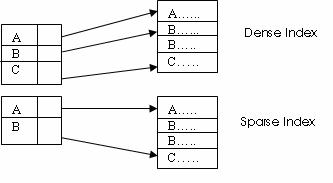
To access a particular record with search key
value, K, using dense index we search index record with search key value, K,
from which reach the first entry of data record with search key value K. Then
the data records are searched linearly to obtain the required record. If either
the index record is not there or the linear search reaches the data record with
different search key value, then the record is not there. Now for sparse index,
we search index record with search key value, K or the index record with
highest search key value less than K, from which reach the first entry of data
record with search key value K or highest value less than K. Then the data
records are searched linearly to obtain the required record. If the linear
searches the data record with search key value greater than K, then the record
is not there.
Q.3 Define the terms entity,
attribute, role and relationship between the entities, giving examples for each
of them. (4)
Ans:
Entity: An entity is a “thing” or “object” in the real
world that is distinguishable from other objects. For example, a person and
bank account can be considered as entities.
Attribute: Entities are described in a
database by a set of attributes, i.e., the characteristics of an entity are
known as attributes. For example, name, age, date of birth, etc are attributes
of the entity person. Similarly, account number, balance, nature of account,
etc are attributes of the entity bank account.
Relationship:
A relationship is
an association among the several entities. For example, a depositor
relationship associates the entity person with a bank account.
Role: The function that an entity plays in a
relationship is called that entity’s role. For example, in the relationship
depositor mentioned above, the entity person plays the role of a customer in
the relationship.
Q.4 What are the three data
anomalies that are likely to occur as a result of data redundancy? Can data redundancy be completely eliminated
in database approach? Why or why not? (5)
Ans: The three type of
anomalies that can arise in the database because of redundancy are insertion,
deletion and modification/updation anomalies.
Consider a relation emp_dept with attributes: E#, Ename, Address, D#, Dname,
Dmgr# with the primary key as E#.
Insertion anomaly: Let us assume that a new department has been started by the organization but initially there is no employee appointed for that department, then the tuple for this department cannot be inserted into this table as the E# will have NULL, which is not allowed as E# is primary key. This kind of a problem in the relation where some tuple cannot be inserted is known as insertion anomaly.
Deletion anomaly: Now consider there is only one employee in some department and that employee leaves the organization, then the tuple of that employee has to be deleted from the table, but in addition to that the information about the department also will get deleted. This kind of a problem in the relation where deletion of some tuples can lead to loss of some other data not intended to be removed is known as deletion anomaly.
Modification /update
anomaly: Suppose the manager of a department has
changed, this requires that the Dmgr# in all the tuples corresponding to that
department must be changed to reflect the new status. If we fail to update all
the tuples of the given department, then two different records of employee
working in the same department might show different Dmgr# leading to
inconsistency in the database. This is known as modification/update anomaly.
The data redundancy. Cannot be totally removed from the database, but there should be controlled redundancy, for example, consider a relation student_report(S#, Sname, Course#, SubjectName, marks) to store the marks of a student for a course having some optional subjects, but all the students might not select the same optional papers. Now the student name appears in every tuple, which is redundant and we can have two tables as students(S#, Sname, CourseName) and Report(S#, SubjectName, Marks). However, if we want to print the mark-sheet for every student using these tables then a join operation, which is a costly operation, in terms of resources required to carry out, has to be performed in order to get the name of the student. So to save on the resource utilization, we might opt to store a single relation, students_report only.
Q.5 Given the dependency diagram shown in the following figure, (the primary key attributes are underlined)
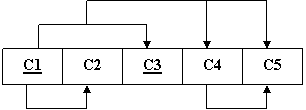
(i) Identify and discuss each of the indicated dependencies?
(ii) Create a database whose tables are atleast in 3NF, showing dependency
Diagram for each table? (4+5)
Ans:
(i) The FDS for the given relation are:
1. C1→ C2
2. C1, C3 → C2, C4, C5
3. C4 → C5
The Primary key of the given relation is (C1, C3), so C1 → C2 is a partial FD and there is a transitive FD also : C1, C3 → C4 →C5 in the relation.
(ii) According to the algorithm to decompose the relation schema into 3NF as follows:
R1 (C1, C2) with FD {C1 → C2} and functional dependency diagram.
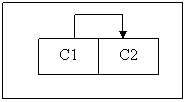
R2(C1, C3, C4) with FD {C1, C3 → C4} and functional dependency diagram
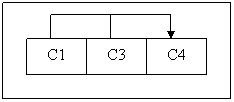
R3(C4, C5) with FD {C4 → C5} and functional dependency diagram.
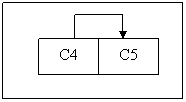
We cannot have a single relation for the FD C1, C3 → C2, C4, C5 as then there will be partial and transitive FDs in the relation.
Q.6 Consider the following relations with underlined primary keys.
 Product(P_code, Description, Stocking_date, QtyOnHand, MinQty,
Price, Discount, V_code)
Product(P_code, Description, Stocking_date, QtyOnHand, MinQty,
Price, Discount, V_code)
Vendor(V_code, Name, Address, Phone)
 Here a vendor can supply
more than one product but a product is supplied by only one vendor. Write SQL queries for the following :
Here a vendor can supply
more than one product but a product is supplied by only one vendor. Write SQL queries for the following :
(i) List the names of all the vendors who supply more than one product.
(ii) List the details of the products whose prices exceed the average
product price.
(iii) List the Name, Address and Phone of the vendors who are currently
not supplying any product. (3 x 3)
Ans:
(i) Select Name from Vendor
Where V_code in (Select V_code from Product
group by V_code having count (V_code) > 1)
(ii) Select * from Product
Where Price > (Select avg (Price)from Product)
(iii) Select Name, Address, Phone From Vendor
Where V_code not in (Select V_code from Product)
Q.7 Define the domain
relational calculus. (5)
Ans: An expression in the domain relational
calculus is of the form
{< x1, x2,……..xn >1 P(x1, x2….., xn)}…………..1 Where x1, x2…….. xn represent the domain variables. P represents a formula composed of atoms. An atom in the domain relational calculas has one of the following forms:
·
{<x1, x2), …..xn > Єr, where
r is a relation on n attributes and x1,
x2, …..xn are domain variables or domain constants.
· x Θ y, where a and y where r
domain variables and Θ is a comparison operator (<, ≤, =,
≠, ≥, >). We require that attributes x and y have domains that
can be compared by Θ.
·
x Θ c, where x is a domain variable, Θ is a comparison
operator, and c is a constant in the domain of the attribute for which x is a
domain variable.
We build up formulae from atoms by
using the following rules :
·
An atom is a formula.
·
If P1 is a formula,
then so are ¬p1 and (P1)
If P1 and P2 are formulae, then so are p1Λ p2
and p1∨ p2 and
p1 ⇒P2
·
If p1 (x) is a
formula in x, where x is a domain variable, then so are Ǝx(p1(x))
and
"x(p1(x)).
Q.8 Given  with the set of FDs,
  . Is the decomposition of R into
  and
and  lossless? Prove. (5)
Ans: To find whether the decomposition of R(A, B,C,D,E) with the set of functional dependencies, F={AB → CD, A → E, C → D} into R1(A,B,C) R2(B,C, D) and R3(C,D,E) is lossless or not, we have the following initial table.
|
|
A |
B |
C |
D |
E |
|
R1 |
aA |
aB |
aC |
a1D |
b1E |
|
R2 |
b2A |
aB |
aC |
aD |
b2E |
|
R3 |
b3A |
b3B |
aC |
aD |
aE |
There is no change in table above for the functional dependencies AB → CD and A →E, but for the functional dependency C → D, all the rows of C have aC so and the corresponding rows of D can be updated to aD as there is an aD in two of such rows. Here the new table is as follows:
|
|
A |
B |
C |
D |
E |
|
R1 |
aA |
aB |
aC |
aD |
b1E |
|
R2 |
b2A |
aB |
aC |
aD |
b2E |
|
R3 |
b3A |
b3B |
aC |
aD |
aE |
No change can be made in the table further and from this table we can see that there is no row with all the a’s, hence the decomposition is a lossy one.
Q.9 Given R(A,B,C,D,E) with the set of FDs,
F{AB→CD, ABC → E, C → A}
(i) Find any two candidate keys of R
(ii)
What is the normal form of R?
Justify. (9)
Ans:
(i) To
find two candidate keys of R, we have to find the closure of the set of
attributes under consideration and if all the attributes of R are in the
closure then that set is a candidate key. Now from the set of FD’s we can make
out that B is not occurring on the RHS of any FD, therefore, it must be a part
of the candidate keys being considered otherwise it will not be in the closure
of any attribute set. So let us consider the following sets AB and BC.
Now (AB)+= ABCDE, CD are included in closure because of the FD AB →CD, and E is included in closure because of the FD ABC → E.
Now (BC) += BCAED, A is included in closure because of the FD C → A, and then E is included in closure because of the FD ABC → E and lastly D is included in closure because of the FD AB → CD.
Therefore two candidate keys are : AB and BC.
(ii) The prime attributes are A, B and C and non-prime attributes are D and E.
A relation
scheme is in 2NF, if all the non-prime attributes are fully functionally
dependent on the relation key(s). From the set of FDs we can see that the non-prime
attributes (D,E) are fully functionally dependent on the prime attributes, therefore,
the relation is in 2NF.
A relation scheme is in 3NF, if for all the non-trivial FDs in F+ of the form X → A, either X is a superkey or A is prime. From the set of FDs we see that for all the FDs, this is satisfied, therefore, the relation is in 3NF.
A relation scheme is in BCNF, if for all the non-trivial FDs in F+ of the form X→ A, X is a superkey. From the set of FDs we can see that for the FD C → A, this is not satisfied as LHS is not a superkey, therefore, the relation is not in BCNF.
Hence, the
given relation scheme is in 3NF.
Q.10 How does a query
tree represent a relational algebra expression?
Discuss any three rules for query optimisation, giving example as to
when should each rule be applied. (8)
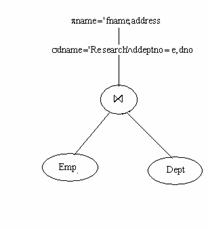
Ans: A query tree is a tree structure that corresponds to a relational algebra expression. It represents the input relations as leaf nodes of the tree, and represents the relational algebra operations as internal nodes. An execution of the query tree consists of executing an internal node operation whenever its operands are available and then replacing that internal node by the relation that results from executing the operation. The execution terminates when the root node is executed and produces the result relation for the query. For example, the query tree for the relational algebra expression
∏E_No =(sp_No = ‘DB2003’ (Assigned_To) :
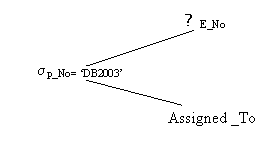
The three rules for query optimization are as follows:
· In a cascade (sequence ) of ∏ operations, all but the last one can be ignored :
∏1(∏2(……∏n ( R))) º ∏1(R )
· If a selection condition c involves only those attributes A1, A2, …. An in the projection list, the two operations can be commuted :
∏A1, A2,……An (sC (R ) º sC (∏A1, A2, ……An (R ))….. ))
· A conjunctive selection condition can be broken up into a cascade of individual s operations :
sC1 AND C2 AND ….AND Cn (R ) º sC1 (sC2(….(sCn (R ))….))
Q. 11 Consider the following database with primary keys underlined
Project(P_No, P_Name, P_Incharge)
Employee(E_No, E_Name)
Assigned_To(P_No, E_No)
Write the relational algebra for the following :
(i) List details of the employees working on all the projects.
(ii) List E_No of employees who do not work on project number DB2003. (6)
Ans:
(i) Employee ⋈(Assigned_To) ÷ ∏ p_no (Project))
(ii) ∏E_No(Assigned_To) - ∏E_No(sp_No = ‘ DB2003’ (Assigned _To))
Q.12 What is a hashing function? What are the properties of a good hashing function? Describe the folding technique for hashing functions. (7)
Ans: Hashing function is a technique to store a file on the disk. A hash function is a function which when applied to a value of a record (hash field) gives a hash value, which is the address of the disk block in which the record is stored.
The properties of a good hash function are
as follows:
· It should be easy to evaluate.
· The hash value obtained should be within the range of valid addresses for a given file.
· The hash values should be uniformly distributed over the range of addresses so that the collisions are minimum.
Folding technique for hashing functions: It involves applying an arithmetic function such as addition or a logical function like exclusive OR to different parts of a hash field to calculate the hash addresses. For example, the numeric hash field can be split into start, middle and end regions, such that the sum of the lengths of the start and end regions equals the length of the middle region. The start, middle and end regions’ digits are added to get a new value, x. Then x mod s, where s is the upper limit for the hash function, gives the hash value.
Q.13 Describe
the problems of lost update, inconsistent read and phantom phenomenon which
arise as a result of concurrency. (7)
Ans: Lost update problem: The problem occurs when two transactions
that access the same database items have their operations interleaved in a way
that makes the value of some database item incorrect. For example, consider the
following interleaved schedule of two transactions:
Time T1 T2
 Read(X)
X
= X+ 100
Read(X)
X
= X – 100
Write(X)
Write(X)
From the schedule, it can
be seen that the updation of x by T1 will be overwritten by T2. If these
transactions execute in serial order then the value of x should not change, but
with this schedule the value of x will be reduced by 100, which is incorrect.
Inconsistent Read or
Temporary Update or Dirty Read problem: problem occurs when one transaction
updates a database item and then the transaction fails for some reason. The
updated value is accessed by another transaction before it is changed back to
the original value. For example, consider the following interleaved schedule of
two transactions :
Time
T1 T2

Read(X)
X
= X + 100
Write(X)
Read(X)
X
= X - 100
From the schedule, it can
be seen that T2 will read the value written by T1, however if T1 fails for some
reason before commit then T2 will use the value which is not valid.
Phantom
Phenomenon : If a
transaction is calculated an aggregate summary function on a number of records
while other transactions are updating some of records, the aggregate function
may calculate some values before they are updated and others after they are
updated. For example, consider the following interleaved schedule of two
transactions:
Time T1 T2
 Sum
= 0
Sum
= 0
Read (X)
X =X + 100
Write(X)
Read(X)
Sum
= Sum + X
Read(Y)
Sum
= Sum + Y
Read(Y)
Y = Y – 100
Write(y)
From the schedule, it can
be seen that T2 will read the new value of X written by T1 but not that of Y,
so the value of Sum will be off by 100 from the actual valid value.
Q.14 Define
(i) Shared locks.
(ii) Serializable schedule.
(iii) Thomas write rule.
(iv) Two phase commit. (4)
Ans:
(i) Shared lock: During concurrent execution
of transactions, before a transaction can access a data item, it has to acquire
a lock on it. Now if the transactions only want to read the data item then
every transaction can lock the data item in shared mode, such a lock is known
as shared lock.
(ii) Serializable schedule: An interleaved schedule of more than one transactions is called a serializable schedule, if it is equivalent to some serial schedule of those transactions.
(iii) Thomas’ write rule: The Thomas’ write rule is a modification of timestamp-ordering protocol for concurrency control. Suppose that transaction Ti issues write (Q) and TS(Ti) is its timestamp then the following actions are taken depending on TS(Ti) and the read-write timestamps of the data item Q:
· If TS(Ti)<R-timestamp (Q), then the value of Q that Ti is producing was previously needed, and it had been assumed that the value would never be produced. Hence, the system rejects the write operation and rolls Ti back.
· If TS(Ti) < W-timestamp (Q), then Ti is attempting to write an obsolete value of Q. Hence, this write operation can be ignored otherwise, the system executes the write operation and sets W-timestamp(Q) to Ts(Ti)
(iv) Two phase commit: To ensure atomicity, all the sites in which a transaction is being executed must agree on the final outcome of the execution. The transaction must either commit at all sites or it must abort at all sites. For this simplest protocol is two-phase commit, which has the voting phase and the decision phase, In the voting phase the sub-transactions are requested to vote on their readiness to commit or abort. In the decision phase the decision as to whether all sub-transactions should commit or abort is made and carried out. The transactions at a site interact with the transaction manager of the site, cooperating in the exchange of messages through which the two –phase commit is executed.
Q.15 Let transactions T1, T2 and T3 be defined to perform the following operations :
T1 : Add one to A
T2 : Double A
T3 : Display A on the screen and then set A to one.
(where A is some item in the database)
Suppose
transactions T1, T2 and T3 are allowed to execute concurrently. If A has initial value zero, how many
possible correct results are there?
Enumerate them. (10)
Ans: The following three transactions, manipulating the contents of A, are to execute concurrently:
T1 : Add one to A ie. A = A + 1
T2 : Double A ie. A + 2 * A
T3 : Display A on screen and then set it to 1 ie. A = 1
Assuming A has an initial value zero. Now three transactions can execute concurrently in the following different ways. The tables are showing the different transaction schedules along with the changes they make in the value of A and the value of A displayed by T3.
|
Transactions Schedule |
Current value of A |
Display |
|
T1 |
1 |
|
|
T2 |
2 |
|
|
T3 |
1 |
2 |
|
Transactions Schedule |
Current value of A |
Display |
|
T1 |
1 |
|
|
T3 |
1 |
1 |
|
T2 |
2 |
|
|
Transactions Schedule |
Current value of A |
Display |
|
T2 |
0 |
|
|
T1 |
1 |
|
|
T3 |
1 |
1 |
|
Transactions Schedule |
Current value of A |
Display |
|
T2 |
0 |
|
|
T3 |
1 |
0 |
|
T1 |
2 |
|
|
Transactions Schedule |
Current value of A |
Display |
|
T3 |
1 |
0 |
|
T1 |
2 |
|
|
T2 |
4 |
|
|
Transactions Schedule |
Current value of A |
Display |
|
T3 |
1 |
0 |
|
T2 |
2 |
|
|
T1 |
3 |
|
Q.16 Define and differentiate between the following :-
(i) Deadlock prevention.
(ii) Deadlock detection.
(iii)
Deadlock avoidance. (6)
Ans:
(i) Deadlock prevention: These protocols ensure that the
system will never enter a deadlock state. There are two approaches to deadlock
prevention. One approach ensures that no cyclic waits can occur by ordering the
requests for locks, or requiring all locks to be acquired together. The other
approach is closer to deadlock recovery, and performs transaction rollback
instead of waiting for a lock, whenever the wait could potentially result in a
deadlock. In this approach two timestamp based techniques are there : wait –
die and wound – wait . In wait –die, the older transaction is allowed to wait
if it needs data from older transaction. In wound - wait, the younger transaction is rolled
back if it needs data from older transaction if older transaction needs data
currently held by a younger transaction, however younger transaction is allowed
wait if it needs data from older transaction.
(ii) Deadlock detection: If a system does
not employ some protocol that ensures deadlock freedom, then a detection and
recovery scheme must be used. An algorithm that examines the state of the
system is invoked periodically to determine whether a deadlock has occurred. If
one has, then the system must attempt to recover from the deadlock.
(iii) Deadlock avoidance : These protocols
also ensure that the system will never enter a deadlock state but the way it is
done is different from deadlock prevention. In this whenever a transaction
requests for some data, the system consider the resources currently allocated
to each process and the future requests and releases of each process currently
allocated to each process and the future requests and releases of each process,
to decide whether the current request can be satisfied or must wait to avoid a
possible future deadlock. In this the transactions have to give additional
information about how the data will be requested in future.
Q.17 Write short notes on any FOUR of the following:
(i)
Two phase locking protocol.
(ii)
Audit Trails.
(iii)
Query Processing.
(iv)
Disadvantages of file based systems.
(v)
Query-by-Example.
(vi)
B-tree. (3.54=14)
Ans:
(i) Two Phase Locking Protocol : This is a protocol which is used to ensure serializability of transactions. This protocol requires that each transaction issue lock and unlock requests in two phases :
Growing Phase : A transaction may obtain locks, but may not release any lock.
Shrinking Phase: A transaction may release locks, but may not obtain any new locks. Initially, a transaction is in growing phase. The transaction acquires locks as needed. Once the transaction releases a lock, it enters the shrinking phase, and it can issue no more lock requests. Two-phase locking ensures conflict serializability, but does not ensure freedom from deadlock.
(ii) Audits trails : Audit trail is maintained by the databases for security. An audit trail is a log of all changes (inserts /deletes /updates) to the database, along with information such as which user performed the change and when the change was performed. The audit trails help in security in several ways. For example, if the balance on an account is found to be incorrect, the bank may wish to trace all the updates performed on the account, to find out incorrect (or fraudulent) updates, as well as the persons who carried out the updates. The bank could then also use the audit trails to trace all the updates performed by these persons, in order to find other incorrect or fraudulent updates.
An audit trail is a series of records of computer events, about an operating system, an application, or user activities. It is generated by an auditing system that monitors system activity. Audit trails have many uses in the realm of computer security :
Individual Accountability : An individual's actions are tracked in an audit trail allowing users to be personally accountable for their actions. This deters the users from circumventing security policies. Even if they do, they can be held accountable. Reconstructing Events : Audit trails can also be used to reconstruct events after a problem has occurred. The amount of damage that occurred with an incident can be assessed by reviewing audit trails of system activity to pinpoint how, when, and why the incident occurred.
Problem Monitoring : Audit trails may also be used as on-line tools to help monitor problems as they occur. Such real time monitoring helps in detection of frauds etc.
Intrusion Detection : Intrusion detection refers to the process of identifying attempts to penetrate a system and gain unauthorized access. Audit trails can help in intrusion detection if they record appropriate events. Determining what events to audit so that audit trails can be used in an effective manner to aid intrusion detection is one of the present research issues being looked into by the research community.
(iii) QueryProcessing: query processing is the procedure of selecting the best plan or strategy to be used in responding to a database request. The plan is then executed to generate a response. The component of the DBMS responsible for generating this strategy is called a query processor. It is a stepwise process. The first step is to transform the query into a standard from. For example, a query in QBE looked into by the research community. Query may be transformed into a relational algebraic expression, the optimization is performed by substituting equivalent expressions for those in the query. In the next step a number of strategies called access pans are generated for evaluating the transformed query. The physical characteristics of the data and any supporting access method are taken into account in generating alternate access pans. The cost of each access plan is estimated and the optimal one is chosen and executed.
(iv) Disadvantages of file based systems : Some of the disadvantages of file based systems are as follows:
· Data redundancy and inconsistency : the different application programs may require the same data but may store it in separate files to be used by them only. For example, in a college environment, the address, contact no. etc., may be maintained both by the office staff and the library staff to sent appropriate reminders to the fee defaulters or to the students who have not returned the books on due dates, respectively. If a student changes the residence and that is reflected in only one of the system then it leads to inconsistency.
· Difficulty in accessing data : Even if the data is there in the file but if a new type of details are required from the data, they cannot be retrieved unless and until a new application is written for it.
· Data isolation : Because data are scattered in various files, and files may be in different formats, writing new application programs to retrieve the appropriate data is difficult.
· Integrity problems: The integrity constraint can be applied through the application program, but not directly to the data file. For example, there is a constraint to insure that the balance of an account must not be below Rs. 1000, then through application program this can be done but someone may directly make the changes to the data file and violate this constraint.
(v) Query-By-Example (QBE) : QBE is a query language based on domain calculus and has two dimensional syntax. The queries are written in the horizontal and vertical dimensions of table. Queries are formed by entering an example of a possible answer in a skeleton table as shown in the following diagram:
|
Relation on Name |
Attribute_name |
Atrtribute_name2 |
|
Attribute_name |
|
|
|
|
|
|
|
Tuple Operations |
Domain var., Constants and Predicates |
Domain Var., Constants and predicates |
………….. |
Domain Var., Constants and predicates |
Conditions specified in a single row are ANDed and conditions specified in separate rows are ORed. The tuple operations are P., I ., etc., for PRINT, insert commands, resp. The variable names are specified by preceding their name with an underscore. QBE also provides a “conditions” box to specify additional constraints so that the conditions that cannot be added in a Skelton table can be entered in the conditions table. The aggregation operations like max., min, sum. etc. are also provided by QBE.
(vi) B-tree : To gain fast random access to record in a file, we can use an index structure. B-trees take the form of a balanced tree in which every path from the root of the tree to a leaf of the tree is of same length. Each nonleaf node in the tree has between n/2 and n children, where n is fixed for a particular tree. A generalized leaf (a) and nonleaf (b) nodes of a B-tree are shown below:
(a)
|
P1 |
K1 |
P2 |
……. |
Pn-1 |
Kn-1 |
Pn |
(b)
|
P1 |
B1 |
K1 |
P2 |
B2 |
|
….. |
Pm-1 |
Bm-1 |
Km-1 |
Pm |
In the leaf nodes, for i =1,2,….n-1, pointer Pi points to either a file record with the search key value Ki or to a bucket of pointers, each of which points to a file record with search key value Ki . The bucket key structure is used only if the search key does not from a primary key, and if the file is not sorted on the search key value order. The pointer Pi is used to chain together the leaf nodes in the search key order. In nonleaf nodes, the pointer Pi are the tree pointers that are similar to leaf node pointers, Pi. The pointers B-tree, they are used to store the indices. How ever, a variation of them, B+-trees, are nowadays more frequently used by the databases as they are more easier to implement.
Q.18 Differentiate between
(i) Single value and multiple valued attribute.
(ii) Derived and non-derived attributes.
(iii) Candidate and super key.
(iv)
Partial key and primary key. (8)
Ans:
(i) Single Value and Multivalued attribute – Single value attribute has a single atomic value for an entity and multivalued attribute may have more than one value for an entity. For example, PreviousDegrees of a STUDENT.
(ii) Derived and Non-Derived Attribute – In some cases, two or more attribute values are related, for example, Age and BirthDate attributes of a person. For particular person entity, the value of Age can be determined from the current date and the value of that person’s BirthDate. Hence, the attribute Age is called as derived attribute and the attribute BirthDate is called as non-derived or stored attribute.
(iii) Candidate Key and Super Key – A super key is a set of one or more attributes that, taken collectively, allows us to identify uniquely a tuple in the relation. While a candidate key is a minimal superkey, which can be used to uniquely identify a tuple in the relation. In superkey, there may some extra attributes.
(iv) Partial Key and Primary Key – A partial key, also called as discriminator, is the set of attributes that can uniquely identify weak entities that are related to the same owner entity. Primary key is a unique key but not have null values. An entity set can have at most one primary key.
Q.19 Define the
basic operations of the relational algebra? (4)
Ans: Basic operators of relational algebra are:
1. Union (È) - Selects tuples that are in either P or Q or in both of them. The duplicate tuples are eliminated.
R = P È Q
2. Difference or Minus (-) - Removes common tuples from the first relation.
R = P – Q
3. Cartesian Product or Cross Product (´) - The cartesian product of two relations is the concatenation of tuples belonging to the two relations and consisting of all possible combination of the tuples.
R = P ´ Q
4. Projection (p) - The projection of a relation is defined as a projection of all its tuples over some set of attributes, i.e., it yields a vertical subset of the relation. The projection of a relation T on the attribute A is denoted by T[A] or pA(T),.
5. Selection (s) - Selects only some of the tuples, those satisfy given criteria, from the relation. It yields a horizontal subset of a given relation.
R = sB(P)
Q.20 Construct an ER diagram for a hospital with a set of patients and a set of medical doctors. Associate with each patient a log of the various tests and examinations conducted. (6)
Ans:
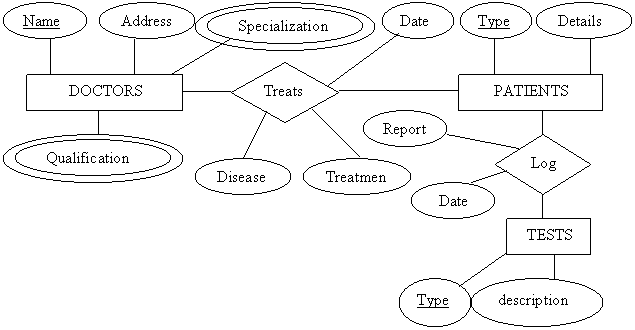
Q.21 Given the following relations :
vehicle (reg_no, make, colour)
Person (eno, name, address)
Owner (eno, reg_no)
Write expressions in relational algebra to answer the following queries :
(i) List the names of persons who do not own any car.
(ii) List the names of persons who own only Maruti Cars. (6)
Ans:
(i) pname(PERSON ⋈ peno(PERSON) - peno(OWNER))
(ii) pname(((peno(OWNER⋈smake=’maruti’(VEHICLE))
- peno(OWNER ⋈ smake¹’maruti’(VEHICLE))) ⋈
PERSON)
Q.22 Define
Join and Outer Join and differentiate between them. (4)
Ans: Join – It produces all the combinations
of tuples from two relations that satisfy a join condition. Outer Join - If there are any values in
one table that do not have corresponding value(s) in the other, in an equi-join
that will not be selected. Such rows can be forcefully selected by using the outer join. The corresponding columns
for that row will have NULLs. There are actually three forms of the
outer-join operation: left outer join ( ), right outer join (
 ) and full outer join (
 ).
).
Q.23 Consider the following relations
Physician (rgno, phyname, addr, phno)
Patient (ptname, ptaddr)
Visits(rgno, ptname, dateofvisit, fees-charged)
Answer the following in SQL :
(i) Define the tables. Identify the keys and foreign keys.
(ii) Create an assertion that the total fees charged for a patient can not be more than Rs.1000/- assuming that patients can visit the same doctor more than once.
(iii) Create a view Patient_visits(name, times) where name is the name of the patient and times is the number of visits of a patient.
(iv) Display the ptname, ptaddr of the patient(s) who have visited more than one physician in the month of May 2000 in ascending order of ptname. (3.5 x 4 = 14)
Ans:
(i) CREATE TABLE PHYSICIAN
( RGNO VARCHAR2(5) PRIMARY KEY,
PHYNAME VARCHAR2(15),
ADDR VARCHAR2(25),
PHNO VARCHAR2(10));
CREATE TABLE PATIENT
( PTNAME VARCHAR2(15) PRIMARY KEY,
PTADDR VARCHAR2(25));
CREATE TABLE VISITS
( RGNO VARCHAR2(5) REFERENCES PHYSICIAN(RGNO),
PTNAME VARCHAR2(15) REFERENCES, PATIENT(PTNAME),
DATEOFVISIT DATE,
FEE-CHARGED NUMBER(8,2),
CONSTRAINT VISITS_PK PRIMARY KEY(RGNO, PTNAME));
(ii) CREATE ASSERTION
CHECK ((SELECT SUM(FEES_CHARGED) FROM VISITS
WHERE PTNAME = :NEW.PTNAME AND RGNO = :NEW.RGNO) <= 1000)
(iii) CREATE VIEW PATIENT_VISITS (NAME, TIMES) ASSELECT PTNAME, COUNT(PTNAME) FROM VISITS GROUP BY PTNAME;
(iv) SELECT * FROM PATIENT
WHERE PTNAME IN (SELECT PTNAME FROM VISITS A, VISITS B
WHERE A.PTNAME = B.PTNAME AND A.RGNO <> B.RGNO
AND A.DATEOFVISIT BETWEEN TO_DATE(‘01-MAY-2000’) AND
TO_DATE(‘31-MAY-2000’)) ORDER BY PTNAME
Q.24 What are the advantages of having an index structure? (2)
Ans: The index
structures typically provide secondary access paths, which provide alternative
ways of accessing the records without affecting the physical placement of
records on disk. They enable efficient access to records based on the indexing
fields that are used to construct the index. Indexes are used to improve the
efficiency of retrieval of records from a data file.
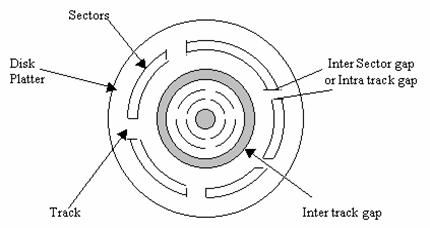
Q.25 What are the physical characteristics of magnetic disks? (4)
Ans: A magnetic disk is a circular plate or platter of plastic or metal which is coated with magnetizable material such as iron-oxide on both sides. Data are recorded on the disk surface in the form of tiny invisible magnetized spots (representing 1s) or non-magnetized spots (representing 0s). A conducting coil, named as Head, performs the job of reading and writing on the surface of magnetic disk. Generally, the head remains stationary while the disk rotates below it for reading or writing operation. The surface of the disk is divided into a number of concentric circles called as tracks. Number of tracks varies from disk to disk. Each track is further subdivided into sectors. Each sector of a disk is assigned a unique number. Each sector having the same capacity.
Q.26 Differentiate between B-tree and B+ tree (4)
Ans: A B-tree (or Balanced Tree) is a search tree with additional constraints that ensures that the tree is always balanced and that the space wasted by deletion, if any, never becomes excessive. In a B-tree, every value of the search field appears once at some level in the tree, along with a data pointer. In B+-tree, data pointers are stored only at the leaf nodes of the tree; hence, the structure of leaf nodes differs from the structure of internal nodes. The leaf nodes of the B+-tree are usually linked together to provide ordered access on the search field to the records. Some search field values from the leaf nodes are repeated in he internal nodes of the B+-tree to guide the search.
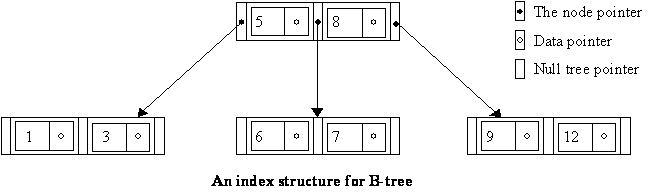
Q.27 Draw an index structure for B-tree. (4)
Ans:
Q.28 Consider the following relation
Professor (Pfcode, dept, head, time)
It
is assumed that
(i) A professor can work in more than one dept.
(ii) The
time he spends in each dept is given.
(iii) Each
dept has only one head
Draw
the dependency diagram for the above relation by identifying the dependencies. (2)
Ans:

Q.29 Normalize
the relation given Q.28. Justify each
step. (6)
Ans:
The key of the relation is {PFCODE, DEPT}. Partial functional dependency because DEPT à HEAD. So,
R1(PFCODE, DEPT, TIME)
R2(DEPT, HEAD)
R1 is not in 4NF because of multivalued dependency PFCODE àà DEPT.
So, final decompositions are:
R1(PFCODE, DEPT) F1={PFCODE àà DEPT}
R2(PFCODE, TIME)
R3(DEPT, HEAD) F2={DEPT à HEAD}
Q.30 Is the decomposition dependency preserving? (2)
Ans: We can see that PFCODE, DEPT à TIME is neither in F1 nor F2 in the given Q.28 and (F1 U F2)+ ¹ F+
So, it is not dependency preserving.
Q.31 Define multivalued dependency and 4NF. (4)
Ans: Multivalued Dependency – Let R be a relation schema and let a Í R and b Í R. The multivalued dependency
a àà b
holds
on R if, in any legal relation r(R), for all pairs of tuples t1 and
t2 in r such that
t1[a] = t2[a], there exist tuples t3 and t4 in r such that
t1[a] = t2[a] = t3[a] = t4[a]
t3[b] = t1[b]
t3[R - b] = t2[R - b]
t4[b] = t2[b]
t4[R - b] = t1[R - b]
Fourth
§
a àà b is a trivial multivalued dependency,
§
a is a
superkey for schema R.
Q.32 What do you understand by
transitive dependencies? Explain with an
example any two problems that can arise in the database if transitive dependencies
are present in the database. (7)
Ans: Suppose X, Y, and Z are the set of attributes. If X à Y and Y à Z then the functional dependency X à Z is a transitive functional dependency. In other words, if a nonkey attribute is also functionally dependent on the other nonkey attribute(s), then there is a transitive functional dependency. Transitive functional dependencies are also cause the data redundancies and the other consequences. For example, consider the following relation:
CREATE TABLE CONTACTS
( CONTACT_ID NUMBER(5) PRIMARY KEY,
L_NAME VARCHAR(20),
F_NAME VARCHAR(20),
COMPANY_NAME VARCHAR(20),
COMPANY_LOCATION VARCHAR(50))
In
the above relation, all the nonkey attributes are functionally dependent on the
primary key, i.e., CONTACT_ID. But, there is also a transitive functional
dependency exists in the relation – CONTACT_ID à COMPANY_LOCATION because CONTACT_ID
à
COMPANY_NAME and COMPANY_NAME à COMPANY_LOCATION. As a result of transitive dependency, there are anomalies in the above relation as follows:
· Insertion Anomaly – A new company cannot be inserted until a contact person has been assigned to that company.
· Deletion Anomaly – If a company has only one contact person and is deleted from the table, we will loose the information about that company, as the company information is associated with that person.
· Update Anomaly – If a company changes its location we will have to make the changes in all the records where the company name appears.
Q.33 Given R
{ABCD} and a set F of functional dependencies on R given as  . Find any two
candidate keys of R. Show each step. In what normal form is R? Justify. (7)
. Find any two
candidate keys of R. Show each step. In what normal form is R? Justify. (7)
Ans: To find out the candidate keys of a relation schema, R, based on given set of FDs, F, we can compute the closure of X (X+), where X is the set of attributes. If the X+ have all the attributes of the relation schema then X is the candidate key of R. With the given set of FDs, it is not possible to derive or access all the other attributes based on single attribute (e.g., {A}+ = {A}, {B}+ = {B}, {C}+ = {CA}, {D}+ = {DB}). Therefore, we have to chose the composite keys:
1. If we assume X = {AB} then X+ = {ABCD} because we can determine the attributes C and D from AB as per F.
2. If we assume X = {CD} then X+ = {CDAB} because we can determine the attributes A and B from C and D respectively as per F.
The other possible candidate keys are: {CB} and {AD}.
If we choose, {CD} as the primary key of the relation R, then FDs CàA and DàB are partial functional dependencies as CD is the key of the relation. Therefore, the given relation R is not in 2NF and therefore first normal form (1 NF).
Q.34 What is a query tree? (2)
Ans: A query tree, also called as operator graph, is a tree data structure that corresponds to a relational algebra expression. It represents the input relations of the query as leaf nodes of the tree, and represents the relational algebra operations as internal nodes or root node.
Q.35 What is meant by heuristic optimisation? Discuss the main heuristics that are applied
during query optimisation. (6)
Ans: In heuristic optimization, heuristics are used to reduce the cost of optimization instead of analyzing the number of different plans to find out the optimal plan. For example, A heuristic optimizer would use the rule ‘Perform selection operation as early as possible’ without finding out whether the cost is reduced by this transformation. Heuristics approach usually helps to reduce the cost but not always. The main heuristics that are applied during query optimization are:
· Pushes the selection and projection operations down the query tree
· Left-deep join trees – convenient for pipelined evaluation
· Non-left-deep join trees
Q.36 Consider the relations of Q.21. For the query
Select eno, name, reg_no
From Person, Owner
Where Person.eno = Owner.eno and Person.name = ‘Hari’
Draw
the initial query tree.
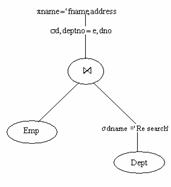
Optimise the query and draw the optimised query tree. (6)
Ans:
Assuming eno in the select statement refers to persons, the SQL statement will be:
Select Person.eno, name, reg_no From Person, Owner
Where Person.eno = Owner.eno and Person.name = ‘Hari’
To draw the query tree the SQL expression is to transformed into relational algebraic expression:
pPerson.eno, name, reg_no(sPerson.name=’Hari’(Person ⋈ Owner))

Q.37 How does the two phase protocol ensure serializability in database schedules? (4)
Ans: A transaction is said to follow the two-phase locking protocol if all locking operations precede the first unlock operation in the transaction. Such transaction can be divided into two phases: and expanding or growing (first) phase and a shrinking (second) phase. The two-phase locking protocol ensures serializability in database schedules. Consider any transaction. The point in the schedule where the transaction has obtained its final lock (the end of its growing phase) is called the lock point of the transaction. Now, transactions can be ordered according to their lock points – this ordering is, in fact, a serializability ordering for the transactions
Q.38 Give a schedule for three transactions T1, T2 and T3 such that the schedule
(i) observes two phase and
(ii) is not deadlock free.
Ans: (4)
|
|
|
Transaction T1 |
Transaction T2 |
Transaction T3 |
|
Time |
|
Write_lock(A) Read_item(A) Read_Lock(B) Read_item(B) A := A * B Write_item(A) Unlock(A) Unlock(B) |
Write_lock(B) Read_item(B) Read_lock(A) Read_item(A) B := A / B Write_item(B) Unlock(B) Unlock(A) |
Sum := 0 Read_lock(A) Read_lock(B) Read_item(A) Read_item(B) Sum := A + B Unlock(A) Unlock(B) |

Q.39 Describe
the algorithm to draw the dependency graph? (4)
Ans: Algorithm to draw Precedence Graph is as follows:
1. For each transaction Ti participating in schedule S, create a node labeled Ti in the precedence graph.
2. For each case in S where Tj executes a read_item(X) after Ti executes a write_item(X), create an edge (Ti à Tj) in the precedence graph.
3. For each case in S where Tj executes a write_item(X) after Ti executes a read_item(X), create an edge (Ti à Tj) in the precedence graph.
4. For each case in S where Tj executes a write_item(X) after Ti executes a write_item(X), create an edge (Ti à Tj) in the precedence graph.
5. The schedule S is serializable if and only if the precedence graph has no cycles.
Q.40 What is system log? What are the entries? (3)
Ans: The system log, which is usually written on stable storage, contains the redundant data required to recover from volatile storage failures and also from errors discovered by the transaction or the database system. System log is also called as log and has sometimes been called the DBMS journal. It contains the following entries (also called as log records):
· [start_transaction, T]: Indicates that transaction T has started execution.
· [write_item, T, X, old_value, new_value]: Indicates that transaction T has changed the value of database item X from old_value to new_value.
· [read_item, T, X]: Indicates that transaction T has read the value of database item X.
· [commit, T]: Indicates that transaction T has completed successfully, and affirms that its effect can be committed (recorded permanently) to the database.
· [abort, T]: Indicates that transaction T has been aborted.
Q.41 Discuss deferred update technique of recovery. What are the advantages? (6)
Ans: The deferred update techniques do not physically update the database on disk until after a transaction reaches its commit point; then the updates are recorded in the database. In other words, deferred update techniques postpone any actual updating of the database on disk until a transaction reaches its commit point. The transaction force-writes the log to disk before recording the updates in the database.
Advantages:
· If a transaction fails before reaching its commit point, it will not have changed the database in any way, so UNDO is not needed. Deferred update can lead to a recovery algorithm known as NO-UNDO/REDO.
· This approach, when used with certain concurrency control methods, is designed never to require transaction rollback, and recovery simply consists of redoing the operations of transactions committed after the last checkpoint from the log.
Q.42 How does the system cope up with a record crash when recovery is going on after the first crash. (2)
Ans: In a system the undo and redo operations are required to be idempotent to cope up with a record crash when recovery is going on after the crash. Due to the idempotent property, recovery process, while in the process of undoing or redoing the actions of a transaction, may fail without a trace, and this type of failure can occur any number of times before the recovery is completed successfully.
Q.43 Define check point and its impact on data base recovery. (3)
Ans: In a large on-line database
system there could be hundreds of transactions handled per minute. The log for
this type of database contains a very large volume of information. A scheme
called checkpoint is used to limit the volume of log information that has to be
handled and processed in the event of a system failure involving the loss of
volatile information. The checkpoint scheme is an additional component of the
logging scheme. A checkpoint operation, performed periodically, copies log
information onto stable storage. For all transactions active at checkpoint,
their identifiers and their database modification actions, which at that time
are reflected only in the database buffers, will be propagated to the
appropriate storage.
Q.44 Write
short notes on
a Wait for graph.
b Direct file organization.
c Canonical cover.
d. Timestamp ordering. (3.5
x 4)
Ans:
a The wait-for-graph is a directed graph and contains nodes and directed arcs; the nodes of the graph are active transactions. An arc of the graph is inserted between two nodes if there is a data-item is required by the node at the tail of the arc, which is being held by the node at the head of the arc. If there is a transaction Ti, waiting for a data-item that is currently allocated and held by transaction Tj, then there is a directed arc from the node for transaction Ti, to the node for transaction Tj. The wait-for-graph is used for detection of deadlock in the system. If there is cycle exits in the graph, all the transaction (represented as nodes) are in deadlock, which are in the cycle.
b. The direct file organization is used to improve the performance in accessing the records as compared to sequential file organization. In direct file organization, the key value is mapped directly to the storage location. The usual method of direct mapping is by performing some arithmetic manipulation of the key value. This process is called hashing. When using this organization, an application such as on-line transaction processing system can be designed so that centralized data are not only instantly accessible but are always up-to-date.
c. A canonical cover Fc for F is a set of dependencies such that F logically implies all dependencies in Fc, and Fc logically implies all dependencies in F. Fc must have the following properties:
· No functional dependency in Fc contains extraneous attribute
· Each left side of a functional dependency in Fc is unique. That is, there are no two dependencies a1 à b1 and a2 à b2 in Fc such that a1 = a2.
Fc is minimal in certain sense – it does not contain extraneous attributes, and it combines functional dependencies with the same left side. It is cheaper to test Fc than it is to test F itself.
d. In timestamp-based method, a serial order is created among the concurrent transaction by assigning to each transaction a unique nondecreasing number. The usual value assigned to each transaction is the system clock value at the start of the transaction, hence the name timestamp ordering. This value then can be used in deciding the order in which the conflict between two transactions is resolved. A transaction with a smaller timestamp value is considered to be an “older” transaction than another transaction with a larger timestamp value.
Q.45 Convert the following ER – diagram into a relational database (the
primary keys are underlined): (8)
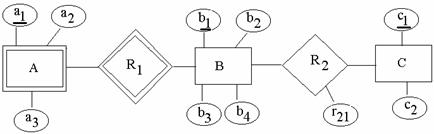
Ans: The relational database schema for the given ER diagram is as follows:
A(a1, b1, a2, a3)
B(b1, b2, b3, b4)
C(c1, c2)
D(b1, c1, r21)
Q.46 List two restrictions that are applied on the modification
(updation, insertion or deletion) of base tables through view. With the help of examples, explain why those
restrictions are required. (6)
Ans: The two restrictions are:
· If a view does not contain primary key and/or at least one of the attributes with the NOT NULL constraint that do not have default values specified, is not updatable. This restriction is required because if we are inserting any row in the view than all attributes not included in view of the base relation are will be represented by the NULLs if any default value is not specified. In that case, if any attribute is set as NOT NULL or primary key, then it must not be NULL, and the insertion will be violating the constraints.
· If a view defined using grouping and/or aggregate functions, is not updatable. This restriction is also required because, if we want to modify the base relation through view then we are not in the position to identify which tuple(s) will be modified in the group in what way.
For Example:
Employee:
EmpNo
|
Name |
Job |
Salary
|
|
1 |
Ramesh |
Salesman |
5000 |
|
2 |
John |
Clerk |
3000 |
|
3 |
Sanjeet |
Manager |
10000 |
|
4 |
Praveen |
Salesman |
4500 |
|
5 |
Rakesh |
Manager |
12000 |
View1: Create View Name_Job as Select Name, Job from Employee
View2: Create View Job, Sum(salary) from Employee Group By Job
In the view1 if we want to insert a new record, then the primary key constraint violates because primary key does not accept NULL. In the view2 if we want to make any modification (insertion, updation, or deletion) then it is difficult to identify the corresponding tuples of base relation from the view for the modification.
Q.47 Consider the following relations with key underlined
Customer (C#, Cname, Address)

 Item
(I#, Iname, Price, Weight)
Item
(I#, Iname, Price, Weight)
Order
(O#, C#, I#, Quantity)
Write SQL queries for the following:
a. List the names of customers who have ordered items weighing more than 1000 and only those.
b. List the names of customers who have ordered atleast one item priced over Rs.500.
c. Create a view called “orders” that has the total cost of every order. (9)
Ans:
(a) SELECT CNAME FROM CUSTOMER WHERE C# IN
(SELECT C# FROM ORDER
MINUS
SELECT C# FROM ORDER, ITEM
WHERE ORDER.I# = ITEM.I# AND WEIGHT <= 1000)
(b) SELECT CNAME FROM CUSTOMER WHERE C# IN
(SELECT C# FROM ORDER WHERE I# IN
(SELECT I# FROM ITEM WHERE PRICE > 500))
OR
SELECT
DISTINCT CNAME FROM CUSTOMER, ORDER, ITEM
WHERE CUSTOMER.C# = ORDER.C# AND ORDER.I# = ITEM.I#
AND PRICE > 500
(c) CREATE VIEW ORDERS (O#, TOTALCOST) AS
SELECT O#, SUM(QUANTITY * PRICE)
FROM ORDER, ITEM WHERE ORDER.I# = ITEM.I#
GROUP BY O#
Q.48 List
the Armstrong’s axioms for functional dependencies. What do you understand by soundness and
completeness of these axioms? (5)
Ans: The Armstrong’s axioms are:
· F1: Relexivity: If X is a set of attributes and Y Í X then X à Y holds.
· F2: Augmentation: If X à Y holds and Z is a set of attributes then XZ à YZ.
· F3: Transitivity: {X à Y, Y à Z}╞ {X à Z}
Soundness: By sound, we mean that a given set of functional
dependencies F specified on a relation schema R, any dependency that we can
infer from F by using F1 through F3 holds in every relation state r of R that
satisfies the dependencies in F.
Completeness: By complete, we mean that using F1 through F3
repeatedly to infer dependencies until no more dependencies can be inferred
results in the complete set of all possible dependencies that can be inferred
from F.
Q.49 Consider the following relations
Employee (E#, Ename, salary, Bdate, D#)
Department (D#, Dname, mgremp#, Location)
Dependent (E#, DependentName)
a. Write tuple calculus queries for the following:
(i) List the names of mangers who have at least one dependent.
(ii) List the names of
employees working for ‘research’ department. (6)
b. Write QBE queries for the following:
(i) List all the employees who earn more than the
average salary of all employees.
(ii) Increase the salary of managers by 10%.
(iii) List the names of all employees working in
(iv) Change the location of all
departments to “Mumbai” which have location as “
Ans:
(a) (i) List names of managers who have at least one dependent.
{m[Ename] | m Î EMPLOYEE Ù $u, t (t Î DEPENDENT
Ù u Î DEPARTMENT Ù t[E#] = u[mgremp#] Ù m[E#] = u[mgremp#])}
(ii) List the names of employees working for ‘research’ department.
{e[Ename] | e Î EMPLOYEE Ù $d (d Î DEPARTMENT
Ù d[Dname] = ‘research’ Ù e[D#] = d[D#])}
(b) (i) List all the employees who
earn more than the average salary of all employees.
|
EMPLOYEE |
E# |
Ename |
Salary |
Bdate |
D# |
|
Conditions |
|
P. |
EX |
NX
|
SX
AVG.ALL.SY |
BX
|
DX
|
|
SX > AVG.ALL.SY |
(ii) Increase the salary of managers by 10%.
|
DEPARTMENT |
D# |
Dname |
mgremp# |
Location |
|
|
|
|
MX
|
|
|
EMPLOYEE |
E# |
Ename |
Salary |
Bdate |
D# |
|
U. |
MX |
|
SX
SX * 1.1 |
|
|
(iii) List the names of all employees working in
|
DEPARTMENT |
D# |
Dname |
mgremp# |
Location |
|
|
DX |
|
|
|
|
EMPLOYEE |
E# |
Ename |
Salary |
Bdate |
D# |
|
|
|
P.NX
|
|
|
DX
|
(iv) Change
the location of all departments to “Mumbai” which have locations as “
|
DEPARTMENT |
D# |
Dname |
mgremp# |
Location
|
|
U. |
|
|
|
Mumbai |
Q.50 Consider the following relation:
|
A |
B |
C |
|
10 |
b1 |
c1 |
|
10 |
b2 |
c2 |
|
11 |
b4 |
c1 |
|
12 |
b3 |
c4 |
|
13 |
b1 |
c1 |
|
14 |
b3 |
c4 |
Given the above state, which of the following dependencies hold in the above relation at this point of time? If the dependency does not hold, explain why, by specifying the tuples that cause the violation
(i)  (ii)
(ii) 
(iii)  (iv)
(iv)

(v)  .
.
Does
the above relation have a potential candidate key? If it does, what is it? If it does not, why not? (7)
Ans:
|
S. No. |
FD |
Valid
/ Invalid |
Tuples that cause the violation |
|
(i) |
A à B |
Invalid |
1st and 2nd |
|
(ii) |
B à C |
Valid |
|
|
(iii) |
C à B |
Invalid |
3rd and 1st |
|
(iv) |
B à A |
Invalid |
1st and 5th, 4th and 6th |
|
(v) |
C à A |
Invalid |
1st, 3rd, and 5th |
Yes, the given relation has the potential candidate keys. The candidate keys are: {AB}, and {BC} because {AB}+ = {ABC} and {BC}+ = {BCA}.
Q.51 Find 3NF decomposition of the relation scheme,
R = {Faculty, Dean, Dept, Chairperson, Professor, Rank, Student} with the set of functional dependencies,
F
= {Faculty  Dean Department Chairperson
Professor
Rank, Chairperson Department Faculty
Student
Department, Faculty,Dean Dean
Faculty
Professor,
Rank Department, Faculty} (7)
Ans: To find out 3NF decomposition of a relation we use canonical cover (Fc).
Requirements for canonical cover (Fc):
1. Each FD in Fc must be simple.
F’ = {Faculty à Dean, Department à Chairperson, Professor à Rank, Professor à Chairperson, Department à Faculty, Student à Department, Student à Faculty, Student à Dean, Dean à Faculty, ProfessorRank à Department, ProfessorRank à Faculty}
2. Each FD in Fc must be left reduced.
As given in F, the attribute Rank is functionally dependent on the Professor. Therefore the FDs ProfessorRank à Department and ProfessorRank à Faculty can be left reduced to Professor à Department and Professor à Faculty respectively based on the Augmentation axiom.
F’’ = {Faculty à Dean, Department à Chairperson, Professor à Rank, Professor à Chairperson, Department à Faculty, Student à Department, Student à Faculty, Student à Dean, Dean à Faculty, Professor à Department, Professor à Faculty}
3. Each FD in Fc must be non-redundant.
The FDs Professor à Chairperson, Student à Faculty, Student à Dean and
Professor à Faculty are redundant and have to be removed based on the Transitivity axiom.
Fc
= {Faculty à Dean, Department à Chairperson, Professor à Rank, Department à Faculty, Student à Department, Dean à Faculty, Professor à Department}
To make lossless join decompositions, it is required to preserve the key of the original relation. The key of the relation R is {Professor, Student}. The 3NF decompositions of the given relation are:
R1 = {Faculty, Dean} F1= {Faculty à Dean, Dean à Faculty}
R2 = {Department, Chairperson, Faculty} F2 = {Department à Chairperson,Faculty}
R3 = {Professor, Rank, Department} F3 = {Professor à Rank,Department}
R4 = {Student, Department} F4 = {Student à Department }
R5 = {Professor, Student} F5 = {ProfessorStudent à f}
Q.52 Set R(A,B,C) and S(B,C,D) be the relations:
|
R: R: |
A |
B |
C |
S: |
B |
C |
D |
|
|
a |
c |
c |
|
c |
c |
a |
|
|
a |
e |
c |
|
d |
c |
a |
|
|
a |
c |
d |
|
e |
d |
b |
|
|
b |
d |
d |
|
|
|
|
Compute the following for the relations above:
(i)  (ii)
(ii)

(iii)  . (8)
. (8)
Ans: (i) R ¸ pc(S)
pc(S) R ¸ pc(S)
|
C |
|
A |
B |
|
c |
|
a |
c |
|
d |
|
|
|
(ii) pR.B, S.C (sA=D (R ´ S))
|
R.B |
S.C |
|
c |
c |
|
e |
c |
|
d |
d |
(iii) R
È S
|
A |
B |
C |
|
a |
c |
c |
|
a |
e |
c |
|
a |
c |
d |
|
b |
d |
d |
|
c |
c |
a |
|
d |
c |
a |
|
e |
d |
b |
Q.53 Consider
the decomposition of relation scheme, shipping = (Ship, Capacity, Date, Cargo, Value) with the set of functional
dependencies, F = {Ship Capacity
Ship, Date Cargo, Cargo, Capacity Value} into  ={Ship, Capacity}
with
={Ship, Capacity}
with  = {Ship Capacity} and
  ={Ship, Date, Cargo, Value} with
 ={Ship, Date Cargo, Value}.
Is
this decomposition in BCNF? Is this
decomposition lossless and dependency preserving? Justify your answers. (6)
Ans: The given
decomposition of the given relation is in BCNF because there is no overlapped
composite keys in the relation. The decomposition is lossless because the key
of the original relation {Ship,Date} is preserved in the decomposition R2. But
the decomposition is not dependency preserving because the FD Cargo,Capacity à Value is not implied by the set of
FDs {Ship à
Capacity, Ship,Date à Cargo,Value}
Q.54 What are deferred modification and immediate modification technique for recovery? How does recovery takes place in case of a failure in these techniques? (7)
Ans: Deferred Update – The deferred update techniques do not physically update the database on disk until after a transaction reaches its commit point; then the updates are recorded in the database. In other words, deferred update techniques postpone any actual updating of the database on disk until a transaction reaches its commit point. The transaction force-writes the log to disk before recording the updates in the database.
Immediate Update – The immediate update techniques may apply changes to the database on disk before the transaction reaches a successful conclusion. However, these changes are typically recorded in the log on disk by force writing before they are applied to the database, making recovery still possible.
Recovery – In deferred update technique, if a transaction fails before reaching its commit point, it will not have changed the database in any way, so UNDO is not needed. Deferred update can lead to a recovery algorithm known as NO-UNDO/REDO. This approach, when used with certain concurrency control methods, is designed never to require transaction rollback, and recovery simply consists of redoing the operations of transactions committed after the last checkpoint from the log. In immediate update technique, if a transaction fails after recording some changes in the database but before reaching its commit point, the effect of its operations on the database must be undone; that is, the transaction must be rolled back. This technique requires both operations and is used most often in practice. Therefore, it is also known as UNDO/REDO.
Q.55 What
are the two integrity rules? Explain
with examples how these rules are important to enforce consistent database
states. (7)
Ans: The two integrity rules are: Entity Integrity Rule and Referential Integrity Rule.
Entity Integrity Rule – If the attribute A of relation R is a prime attribute of R then A cannot accept null values.
Referential Integrity Rule – In referential integrity, it is ensured that a
value that appears in one relation for a given set of attributes also appears
for a certain set of attributes in another relation.
For example:
STUDENT
|
Enrl
No |
Roll No |
Name |
City |
|
|
11 |
17 |
Ankit Vats |
|
9891663808 |
|
15 |
16 |
Vivek Rajput |
|
9891468487 |
|
6 |
6 |
Vanita |
|
|
|
33 |
75 |
Bhavya |
|
9810618396 |
GRADE
|
Roll No |
Course |
Grade
|
|
6 |
C |
A |
|
17 |
VB |
C |
|
75 |
VB |
A |
|
6 |
DBMS |
B |
|
16 |
C |
B |
· Roll No is the primary key in the relation STUDENT and Roll No + Course is the primary key of the relation GRADE - (Entity Integrity). Primary keys ensure that any prime attribute must not be NULL.
· Roll No in the relation GRADE (child table) is a foreign key, which is referenced from the relation STUDENT (parent table) - (Referential Integrity). Referential integrity here ensures that the values in the foreign key must belongs to it parent key or it may be entirely NULL.
Q.56 What are the various states
through which a transaction passes through in its lifetime? Briefly discuss all the events that causes
transition from one state to another. (7)
Ans: A transaction can be considered to be an atomic operation by the user, but actually it goes through a number of states during its lifetime as given follows:
§ Active, the initial state; the transaction stays in this state while it is executing
§ Partially Committed, after the initial statement has been executed
§ Failed, after the discovery that normal execution can no longer proceed
§ Aborted, after the transaction has been rolled back and the database has been restored to its state prior to the start of the transaction
§
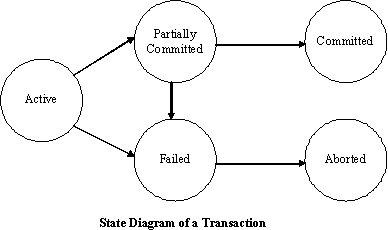 Committed, after successful completion.
It is assumed that before a transaction starts, the database is in a consistent state. A transaction starts when the first statement of the transaction is executed; it becomes active. After any outcome, the database will be considered in consistent state.
Q.57 Consider three transactions :  ,
,  and
and  . Draw the precedence
graph for the following schedule consisting of these three transactions and
determine whether it is serializable. If
so, give its serial order(s). (7)
. Draw the precedence
graph for the following schedule consisting of these three transactions and
determine whether it is serializable. If
so, give its serial order(s). (7)
|
Time |
T1 |
T2 |
T3 |
|
|
|
|
read(Y) |
|
|
|
|
read(Z) |
|
|
read(X) |
|
|
|
|
write(X) |
|
|
|
|
|
|
write(Y) |
|
|
|
|
write(Z) |
|
|
|
read(Z) |
|
|
|
read(Y) |
|
|
|
|
write(Y) |
|
|
|
|
|
read(Y) |
|
|
|
|
write(Y) |
|
|
|
|
read(X) |
|
|
|
|
write(X) |
|
 :
: :
: :
:


Ans:
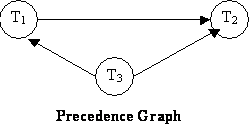
The given schedule is serializable. The serial orders of the transactions are: T3, T1, and T2.
Q.58 Which sorting technique is
used to sort databases, whose sizes are very big? Give one such algorithm. Why do sorting techniques like quicksort,
insertion sort, etc. not applied on very
big databases? (7)
Ans: To sort a large database or file, the sort-merge (or k-way merge) algorithm is widely used. This is one of the external sorting algorithms. External sorting algorithm refers to sorting algorithms that are suitable for large file of records stored on disk that do not fit entirely in main memory, such as most database files. The sort-merge algorithm starts by sorting small subfiles -–called runs – of the main file and then merges the sorted runs, creating larger sorted subfiles that are merged in turn. Like other database algorithms, it requires buffer space in main memory, where the actual sorting and merging of the runs is performed. This algorithm consists of two phases: (1) the sorting phase, and (2) the merging phase.
The sorting techniques like quick sort, insertion sort, etc. are not applied on large databases because these are internal sorting algorithms, which requires buffer space in main memory. The space complexity of these algorithms are O(n) and require a large buffer space in main memory to sort the large database. Therefore, internal sorting algorithms are not applied on large databases.
Q.59 Insert the keys below in the order stated into an initially empty B-tree of order 3. Show all intermediate steps
a g f b k d h m j e s i r (7)

Ans:

Q.60 What are wait-for-graphs? Give the algorithm to construct a
wait-for-graph from a given schedule of transactions? How can deadlocks be detected from
wait-for-graphs? (7)
Ans: The wait-for-graph is a directed graph and contains nodes and directed arcs; the nodes of the graph are active transactions. An arc of the graph is inserted between two nodes if there is a data-item is required by the node at the tail of the arc, which is being held by the node at the head of the arc.
Algorithm to construct wait-for-graph is as
follows:
1. For each transaction Ti active at the time of deadlock detection, create a node labeled Ti in the wait-for-graph.
2. For each case, if there is a transaction Ti, waiting for a data-item that is currently allocated and held by transaction Tj, then there is a directed arc from the node for transaction Ti, to the node for transaction Tj.
3. For each case, if there is a directed arc from the node for transaction Ti, to the node for transaction Tj and transaction Tj released the lock, then remove the arc between them.
4. There no deadlock if the wait-for-graph is acyclic.
The wait-for-graph is used for detection of deadlock in the system. If there is any cycle exits in the wait-for-graph, all the active transaction (represented as nodes) are in deadlock, which are in the cycle.
Q.61 What is
the need of a log in a DBMS? Briefly describe the various types of records that
are normally present in a log. (7)
Ans: The system log, which is usually written on stable storage, contains the redundant data required to recover from volatile storage failures and also from errors discovered by the transaction or the database system. System log is also called as log and has sometimes been called he DBMS journal. It contains the following entries (also called as log records):
· [start_transaction, T]: Indicates that transaction T has started execution.
· [write_item, T, X, old_value, new_value]: Indicates that transaction T has changed the value of database item X from old_value to new_value.
· [read_item, T, X]: Indicates that transaction T has read the value of database item X.
· [commit, T]: Indicates that transaction T has completed successfully, and affirms that its effect can be committed (recorded permanently) to the database.
· [abort, T]: Indicates that transaction T has been aborted.
Q.62 Write short notes on (any FOUR) of
the following:
(i) Deadlock recovery measures.
(ii) Query optimisation.
(iii) Hashing techniques.
(iv) Two phase locking protocol.
(v) ANSI SPARC architecture.
(vi) Domain calculus. (3.5 x 4=14)
Ans:
(i) To recover from deadlock, the cycle in the wait-for-graph must be broken. The common method of doing this is to rollback one or more transactions in the cycles until the system exhibits no further deadlock situation. The selection of the transaction to be rolled back is based on the following deadlock recovery measures:
· The progress of the transaction and the number of data-items it has used and modified. It is preferable to rollback a transaction that has just started or has not modified any data-item.
· The amount of computing remaining for the transaction and the number of data items that have yet to be accessed by the transaction. It is preferable not to rollback a transaction it has almost run to completion and/or it needs very few additional data-items before its termination.
· The relative cost of rolling back a transaction. It is preferable to roll back a less important or non-critical transaction.
(ii) The query parser typically generate a standard initial tree to correspond to an SQL query, without doing any optimization. Such a canonical query tree represents a relational algebra expression that is very inefficient if executed directly. A query typically has many possible execution strategies, and the process of choosing a suitable one for processing a query is known as query optimization. The main guidelines that are applied during query optimization are:
· Combine a cascade of selections
· Combine a cascade of projections
· Commute selection and projection
· Commuting selection with join or cartesian product Commuting projection with join or cartesian product
· Commute projection with set operations
· Commute selection with set operations
(iii) The hashing techniques can be classified as:
Static Hashing Techniques – In this technique, the data can be viewed a collection of buckets, with one primary page and possibly additional overflow pages per bucket. A file consists of buckets 0 through N-1, with one primary page per bucket initially and additional overflow pages chained with bucket, if required later. Buckets contain data entries (or data records). A major drawback of the static hashing is that the hash address space is fixed. Hence, it is difficult to expand or shrink the file dynamically.
Dynamic Hashing Techniques – There are two schemes in it: extendible hashing – stores an access structure in addition to the file , and hence is somewhat similar to indexing. The main difference is that the access structure is based on the values that the result after application of the hash function to the search field. The second one is, linear hashing – does not require additional access structures.
(iv) A transaction is said to follow the two-phase locking protocol if all locking operations precede the first unlock operation in the transaction. Such transaction can be divided into two phases: and expanding or growing (first) phase, during which new locks on items can be acquired but none can be released; and a shrinking (second) phase, during which existing locks can be released but no new locks can be acquired. This two-phase protocol can ensure the serializability because all the data items required by a transaction will be locked at the beginning of the transaction and if other transaction wants to use those data items then it has to wait until they become unlocked.
(v) The three-schema architecture is also known as ANSI SPARC architecture. The goal of the three-schema architecture is to separate the user applications and the physical database. The view at each of these levels is described by a schema. The processes of transforming requests and results between levels are called mappings. In this architecture, schemas can be defined at the following three levels:
· External Level or Subschema – It is the highest level of database abstraction where only those portions of the database of concern to a user or application program are included. Any number of user views may exist.
· Conceptual Level or Conceptual Schema - At this level of database abstraction all the database entities and the relationships among them are included. There is only one conceptual schema per database.
· Internal Level or Physical Schema – It is closest to the physical storage method used.
(vi) Domain calculus is one of the type of the relational calculus. The formal specification of the domain calculus was proposed after the development of the QBE system. Domain calculus has the variables range over single value from domains of attributes. To form a relation degree n for a query result, we must have n domain variables – one for each attribute. An expression of the domain calculus is of the form
{X | F(X)}
Where F is a formula on X and X represents a set of domain variables. The expression characterizes X such that F(X) is true.
Q.63 Describe five main functions of a
database administrator. (5)
Ans:
A database administrator (DBA) is a
person who is responsible for the environmental aspects of a database. In
general, these include:
· Recoverability -
Creating and testing Backups
· Integrity - Verifying
or helping to verify data integrity
· Security - Defining
and/or implementing access controls to the data
· Availability -
Ensuring maximum uptime
· Performance -
Ensuring maximum performance
· Development and testing support - Helping programmers and engineers to efficiently utilize the database.
Q.64 Define the following with respect to an E-R diagram. Explain the manner in which each is mapped to a table. Illustrate with an example.
(i) Relationship set. (ii) Aggregation.
(iii) Multivalued attribute. (9)
Ans:
(i) Relationship set: It is a set of relationships of
same type. Formally, it is a mathematical relation on n >=2 entity sets. If
E1, E2-----,En are entity sets, then a
relationship set R is a subset of { (e1, e2,-----, en) | e1, e1 ε
E1, e2 ε E 2 , ----, en ε En } where (e1,e2,----,en) is a relationship
Mapping to a table: Let R be a relationship set, let a1, a2,-----, am
be set of attributes formed by the union primary keys of each of entity
sets participating in R, and let the descriptive attributes (if any) of R be b1,b2,------bn.
Then the table corresponding to R will have one column for each attribute of
the set: { a1, a2, ----, am) U { b1,
b2,----bn}
Eg, given an ER diagram as
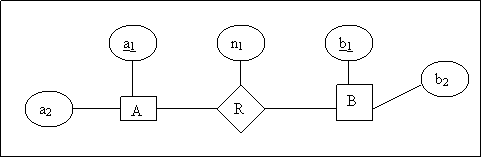
The table corresponding to R will be R(a1, b1, r1)
ii) Aggregation: It is an abstraction through which relationships are treated as higher level entities.
Mapping to a table: This is explained through following example. Consider the E-R diagram given below:
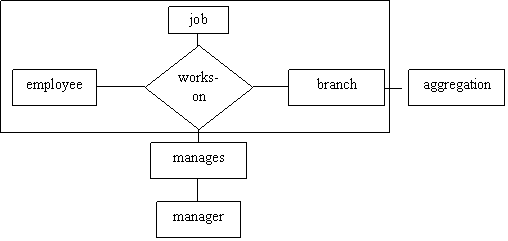
The table for relationship set manages between aggregation onworks-on and entity set manager includes a column for each attribute in primary keys of entity set manages and relationship set works. It would also include a column for any descriptive attribute if they exist, of relationship manages.
iii) Multivalued attribute: An attribute that is having more than one values for a given attribute. Eg, Telephone no. of an employee
Mapping to a table: For a multivalued attribute M, a table is created with a column C that corresponds to M and columns corresponding to the primary key of the entity set or relationship set of which M is an attribute. Eg, Given ER diagram as below:
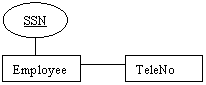
The corresponding table will be Telephone (SSN, TeleNo)
Q.65 Consider the following relations with primary keys underlined.
Salesperson (SNo, Sname, Designation)
Area (ANo, Aname, ManagerNo)
Product (PNo, Pname, Cost)
SAP (SNo, ANo, PNo)
(a) Define the schema in SQL specify the
attributes, and keys assuming that ManagerNo is a foreign key. Specify the constraint that the cost of a
product cannot be greater than Rs.10000/-. (5)
(b) Answer using SQL
(i) Get the names of all the products that are sold.
(ii) Get the product numbers which are marketed by alteast two sales persons.
(iii) Get
the names of all salespersons who are not Managers. (9)
Ans:
(a) Create table Salesperson ( SNo number(3) primary key, Sname char(30), Destination char(15));
Create table Area (Ao number(3) primary key, Aname char(30), ManagerNo number(3) references Salesperson(SNo));
Create table Product ( PNo number(3) primary key, Pname char(30), Cost number(5) check cost < 100000);
Create table SAP (SNo number(3), ANo number(3), PNo number(3), primary key (SNo, ANo, PNo), SNo references Salesperson(SNo), PNo references Product(PNo), ANo references Area (ANo));
(b)
(i) Select PNo from Product, SAP where Product. PNo = SAP.PNo;
(ii) Select T1.PNo from SAP T1, SAP T2 where T1.PNo= T2.PNo and
T1.SNo <> T2.SNo;
(iii) Select Sname from Salesperson where designation <> ‘Managers’.
Q.66 What is the basic
difference between relational algebra and relational calculus? Define the atoms in tuple relational
calculus. Use these to define the
formulae. (5)
Ans: An algebra consists of a set of objects and a set of operators that together satisfy certain axioms or laws (such as closure, commutativity, associativity, and so on). The word "algebra" itself ultimately derives from Arabic al-jebr, meaning a resetting (of something broken) or a combination.
Relational calculus is an applied form of a fundamental branch of logic called predicate calculus. In general, the term "calculus" signifies merely a system of computation (the Latin word calculus means a pebble, perhaps used in counting or some other form of reckoning). Thus, relational calculus can be thought of as a system for computing with relations
Atoms
For
the construction of the formulas we will assume an infinite set V of tuple
variables. The formulas are defined given a database schema S = (D, R, h) and a
partial function type : V -> 2C that
defines a type assignment that assigns headers to some tuple variables.
We then define the set of atomic formulas A[S,type]
with the following rules
1. if
v and w in V, a in type(v) and b
in type(w) then the formula " v.a = w.b
" is in A[S,type],
2. if v in V, a in type(v) and k denotes a value in D then the formula " v.a = k " is in A[S,type], and
3. if v in V, r in R and type(v) = h(r) then the formula " r(v) " is in A[S,type].
Examples of atoms are:
· (t.age = s.age) — t has an age attribute and s has an age attribute with the same value
· (t.name = "Codd") — tuple t has a name attribute and its value is "Codd"
· Book(t) — tuple t is present in relation Book.
The formal semantics of
such atoms is defined given a database db over S and a tuple
variable binding val : V -> TD that
maps tuple variables to tuples over the domain in S:
1. " v.a = w.b
" is true if and only if val(v)(a) = val(w)(b)
2. " v.a = k "
is true if and only if val(v)(a) = k
3. " r(v) " is true
if and only if val(v) is in db(r)
 The atoms can be combined into formulas,
as is usual in first-order logic, with the logical operators Λ (and), V (or)
and ¬ (not), and we can use the existential quantifier ($)
and the universal quantifier (∀) to bind the variables. We define the set of formulas F[S,type]
inductively with the following rules:
The atoms can be combined into formulas,
as is usual in first-order logic, with the logical operators Λ (and), V (or)
and ¬ (not), and we can use the existential quantifier ($)
and the universal quantifier (∀) to bind the variables. We define the set of formulas F[S,type]
inductively with the following rules:
1. every atom in A[S,type]
is also in F[S,type]
2.  if f1 and f2
are in F[S,type] then the formula " f1
V f2 " is also in F[S,type]
if f1 and f2
are in F[S,type] then the formula " f1
V f2 " is also in F[S,type]
3. if f1 and f2
are in F[S,type] then the formula " f1
Λ f2 " is also in F[S,type]
4. if f is in F[S,type]
then the formula " ¬ f " is also in F[S,type]
5. if v in V, H a header
and f a formula in F[S,type[v->H]]
then the formula " $ v : H ( f )
" is also in F[S,type], where type[v->H]
denotes the function that is equal to type except that it maps v
to H,
6. if v in V, H a header
and f a formula in F[S,type[v->H]]
then the formula” ∀v : H ( f ) " is also in F[S,type]
Example of formula:
t.name = "C. J. Date" ∀ t.name = "H. Darwen"
Q.67 Consider the following relations
Person (name, street, city)
Owns (name, reg_no, model, year)
Accident (date, reg_no)
Answer the following using tuple relational calculus
(i) Find the names of persons who are not involved in any accident.
(ii) Find the names and street of persons who own a maruti car.
(iii) Find the registration numbers of
the cars manufactured in the year 2004. (9)
Ans:
(i) {t[name]½t Є owns Ù Ø $a Є Accident(t[reg-no]
= a[reg-no])}
(ii) {t[name], t[street] ½t Є person Ù $ O Є Owns(t[name]= O[name] Ù O[model]
=’Maruti’)}
(iii) {t[reg-no] ½ tЄ owns Ù t(year] = 2004}
Q.68 Define functional and multivalued
dependencies. (2)
Ans: A functional dependency is a property of the semantics of the attributes in a relation. The semantics indicate how attributes relate to one another, and specify the functional dependencies between attributes. When a functional dependency is present, the dependency is specified as a constraint between the attributes. Consider a relation with attributes A and B, where attribute B is functionally dependent on attribute A. If we know the value of A and we examine the relation that holds this dependency, we will find only one value of B in all of the tuples that have a given value of A, at any moment in time. Note however, that for a given value of B there may be several different values of A.
Multivalued
Dependencies: A
multivalued dependency is an outcome of two independent 1: N relationships A: B
and A: C being mixed in the same relation R(A,B,C)
Q.69 Consider the relation Student (stid, name, course, year)
Given that
A student may take more than one course but has unique name and the year of joining. (i) Identify the functional and multivalued dependencies for Student. (4)
(ii) Identify a candidate key using the functional and multivalued dependencies arrived at in step (b). (4)
(iii) Normalize the relation so that every decomposed relation is in 4NF. (4)
Ans:
(i)
F.D are:
stid →
name, year
M.V.D. are: stid →→ Course
course →→ stid
(ii) Candidate Keys: (stid, course)
(iii) Since in both the MVDs, LHS is not a
superkey . Therefore decomposition is as follows:
R1( stid, name, year) Primary Key = stid
R2(stid, course) Primary Key = (stid, course)
Foreign Key = stid
Q.70 Explain the following
(i) ISA relationship.
(ii) NULL value.
(iii) Trigger.
(iv) EXEC statement in SQL. (2 x 4)
Ans:
(i) ISA notation is used in generalization/ specialization to show relationship between lower and higer level entity set.
(ii) NULL value NULL means something is unknown. It does NOT mean null (the digit 0). Null is also used as attribute value for a particular entity where attribute is not applicable eg, name of child for unmarried.
(iii)
Trigger: A database trigger is procedural code that
is automatically executed in response to certain events on a particular table
in a database.
Triggers can restrict access to specific data, perform logging, or audit data
modifications.
(iv)
EXEC statement
in SQL
Q.71 Define a view ProductArea in relational algebra and SQL,
using the relations of question (65) above, which contains the area name and the names of
products sold in that area. (6)
Ans: Πaname, pname (Area
⋈ SAP ⋈ Product)
Create
view ProductArea as select Aname, Pname from Area, Product, SAP
where SAP.PNo = Product.PNo and SAP.ANo=
Area. ANo
Q.72 Compare the two method for storing
variable length records – byte string representation and fixed length
representation. Discuss the merits and
demerits of the two. (6)
Ans: Variable-Length Records
Variable-length records arise in a database in several ways:
· Storage of multiple items in a file
· Record types allowing variable field size
· Record types allowing repeating fields
Byte
string representation uses the technique of
attaching a special end-of record symbol( )to the end of
each record. Then we can store each record as a string of successive bytes.
)to the end of
each record. Then we can store each record as a string of successive bytes.
Byte string representation has several disadvantages:
· It is not easy to re-use space left by a deleted record
· In general, there is no space for records to grow longer. (Must move to expand, and record may be pinned.)
So this method is not usually used.
Fixed-length representation uses one or more fixed-length records to represent one variable-length record. Two techniques:
· Reserved space - uses fixed-length records large enough to accommodate the largest variable-length record. (Unused space filled with end-of-record symbol.)
· Pointers - represent by a list of fixed-length records, chained together.
The reserved space method requires the selection of some maximum record length. If most records are of near-maximum length this method is useful.
o Otherwise, space is wasted.
o Then the pointer method may be used .
o Disadvantage is that space is wasted in successive records in a chain as non-repeating fields are still present.
o To overcome this last disadvantage we can split records into two blocks
· Anchor block - contains first records of a chain
· Overflow block - contains records other than first in the chain.
o Now all records in a block have the same length, and there is no wasted space.
Q.73 Describe
the different RAID levels. Discuss the
choices of the different RAID levels for different applications. (8)
Ans: There are various combinations of these approaches giving different trade offs of protection against data loss, capacity, and speed. RAID levels 0, 1, and 5 are the most commonly found, and cover most requirements.
§ RAID 0 (striped disks) distributes data across several disks in a way that gives improved speed and full capacity, but all data on all disks will be lost if any one disk fails.
§ RAID 1 (mirrored disks) could be described
as a backup solution, using two (possibly more) disks that each store the same
data so that data is not lost as long as one disk survives. Total capacity of
the array is just the capacity of a single disk. The failure of one drive, in
the event of a hardware or software malfunction, does not increase the chance
of a failure nor decrease the reliability of the remaining drives (second,
third, etc).
§ RAID 2 It uses memory style redundancy by
using Hamming codes, which contain parity bits for distinct overlapping subsets
of components.
§ RAID 3 It uses a single parity disk relying on the disk controller to figure out which disk has failed.
§ RAID 4 It uses block-level data striping.
§ RAID 5 (striped disks with parity) combines three or more disks in a way that protects data against loss of any one disk; the storage capacity of the array is reduced by one disk.
§ RAID 6 (less common) can recover from the loss of two disks through P + Q redundancy scheme using Reed- Adoman codes
Q.74 Define two-phase
locking protocol. (2)
Ans: Two-phase locking is important in the context of ensuring that schedules are serializable. The two-phase locking protocol specifies a procedure each transaction follows.
The
two-phase locking protocol
1. Before operating on any row, a transaction must acquire a lock
on that row.
2. After releasing a lock, a transaction must never acquire any
more locks.
Q75 Differentiate
between strict two-phase and rigorous two-phase with conversion protocol (4)
Ans: Strict
two-phase locking holds all its exclusive (write)
locks until commit time, once granted. While Rigorous two-phase locking is more restrictive than standard 2PL in
that it enforces the rule that no locks can be released by a transaction until
after it commits or aborts. The former locks all its items before it starts so
once transaction starts, it is in its shrinking phase whereas latter does not
unlock any of its items until after it terminates to the transaction is in its
expanding phase until it ends.
Q.76
Describe the nested-loop join and block-nested loop join. Compare them. (8)
Ans: The block nested- loop join algorithm is as given below: for
each block Br of relation R do begin
for
each block Bs of relation S
do begin for
each tuple tr in Br do begin for
each tuple ts in Bs do begin test pair (tr,ts) to
see if they satisfy the join condition if they do, add tr.ts
to the result end
end
end
end
The nested-loop from algorithm is as below:
for each tuple tr in relation R
do begin
for each tuple ts in
relation S do begin
test
pair (tr,ts) to see if they satisfy the join condition
Ө
if
they do, add tr.ts to the result
end
end
Difference between them:
|
Nested loop join |
Block-nested-loop join |
|
It is expensive as worst case
cost, no. of block accesses required is nr * bs + br
where bs and br represent no. of
blocks containing ns and nr tuples
of relations S and R, respective and in best case there will be br
+ bs block accesses |
In worst case no. of block accesses
is br*bs + br. In best case, br
+bs block accesses will be required. |
Q.77 Two relations R with 60000 tuples
and occupying of 300 blocks is to be joined with a relation S with 40000 tuples
and occupying 400 blocks. What is the
total cost using the two algorithms of (Q 76) above in terms of block
transfers. Give both the best case and
the worst case figures. (6)
Ans:
Nested-loop-join:
Worst Case: If R as the outer relation 60000 Χ
400 + 300 = 24000300 Disk
access, if S as the outer relation we need 40000 Χ 300 + 400 = 12000400 disk accesses
Best Case: 300 + 400 = 700 disk accesses will be required.
Block-nested loop join:
Worst Case: If R is the outer relation, we need 300 * 400 + 300 =
120300 disk access, if S is the outer relation we need 400 * 300 + 400
= 120400 disk access
Best Case: 300+ 400 = 700 disk accesses will be required.
Q.78 Explain the ACID properties of a transaction. (6)
Ans: ACID properties are an important concept for databases. The acronym stands for Atomicity, Consistency, Isolation, and Durability.
Atomicity: Either all operations of transaction are reflected properly in the database or none are.
Consistency: Execution of a transaction in isolation (i.e., with no other transaction executing concurrently) preserves the consistency of the database
Isolation: Even though multiple transactions may execute concurrently the system guarantees that for every pair of transaction Ti and Tj, it appears to Ti that either Tj that either Tj finished execution before Ti started or Tj started execution after Ti finished. Thus each transaction is unaware of other transactions executing concurrently in the system.
Durability: After a transaction completes successfully, the changes it has made to the database persist, even if there are system failures.
Q.79 Compare
wait-die deadlock prevention scheme with wait-wound scheme. (4)
Ans:
Wait-Die Scheme
§ Based on a nonpreemptive technique.
§ If Pi requests a resource currently held by Pj, Pi is allowed to wait only if it has a smaller timestamp than does Pj ( Pi is older than Pj). Otherwise, Pi is rolled back (dies).
§ Example: Suppose that processes P1, P2, and P3 have timestamps 5, 10, and 15, respectively.
§ If P1 requests a resource held by P2, then P1 will wait.
§ If P3 requests a resource held by P2, then P3 will be rolled back.
Wound-Wait
Scheme
§ Based on a preemptive technique; counterpart to the wait-die system.
§ If Pi requests a resource currently held by Pj, Pi is allowed to wait only if it has a larger timestamp than does Pj ( Pi is younger than Pj). Otherwise, Pj is rolled back ( Pj is wounded by Pi).
§ Example: Suppose that processes P1, P2, and P3 have timestamps 5, 10, and 15, respectively.
§ If P1 requests a resource held by P2, then the resource will be preempted from P2 and P2 will be rolled back.
§ If P3 requests a resource held by P2, then P3 will wait.
Q.80 What are the costs to be considered when a transaction has to be
rolled back when recovering from deadlock? (4)
Ans: Some transaction will have to rolled back (made a victim) to break deadlock. Select that transaction as victim that will incur minimum cost.
§ Rollback -- determine how far to roll back transaction.
§ Total rollback: Abort the transaction and then restart it.
§ More effective to roll back transaction only as far as necessary to break deadlock.
§ Starvation happens if same transaction is always chosen as victim. Include the number of rollbacks in the cost factor to avoid starvation.
Q.81 Write short notes on
(i) Views in relational algebra.
(ii) Data dictionary.
(iii) Assertions in SQL.
(iv)  tree. (3.5 x 4=14)
Ans:
(i) Views in relational algebra:
1. basic expression consists of either
o A relation in the database.
o A constant relation.
2. General expressions are formed out of smaller sub expressions using
o sp(E1) select (p a predicate)
o ∏s(E1) project (s a list of attributes)
o Px(E1 )rename (x a relation name)
o E1ÈE2 union
o E1- E2 set difference
o E1x x E2 cartesian product
(ii) Data dictionary
A data dictionary is a reserved space within a database which is used to store information about the database itself.
A data dictionary may contain information such as:
§ Database design information
§ Stored SQL procedures
§ User permissions
§ User statistics
§ Database process information
§ Database growth statistics
§ Database performance statistics
(ii)
Assertions in SQL
1.
An assertion
is a predicate expressing a condition we wish the database to always satisfy.
2.
Domain
constraints, functional dependency and referential integrity are special forms
of assertion.
3.
Where
a constraint cannot be expressed in these forms, we use an assertion, e.g.
o
Ensuring
the sum of loan amounts for each branch is less than the sum of all account
balances at the branch.
o
Ensuring
every loan customer keeps a minimum of $1000 in an account.
(iv) B+ tree
B+ tree is a type of tree which represents sorted
data in a way that allows for efficient insertion, retrieval and removal of
records, each of which is identified by a key. It is a dynamic,
multilevel index, with maximum and minimum bounds on the number of keys in each
index segment (usually called a 'block' or 'node'). In a B+ tree, in contrast
to a B-tree, all records are stored at the lowest level of the tree; only keys
are stored in interior blocks.
The primary value of a B+
tree is in storing data for efficient retrieval in a block-oriented storage
context. Given a storage system with a block size of b,
a B+ tree which stores a number of keys equal to a multiple of b will be very efficient when compared to a binary
search tree (the corresponding data structure for non-block-oriented storage
contexts).
Q.82 What
is completeness constraint on generalization?
Explain the difference between total and partial design constraint. Give an example each. (6)
Ans: Completeness Constraints
o total specialization constraint
§ every entity in the superclass must be a member of some subclass in the specialization
e.g., {HOURLY_EMPLOYEE, SALARIED_EMPLOYEE}
§ notation: superclass
o partial specialization constraint
an entity may not belong to any of the subclasses
e.g., {SECRETARY, ENGINEER, TECHNICIAN}
Q.83 Design a
generalization-specialization hierarchy for a motor-vehicle sales company. The company sells motorcycles which have an
engine number and cost; cars which have a chassis number, an engine number,
seating capacity and cost; trucks which have chassis number, an engine number
and cost. (10)
Ans:
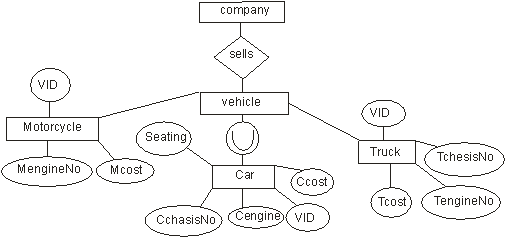
Q.84 Define the following operations of relational algebra and give an example each
(i) Division.
(ii) Cartesian product. (7)
Ans:
(i) Division:
Let R be a relation having attributes (A1,...Ap,Ap+1,...An) and S having attributes (Ap+1,...An)
DEF: Division
The division of R by S, denoted R ¸ S, gives a new relation Q, the quotient of the division, such that Q has attributes (A1,...Ap) and every tuple of Q must appear in R in combination with every tuple in S.
The division can be obtained from the difference, the Cartesian product and the projection as follows:
R ¸ S = T - Y, where T = pA1,...Ap (R ) and Y = p A1,...Ap ( (T X S) - R)
ii) Cartesian product:
The Cartesian product operation does not require relations to union-compatible. It means that the involved relations may have different schemas. Let R & S be relations that may have different schemas.
DEF: Cartesian
Product
The Cartesian product of relations R and S, denoted R X S, is the set of all possible combinations of tuples of the two operation relations. Each resultant tuple consists of all the attributes of R and S.
The resultant relation has
cardinality = (cardinality of R) * (cardinality of S); and
arity = (arity of R) + (arity of S).
For example, in given table, STUDENT X MODULE is equal to
|
STUDENT-NAME |
COURSE |
MODULE
# |
MODULE-NAME |
|
|
A101 |
Astor |
APPCOM |
CS301 |
IS |
|
A101 |
Astor |
APPCOM |
CS302 |
DBS |
|
B334 |
Bernstein |
INFTEC |
CS301 |
IS |
|
B334 |
Bernstein |
INFTEC |
CS302 |
DBS |
|
J326 |
Jones |
APPCOM |
CS301 |
IS |
|
J326 |
Jones |
APPCOM |
CS302 |
DBS |
Q.85 Let R(A, B) and S(A, C) be two relations. Give relational algebra expressions for the following domain calculus expressions.
(i)

(ii)

(iii)
 (9)
(9)
Ans:
(i) ΠA (σ B=17
(r))
(ii) r ⋈ s
(iii) Π r.A ( (r ⋈
s ) )
Q.86 Consider the following relations with key underlined
lives (person_name, street, city)
works (person_name, company_name, salary)
located (company_name, city)
manages (person_name, manager_name)
Answer the following using SQL:
(i) Find the names and city of persons who work for manager John.
(ii) Find the names of persons who live in the same city as the company they work for.
(iii) John’s manager has changed. The new manager is Anna.
(iv) Susan doesn’t work anymore.
(v) Create a view BangWork (person_name,
company_name, manager_name) of all people who work in
Ans:
(i) Select person_name, city from lives, manages
where manager_name = ‘John’ and lives.person_name = manages.person_name;
(ii) Select person_name from lives works, located where lives.person_name =
works.person_name and works.company_name = located.company_name
and lives.city = located. city;
(iii) Update manages
set manager_name = ‘Anna’
where manager_name = ‘John’;
(iv) delete from works where person_name = ‘Susan’;
(v) create view BangWork as select person_name, company_name,
manager_name from work where city = ‘
Q.87 What are the
problems if one were not to normalize?
When do these problems surface? (2)
Ans: Database normalization, sometimes referred to as canonical synthesis, is a technique for designing relational database tables to minimize duplication of information and, in so doing, to safeguard the database against certain types of logical or structural problems, namely data anomalies. For example, when multiple instances of a given piece of information occur in a table, the possibility exists that these instances will not be kept consistent when the data within the table is updated, leading to a loss of data integrity. A table that is sufficiently normalized is less vulnerable to problems of this kind, because its structure reflects the basic assumptions for when multiple instances of the same information should be represented by a single instance only.
Q.88 Consider the relation
Book (accno, author, author_address, title, borrower_no, borrower_name, pubyear)
with the following functional dependencies
accno title accno pubyear
author accno
accno author author author_address
accno borrower_no borrower_no borrower_name
(i) Normalize the
relation. Clearly show the steps. (6)
(ii)
For each decomposed relation identify the functional dependencies that
apply and identify the candidate key. (8)
Ans:
(i) Book1 ( accno, title, author, borrow_no, pubyear,
author_address)
Book2 ( borrower_no, borrower_name)
Book3 ( author, account)
ii) a) Functional Dependencies for “Book1” relation are:
accno → title
accno → author
accno → borrow_no
accno → pubyear
accno → author_address
b) F.Ds for “Book2” relation are:
borrow_no → borrower_name
c) F.Ds for “Book3” relation are:
author → account_no
Q.89 Describe sequential file organization. Explain the rules for
(i) inserting a new record.
(ii) Deleting an existing record. (8)
Ans: A sequential file contains records organized by the order in which they were entered. The order of the records is fixed.
Records in sequential files can be read or written only sequentially.
After you have placed a record into a sequential file, you cannot shorten, lengthen, or delete the record. However, you can update (REWRITE) a record if the length does not change. New records are added at the end of the file.
If the order in which you keep records in a file is not important, sequential organization is a good choice whether there are many records or only a few. Sequential output is also useful for printing reports.
(i) Inserting a new record: Insertion poses problems if no space where new record should go. If
space, use it, else put new record in an overflow block.
(ii) Deleting an existing record: Deletion can be managed with the pointer chains
Q.90 Define and
differentiate between ordered indexing and hashing. (8)
Ans: Ordered indexing: To gain fast random access to
records in a file, we can use an index structure. Each index structure is
associated with a particular search key. An ordered index stores the values of
the search keys in sorted order and associates with each search key records
that contain it. The records in the indexed file may themselves be stored in
some sorted order. A file may have several indices on different search keys.
Hashing:
It also provides
a way of constructing indices. In hashing, the address of the disk lock
containing a desired record directly is computed by a function on the search-key
value of the record.
Differentiate between
ordered indexing and hashing: Ordered indexing is
stored in sorted order while in Hashing search
keys are distributed uniformly across “buckets” using ‘hash function’
Q.91 How do you compute the query cost for the following?
(i) Selection with linear search.
(ii) Negation. (9)
Ans:
(i) Scan each file block and test all records to see whether they satisfy the selection condition
o Cost estimate (number of disk blocks scanned)
= br
(br denotes number of blocks containing records from relation
r)
o Selections on key attributes have an average
cost br/2,
but still have a worst-case cost of br
o Linear search algorithm can be applied to any file, regardless of
§ Ordering of records in the file
§ Availability of indices
§ Nature of the selection operation
(ii) Negation: In the absence of nulls the result of a selection σ7Ө( r) is simply the tuples of r that are not in σӨ( r). The number of tuples in σ7Ө(r) therefore estimated to be n (r) minus the estimated number of tuples in σӨ ( r). To account for nulls, the number of tuples for which the condition Ө would evaluate to unknown will be estimated and subtracting that number from above estimate ignoring nulls.
Q.92 Explain
the statement ‘Projection operation distributes over the union operation’. Give an example. (4)
Ans: PL(E1 È E2) = (PL(E1)) È (PL(E2))
This
says that result obtained by projecting on an attribute set A, after taking
union of two relations is same as union of two relations each of which is a
projection of original relations on A.
Q.93 Explain pipelining. (3)
Ans: In order to explain pipelining in simple terms,
think of it as breaking down processor functions into smaller and smaller
parts. For example, the act of drinking milk can be broken down to opening the
refrigerator, getting the milk carton, getting a glass from the cupboard,
opening and pouring the milk, lifting the glass to your mouth, and pouring the
milk inside. Each one of these subprocesses is much shorter than the entire
process of drinking milk.A processor functions similarly. Instructions progress
through, and as they do, they accomplish smaller parts of the overall
execution. The more pipeline stages you have, the smaller each of these
sub-processes are. Designers can design these sub-processes to be very fast,
and efficient. The frequency of a processor advances each of these
sub-processes to the next stage, so smaller sub-processes mean less time to
complete them, and thus higher frequencies
Q.94 Explain the rules for creating a
labelled precedence graph for testing view serializability. (8)
Ans: A schedule S is view serializable if it is view equivalent to a serial schedule
§ Every conflict serializable schedule is also view serializable
§ A schedule which is view serializable but not conflict serializable:
Testing for
Serializability
· Consider some schedule of a set of transactions T1, T2, ..., Tn
· Precedence graph is a direct graph where the vertices represent the transactions
·
We draw an arc from Ti
to Tj if the two transaction conflict and
Ti accessed the data item earlier on which the conflict arose
· We may label the arc by the item on which the conflict arose
A schedule is conflict serializable if and only if its precedence graph is acyclic
· If precedence graph is acyclic, the serializability order can be obtained by a topological sorting of the graph.
· The problem of checking if a schedule is view serializable falls in the class of NP-complete problems
· However practical algorithms that just check some sufficient conditions for view serializability can still be used
Q.95 Explain
the difference between the three storage types – volatile, non volatile and
stable. (8)
Ans: Volatile storage: if storage media loses data when
power goes off, it is known as volatile storage media eg, RAM. It is the
fastest between the three in terms of data access time.
Non-volatile
storage: If
storage media retains data even when power goes off, it is known as
non-volatile storage media. Eg: hard disk. It is faster than stable storage but
slower than volatile storage.
Stable
Storage: Information
residing in stable storage is never lost (theoretically). A natural catastrophe
may result in a loss otherwise the probability of data loss is negligible. Eg,
using multiple hard disks as in the case of RAID technology. This is the
slowest of all storage media mentioned above.
Q.96 How does the system recover from a
crash? (8)
Ans: Not all problems that cause computer crashes are severe. If you carefully analyze and try to find out probable causes, you usually have a good chance to quickly and completely recover your system.
Most of the time, it is quite simple to point out the main reason behind a problem. Suppose that your system starts freezing when you restart after installing a new hardware or software or if you have made some changes to system configuration, then you can safely say that the new device, driver, or software is the reason behind the problem.
Windows XP comes equipped with a number of options that you can use to troubleshoot and repair your PC problems. Here, we are going to discuss a few common options that can help you recover your Windows XP system after a crash.
Safe Mode
If your system frequently hangs during startup, then you must try to start your system in Safe Mode. To do this, restart your PC and press F8 as soon as your system starts booting up. Now, scroll down the displayed options using arrow keys and select one of the three Safe Mode options displayed. You can perform a number of activities to fix your computer in this mode. You can uninstall the suspect driver or software, and change configuration settings.
Last Known Good Configuration
The Last Known Good Configuration option also appears when you press the F8 key during system boot up. This option helps you in reversing any driver and hardware changes that you would have done since your last successful startup.
Recovery Console
In case your system is unable to start up even in the Safe Mode, then you may have to use the Recovery Console. You can start the Recovery Console by booting up from the Windows XP installation CD, and selecting the Repair option. This utility helps you delete corrupted software and driver files to stop services that might be causing frequent system crashes.
System
Restore
System Restore is a boon for all computer users. The tool monitors all changes on your system, periodically takes snapshots of system files and settings, and stores original files in compressed form in a protected location on the hard drive. To perform system restore, log on as an Administrator, and open the Start menu. Next, select All Programs-Accessories-System Restore command to display the System Restore dialog box. Follow the simple instructions in the dialog box to rollback your computer to the most current system checkpoint.
Reinstallation
If none of the options above work, then you may have to reinstall the operating system. If you are careful with this step, you can easily reinstall the operating system without effecting your system preferences and settings.
Q.97 Describe
the storage structure of indexed sequential files and their access method. (7)
Ans: Index provides a lookup capability to quickly reach the vicinity of the desired record.
· Contains key field and a pointer to the main file
· Indexed is searched to find highest key value that is equal to or precedes the desired key value
· Search continues in the main file at the location indicated by the pointer.
If an index contains 1000 entries, it will take on average 500 accesses to find the key, followed by 500 accesses in the main file. Now on average it is 1000 accesses.
· New records are added to an overflow file
· Record in main file that precedes it is updated to contain a pointer to the new record
· The overflow is merged with the main file during a batch update
· Multiple indexes for the same key field can be set up to increase efficiency.
ISAM (Indexed Sequential Access Method) is a
file management system developed at IBM that allows records to be accessed
either sequentially (in the order they were entered) or randomly (with an
index). Each index defines a different ordering of the records. An employee
database may have several indexes, based on the information being sought. For
example, a name index may order employees alphabetically by last name, while a
department index may order employees by their department. A key is specified in
each index. For an alphabetical index of employee names, the last name field
would be the key.
Q.98 Map the following ER diagram to a relational database. Give the
relation names and attributes in them. Also mention the primary key and foreign
keys if any for each table. (10)
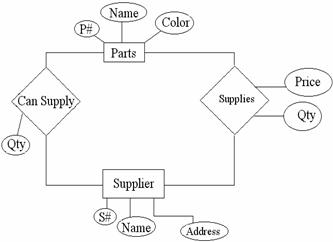
Ans:
|
Relation Name |
Attributes |
Primary key |
Foreign Key (s) |
|
Parts |
P#, Name, color |
P# |
NIL |
|
Supplier |
S#, Name, Address |
S# |
NIL |
|
Can_supply |
P#, S#, QTY |
P#,S# |
P# references Parts.P# S# references Supplier. S# |
|
Supplies |
P#, S#, QTY, Price |
P#, S# |
P# references Parts. P# S# references Supplier.S# |
Q.99 What are the three data anomalies
that are likely to occur as a result of data redundancy? Can data redundancy be completely eliminated
in database approach? Why or why not? (5)
Ans: The most
common anomalies considered when data redundancy exists are: update anomalies,
addition anomalies, and deletion anomalies. All these can easily be avoided
through data normalization. Data redundancy produces data integrity problems,
caused by the fact that data entry failed to conform to the rule that all
copies of redundant data must be identical. The data redundancy cannot be
totally removed from the database, but there should be controlled redundancy.
Sometimes redundancy is allowed to overcome the problem of excessive join
operations for computing queries.
Q.100 Given the dependency diagram shown in the following figure, (the primary key attributes are underlined)
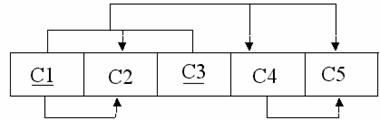
(i) Identify and discuss each of the indicated dependencies.
(ii) Create a database whose tables are atleast in 3NF, showing dependency diagram for each table (4+5)
Ans:
(i) C1 ® C2 represents a partial dependency, because C2 depends only on C1, rather than on
the entire primary key composed of C1 and C3.
C4
® C5 represents a transitive dependency, because C5 depends
on an attribute (C4) that is not part of a primary key.
C1,
C3 ® C2, C4,
C5 represents a functional dependency, because C2, C4, and C5 depend on the
primary key composed of C1 and C3.
ii) After decomposition into 3NF, relations are
1) R1 (C1, C2) with FD {C1® C2)} and functional dependency diagram:
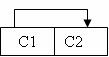

2) R2 (C1,C3, C4) with FD {C1,C3 ®C4) and functional dependency
diagram:
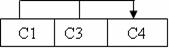
3) R3 (C4, C5) with FD{C4 ® C5} and functional dependency diagram:

Q.101 Consider the following relations with underlined primary keys
Product(P_code, Description, Stocking_date, QtyOnHand, MinQty, Price, Discount, V_code)
Vendor(V_code, Name, Address, Phone)
Here a vendor can supply more than one product but a product is supplied by only one vendor. Write SQL queries for the following :
(i) List the names of all the vendors who supply more than one product.
(ii) List the details of the products whose prices exceed the average
product price.
(iii) List the Name, Address and Phone of the vendors who are currently
not supplying any product. (3 x 3)
Ans: (i) Select name from Vendor where
V_code in (Select
V_code from Product group by
V_code having count (V_code) >1)
(ii) Select * from Product where price > (select
avg(Price) from
product)
(iii) Select Name, Address, Phone from
Vendor v where not exists (
select * from Product p where
p.V_code = v.V_code)
Q.102 Define the domain
relational calculus. (5)
Ans: In DRC, queries have the form: { <x1,x2,--------xn> |
P(x1,x2,--------xn)}
where each Xi is either a
domain variable or constant, and p(<X1, X2, ...., Xn>) denotes a DRC formula.
The result of the query is the set of tuples Xi to Xn
which makes the DRC formula true.
This language uses the same
operators as tuple calculus, the logical connectives (and), (or) and ¬ (not).
The existential quantifier and the universal quantifier can be used to bind the
variables.
Q.103 Consider the transactions t1, t2 and t3 and a schedule S given below.
 Where the subscript denotes
the transaction number. Assume that the
time stamp of t1<t2<t3. Using
time-stamp ordering scheme for concurrency control find out if the schedule
will go through. If there is to be a
rollback, which transaction(s) will be rolled back? (8)
Where the subscript denotes
the transaction number. Assume that the
time stamp of t1<t2<t3. Using
time-stamp ordering scheme for concurrency control find out if the schedule
will go through. If there is to be a
rollback, which transaction(s) will be rolled back? (8)
Ans: Schedule:
|
t1 |
t2 |
t3 |
|
read(A) write (C) |
read(B) * write(B) |
read (B) read (C ) write (A) |
Since this write in t2 is after a younger transaction (t3) has read the value of B, therefore t2 will be rolled back.
Q.104 Consider the following database with primary keys underlined
Project(P_No, P_Name, P_Incharge)
Employee(E_No, E_Name)
Assigned_To(P_No, E_No)
Write the relational algebra for the following :
(i) List details of the employees working on all the projects.
(ii) List E_No of employees who do not work on
project number DB2003. (6)
Ans:
(i) ∏E_No, E__Name (Project ⋈Employee ⋈Assigned) ÷ ∏E_Name (Employee)
(ii) ∏E_No (Assigned _To) -∏E_No (sP_No =
“DB2003” (Assigned_To)
Q.105 The following represents the sequence of events in a schedule involving transactions T1, T2, T3, T4 and T5. A,B, C, D, E, F are items in the database.
|
T2 |
: |
Read |
B |
|
T4 |
: |
Read |
D |
|
T2 |
: |
Read |
E |
|
T2 |
: |
Write |
E |
|
T3 |
: |
Read |
F |
|
T2 |
: |
Read |
F |
|
T1 |
: |
Read |
C |
|
T5 |
: |
Read |
A |
|
T5 |
: |
Write |
A |
|
T1 |
: |
Read |
E |
|
T5 |
: |
Read |
C |
|
T3 |
: |
Read |
A |
|
T5 |
: |
Write |
C |
|
T2 |
: |
Write |
F |
|
T4 |
: |
Read |
A |
Draw a wait-for-graph for the data above and find whether the transactions are in a deadlock or not? (8)
1. T2 : Read B
The data item B is locked by T2 and no change in the wait-for-graph
2. T4 : Read D
The data item D is locked by T4 and no change in the wait-for-graph
3. T2 : Read E
The data item E is locked by T2 and no change in the wait-for-graph
4. T3 : Write E
The data item E is unlocked by T2 and no change in the wait-for-graph
5. T3 : Read F
The data item F is locked by T3 and no change in the wait-for-graph
6. T2 : Read F
Now T2 wants to lock F, which is already locked by T3 (in step 5) so insert an edge from T2 to T3 in the wait-for-graph.
7. T1 : Read C
The data item C is locked by T1 and no change in the wait-for-graph.
8. T5 : Read A
The data item A is locked by T5 and no change in the wait-for-graph.
9. T5 : Write A
The data item B is locked by T5 and no change in the wait-for-graph.
10. T1 : Read E
The data item E is locked by T1 and no change in the wait-for-graph.
11. T5 : Read C
Now T5 wants to lock C, which is already locked by T1 (in step 7) so insert an edge from T5 to T1 in the wait-for-graph.
12 T3 : Read A
The data item A is locked by T3 and no change in the wait-for-graph.
13. T5 : Write C
The transaction cannot proceed further as it was not able to lock data item C (in step 11) so the transaction has to wait, hence there is no change in the wait-for-graph.
14. T2 : Write F
The transaction cannot proceed further as it was not able to lock data item F (in step 6) so the transaction has to wait, hence there is no change in the wait-for-graph.
15. T4 : Read A
Now T4 wants to lock A, which is already locked by T3 (in step 13) so insert an edge from T4 to T3 in the wait-for-graph.
Thus finally the wait-for graph will be as follows:
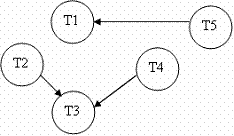
Since there is no cycle in the wait-for-graph, the system is not in a deadlock.
Q.106 Write short notes on any
(i)
Disadvantages of file based systems.
(ii)
Query-by-Example.
(iii)
B-tree. (3.53=14)
Ans:
(i) Disadvantages of file based systems:
1. duplication of data
2. data integrity problem
3. limited data sharing
4. lengthy processing time
(ii) Query-by-Example:
Query by Example (QBE) is a method of query creation that allows the user to search for documents based on an example in the form of a selected text string or in the form of a document name or a list of documents. Because the QBE system formulates the actual query, QBE is easier to learn than formal query languages, such as the standard Structured Query Language (SQL), while still enabling powerful searches.
(iii) B-tree:
B-tree is a tree data
structure that keeps data sorted and allows searches, insertions, and deletions
in logarithmic amortized time. It is most commonly used in databases and
filesystems.
In
B-trees, internal (non-leaf) nodes can have a variable number of child nodes
within some pre-defined range. When data is inserted or removed from a node,
its number of child nodes changes. In order to maintain the pre-defined range,
internal nodes may be joined or split. Because a range of child nodes is
permitted, B-trees do not need re-balancing as frequently as other
self-balancing search trees, but may waste some space, since nodes are not
entirely full. The lower and upper bounds on the number of child nodes are
typically fixed for a particular implementation. For example, in a 2-3 B-tree
(often simply referred to as a 2-3 tree), each internal node may have
only 2 or 3 child nodes.
Q.107 Supreme Products manufactures products like pressure cookers, cookwares, water purifiers, food processors etc. The company markets its products to wholesalers all over the country and dealers sell them to customer. The company has five regional offices and many sales persons are attached to regional offices. Salespersons contact dealers and explain about products, incentives offered, training programs for wholesalers and demo for customers etc. Dealers place orders with the salespersons attached with the regional office of their location. After receiving goods they make payments, which may be in installments. Company would like to develop a system to monitor sales of different products, performance of salespersons and orders from wholesalers.
Do the
following :
(i) Identify entities, attribute
and relationships giving functionalities and draw E-R diagram for the system.
(ii) Convert this to relational tables
explaining logic involved. (5+5)
Ans: The ER Diagram for the given problem is : The various entities for the given problem will be
WHOLESALER
REGIONALOFFICE
SALESPERSON
PAYMENT
DEALER
ORDER
ITEM
CUSTOMER
The various assumptions for
the given system are :
Ÿ A salespersons
is attached to only one regional office; however a regional office may have
several salespersons under it.
Ÿ A dealer can
place several orders but an order will be placed by a single dealer.
Ÿ A dealer will
make payment to only one salesperson of his/her area but a salesperson can
collect payments from several dealers of his/her area.
Ÿ An order may
contain several items but an item can be placed only in one order.
Ÿ A wholesaler
can appoint several dealers but a dealer will be only under one wholesaler.
Ÿ Many dealers
can sales their products to several customers and several customers can
purchase the products from many dealers.
The relational schema of the above ER Diagram is given here :
WHOLESALER:
WS_ID
|
WS_NAME
|
WS_ADD
|
REGIONAL OFFICE:
RO_ID
|
RO_NAME
|
RO_ADD
|
SALESPERSON:
SALES_ID
|
SALES_NAME
|
SALES_ADD
|
CATEGORY
|
PAYMENT
AMIT_PAYABLE
|
AMT_PAID
|
DATE
|
DEALER:
DEAL_ID
|
DEAL_NAME
|
DEAL_ADD
|
ORDER:
ORDER_ID
|
ITEM_ID
|
DATE
|
QTY
|
ITEM:
ITEM_ID
|
ITEM_NAME
|
STOCK
|
PRICE
|
CUSTOMER:
CUST_ID
|
CUST_NAME
|
CUST_ADD
|
For relationship, some of
the relations will be as follows:
APPOINTS:
WS_ID
|
DEAL_ID
|
SALES:
CUST_ID
|
DEAL_ID
|
WS_ID
|
DEAL_ID
|
SALES:CUST_ID
|
DEAL_ID
|
PLACE:
DEAL_ID
|
ORDER_ID
|
ATTACHED:
SALES_ID
|
RO_ID
|
Some reports which can
be proposed from the above system are :
Ÿ List the names of all salespersons with maximum sales from all regional offices.
Ÿ Name of the dealer who have maximum customers under him/her.
Ÿ All the dealers who have payments due against them.
Ÿ Lists the highest selling items.
Ÿ List of all regional offices along with their dealers and salespersons
Q.108 Give examples of :
(i) A many – to – many relationship in which
one of the participants is another relationship;
(ii) A subtype that has an associated weak entity that dose not apply to the super type
Ans:
(i) A many-to-many relationship in which one of the participants is another relationship;
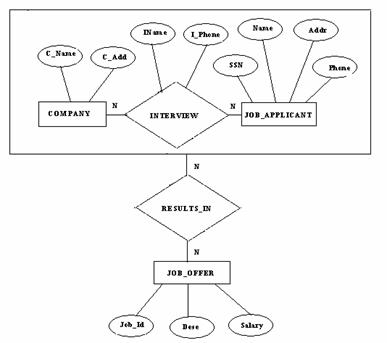
(ii) A subtype that has an associated weak entity that does not apply to the supertype.
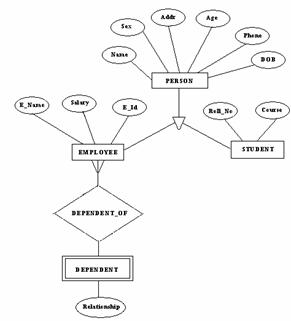
PERSON can be EMPLOYEE or STUDENT. EMPLOYEE has DEPENDENT that works under him. DEPENDENT is a weak entity set because many dependents can have same Name, Age, Sex, etc.
Q.109 What is meant by heuristic optimisation? Discuss the main heuristics that are applied during query optimisation. (6) Ans: In heuristic opimization, heuristics are used to reduce the cost of optimization instead of analyzing the number of different plans to find out the optimal plan. For example. A analyzing optimizer would use the rule ‘perform selection operation as early as possible’ without finding out whether the cost is reduced by this transformation. Heuristics approach usually helps to reduce the cost but not always. The heuristics that are applied during query optimization are:
 Pushes the selection
and projection operations down the query tree
Pushes the selection
and projection operations down the query tree
Left-deep join
trees- convenient for pipelined evaluation
Non- left-deep join
trees
Q.110 Consider the following tables :
customer (c_id, c_name,
c_address)
branch (br_name, br_city,
assets)
account (c_id, act_no,
br_name, balance)
(i) Customers who have accounts in all
branches of Bhopal
(ii) Customers who have accounts in branches with assets more than 50 crores. (3X2)
Ans:
The customers
who have accounts in branches of Bhopal

 ⋈ ACCOUNT ⋈ CUSTOMER
  )
)

 ⋈ ACCOUNT CUSTOMER )
Q.111 Consider the following tables.
EMP (emp_no,
name, salary, supervisor_no, sex_code, dept_code)
DEPT (dept_cd, dept_name)
Write down queries in SQL
for getting following information:
(i) Employees getting more salary than their
supervisor.
(ii) Department name and total number of employees in each department who earn more than average salary for their department.
(iii) Department(s) having maximum employees
earning more than 25000.
(iv) Name of employee(s) who earn maximum salary in their organization. (4x3)
Ans:
(i) Employees getting more salary than their supervisor.
Again it will be solved by using self join concept.
SELECT E1.name,
E2.name Supervisor
FROM
EMPAS E1, EMP AS E2
WHERE
E1.supervisor_no = E2.emp_no
AND
E1.salary>E2.salary;
(ii) Department name and total
number of employees in each department who earn more than average salary for
their department.
This will use the
correlated query concept.
SELECT dept_name, COUNT(*)
FROM
EMP E, DEPT
WHERE
E.dept_code=DEPT.dept_cd
AND
salary>(SELECT AVG(salary)FROM EMP
WHERE
EMP.dept-code=E.dept_code)
GROUP
BY dept_name;
(iii) Departments having maximum employees earning
more than 25000.
SELECT
dept_name, COUNT(*)
FROM
EMP E,DEPT
WHERE
E.dept_code=DEPT.dept_cd AND salary>25000
GROUP
BY dept_name
HAVING
COUNT(*)>=ALL(SELECT COUNT(*)
FROM EMP GROUP
BY dept_code);
(iv) Name of employee(s) who earn maximum salary
in the organization.
SELECT
name FROM EMP
WHERE
salary=(SELECT MAX (salary) FROM EMP);
Q.112 Let R = (A,B,C,D)
and F be the set of functional dependencies for R given by {A→B, A→C,
BC→D} (4)
Prove A→D.
Ans: Given
set of functional dependencies for a relation R is {A→B, A→C, BC→D}
By using Armstrong Axioms, named
projectivity, we can show that A→BC
(as A→B, A→C)
Since BC→D, so by transitivity rule,
A→BC and BC→D means A→D
Hence Proved.
Q113 a. Consider a relation TENANT (NAME,
CITY, STREET#, APT#, APT_TYPE, RENT,
LANDLORD, ADDRESS) where following functional dependencies hold APT#STREET#CITY
ADDRESS
ADDRESS→APT_TYPE
NAME ADDRESS →RENT
LAND_LORD APT_TYPE→RENT
(i) Are the following relation schemes in 3NF?
APARTMENT (APT_TYPE, ADDRESS, RENT)
DWELLER (NAME, ADDRESS, RENT)
(ii) What updating and insertion anomalies do you foresee in TENANT, APARTMENT & DWELLER relations.
Do the APARTMENT & DWELLER relations have lossless join?
(iii) Find a key of this relation. How many keys does TENANT have? (2x4)
(iv) Find
a key of this relation. How many keys
does TENANT have? (2x4)
b. Find the decomposition of TENANT into 3NF having lossless join and preserving dependencies.

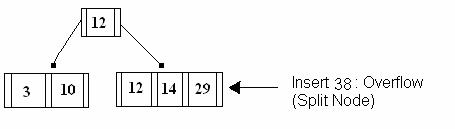
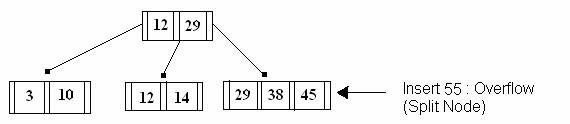
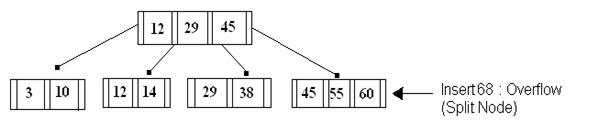
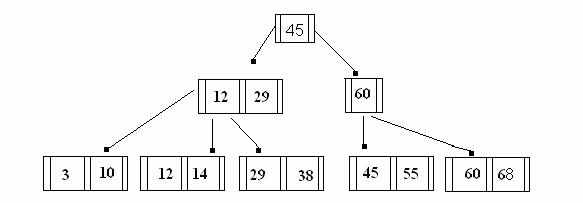
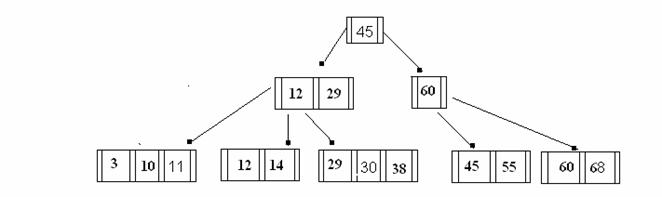


 .
.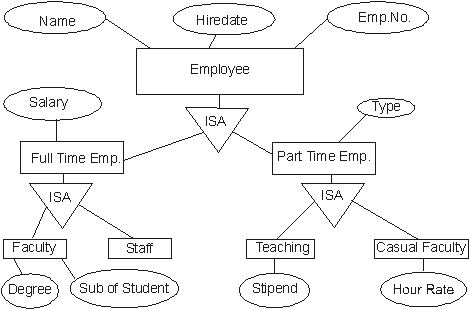
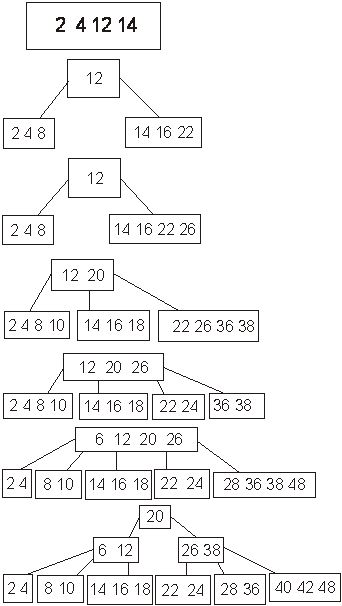
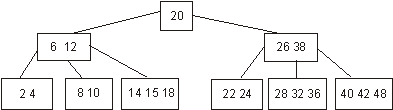
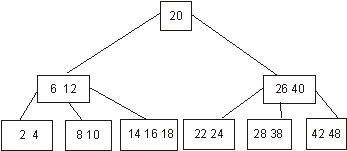
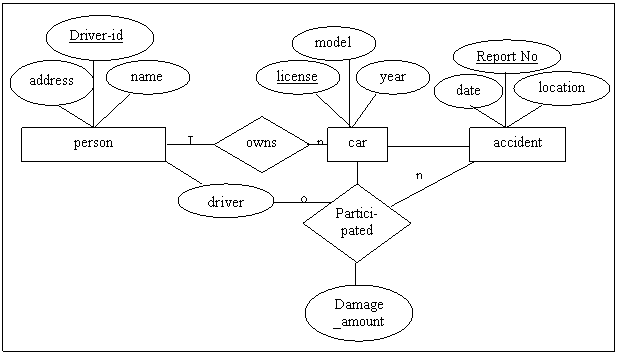
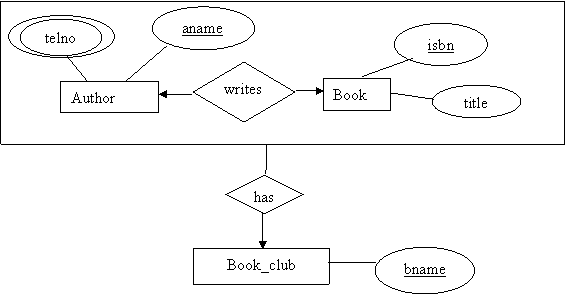

 s ε
s ε s
s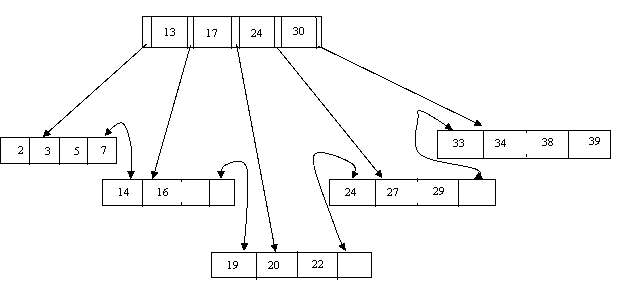
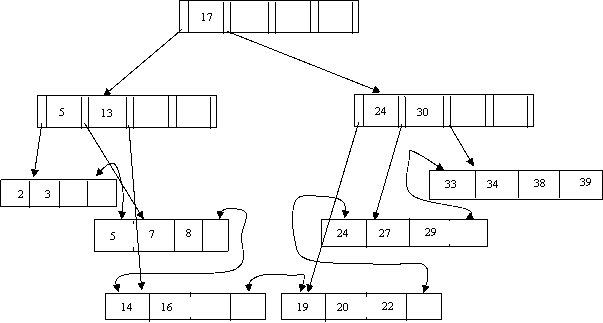
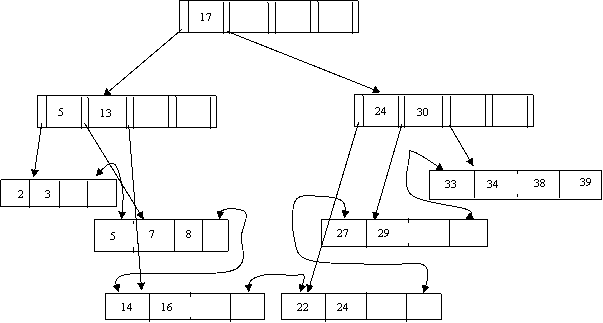
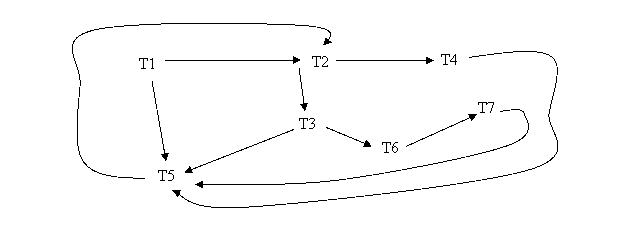
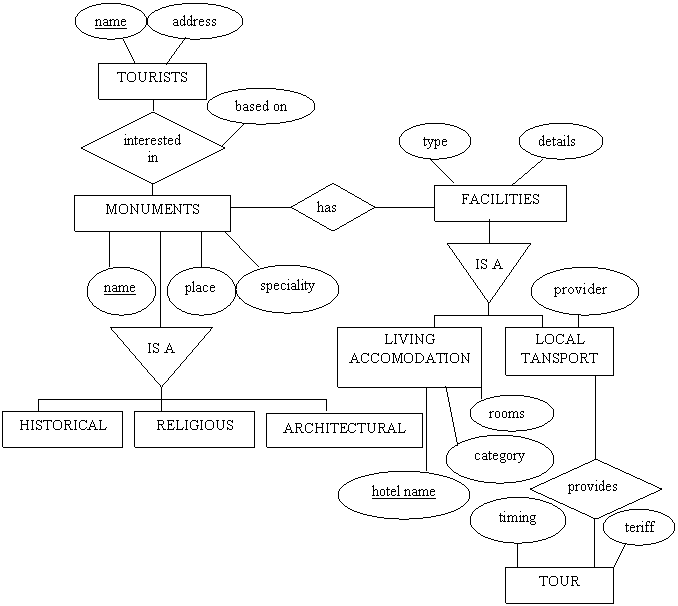




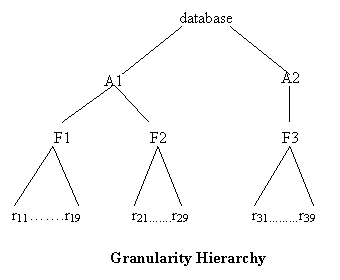
 page.
page.


 . The given decompositions are also lossless
  in
in 


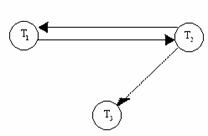
 (R
(R





 dname= ‘Research’ AND d,deptno=e. dno(EMP
 name, fname, address