PART
– II
DESCRIPTIVES
Q.1 Write a C program to compute the sum of first n terms (n  1) of the following
series using ‘for’ loop.
1) of the following
series using ‘for’ loop.
1
– 3 + 5 – 7 + 9 - …… (6)
Ans:
A C program to compute the sum of first n terms of the
series 1-3+5-7+9-… is listed below:
main()
{
int start=1,i=1,no=0,sum=0;
clrscr();
printf ("\nEnter number of terms to be
added:-> ");
scanf("%d",&no);
for (i=1;i<=no;i++)
{
if (i%2!=0)
{
sum+=start;
if (i==1)
printf ("%d",start);
else
printf ("+%d",start);
}
else
{
sum-=start;
printf ("-%d",start);
}
start+=2;
}
printf ("=%d",sum);
getch();
}
Q.2 Write a C program to convert a
binary number to its corresponding octal number. (8)
Ans:
A
C program to convert a binary number to its binary octal number is as follows:
main()
{
long int bin_no,no;
int oct_no,oct_p,i,rem,pow2,pow8,inter_oct;
clrscr();
printf ("\nEnter the Binary number: -> ");
scanf("%ld",&bin_no);
no=bin_no;
pow8=1;
oct_no=0;
while (no>0)
{
i=0;
inter_oct=0;
pow2=1;
while (i<=2)
{
if (no==0)break;
rem=no%10;
inter_oct+=rem*pow2;
i++;
pow2*=2;
no/=10;
}
oct_no+=inter_oct*pow8;
pow8*=10;
}
printf ("\nOctal Equivalent for %ld = %d",bin_no,oct_no);
getch();
}
Q.3 Write a C program to print out n values of the following sequence.
1
–1 1 –1 1 … (6)
Ans:
A C
program to print n values of following sequence 1 –1 1 –1 1 … is listed below:
#include<stdio.h>
#include<conio.h>
main()
{
int i,j,n,k;
clrscr();
printf("\n enter number
\n");
scanf("%d",&n);
k=1;
for(i=1;i<=n;i++)
{
for(j=1;j<=i;j++)
printf("%d",k);
printf("\t");
}
getch();
}
Q.4 Write a C program to test whether a given
pair of numbers are amicable numbers.
(Amicable number are pairs of numbers each of whose divisors add to the other
number) (8)
Ans:
A C program to test whether a
given pair of numbers is amicable numbers is as follows:
#include<stdio.h>
#include<conio.h>
#include<math.h>
void main()
{
int i,j,n,sum_i=0,sum_j=0;
clrscr();
printf("enter any two
numbers >");
scanf("%d%d",&i,&j);
for(n=1;n<i;n++)
{
if (i%n==0)
sum_i+=n;
}
for (n=1;n<j;n++)
{
if (j%n==0)
sum_j+=n;
}
if ((sum_j==i) &&
(sum_i==j))
printf ("\nAmicable");
else
printf ("\nNot Amicable");
getch();
}
Q.5 Write a C program to rearrange the elements
of an array so that those originally stored at odd suffixes are placed before
those at even suffixes. (6)
Ans:
A C
program to rearrange the elements of an array so that those originally stored
at odd suffixes are placed before those at even suffixs:
main()
{
char a[25],ch,temp;
int i;
clrscr();
printf ("\nEnter the string:->
");
gets(a);
for (i=0;a[i]!='\0';i++)
{
if (a[i+1]=='\0')break;
temp=a[i];
a[i]=a[i+1];
a[i+1]=temp;
i++;
}
puts(a);
getch();
}
Q.6 Admission
to a college in science branch is given if the following conditions are
satisfied
(i)
Maths marks >= 80
(ii)
Physics marks >= 75
(iii)
Chemistry marks >= 70
(iv)
Total percentage in all three
subjects >= 80
Given the marks in three subjects,
write a program to process the applications to list the eligible candidates. (8)
Ans:
A C
program to process the applications to list the eligible candidates is listed
below:
#include<stdio.h>
#include<conio.h>
void main()
{
float math,phy,che;
float per;
char ch;
clrscr();
printf("\nDo u want to enter any
record:-> ");
ch=getch();
while(ch=='y' || ch=='Y')
{
clrscr();
printf("\nEnter Marks in Math:-> ");
scanf("%f",&math);
printf("\nEnter Marks in Physics:-> ");
scanf("%f",&phy);
printf("\nEnter Marks in Chemistry:-> ");
scanf("%f",&che);
per=(math+phy+che)/3.00;
if(math>=80.00 && phy>=75.00 && che>=70.00
&& per>=80.00)
printf("\nYou are eligible for selection.");
else
printf("\nSorry you are not eligible!!");
printf("\nDo u want to enter new record:-> ");
ch=getch();
}
printf ("\nThanks for using it!");
getch();
}
Q.7 Write a C program using
while loop to reverse the digits of a given number. (for example, If number is=12345 then output
number is= 54321) (5)
Ans:
A C program to reverse the digits of a given number:
#include<stdio.h>
#include<conio.h>
void main()
{
int n,r;
clrscr();
printf("enter an
integer");
scanf("%d",&n);
printf("\nreverse of %d
: ",n);
while(n>0)
{
r=n%10;
printf("%d",r);
n=n/10;
}
getch();
}
Q.8 Write C program to produce 10 rows of the
following form of Floyd’s triangle (5)
Ans:
A C program to produce 10 rows of Floyd’s triangle is:
#include<conio.h>
void main()
{
int i,j;
clrscr();
for(i=1;i<=10;i++)
{
for(j=1;j<=i;j++)
{ printf("
");
if(i%2==0)
if(j%2==0)
printf("1");
else
printf("0");
else
if(j%2==0)
printf("0");
else
printf("1");
}
printf("\n\n");
}
getch();
}
Q.9 Consider the following macro definition
#define root (a, b) sqrt((a)
* (a) + (b) * (b))
What will be the
result of the following macro call statement
root(a++, b++) if a = 3 and b = 4 (3)
Ans:
Result of this macro is:5
sqrt(3*3+4*4)
sqrt(9+16)=sqrt(25)=5
Q.10 Write a nested macro that gives the minimum of three values. (3)
Ans:
A nested macro that gives the minimum of three
variables is listed below:
#include<stdio.h>
#include<conio.h>
#define min(a,b)
((a>b)?b:a)
#define minthree(a,b,c)
(min(min(a,b),c))
void main()
{
int x,y,z,w;
clrscr();
printf("enter three
numbers :\n");
scanf("%d%d%d",&x,&y,&w);
z=minthree(x,y,w);
printf("Minimum of
three value is %d",z);
getch();
}
Q.11 Given are two one
dimensional arrays A and B which are stored in ascending order. Write a program to merge them into a single
sorted array C that contains every element of A and B in ascending order. (8)
Ans:
A
program to merge two arrays into single sorted array that contains every
element of arrays into a ascending order:
#include<stdio.h>
#include<conio.h>
void sort(int*,int);
void
merge(int*,int*,int,int);
void main()
{
int a[10],b[10];
int i,j,m,n;
clrscr();
printf("how many
numbers u want to enter in 1st array : ");
scanf("%d",&n);
printf("enter numbers
in ascending order :\n");
for(i=0;i<n;i++)
scanf("%d",&a[i]);
printf("how many
numbers u want to enter in 2nd array : ");
scanf("%d",&m);
printf("enter numbers
in ascending order :\n");
for(i=0;i<m;i++)
scanf("%d",&b[i]);
merge(a,b,n,m);
getch();
}
void merge(int *a,int *b,int
n,int m)
{
int
i=0,c[20],j=0,k=0,count=0;
while(i<=n&&j<=m)
{
if(a[i]<b[j])
{
c[k]=a[i];
i++;
k++;
}
if(a[i]>b[j])
{
c[k]=b[j];
j++;
k++;
}
if(a[i]==b[j])
{
c[k]=a[i];
k++;
i++;
j++;
count++;
}
}
if(i<=n&&j==m)
{
while(i<=n)
{
c[k]=a[i];
i++;
k++;
}
}
if(i==n&&j<=m)
{
while(j<=m)
{
c[k]=b[j];
i++;
j++;
}
}
for(i=0;i<m+n-count;i++)
printf("%d\t",c[i]);
}
Q.12 Write a C program that reads the text and
counts all occurrences of a particular word. (6)
Ans:
A C program that reads the text and count all
occurrences of a particular word:
#include <string.h>
void main()
{
char a[100],b[20],c[20];
int i,count=0,k=0,len;
clrscr();
printf ("\nEnter a string:-> ");
gets(a);
printf("\nEnter the word to be
searched:-> ");
gets(b);
len=strlen(a);
for(i=0;i<=len;i++)
{
//Assuming Space , Tab and NULL as word separator
if(a[i]==32 || a[i]=='\t' || a[i]=='\0')
{
c[k]='\0';
if(strcmp(b,c)==0)count++;
k=0;
}
else
{
c[k]=a[i];
k++;
}
}
printf("Occurance of %s is =
%d",b,count);
getch();
}
Q.13 Write a C program that reads a string from
keyboard and determines whether the string is palindrome or not. (A string is palindrome if it is read from
left or right gives you the same string) (8)
Ans:
A C program to check if input string is palindrome or
not:
#include<stdio.h>
#include<conio.h>
void main()
{
int i,j,k,flag=1;
char a[20];
clrscr();
printf("enter any
word:\n");
scanf("%s",a);
i=0;
while(a[i]!='\0')
i++;
k=i;
for(j=0;j<k/2;)
{
if(a[j]!=a[i-1])
{
flag=0;
break;
}
if(a[j]==a[i-1])
{
j++;
i--;
}
}
if(flag==0)
printf("it is a not
palindrome");
else
printf("it is a
palindrome");
getch();
}
Q.14 Write a C function strend(s, t), which
returns 1 if the string t occurs at the end of the string s, and zero
otherwise. (7)
Ans:
C
function strend(s, t), which returns 1 if the string t occurs at the end of the
string s, and zero otherwise.
#include<conio.h>
#include<string.h>
strend ()
{
char s[100],t[20],c[20];
int i,j,k=0,len1,len2;
clrscr();
printf("\n Enter the string : ");
gets(s);
printf("\n Enter the string to be searched for : ");
gets(t);
len1=strlen(s);
len2=strlen(t);
for(i=len1-(len2);i<=len1;i++)
{
c[k++]=s[i];
}
c[k]='\0';
if(strcmp(t,c)==0)
return 1;
else
return 0;
getch();
}
Q.15 Write a function
rightrot(x, n) that returns the value of the integer x rotated to the right by
n positions. (7)
Ans:
A function
rightrot(x, n) that returns the value of the integer x rotated to the right
by n
positions.
#include<conio.h>
rightrot(x,n)
{
int x,n,k=0,num,rem,i,j,dig;
int arr1[10],arr2[10];
clrscr();
printf("\n Enter the integer to be rotated : ");
scanf("%d",&x);
printf("\n Enter the positions by which %d is to be rotated :
",x);
scanf("%d",&n);
for(num=x;num!=0;num/=10)
{
rem=num%10;
arr1[k++]=rem;
}
i=k-1;
k=0;
for(;i>=0;i--)
arr2[k++]=arr1[i];
k-=1;
for(i=1;i<=n;i++)
{
dig=arr2[k];
for(j=k;j>0;j--)
arr2[j]=arr2[j-1];
arr2[0]=dig;
}
printf("\n\n The original number is : “);
return x;
printf("\n The rotated number is : ");
for(i=0;i<=k;i++)
printf("%d",arr2[i]);
getch();
}
Q.16 Write recursive function
in C to obtain nth term of the
Fibonacci series. (7)
Ans:
recursive function in C to obtain nth term of the Fibonacci series
#include<stdio.h>
#include<conio.h>
void main()
{
int n;
void fibonac(int );
clrscr();
printf("enter the
length for the series");
scanf("%d",&n);
printf("Fibonacci
sequence upto %d terms is:\n\n",n);
fibonac(n);
getch();
}
void fibonac(int n)
{ static int f1=0,f2=1;
int temp;
if(n<2)
{ f1=0;
f2=1;
}
else
{
fibonac(n-1);
temp=f2;
f2=f1+f2;
f1=temp;
}
printf("%5d",f1);
}
Q.17 Write C function named
‘fiddle’ that takes two arguments, x and y and changes both values. x is an int
while y is a pointer to int (7)
Ans:
C function
named ‘fiddle’ that takes two arguments, x and y and changes
both values.
x is an int while y is a pointer to int
#include<conio.h>
void main()
{
int x,z,*y,temp;
clrscr();
printf("\n Enter two numbers : \n");
scanf("%d %d",&x,&z);
y=&z;
printf("\n\n x = %d and y = %d",x,*y);
fiddle(&x,y);
printf("\n After changing their values ");
printf("\n x = %d and y = %d",x,*y);
getch();
}
fiddle(int *a,int *b)
{
int temp;
temp=*a;
*a=*b;
*b=temp;
getch();
}
Q.18 What is an unsigned
integer constant? What is the significance of declaring a constant as unsigned? (4)
Ans:
An
integer constant is any number in the range -32768 to +32767, because an
integer constant always occupies two bytes in memory and in two bytes we cannot
store a number bigger than +32767 or smaller than -32768. Out of the two bytes
to store an integer, the highest bit is used to store the sign of the integer.
This bit is 1 if the number is negative and 0 if number is positive. Unsigned
integer constant is an integer constant which has the permissible range from 0
to 65536. Thus significance of declaring a constant as unsigned almost doubles
the size of the largest possible value. This happens because on declaring a
constant as unsigned, the sixteenth bit is free and is not used to store the
sign of the constant.
Q.19 Explain pointers and structures by giving an example of
pointer to structure variable? (5)
Ans:
We
can have a pointer pointing to a structure just the same way a pointer pointing
to an int, such pointers are known as structure pointers. For example consider
the following example:
#include<stdio.h>
#include<conio.h>
struct student
{
char name[20];
int roll_no;
};
void main()
{
struct student stu[3],*ptr;
clrscr();
printf("\n Enter data\n");
for(ptr=stu;ptr<stu+3;ptr++)
{
printf("Name");
scanf("%s",ptr->name);
printf("roll_no");
scanf("%d",&ptr->roll_no);
}
printf("\nStudent Data\n\n");
ptr=stu;
while(ptr<stu+3)
{
printf("%s %5d\n",ptr->name,ptr->roll_no);
ptr++;
}
getch();
}
Here
ptr is a structure pointer not a structure variable and dot operator requires a
structure variable on its left. C provides arrow operator “->” to refer to
structure elements. “ptr=stu” would assign the address of the zeroth element of
stu to ptr. Its members can be accessed by statement like “ptr->name”. When
the pointer ptr is incremented by one, it is made to point to the next record,
that is stu[1] and so on.
Q.20 Compare the following pairs of statements
with respect to their syntax and function:
a.
break and continue.
b.
goto and break. (4)
Ans:
a.
break and continue
Two
keywords that are very important to looping are break and continue. The break command will exit the most
immediately surrounding loop regardless of what the conditions of the loop are.
Break is useful if we want to exit a loop under special circumstances.
#include <stdio.h>
void main() {
int a;
printf("Pick a number from 1 to
4:\n");
scanf("%d", &a);
switch (a) {
case 1:
printf("You chose number 1\n");
break;
case 2:
printf("You chose number 2\n");
break;
case 3:
printf("You chose number 3\n");
break;
case 4:
printf("You chose number 4\n");
break;
default:
printf("That's not 1,2,3 or
4!\n");
}
getch();
}
Continue is another keyword that controls the flow of loops. If we are
executing a loop and hit a continue statement, the loop will stop its current
iteration, update itself (in the case of for loops) and begin to execute again
from the top. Essentially, the continue statement is saying "this
iteration of the loop is done; let's continue with the loop without executing
whatever code comes after me."
The
syntax of continue statement is simple continue;
b.
goto and break
C support goto statement to branch
unconditionally from one point to another in the program.The goto keyword is
followed by a label, which is basically some identifier placed elsewhere in the
program where the control is to be transferred.
During running of a program, the
statement like “goto label1;” cause the flow of control to the statement
immediately following the label “label1”. We can have a forward jump or a
backward jump.
#include <stdio.h>
void main()
{
int attempt, number = 46;
looping: /* a label */
printf("Guess a number from
0-100\n");
scanf("%d", &attempt);
if(number==attempt) {
printf("You guessed
correctly!\n\n");
}
else {
printf("Let me ask again...\n\n");
goto looping; /* Jump to the label*/
}
getch();
}
Q.21 Explain the difference
between the following:
(i)
Program testing and debugging.
(ii)
Top down and bottom up
approaches.
(iii)
Interpreted and compiled
languages. (6)
Ans:
(i)
Program testing and debugging:
Program
testing is the process of checking program, to
verify that it satisfies its requirements and to detect errors. These errors
can be of any type-Syntax errors, Run-time errors, Logical errors and Latent
errors. Testing include necessary steps to detect all possible errors in the
program. This can be done either at a module level known as unit testing or at
program level known as integration testing.
Debugging is a methodical process of finding and reducing
the number of bugs in a computer
program making it behave as expected. One simple way to find the
location of the error is to use print statement to display the values of the
variables. Once the location of the error is found, the error is corrected and
debugging statement may be removed.
(ii)
Top Down and Bottom up approaches
A top-down approach is essentially breaking
down a system to gain insight into its compositional sub-systems. In a top-down
approach an overview of the system is first formulated, specifying but not
detailing any first-level subsystems. Each subsystem is then refined in greater
detail, sometimes in many additional subsystem levels, until the entire
specification is reduced to base elements. In short the top down approach means
decomposing of the solution procedure into subtasks. This approach produces a
readable and modular code that can be easily understood and maintained.
A bottom-up approach is essentially piecing
together systems to give rise to grander systems, thus making the original
systems sub-systems of the emergent system. In a bottom-up approach the
individual base elements of the system are first specified in great detail.
These elements are then linked together to form larger subsystems, which then
in turn are linked, sometimes in many levels, until a complete top-level system
is formed.
(iii)
Interpreted and Compiled Languages
In interpreted languages, the instructions are executed immediately
after parsing. Both tasks are performed by the interpreter. The code is saved in the same format that we entered. Interpreted languages include the MS-DOS Batch
language (the OS itself is the interpreter), shell scripts in Unix/Linux
systems, Java, Perl etc. Advantages of interpreted languages include relative
ease of programming and no linker requirement. Disadvantages include poor speed
performance and that we do not generate an executable (and therefore distributable)
program. The interpreter must be present on a system to run the program.
In compiled languages the instructions into machine code and store
them in a separate file for later execution. Many modern compilers can compile
(parse) and execute in memory, giving the 'appearance' of an interpreted
language. However, the key difference is that parsing and execution occurs in
two distinct steps. Examples of compiled languages include Visual Basic, C/C++,
Delphi and many others. In a compiled
environment, we have several separate files like: source code (the text
instructions), object code (the parsed source code) and the executable (the
linked object code). There is definitely an increase in complexity in using
compilers, but the key advantages are speed performance and that one can
distribute stand-alone executables.
Q.22 Write a complete C program for reading an
employees file containing {emp_number, name, salary, address}. Create an output file containing the names of
those employees along with their salary and address whose salary is >
20,000. (8)
Ans:
#include<stdio.h>
struct employee
{
int code;
char name[30];
char address[50];
char phone[10];
float sal;
}emp,tmp;
FILE *fp1,*fp2;
void main()
{
char ch='y';
int i=1;
//Assuming that the file already exists
fp1=fopen("employee.txt","r");
if (fp1==NULL)
{
fp1=fopen("employee.txt","w");
if (fp1==NULL)
{
printf ("\nUnable to
create Employee.txt file");
getch();
exit();
}
printf ("\nNo Data found in
Employee.txt. Add new
records");
while (1)
{
printf ("\nEnter
Employee Code:-> ");
flushall();
scanf
("%d",&emp.code);
printf ("\nEnter
Employee Name:-> ");
flushall();
gets(emp.name);
printf ("\nEnter
Employee Address:-> ");
flushall();
gets(emp.address);
printf ("\nEnter
Employee Phone Number:-> ");
flushall();
gets(emp.phone);
printf ("\nEnter
Employee Salary:-> ");
flushall();
scanf("%f",&emp.sal);
//Writing records to
Employee.txt file
fwrite(&emp,
sizeof(emp),1,fp1);
printf ("\nDo u want to
add more records (y/n):->
");
flushall();
scanf("%c",&ch);
if (ch=='n' ||
ch=='N')break;
}
fclose(fp1);
fp1=fopen("employee.txt","r");
}
printf ("\nList of Employees having
Salary greater than
20000\n");
printf
("\nCode\tName\t\tAddress\tPhone No.\tSalary\n");
i=1;
fp2=fopen("Output.txt","w");
getch();
if (fp2==NULL)
{
printf ("\nUnable to create
Output file\n");
getch();
exit();
}
while (1)
{
i=fread(&emp,sizeof(emp),1,fp1);
if(i==0)break;
if (emp.sal>20000)
fwrite
(&emp,sizeof(emp),1,fp2);
}
fclose (fp2);
fp2=fopen("output.txt","r");
i=1;
while (1)
{
i=fread(&emp,sizeof(emp),1,fp2);
if(i==0)break;
printf ("\n%d\t%s\t\t%s\t%s\t%f",emp.code,emp.name,emp.address,emp.phone,emp.sal);
}
getch();
}
Q.23 Write a function
to display the binary number corresponding to the integer passed to it as an
argument. (6)
Ans:
#include<stdio.h>
#include<conio.h>
void dis_bin(int n)
{
num=n;
for(i=0;num!=0;i++)
{
q=num/2;
r[i]=num%2;
num=q;
}
clrscr();
printf("\n\n The integer the number is : %d\n",n);
printf("\n The binary conversion is : ");
for(i-=1;i>=0;i--)
printf("%d",r[i]);
getch();
}
Q.24 Write a function,
my_atoi, similar to the library function atoi
that returns the numeric value corresponding to the string passed to it as an
argument. (6)
Ans:
#include <stdio.h>
main()
{
long int n=0;
char str[25];
clrscr();
printf ("\nEnter the string:->
");
gets(str);
my_atoi(str,&n);
printf ("\nInteger Equvalent of string
%s=%ld",str,n);
getch();
}
my_atoi(char str[25],long
int *num)
{
int i=1;
long int s=1,l=0,j;
float po10=1;
//Trimming the string for integers
for (i=0;str[i]!='\0';i++)
{
if (str[i]==' ')
{
for (j=i;str[j]!='\0';j++)
str[j]=str[j+1];
i--;
}
else if (str[i]>=48 && str[j]<=57)
continue;
else
{
str[i]='\0';
break;
}
}
l=strlen(str);
for (i=l-1;i>=0;i--)
{
switch (str[i])
{
case 48: s*=0;break;
case 49: s*=1;break;
case 50: s*=2;break;
case 51: s*=3;break;
case 52: s*=4;break;
case 53: s*=5;break;
case 54: s*=6;break;
case 55: s*=7;break;
case 56: s*=8;break;
case 57: s*=9;break;
}
*num+=s;
po10*=10;
s=po10;
}
}
Q.25 Briefly explain
what do you understand by stepwise refinement of the program? (4)
Ans:
Stepwise
refinement of the Program:
The concept of “Stepwise refinement”
means to take an object and move it from a general perspective to a precise
level of detail and this cannot be done in one jump but in steps. The number of
steps needed to decompose an object into sufficient detail is ultimately based
on the inherent nature of the object. “Stepwise
refinement” of program represents a "divide and conquer" approach to
design. In simple words, break a complex program into smaller, more manageable
modules that can be reviewed and inspected before moving to the next level of
detail. Step-wise refinement is
a powerful paradigm for developing a complex program from a simple program by
adding features incrementally.
Some of
the steps taken for refinement of a program are:
1.
Analysis of the algorithm used
to develop the program, and analysis of various parts of the program and then
making appropriate changes to improve the efficiency of the program.
2.
Keep the program simple to
improve memory efficiency.
3.
Evaluation and incorporation of
memory compression features.
4.
Debugging and testing performed
first to module level and then to interface level.
5.
Take care of correct working
and clarity while making it faster.
Q.26 Write a function
to remove duplicates from an ordered array. For example, if input is:
a,a,c,d,q,q,r,s,u,w,w,w,w; then the output should be a,c,d,q,r,s,u,w. (8)
Ans:
A C program to remove duplicates from an odered array:
#include<stdio.h>
#include<conio.h>
#include<string.h>
void main()
{
int i,j,k,l,flag=0;
char a[50];
clrscr();
printf("enter the
characters in the array");
gets(a);
l=strlen(a);
for(i=0;i<l-1;i++)
for(j=i+1;j<l;j++)
{
if(a[i]==a[j])
{ l=l-1;
for(k=j;k<l;k++)
a[k]=a[k+1];
flag=1;
j=j-1;
}
}
if(flag==0)
printf("No duplicates found");
else
for(i=0;i<l;i++)
printf("%c",a[i]);
getch();
}
Q.27 Write a function to sort the characters of
the string passed to it as argument. (8)
Ans:
A C function to sort the characters of the string:
main()
{
char a[100],ch;
int i,j;
printf ("\nEnter the string:->
");
gets(a);
for (i=0;a[i]!='\0';i++)
{
for (j=i+1;a[j]!='\0';j++)
{
if (a[i]>a[j])
{
ch=a[i];
a[i]=a[j];
a[j]=ch;
}
}
}
printf ("\nString after sorting\n");
puts(a);
getch();
}
Q.28
Give the outputs of the following code
segments, if any and justify your answers.
(i) #define CUBE(x)
(x * x * x)
main( )
{
printf(“%d”, CUBE(4+5));
}
(ii) int j = 5;
printf(“%d”, j = j == 6);
printf(“%d”, j = ++j == 6);
(iii)for (j = 0; j = 3; j++)
printf(“%d”, j);
(iv) main( )
{
static char a[ ]
= “Test String”;
static char *b = “Test String”;
printf(“%d %d”, sizeof(a),
sizeof(b));
}
(v) main( ) {
enum test {RED, BLUE, GREEN};
enum test t = BLUE;
printf(“%d”, t);
}
(vi) main( ) {
union U { int j;
char c; float f; } u;
u.j = 10; u.c = ‘A’; u.f = 99.99;
printf(“u.j = %d u.c = %c u.f =
%f”, u.j, u.c, u.f);
} (2 x 6)
Ans:
(i)
Output is: 49
macro
cube(x *x*x) is expanded into (4+5*4+5*4+5) which is evaluated as 4+20+20+5=49 due to priority of operators.
So output is 49.
(ii)
Output is: 0 0
Both
the expressions are evaluated as 0 so the output is 0.
(iii)
Output is: infinite loop
There
is an incorrect assignment, j=3 in test expression.
(iv)
Output is:12 2,
The
printf is printing the size of char array a and char b, null char is included.
(v)
Output is:1,
The
compiler automatically assigns integer digits beginning with 0 to all the
enumeration constants so BLUE has value 1.
(vi)
Output is:
u.j=1311,u.c=’β’,u.f=99.989998
The
first two outputs are erroneous output which is machine dependent. During
accessing a union member, we should make sure that we are accessing the member
whose value is currently stored otherwise we will get errors.
Q.29 What are
preprocessor directives? List three types of them. What is the difference
between the following directives: #include <filename> and #include
“filename”? (4)
Ans:
Preprocessor directives:
These are the commands given to a program known as preprocessor that processes
the source code before it passes through the compiler. Each of these
preprocessor directives begins with a # symbol. These can be placed anywhere in
the program but usually placed before main ( ) or at the beginning of the
program. Before the source code passes through the compiler, it is examined by
the preprocessor for any directives. If there are any, appropriate action is
taken and the source program is handed over to compiler. These directives can
be divided into following three categories:
1.
Macro substitution directives
2.
File inclusion directives.
3.
Compiler control directives.
#include
“filename”: The search for the file is made first in the current directory and
then in the standard directories as mentioned in the include search path.
#include
<filename>: This command would look for the file in the standard list of
directories.
Both
of these directives cause the entire contents of filename to be inserted into
the source code at that point in the program.
Q.30 Write a function to compute the frequency of
‘the’ in a file. (8)
Ans:
A C function to compute the frequency of ‘the’:
void main()
{
int
i=0,j=0,k,n=0,m=0,l;
char
a[100],b[10],c[10]="the";
clrscr();
printf("enter
the sentence");
gets(a);
while(a[i]!='\0')
{
if(a[i]==' '|| a[i]=='.')
m++;
i++;
}
i=0;
l=0;
while(l!=m+1)
{
while(a[i]!=' '
&& a[i]!='.' && a[i]!='\0')
{
b[j]=a[i];
j++;
i++;
}
b[j]='\0';
k=strcmp(b,c);
if(k==0)
{
n++;
j=0;
if(a[i]!='\0')
i++;
}
else
{
j=0;
i++;
}
l++;
}
if(n!=0)
printf("it
is present %d times",n);
else
printf("it
is not present");
getch();
}
Q.31 Write a recursive function
to print the reverse of a string passed to it as an argument. (8)
Ans:
A recursive function to print the reverse of a
string is given below:
void main()
{
char str[100];
clrscr();
printf("enter a
string\n");
gets(str);
printf("reverse of the
entered string is\n");
rev(str);
getch();
}
rev (char *string)
{
if (*string)
{
rev(string+1);
putchar(*string);
}
}
Q.32 Write a program which
accepts two file names from the command line and prints whether the contents of
the two files are same or not. If not, then print the first line number and
then the contents of the lines from which they differ. Assume that the lines in
both the files have at most 80 characters. (12)
Ans:
A
program that accepts two file names from command prompt and check if two files
are same or not:
#include<stdio.h>
main(int argc, char *argv[])
{
FILE *fp1, *fp2;
char ch1[80],ch2[80];
int i=1,j=1,l1=0,l2=0;
if (argc!=3)
{
printf ("\nWrong number of arguments.");
getch();
exit();
}
fp1=fopen(argv[1],"r");
if (fp1==NULL)
{
printf ("\nunable to open the file %s",argv[1]);
getch();
exit();
}
fp2=fopen(argv[2],"r");
if (fp2==NULL)
{
printf ("\nunable to open the file %s",argv[2]);
getch();
exit();
}
l1=0;
l2=0;
while (i!=0 && j!=0)
{
i=fgets(ch1,80,fp1);l1++;
j=fgets(ch2,80,fp2);l2++;
if (strcmp(ch1,ch2)!=0)
{
printf ("\nContents of both Files are not
Equal");
printf ("\nLine Number\tContents\tFile
name\n");
printf ("%d\t\t%s\t\tFrom
%s",l1,ch1,argv[1]);
printf ("%d\t\t%s\t\tFrom
%s",l2,ch2,argv[2]);
exit();
}
}
if (i==0 && j==0)
printf ("\nBoth Files are equal");
else
printf("\nBoth files are not equal");
getch();
}
Q.33 Differentiate between the following:
(i) call by value and call by reference
(ii) do..while and while
loops (4)
Ans:
(i) Call
by value and Call by reference
Call by value means
sending the values of the arguments- The value of each of the actual arguments
in the calling function is copied into corresponding formal arguments of the
called function. The changes made to the formal arguments have no effect on the
values of actual arguments in the calling function. This technique of passing arguments is called
call by value illustrated by swapv(int x, int y) function in the following example.
Call by reference means
sending the addresses of the arguments- the addresses of actual arguments in
the calling function are copied into formal arguments of the called function.
Using these addresses we are actually working on actual argument so changes
will be reflected in the calling function. This technique of passing arguments
is called call by reference, illustrated by swapr(int *x,int *y) in following
example.
#include<stdio.h>
#include<conio.h>
#include<math.h>
void main(){
int i=10,j=20;
clrscr();
printf("The values
before swap is i: %d, j:%d\n",i,j);
swapv(i,j);
printf("The values
after swap is i: %d, j:%d\n",i,j);
printf("\n");
swapr(&i,&j);
printf("The values
after swap is i: %d, j:%d\n",i,j);
printf("\n");
getch();
}
swapv(int x,int y)
{ int temp;
temp=x;
x=y;
y=temp;
}
swapr(int *x,int *y)
{
int temp;
temp=*x;
*x=*y;
*y=temp;
}
The
value of i and j is 10 and 20 only after
calling function swapv, that is call by value. However the result of calling
swapr(), call by reference is i=20 and j=10
(ii) do-while
and while loops
while statement: The basic format of while statement is
while (conditional expression)
{ ...block of statements to execute...
}
The while
loop continues to loop until the conditional expression
becomes false. Once this expression become false, the control is transferred
out of the loop. On exit, the program continues with the statement immediately
after the body of the loop. For example:
i=0;
while(i<10)
{
printf(“Hello world\n”);
i++;
}
This statement will print “Hello
world” 10 times in a new line and come out of the loop when ‘i’ become 10.
Do
statement:
This loop construct is of the form:
do
{
...block of statements to execute...
}while(conditional
expression);
While construct checks the conditional
expression before the loop is executed. Sometimes it is necessary to execute
the body of the loop before the conditional expression is evaluated. Such
situations are handled by do-while loop construct. On reaching the do
statement, the body of the loop is evaluated and at the end of the loop, the
conditional expression is checked for true or false. If true,it continues to evaluate the body
again and when condition become false, the control is transferred to the
statement immediately after the while statement.
For example:
do
{
printf( “Input a character\n”);
ch=getch( );
}while(ch=’n’);
This segment of program reads a character from the
keyboard until ‘n’ is keyed
in.
Q.34 Write a program to generate a triangle as
shown below for n = 4. The program should take the input from the user.
A
A B A
A B C B A
A B C D C B A (8)
Ans:
A C program to generate a triangle for n=4 is listed
below:
#include<conio.h>
void main()
{
int i,j,k,ch;
clrscr();
for(i=3;i>=0;i--)
{
ch=65;
printf("\n\n");
for(j=i;j>0;j--)
printf("
");
for(k=i;k<4;k++)
printf("%c ",ch++);
ch-=2;
for(j=i;j<3;j++)
printf("%c ",ch--);
for(k=i;k>0;k--)
printf("
");
}
getch();
}
Q.35 Write a function
that accepts two strings str1 and str2 as arguments and finds which of the two
is alphabetically greater (without using the library functions). The function
should return 1 if str1 is greater than str2, 0 if str1 is equal to str2, and
-1 is str1 is smaller than str2. (8)
Ans:
A
function that accept two strings to check which one is alphabetically greater:
void main()
{
char a[10],b[10];
int k;
clrscr();
printf("enter 1st
string");
gets(a);
printf("enter 2nd
string");
gets(b);
k=comp(a,b);
if(k==1)
printf("%s is greater than
%s",a,b);
if(k==-1)
printf("%s is less than %s",a,b);
if(k==0)
printf("%s is equal to %s",a,b);
getch();
}
int comp(char *a,char *b)
{
int i=0,j=0,k;
while(a[i]!='\0'&&
b[j]!='\0)
{ if (a[i]<b[j])
return (-1);
else if(a[i]>b[j])
return (1);
else
i++;
j++;
}
if(i==j)
return (0);
if (i<j)
return (-1);
if(i>j)
return (1);
}
Q.36 Consider a linked list to store a
polynomial, that is, every node of the linked list has coefficient, exponent
and pointer to the next node in the list.
(i) Define a structure for node of such a list.
(ii)Write
a function to subtract two such polynomials. The function should accept
pointers to the two polynomials as arguments and return the pointer to the
resultant polynomial. Assume that the polynomials passed to the function are in
decreasing order on the exponents. (2 + 8)
Ans:
(i)
Structure for polynomial node
struct polynode
{
float coeff ;
int exp ;
struct polynode *link ;
};
(ii) A function that subtract two polynomials:
struct
polynode * poly_sub ( struct polynode *x, struct polynode
*y
)
{
struct polynode *z,*temp,*s=NULL;
/* if both linked lists are empty */
if ( x == NULL && y == NULL )
return ;
/* traverse till one of the list ends */
while ( x != NULL || y != NULL )
{
/* create a new node if the list
is empty */
if ( s == NULL )
{
s = malloc ( sizeof ( struct
polynode ) ) ;
z = s ;
}
/* create new nodes at
intermediate stages */
else
{
z -> link = malloc ( sizeof (
struct polynode ) ) ;
z = z -> link ;
}
if (y==NULL && x!=NULL)
{
z -> coeff = x ->
coeff;
z -> exp = x -> exp;
z -> link = NULL;
x=x -> link;
continue;
}
if (x==NULL && y!=NULL)
{
z -> coeff = y ->
coeff;
z -> exp = y -> exp;
z -> link = NULL;
y = y -> link;
continue;
}
/* store a term of the larger
degree polynomial */
if ( x -> exp < y -> exp
)
{
z -> coeff = y ->
coeff ;
z -> exp = y -> exp ;
z -> link = NULL;
y = y -> link ; /* go to the next node */
}
else
{
if ( x -> exp > y
-> exp )
{
z -> coeff = x
-> coeff ;
z -> exp = x ->
exp ;
z
-> link = NULL;
x = x -> link
; /* go to the next node */
}
else
{
/* add the coefficients, when
exponents are equal */
if ( x -> exp == y
-> exp )
{
/* assigning
the added coefficient */
z -> coeff = x
-> coeff - y -> coeff ;
z -> exp =
x -> exp ;
z -> link =
NULL;
/* go to the
next node */
x = x ->
link ;
y = y ->
link ;
}
}
} }
return (s);
}
Q.37 Differentiate between the following:
(i) compiler and interpreter
(ii) unit testing and integration testing
(iii) syntax errors and logical errors (6)
Ans:
(i) Compiler and Interpreter: These are two types of language
translators.
A compiler converts the source program
(user-written program) into an object code (machine language by checking the
entire program before execution. If the program is error free, object program
is created and loaded into memory for execution. A compiler produces an error
list of the program in one go and all have to be taken care even before the
execution of first statement begin. It takes less time for execution.
An interpreter
is also a language translator that translates and executes statements in the
program one by one. It work on one statement at a time and if error free,
executes the instruction before going to second instruction. Debugging is
simpler in interpreter as it is done in stages. An interpreter takes more time
for execution of a program as compared to a compiler.
(ii) Unit testing
and integration testing:
Unit testing focuses on
the smallest element of software design viz. the module. Unit test is conducted
on each of the modules to uncover errors within the boundary of the module. It
becomes simple when a module is designed to perform only one function. Unit testing makes heavy use of white-box
testing.
Integration testing is a systematic
approach for constructing program structure while conducting tests to uncover
errors associated with interfacing. There are likely to be interfacing
problems, such as data mismatch between the modules. In Incremental
integration the program is constructed and tested in small segments. We have
two types of integration testing:
-Top-Down Integration testing
-Bottom-Up Integration testing
(iii) Syntax
errors and logical errors:
Syntax errors also
known as compilation errors are caused by violation of the grammar rules of the
language. The compiler detects, isolate these errors and give terminate the
source program after listing the errors.
Logical errors: These are
the errors related with the logic of the program execution. These errors are
not detected by the compiler and are primarily due to a poor understanding of
the problem or a lack of clarity of hierarchy of operators. Such errors cause
incorrect result.
Q.38 Write a function
to reverse the links in a linked list such that the last node becomes the first
and the first becomes the last by traversing the linked list only once. (8)
Ans:
A C function to reverse the linked list:
struct node
{
int data ;
struct node *link ;
} ;
void reverse ( struct node
**x )
{
struct node *q, *r, *s ;
q = *x ;
r = NULL ;
/* traverse the entire linked list */
while ( q != NULL )
{
s = r ;
r = q ;
q = q -> link ;
r -> link = s ;
}
*x = r ;
}
Q.39 Define a structure for an employee of an
organization having employee code, name, address, phone number and number of
dependents. Assume that “allEmployees” is an array of employees in ascending
order on the employee code. Write a function to display the details of an
employee given its employee code. (8)
Ans:
A
structure for an employee and a function to display the details of an employee:
struct employee
{
int emp_code;
char emp_name[30];
char emp_address[50];
char emp_ph_num[10];
int no_of_dep;
}allEmployees[100],b;
void
display()
{
int ctr=0;
fp=fopen("employee.c","r");
rewind(fp);
while(fread(&allEmployees,sizeof(allEmployees[i]),1,fp)==1)
{
ctr++;
clrscr();
heading();
printf("\n\n\n\tFollowing are
the details :-");
printf("\n\n\tRecord
#%d",ctr);
printf("\n\n\t\tCode :
%d",allEmployees[i].emp_code);
printf("\n\n\t\tName :
%s",allEmployees[i].emp_name);
printf("\n\n\t\tAddress :
%s",allEmployees[i].emp_address);
printf("\n\n\t\tPhoneNumber:%s",allEmployees[i].emp_ph_num);
printf("\n\n\t\tNumber of
Dependents
:%s",allEmployees[i].no_of_dep);
printf("\n\n\n\n\t\tPlease
Press Enter...");
getch();
}
}
Q.40 Explain the
concept of top-down design for a program. (5)
Ans:
Top down Design:
A top-down approach is essentially breaking
down a system to gain insight into its compositional sub-systems. In a top-down
approach an overview of the system is first formulated, specifying but not
detailing any first-level subsystems. Each subsystem is then refined in greater
detail, sometimes in many additional subsystem levels, until the entire
specification is reduced to base elements. In short the top down approach means
decomposing of the solution procedure into subtasks. This approach produces a
readable and modular code that can be easily understood and maintained.
Top-down programming is a programming style in which design begins by
specifying complex pieces and then dividing them into successively smaller
pieces. Eventually, the components are specific enough to be coded and the
program is written. The technique for writing a program using top-down methods
is to write a main procedure that names all the major functions it will need.
Later, the programming team looks at the requirements of each of those
functions and the process is repeated. These compartmentalized sub-routines
eventually will perform actions so simple they can be easily and concisely
coded. When all the various sub-routines have been coded the program is done.
Q.41 What are compilers and interpreters? List
the advantages of an interpreter over a compiler. Under which situations you will prefer to use
interpreter over compiler. (8)
Ans:
Compiler and
Interpreter: These are two types of language
translators.
A compiler converts the source program
(user-written program) into an object code (machine language by checking the
entire program before execution. If the program is error free, object program
is created and loaded into memory for execution. A compiler produces an error
list of the program in one go and all have to be taken care even before the
execution of first statement begin. It takes less time for execution. An
interpreter is also a language translator that translates and executes
statements in the program one by one. It work on one statement at a time and if
error free, executes the instruction before going to second instruction.
Debugging is simpler in interpreter as it is done in stages. An interpreter
takes more time for execution of a program as compared to a compiler.
Q.42 Give any two
characteristics of a good programming language. (3)
Ans:
Two
characteristics of a good programming language are:
1.
It should support a large
number of data types, built-in functions and powerful operators. In simple
terms, a programming language should be robust, only then it can efficient and
fast.
2.
It should be portable means
that programs written for one computer can be run on another with little or no
modification.
Q.43 Write a program in
C to demonstrate the use of scope resolution operator. (8)
Ans:
The
scope resolutions operator is used to find the value of a variable out of the
scope of the variable.
Example:
int i=10;
main(){
int i =5;
cout<<::i;
cout<<i;
}
::i refers to the value just
before the scope (i.e.10).
Q.44 Why
‘&’ operator is not used with array names in a scanf statement? (2)
Ans:
In
scanf() statement, the “address of”
operator (&) either on the element of the array (e.g marks[i]) or on the
variables (e.g &rate) are used. In doing so, the address of this particular
array element is passed to the scanf() function, rather then its value; which
is what scanf() requires. BUT many times the address of zeroth element (also
called as base address) can be passed by just passing the name of the array.
Q.45 Write a C program
to read a set of numbers from the keyboard and to sort to given array of
elements in ascending order using a function.
(7)
Ans:
A C program to sort given array of elements in
ascending order:
#include<stdio.h>
#include<conio.h>
void sort(int*,int);
void main()
{
int a[10];
int i,n;
clrscr();
printf("how many numbers u want to
enter in 1st array : ");
scanf("%d",&n);
printf("enter numbers :\n");
for(i=0;i<n;i++)
scanf("%d",&a[i]);
sort(a,n);
for(i=0;i<n;i++)
printf("%d",a[i]);
getch();
}
void sort(int *a,int m)
{
int i,j,temp;
for(i=0;i<m-1;i++)
{
for(j=i+1;j<m;j++)
{
if(a[i]>a[j])
{
temp=a[j];
a[j]=a[i];
a[i]=temp;
}
}
}
}
Q.46 Write a recursive
function to calculate the factorial of a positive integer. (6)
Ans:
A recursive function to calculate the factorial of a
given positive number:
void main()
{
int n,c;
clrscr();
printf("enter the
number :");
scanf("%d",&n);
c=fact(n);
printf("factorial of %d
= %d",n,c);
getch();
}
fact(int n)
{
int factorial;
if(n==1||n==0)
return(1);
else
factorial=n*fact(n-1);
return
(factorial);
}
Q.47 How does an
enumstatement differ from a typedef statement? (3)
Ans:
Typedef statement allows
user to define an identifier that would represent an exiting data type. The
user-defined data type identifier can be used further to declare variables. It
has the following syntax
typedef datatype identifier;
where
datatype refers to exiting data type and identifier is the new name given to
this datatype. For example
typedef int nos;
nos
here symbolizes int type and now it can be used later to declare variables like
nos
num1,num2,num3;
enum statement is used to declare variables that can have
one of the values enclosed within braces known as enumeration constant. After
declaring this, we can declare variables to be of this ‘new’ type. It has the
following syntax
enum identifier
{value1, value2, value3……,valuen);
where
value1, value2 etc are values of the identifier. For example
enum day { Monday, Tuesday, Wednesday, Thursday,
Friday, Saturday}
We
can define later
enum day
working_day;
working_day=Monday;
The
compiler automatically assigns integer digits beginning with 0 to all
enumeration constants.
Q.48 Define a structure. How it
is different from union? Write a C
program to illustrate a structure. (8)
Ans:
Structures and
union
A structure contains an
ordered group of data objects. Unlike the elements of an array, the data
objects within a structure can have varied data types. Each data object in a
structure is a member or field. A union
is an object similar to a structure except that
1. In
union, one block is used by all the member of the union but in case of
structure, each member has their own memory space.
All of union members
start at the same location in memory. A union variable can represent the value
of only one of its members at a time.
2. The
size of the union is equal to the size of the largest member of the union where
as size of the structure is the sum of the size of all members of the
structure.
For example
struct book
{
char name;
int pages;
float price;
};
Now if we define
struct book book1, then it will assign 1+2+4=7 bytes of memory for book1.
If we define it as
union like
union
book
{
char name;
int pages;
float price;
};
The compiler allocates a piece of storage
that is large enough to store the largest variable types in union. All three
variables will share the same address and 4 bytes of memory is allocated to it.
This program of structure will read name, roll
no and marks in 6 subject of 3 students & then display name and roll of
student who scored more than 70% marks in total.
#include<stdio.h>
#include<conio.h>
struct student
{
char name[10];
int roll_no;
int marks[6];
int total;
int per;
};
void main()
{
struct student stu[3];
int i,j,req;
clrscr();
for(i=0;i<3;i++)
{
stu[i].total=0;
printf("enter data for
%d students :",i+1);
printf("\nenter
name");
scanf("%s",stu[i].name);
printf("\nenter roll
no ");
scanf("%d",&stu[i].roll_no);
printf("\nenter marks
in subjects\t");
for(j=0;j<6;j++)
{
printf("\nenter marks in %d
subject\t",j+1);
scanf("%d",&stu[i].marks[j]);
stu[i].total=stu[i].total+stu[i].marks[j];
}
stu[i].per=stu[i].total/6;
printf("\n");
}
for(i=0;i<3;i++)
{
if(stu[i].per>70)
{
printf("\nSTUDENT %d",i+1);
printf("\nname :");
printf("%s",stu[i].name);
printf("\nroll no");
printf("%d",stu[i].roll_no);
for(j=0;j<6;j++)
{
printf("\nmarks in %d
subject\t",j+1);
printf("%d",stu[i].marks[j]);
}
printf("\nTOTAL :%d",stu[i].total);
}
}
getch();
}
Q.49 Write a C program to concatenate two
strings. (8)
Ans:
A program to concatenate two strings is given below:
#include<stdio.h>
#include<conio.h>
void main()
{
char a[100],b[100];
int i=0,j=0;
clrscr();
printf("enter
the set of lines");
gets(a);
while(a[i]!='\0')
{
while(a[i]!='
'&&a[i]!='\t'&&a[i]!='\0')
{
b[j]=a[i];
j++;
i++;
}
while(a[i]=='
'||a[i]=='\t')
i++;
}
b[j]='\0';
printf("%s",b);
getch();
}
Q.50 What is a pointer? How it
is declared? Write a C program to reverse a string using pointers. (2+3+4)
Ans:
A pointer is a variable which contains the address in memory of
another variable. We can have a pointer to any variable type. The unary
or monadic operator & gives the “address of a
variable”. The indirection or dereference operator *
gives the “contents of an object pointed to by a
pointer”.
A pointer is declared as follows:
int
*ptr;
where *ptr is a pointer of int type.
A program to reverse a
string using pointer is listed below:
#include<stdio.h>
#include<conio.h>
void main()
{
int i,j;
char *a;
clrscr();
printf("enter
a string");
scanf("%s",a);
i=0;
while(*(a+i)!='\0')
i++;
for(j=i-1;j>=0;j--)
printf("%c",*(a+j));
getch();
}
Q.51 Differentiate
between pointers and arrays? Write a C program to display the contents of an
array using a pointer arithmetic. (2+5)
Ans:
Pointer and arrays:
Pointers and arrays are very closely linked in C. Consider the
following statements:
int a[10], x;
int *ptr; /* ptr is a pointer variable*/
ptr = &a[0]; /* ptr points to address of a[0] */
x = *ptr;
/* x = contents of ptr (a[0] in this case) */
A pointer is a variable so we can do
ptr
= a and ptr++ ;
while an array is not a variable so statements
a =
pa and a++ are illegal.
A C program to display the contents of an
array using a pointer arithmetic is listed below:
//display the
contents of an array using pointer
#include<conio.h>
void main()
{
int *p,sum,i;
static int x[5] = {5,9,6,3,7};
i=0;
p=x;
sum=0;
clrscr();
printf("\nElement Value
Address\n\n");
while(i<5)
{
printf(" x[%d]
%d %u\n",i,*p,p);
sum+=*p;
i++;
*p++;
}
printf("\n Sum = %d\n",sum);
printf("\n &x[0] =
%u\n",&x[0]);
printf("\n p
= %u\n",p);
getch();
}
Q.52 What is a linked
list? List different types of linked list.
Write a C program to demonstrate a simple linear linked list. (2+2+6)
Ans:
Linked list: A linked list is a self referential structure which contain a
member field that point to the same structure type. In simple term, a linked
list is collections of nodes that consists of two fields, one containing the
information about that node, item and second contain the address of next node.
Such a structure is represented as follows:
struct node
{ int
item;
struct node *next;
};
Info part can be any of the data type; address part should always be
the structure type.
Linked lists are of following types:
1.
Linear Singly linked list: A list type in which each node points to the
next node and the last node points to NULL.
2.
Circular linked list: Lists which have
no beginning and no end. The last node points back to the first item.
3.
Doubly linked list or Two-way linked list: These lists contain double set of pointers, one pointing to the
next item and other pointing to the preceding item. So one can traverse the
list in either direction.
4.
Circularly doubly linked list: It
employs both the forward and backward pointer in circular form.
A program to demonstrate simple linear linked list is given below:
#include<stdio.h>
#include<stdlib.h>
#define NULL 0
struct
linked_list
{
int number;
struct linked_list *next;
};
typedef struct
linked_list node;
void main()
{
node *head;
void create(node *p);
int count(node *p);
void print(node *p);
clrscr();
head=(node *)malloc(sizeof(node));
create(head);
printf("\n");
print(head);
printf("\n");
printf("\n Number of items = %d \n",count(head));
getch();
}
void create(node
*list)
{
printf("Input a number\n");
printf("(type -999 to end) : ");
scanf("%d",&list->number);
if(list->number == -999)
list->next=NULL;
else
{
list->next=(node
*)malloc(sizeof(node));
create(list->next);
}
return;
}
void print(node
*list)
{
if(list->next!=NULL)
{
printf("%d -
->",list->number);
if(list->next->next == NULL)
printf("%d",list->next->number);
print(list->next);
}
return;
}
int count(node
*list)
{
if(list->next == NULL)
return(0);
else
return(1+count(list->next));
}
Q.53 Explain the different types of memory
allocations in C. (6)
Ans:
Different types
of memory allocation function are:
(i) malloc( ): It is a
memory allocation function that allocates requested size of bytes and returns a
pointer to the first byte of the allocated space. The malloc function returns a
pointer of type void so we can assign it to any type of pointer. It takes the
the following form:
ptr= (cast type
*) malloc(byte-size);
where ptr is a pointer of type cast-type. For example,
the statement
x=(int *)
malloc(10 *sizeof(int)) means that a memory space
equivalent to 10 times the size of an int byte is reserved and the address of
the first byte of memory allocated is assigned to the pointer x of int type.
The
malloc function can also allocate space for complex data types such as
structures. For example:
ptr= (struct student*)
malloc(sizeof (struct student)); where ptr is a pointer
of type struct student.
(ii) calloc( ): It is
another memory allocation function that allocates space for an array of
elements, initializes them to zero and then returns a pointer to the memory.
This function is normally used for requesting memory space at run time. It
takes the following form:
ptr= (cast type
*) calloc(n,element-size);
This statement allocates contiguous space for n blocks, each of size
element-size bytes.
(iii) realloc( ): realloc
is a memory allocation function that modifies the size of previously allocated
space. Sometime it may happen that the allocated memory space is larger than
what is required or it is less than what is required. In both cases, we can
change the memory size already allocated with the help of the realloc function
known as reallocation of memory. For example, if the original allocation is
done by statement
ptr=
malloc(size);
then reallocation is done by the statement
ptr=realloc(ptr,newsize); which will allocate a new memory space of size newsize to the
pointer variable ptr and returns a pointer to the first byte of the new memory
block.
Q.54 Explain the following file functions.
(i) fgetc( ) (ii) ftell
(iii)
fgets( ) (iv) rewind( )
(v) fseek (5)
Ans:
(i)getc( ): reads a
character from a file. This function is used to read a character from a file
that has been opened in the read mode. For example, the statement c=getc(fp2);
would read a character from the file whose file pointer is fp2.
(ii)ftell( ): gives the
current position in the file from the start. ftell takes a file pointer and returns a number of type long, that
corresponds to the current position. For example:n=ftell(p); would give the
relative offset n in bytes of the current position. This means that n bytes
have already been read (or written).
(iii)fgets( ): To read a line of characters from a file,we use the fgets() library
function. The prototype is char *fgets(char
*str, int n, FILE *fp);The argument str is a pointer to
a buffer in which the input is to be stored, n is the maximum number of
characters to be input, and fp is the pointer to type FILE that was returned by
fopen() when the file was opened.
(iv) rewind( ):sets the
position to the beginning of the file. It also takes a file pointer and reset
the position to the start of the file. For example:
rewind(fp);
n=ftell(fp); would assign 0 to n because file pointer has been set to the start
of the file by rewind.
(v)fseek( ):sets the
position to a desired point in the file. fseek function is used to move the
file position to a desired location within the file. For example: fseek(fp,m,0); would
move the file pointer to (m+1)th byte in the file.
Q.55 Write a program that reads the following
information from the keyboard – student_id, student name and total marks and
writer to a file. After taking the
information it closes the file and displays the information about the student
whose student_id has been entered by the user. (9)
Ans:
//display records
on the basis of student id entered.
#include<stdio.h>
struct student
{
int stu_id;
char stu_name[30];
int marks;
}s[100],b;
void menu();
void create();
void display();
void search();
void heading();
void disp();
int i=0;
FILE *fp,*ft;
void main()
{
int first_ch;
clrscr();
heading();
printf("\n\n\n\t\t\t\t MENU");
printf("\n\n\n\t\t1.Create a new
database.");
printf("\n\n\t\t2.Continue with the
existing database.");
printf("\n\n\t\t3. Exit.");
printf("\n\n\n\t\tEnter your choice( 1 -
3): ");
scanf("%d",&first_ch);
switch(first_ch)
{
case 1:
create();
break;
case 2:
menu();
break;
case 3:
exit();
break;
default:
printf("\n\n\n\t\tYou
have entered wrong choice...!!!..The program will exit now.");
}
getch();
}
void create()
{
int ctr=0;
char ch = 'y';
fp=fopen("student.c","w");
while(ch == 'y')
{
ctr++;
clrscr();
heading();
printf("\n\n\n\n\tEnter the Employee
Records :\n ");
printf("\n\n\t\t Student id : ");
fflush(stdin);
scanf("%d",&s[i].stu_id);
printf("\n\n\t\t Name : ");
fflush(stdin);
scanf("%s",&s[i].stu_name);
printf("\n\n\t\t Total Marks :
");
fflush(stdin);
scanf("%d",&s[i].marks);
fwrite(&s,sizeof(s[i]),1,fp);
printf("\n\n\n\t\tDo you wish to
enter more records (y/n) ?");
ch=getch();
}
printf("\n\n\n\t%d Records have been
written in the file.",ctr);
fclose(fp);
menu();
}
void menu()
{
char ch;
clrscr();
heading();
printf("\n\n\n\t\t\t MENU :-");
printf("\n\n\t\t1.To DISPLAY all
the records");
printf("\n\n\t\t2.To SEARCH a
record");
printf("\n\n\t\t3.EXIT");
printf("\n\n\n\t\tEnter
your choice (1 - 3) : ");
scanf("%d",&ch);
switch(ch)
{
case 1:
display();
break;
case 2:
search();
break;
case 3:
exit();
break;
default:
printf("\n\n\tYou
have entered a WRONG CHOICE..!!..Please Re-enter your choice");
menu();
}
}
void display()
{
int ctr=0;
fp=fopen("student.c","r");
rewind(fp);
while(fread(&s,sizeof(s[i]),1,fp)==1)
{
ctr++;
clrscr();
heading();
printf("\n\n\n\tFollowing are the
details :-");
printf("\n\n\tRecord
#%d",ctr);
printf("\n\n\t\tStudent id :
%d",s[i].stu_id);
printf("\n\n\t\t Name : %s",s[i].stu_name);
printf("\n\n\t\tTotal Marks:
%d",s[i].marks);
printf("\n\n\n\n\t\tPlease Press
Enter...");
getch();
}
menu();
}
void search()
{
int f,flag=0;
char ch='y';
while(ch=='y')
{
clrscr();
flag=0;
heading();
printf("\n\n\n\tEnter the Student id to
be searched : ");
fflush(stdin);
scanf("%d",&b.stu_id);
fp=fopen("student.c","r");
rewind(fp);
while(fread(&s,sizeof(s[i]),1,fp)==1)
{
if(s[i].stu_id == b.stu_id)
{
clrscr();
flag=1;
heading();
printf("\n\n\n\tThe
details of the record having Student id %d are :-",b.stu_id);
disp();
}
}
fcloseall();
if(flag==0)
printf("\n\n\n\t\tNo Match found
!!");
printf("\n\n\n\tDo
u wish to search for more records (y/n)
? ");
ch=getch();
}
menu();
}
void heading()
{
printf("\n\n\t\t\tSTUDENT DATABASE
MANAGEMENT");
printf("\n\n\t\t\t----------------------------");
}
Q.56 Define macros. (2)
Ans:
A macro is a
pre-processor directive which is a program
that processes the source code before it passes through the compiler. These are
placed in the source program before the main. To define a macro, # define
statement is used. This statement, also known as macro definition takes the
following general form:
#define identifier string
The pre-processor replaces every occurrence of the identifier in the
source code by the string. The preprocessor directive definition is not
terminated by a semicolon. For example
#define COUNT 100 will replace all occurrences of COUNT with 100 in
the whole program before compilation.
Q.57 Write a C program that reads two strings
str1 and str2 and finds the no of occurrence of smaller strings in large
string. (8)
Ans:
#include<conio.h>
#include<string.h>
void main()
{
char str1[100],str2[100],a[100],b[100],c[100];
int len1,len2,l1,l2,k=0,i,j,count=0,n;
clrscr();
printf("\n Enter the first string :
");
gets(str1);
printf("\n Enter the second string :
");
gets(str2);
len1=strlen(str1);
len2=strlen(str2);
if(len1>len2)
{
strcpy(a,str1);
strcpy(b,str2);
l1=len1;
l2=len2;
}
else if(len2>len1)
{
strcpy(a,str2);
strcpy(b,str1);
l1=len2;
l2=len1;
}
else
printf("\n\n Please enter one
string smaller than the other!!!");
for(i=0;i<l1;i++)
{
n=i;
for(j=1;j<=l2;j++)
c[k++]=a[n++];
c[k]='\0';
if(strcmp(b,c)==0)
++count;
k=0;
}
printf("\n The number of occurences is :
%d",count);
getch();
}
Q.58 Explain path testing. (6)
Ans:
Path Testing: Testing in which all paths in the program source code are tested at
least once. Path testing has
been one of the first test methods, and even though it is a typical white box
test, it is nowadays also used in black box tests. First, a certain path
through the program is chosen. Possible inputs and the correct result are
written down. Then the program is executed by hand, and its result is compared
to the predefined. Possible faults have to be written down at once.
Q.59 Distinguish between malloc( ) and calloc( ). (2)
Ans:
While malloc allocates a single block of storage space, calloc
allocates multiple block of storage, each of the same size, and then sets all
bytes to zero. (Explained in Q53)
Q.60 What is a compiler? What type of errors can
be detected by it? How does it differ from an interpreter? (2+3+3)
Ans:
A Compiler is a program
that accepts a program written in a high level language and produces an object
program. The types of errors detected by a compiler are:
·
Syntax errors -- The compiler cannot
understand a program because it does not follow the syntax that is the
rules and grammar of a particular language. Common syntax errors include
·
missing or misplaced ; or },
·
missing return type for a
procedure,
·
Missing or duplicate variable
declaration.
·
Type errors that include
·
type mismatch on assignment,
·
type mismatch between actual
and formal parameters.
An interpreter is a
program that appears to execute a source program as if it were machine
language.
Q.61 What is a subroutine? How do subroutines
help in program writing? (2+2)
Ans:
A subroutine is a
named, independent section of C code that performs a specific task and
optionally returns a value to the calling program. Some of the important
characteristics of subroutine that help in program writing are:
·
A subroutine is named, each have a unique name.
By using that name in another part of the program, one can execute the
statements contained in the subroutine.
·
A subroutine is independent that can perform
its task without interference from or interfering with other parts of the program.
·
A subroutine performs a specific task. A task
is a discrete job that a program must perform as part of its overall operation,
such as sending a line of text to a printer, sorting an array into numerical
order, or calculating a cube root.
·
A subroutine can return a value to the calling program. When a program calls a subroutine, then statements it contains are
executed. These statements can pass information back to the calling program.
Q.62 Define the term ‘complexity of an algorithm;
and explain worst-case and average case analysis of an algorithm. (2+4)
Ans:
Complexity of an algorithm is the measure of analysis of algorithm.
Analyzing an algorithm means predicting the resources that the algorithm
requires such as memory, communication bandwidth, logic gates and time. Most
often it is computational time that is measured for finding a more suitable
algorithm. This is known as time complexity of the algorithm. The running time of a program is described as
a function of the size of its input. On a particular input, it is traditionally
measured as the number of primitive operations or steps executed. Worst case
analysis of an algorithm is an upper bound on the running time for any input.
Knowing that in advance gives us a guarantee that the algorithm will never take
any longer. Average case analysis of an algorithm means expected running time
of an algorithm on average input data set. The average case is often as bad as
the worst case. One problem with performing an average case analysis is that it
is difficult to decide what constitutes an “average” input for a particular
problem. Often we assume that all inputs of a given size are equally likely.
Q.63 Write a C program to generate a series of
Armstrong numbers. A number is an Armstrong number if the sum of the cube of
its digit is equal to the number. (6)
Ans:
A C program to generate
a series of Armstrong numbers is listed below:
#include<stdio.h>
#include<conio.h>
#include<math.h>
void main()
{
int
n,r,k,sum=0,up;
clrscr();
printf("enter
the limit of series ");
scanf("%d",&n);
up=n;
while (up>1)
{
k=n;
sum=0;
while(n>0)
{
r=n%10;
sum=sum+pow(r,3);
n=n/10;
}
if(sum==k)
printf("%d\t",k);
up--;
n=up;
}
getch();
}
Q.64 Write a C program
to generate the following series:
 (8)
(8)
Ans:
A C program to
generate an exponential series is given below:
main()
{
int n,i=0,j=1;
long int fact=1;
clrscr();
printf ("\nEnter the limit for the
series:-> ");
scanf("%d",&n);
if (n%2!=0)
n-=1;
printf(“X +”);
for (i=1;i<=n;)
{
fact=1;j=1;
while (j<=i)
{
fact*=j;
j++;
}
printf("\tX^%d/%ld\t+",i,fact);
i*=2;
}
getch();
}
Q.65 What is bubble sort? Write a program to sort
a list of n elements of an array using bubble sort. (8)
Ans:
Bubble Sort:
The basic idea in bubble sort is to scan the array to be sorted
sequentially several times. Each pass puts the largest element in its correct
position by comparing each element in the array with its successor and
interchanging the two elements if they are not in proper order. The first pass
put the largest element at (n-1)th position in an array of n elements, next
pass put second largest element at (n-2)th position and so on. This way each
element slowly bubbles up to its proper position that is why it is called
bubble sort. A program sorting array element using bubble sort is given below:
#include<stdio.h>
#include<conio.h>
void main()
{
int
a[20],i,j,n,c,flag;
clrscr();
printf("how
many numbers u want to enter :\n");
scanf("%d",&n);
printf("\nenter
the numbers :\n");
for(i=0;i<n;i++)
scanf("%d",&a[i]);
for(i=0;i<n-1;i++)
{
for(j=0;j<n-1-i;j++)
{
if(a[j]>a[j+1])
{
c=a[j];
a[j]=a[j+1];
a[j+1]=c;
flag=0;
}
}
if(flag)
break;
else
flag=1;
}
printf("sorted
elements :\n");
for(i=0;i<n;i++)
printf("%d\t",a[i]);
printf("\n");
getch();
}
Q.66 Explain the difference
between a function declaration and function definition. (4)
Ans:
Function declaration and Function definition:
A function declaration contains the name of the
function, a list of variables that must be passed to it, and the type of
variable it returns, if any. For example in the following program in line 2,
the function cube is declared. The variables to be passed to the function are
called arguments, and they are
enclosed in parentheses following the function's name. In this example, the
function's argument is long x. The keyword before the name of the function
indicates the type of variable the function returns. In this case, a type long
variable is returned. The function itself is called the function definition. In the following example, a function cube
is defined from line 13 to 18.A function definition has following several
parts:
· Function header: The
function starts out with a function header on line 13. The function header is at the start of a
function, and it gives the function's name, the function's return type and
describes its arguments. The function header is identical to the function
declaration minus the semicolon.
·
Function Body: The body of the function,
lines 14 through 18, is enclosed in braces. The body contains statements that
are executed whenever the function is called. Local variables are declared within a function body. Finally,
the function concludes with a return statement on line 17, which signals the
end of the function and it passes a value back to the calling program.
The following program uses
a function to calculate the cube of a number.
1:
#include <stdio.h>
2: long
cube(long x);
3: long
a, result;
4:
main()
5: {
6:
printf("Enter an integer value: ");
7:
scanf("%d", &a);
8:
result= cube(a);
9:
printf("\nThe cube of %ld is %ld.\n", a, result);
10: }
11:
12: /*
Function: cube() - Calculates the cube value of a variable */
13:
long cube(long x)
14: {
15:
long y;
16: y =
x * x * x;
17:
return y;
18: }
Q.67 What is a
pre-processor? Which pre-processor is used to define a macro? (4)
Ans:
A pre-processor is a program that processes the source code before it
passes through the compiler. It operates under the control of preprocessor
directive. These are placed in the source program before the main.
To define a macro, # define statement is used. This statement, also
known as macro definition takes the following general form:
#define identifier string
The pre-processor replaces every occurrence of the identifier in the
source code by the string. The preprocessor directive definition is not
terminated by a semicolon. For example
#define COUNT 100 will replace all occurrences of COUNT with 100 in the whole program
before compilation.
Q.68 What are the different
storage classes in C? (4)
Ans:
Storage classes in C
There are four storage classes in C:
a. Automatic storage class: The features of variables are as follows
-Storage: Memory
-Default initial
value: Garbage value
-Scope: Local to the
block in which defined
-Life: till the
control remains within the block in which defined.
b. Register storage class: The features of variables are as follows
-Storage: CPU
registers
-Default initial
value: Garbage value
-Scope: Local to the block in
which defined
-Life: till the
control remains within the block in which defined
c. Static storage class: The features of variables are as follows
-Storage: Memory
-Default initial
value: Zero
-Scope: Local to the
block in which defined
-Life: value of
variable persists between different function calls.
d. External storage class: The features of variables here are as follows
-Storage: Memory
-Default initial
value: Zero
-Scope: global
-Life: As long as
program execution does not come to an end.
Q.69 Differentiate between
recursion and iteration. (4)
Ans:
Recursion and iteration:
The factorial of a number, written as n!, can be calculated
as follows:
n! = n * (n-1) * (n-2) * (n-3) * ... * (2) * 1
This approach is called iteration, that is step by
step calculation.
However, we can also calculate n! like:
n! = n * (n-1)!
Going one step further, we can calculate (n-1)! using
the same procedure:
(n-1)! = (n-1) * (n-2)!
We can continue calculating recursively until the
value of n is 1. This approach is called recursion. It refers to a situation in
which a function calls itself either directly or indirectly. Indirect recursion
occurs when one function calls another function that then calls the first
function.
Q.70 Differentiate between
pointer (*) and address (&) operator using examples. (4)
Ans:
The indirection operator (*) gets the value stored in the memory
location whose address is stored in a pointer variable. The address of (&)
operator returns the address of the memory location in which the variable is
stored. The output of the following example shows the difference between * and
&.
//difference between
* and &.
#include<conio.h>
void main()
{
int k;
int *ptr;
clrscr();
k=10;
ptr=&k;
printf("\n Value of k is %d\n\n",k);
printf("%d is stored at addr
%u\n",k,&k);
printf("%d is stored at addr
%u\n",*ptr,ptr);
*ptr=25;
printf("\n Now k = %d\n",k);
getch();
}
Output: Value of
k is 10
10 is stored at
addr 65524
10 is stored at
addr 65524
Now k=25
Q.71 Write a program to
find the highest of three numbers using pointer to function. 6)
Ans:
A C program to find the highest of three numbers using pointer to
function is listed below:
#include<conio.h>
void main()
{
int x,y,z;
clrscr();
printf("\n Enter three numbers : ");
scanf("%d %d
%d",&x,&y,&z);
printf("\n\n The highest of the three
numbers is : ");
highest(&x,&y,&z);
getch();
}
highest(a,b,c)
int *a,*b,*c;
{
if(*a > *b && *a > *c)
printf("%d",*a);
else if(*b > *a && *b > *c)
printf("%d",*b);
else
printf("%d",*c);
}
Q.72 Differentiate
between
i.
Static variables and auto variables.
ii.
Execution error and compilation error. (6)
Ans:
(i)
Static
variables and auto variables:
Static variables: The features are as follows
Declaration place:-may be declared internally or externally.
Declaration syntax:-we use the keyword static to declare a static variable.
Static int age;
Default initial value:- Zero
Scope:-in case of internal static variable, the scope is local to the
function in which defined while scope of external static variable is to all the
functions defined in the program.
Life:- value of variable persists between different function calls.
Automatic variables: The features are as follows
Declaration place:-declared inside a function in which they are to be utilized,
that’s why referred as local or internal variables.
Declaration syntax:- A variable declared inside a function without storage class
specification by default is an automatic variable. However, we may use the
keyword auto to declare it explicitly.
main()
{
auto int age;
}
Default initial value:-Garbage value
Scope:-created
when the function is called and destroyed on exit from the function.
Life:- till the
control remains within the block in which defined.
(ii)
Execution error and compilation error:
Errors such as mismatch of data types or array out of bound error
are known as execution errors or runtime errors. These errors are generally go
undetected by the compiler so programs with run-time error will run but produce
erroneous results.
Compilation error also known as syntax errors are caused by
violation of the grammar rules of the language. The compiler detects, isolate
these errors and terminate the source program after listing the errors.
Q.73 Explain the use of
structures with pointers. (5)
Ans:
C
allows a pointer to a structure variable. In fact a pointer to a structure is
similar to a pointer to any other variable. The pointer points to the first
element of the structure. A structure can have members which points to a
structure variable of the same type; such structures are called
self-referential structures and widely used in dynamic data structures like
trees, linked list etc. A program showing the usage of pointer with structure
variable is listed below:
#include<stdio.h>
#include<conio.h>
struct student
{
char name[20];
int roll_no;
};
void main()
{
struct student
stu[3],*ptr;
clrscr();
printf("\n
Enter data\n");
for(ptr=stu;ptr<stu+3;ptr++)
{ printf ("Name");
scanf("%s",ptr->name);
printf("roll_no");
scanf("%d",&ptr->roll_no);
}
printf("\nStudent
Data\n\n");
ptr=stu;
while(ptr<stu+3)
{
printf("%s %5d\n",ptr->name,ptr->roll_no);
ptr++;
}
getch();
}
Q.74 Can a structure be used within a structure?
Give appropriate examples to support your answer. (6)
Ans:
Yes,
a structure can be used within a structure called nesting of structures. For example, inside a structure rectangle, a
point (x,y) needs to be represented. So we can first declare a structure point
as:
struct point
{ int x;
int y;
};
We
can now use this definition in defining points in any of geometrical figure.
For example
struct rectangle
{ struct point
pt;
int diagonal;
}
Q.75 What are the different modes in which a file
can be opened? (5)
Ans:
Different modes for opening a file are tabulated below:
|
Modes
|
Operations
|
|
“r”
|
Open text file
for reading
|
|
“w”
|
Open text file
for writing, previous content, if any, discarded
|
|
“a”
|
Open or create
file for writing at the end of the file
|
|
“r+”
|
Open text file
for update
|
|
“w+”
|
Create or open
text file for update, previous content lost, if any
|
|
“a+”
|
Open or create
text file for update, writing at the end.
|
Q.76 Write a C program to insert a new node at a
specified position in a link list.(8)
Ans:
A C program to insert a new node at a specified
position in a linked list is listed below:
#include<stdio.h>
#include<stdlib.h>
#define NULL 0
struct linked_list
{
int
number;
struct
linked_list *next;
};
typedef struct linked_list node;
void main()
{
node
*head;
node
*n;
void
create(node *p);
void
print(node *p);
node
*insert(node *p);
clrscr();
head=(node
*)malloc(sizeof(node));
create(head);
printf("\n");
print(head);
printf("\n");
n=insert(head);
printf("\n");
print(n);
getch();
}
void create(node *list)
{
printf("Input
a number\n");
printf("(type
-999 to end) : ");
scanf("%d",&list->number);
if(list->number
== -999)
list->next=NULL;
else
{
list->next=(node
*)malloc(sizeof(node));
create(list->next);
}
return;
}
void print(node *list)
{
if(list->next!=NULL)
{
printf("%d
- ->",list->number);
if(list->next->next
== NULL)
printf("%d",list->next->number);
print(list->next);
}
return;
}
node *insert(node *head)
{
node
*find(node *p,int a);
node
*new,*tmp;
node
*n1;
int
key;
int
x,i=0;
printf("\nValue
of new item ? ");
scanf("%d",&x);
printf("\nValue
of key index ? (type -999 if last): ");
scanf("%d",&key);
tmp=head;
while
(1)
{
if
(key==0)
{
new=(node
*)malloc(sizeof(node));
new->number=x;
new->next=head;
head=new;
}
else
if(i==key-1)
{
new=(node
*)malloc(sizeof(node));
new->number=x;
new->next=tmp->next;
tmp->next=new;
}
i++;
tmp=tmp->next;
if
(tmp==NULL)
{
printf("\nKey
Index out of Reach");
break;
}
}
return(head);
}
node *find(node *list,int key)
{
if(list->next->number==key)
return(list);
else
if(list->next->next==NULL)
return(NULL);
else
find(list->next,key);
}
Q.77 Distinguish between the functions islower()
and tolower(). (2)
Ans:
islower( ) and tolower( ):
islower(c)
is a character testing function defined in ctype.h header file. This function
determines if the passed argument, in this case c, is lowercase. It returns a
nonzero value if true otherwise 0. tolower (c) is a conversion function defined
in ctype.h header file that convert argument c to lowercase.
Q.78 Write
a C program that reads two strings and copies the smaller string into the
bigger string. (6)
Ans:
A program to copy smaller string to a bigger string:
#include<stdio.h>
#include<conio.h>
void main()
{
char
str1[20],str2[20];
int m,i,flag=0,j;
clrscr();
printf("enter
the 1st string");
gets(str1);
printf("enter
the 2nd string");
gets(str2);
if(strlen(str1)<strlen(str2))
{
char *str;
str=str2;
str2=str1;
str1=str;
}
printf("enter
the index after which u want to insert 2nd string in 1st : ");
scanf("%d",&m);
i=0;
while(i<=m)
{
i++;
}
j=0;
while(str2[j]!='\0')
{
str1[i]=str2[j];
i++;
j++;
if(str1[i]=='\0')
flag=1;
}
if(flag==1)
str1[i]='\0';
printf("%s",str1);
getch();
}
Q.79 Are the following
statements valid? Justify your answer
(i)
k = (char*)& m
(ii)
m= (float*)& p (4)
Ans:
Type of m is not known. If it is of type other
than char and k is a pointer to char type then statement is valid otherwise it is invalid. Similarly,
second statement is valid if m is a pointer to float and p is of type other
than float and pointing to more thant four consecutive bytes.
Q.80 Why is C standard library needed? (4)
Ans:
C Standard Library:
C would have been a tough
programming language in absence of the standard library. The standard library
in C includes header files and standard functions in these files. Header files
are collection of macros, types, functions and constants. Any program that
needs those functions has to include these header files. For example, the standard
library functions, included in “stdlib.h” header file, are used for number
conversions, storage allocation and other functions on the same line. These
functions are called utility functions. C does not have any built-in
input/output statements as part of its syntax. All I/O operations are carried
out through function calls such as printf and scanf. There are many functions
that have become standard for I/O operations in C, collectively known as
standard I/O library “stdio.h”. Because of this standard input-output header
file, standard I/O functions can be used on many machines without any change.
Q.81 What are the functions of the following
header files:
(i)
ctype.h
(ii)
string.h (4)
Ans:
(i)
ctype.h: It is a header file that contains character testing and conversion
functions. For example isalpha (c)
returns an int type data and determine if the argument c is alphabetic. It
returns nonzero value if true; 0 otherwise.
toascii(c ): is a conversion function defined in ctype.h that
converts value of argument to ascii.
(ii)
string.h: It is also a standard header file that contains string manipulation
funcions. For example strcmp(c1,c2) function compares two strings c1 and c2
lexicographically. It returns a negative value if c1<c2; 0 if c1 and c2 are
identical; and a positive value if c1>c2.
Q.82 Explain pointers and structures by giving an
example of pointer to structure
variable? (5)
Ans:
We can have a pointer pointing to a structure just the same way a
pointer pointing to an int, such pointers are known as structure pointers. For
example consider the following example:
#include<stdio.h>
#include<conio.h>
struct student
{
char name[20];
int roll_no;
};
void main()
{
struct student stu[3],*ptr;
clrscr();
printf("\n Enter data\n");
for(ptr=stu;ptr<stu+3;ptr++)
{
printf("Name");
scanf("%s",ptr->name);
printf("roll_no");
scanf("%d",&ptr->roll_no);
}
printf("\nStudent Data\n\n");
ptr=stu;
while(ptr<stu+3)
{
printf("%s %5d\n",ptr->name,ptr->roll_no);
ptr++;
}
getch();
}
Here ptr is a structure pointer not a structure variable and dot
operator requires a structure variable on its left. C provides arrow operator
“->” to refer to structure elements. “ptr=stu” would assign the address of
the zeroth element of stu to ptr. Its members can be accessed by statement like
“ptr->name”. When the pointer ptr is incremented by one, it is made to point
to the next record, that is stu[1] and so on.
Q.83 Explain various
steps for analysing an algorithm. (6)
Ans:
The various steps involved
in analysis of an algorithm are:
1. For any algorithm, the first step should be to prove that it always
returns the desired output for all legal instances of the problem.
2. Second step to analyze an algorithm is to determine the amount of
resources such as time and storage necessary to execute it. Usually the
efficiency or complexity
of an algorithm is stated as a function relating the input length
to the number of steps (time complexity) or storage locations (space
complexity). In theoretical analysis of algorithms it is common to estimate
their complexity in asymptotic sense, i.e., to estimate the complexity function
for reasonably large length of input. Big O
notation, omega notation and theta
notation are used for this purpose. There are many techniques for solving a
particular problem. We must analyze these algorithms and select the one which
is simple to follow, takes less execution time and produces required results.
Q.84
What are Translators? Explain its various
types. (3)
Ans:
A program that translates
between high-level languages is usually called a language translator, source
to source translator, or language
converter.
The various types of translator
are:
A compiler converts the source
program (user-written program) into an object code (machine language by
checking the entire program before execution. If the program is error free,
object program is created and loaded into memory for execution. A compiler
produces an error list of the program in one go and all have to be taken care
even before the execution of first statement begin. It takes less time for
execution.
An interpreter is also a
language translator that translates and executes statements in the program one
by one. It work on one statement at a time and if error free, executes the
instruction before going to second instruction. Debugging is simpler in
interpreter as it is done in stages. An interpreter takes more time for
execution of a program as compared to a compiler.
Q.85 Design an algorithm to generate all the
primes in the first n positive
integers. (7)
Ans:
This algorithm will generate all prime numbers less
than n.
void prime()
{
int i,n,j;
printf("enter any number");
scanf("%d",&n);/*scan the
number */
i=2;
while(i<n)
{ j=2;
while(j<=i-1)
{
if(i%j==0)
break;
else
j++;
}
if(j==i)
printf("%d\n",i);
i++;
}
}
Q.86 Explain
various classes of datatypes of C (4)
Ans:
Following are the major classes of data types in C
language:
1. Primary data types:
Also known as fundamental/basic data types. All C compliers support four basic
data types namely: integer(int), character(char), floating(float), and double
precision floating point (double). Then there are extended data types such as
long int, double int.
2. Derived data types:
also known as secondary or user-defined data types. These data types, derived
from basic data types, include arrays, pointer, structure, union, enum etc.
Q.87 What are escape sequences
characters? List any six of them. (4)
Ans:
The characters which when used with output functions like printf(
),putc(),put() etc. helps in formatting the output are known as Escape sequence
character. The following is a list of six escape sequences.
\n Newline
\t Horizontal
Tab
\v Vertical
Tab
\b Backspace
\r Carriage Return
\\ Backslash
Q.88 Write a C program
to calculate the average of a set of N numbers. (8)
Ans:
A C program to
calculate the average of a set of n numbers:
#include<stdio.h>
#include<conio.h>
void main()
{
int
i,a[1000],n,sum;
float average;
clrscr();
printf("how
many elements you want to enter");
scanf("%d",&n);
printf("enter values: \n");
for(i=0;i<n;i++)
scanf("%d",&a[i]);
sum=0;
for(i=0;i<n;i++)
{
sum=sum+a[i];
}
printf("\n%d",sum);
average=(float)sum/n;
printf("\n%f",average);
getch();
}
Q.89 Compare the use
of switch statement with the use of nested if-else statement. (6)
Ans:
If-else statement: When there are multiple conditional statements that may all evaluate
to true, but we want only one if statement's body to execute. We can use an
"else if" statement following an if statement and its body; that way,
if the first statement is true, the "else if" will be ignored, but if
the if statement is false, it will then check the condition for the else if
statement. If the if statement was true the else statement will not be checked.
It is possible to use numerous else if statements to ensure that only one block
is executed.
#include
<stdio.h>
void main()
{
int age;
printf( "Please enter your age"
);
scanf( "%d", &age );
if ( age < 100 ) {
printf ("You are pretty young!\n"
); }
else if ( age == 100 ) {
printf( "You are old\n"
);
}
else {
printf( "You are really old\n"
);
}
}
Switch case statements are a substitute for long if statements that compare a
variable to several "integral" values ("integral" values
are simply values that can be expressed as an integer, such as the value of a
char).The value of the variable given into switch is compared to the value
following each of the cases, and when one value matches the value of the
variable, the computer continues executing the program from that point. The
condition of a switch statement is a value. The case says that if it has the
value of whatever is after that case then do whatever follows the colon. The
break is used to break out of the case statements. Break is a keyword that
breaks out of the code block, usually surrounded by braces, which it is in. In
this case, break prevents the program from falling through and executing the
code in all the other case statements.
#include<stdio.h>
#include<conio.h>
void main()
{
int flag;
printf( "Enter any value\n" );
scanf( "%d",
&flag );
switch ( flag ) {
case 1:
printf( "It is hot
weather!\n" );
break;
case 2:
printf( "It is a stormy
weather!\n" );
break;
case 3:
printf( "It is a sticky
weather!\n" );
break;
default:
printf( "It is a pleasant
weather!\n" );
break;
}
getch();
}
Q.90 What do you mean
by underflow and overflow of data. (2)
Ans:
Underflow and overflow of
data:
When the value of the variable is either too long or too small for
the data type to hold, the problem of data overflow or underflow occurs. The
largest value that a variable can hold depends on the machine. Since floating
point values are rounded off to the number of significant digits allowed, an
overflow results in the largest possible real value whereas an underflow
results in zero. C does not provide any warning or indication of integer
overflow, it simply give erroneous result.
Q.91 Write a C program to multiply
two matrices (maximum size of the two matrices is 20 x 20 each). (8)
Ans:
A C program to multiply two matrices:
#include<stdio.h>
#include<conio.h>
void
main()
{
int
a[20][20],b[20][20],c[20][20],i,j,k,m,n,p,q;
clrscr();
printf("enter
no. of rows and column for 1st matrix\n");
printf("no.of
rows\n");
scanf("%d",&m);
printf("no.
of columns");
scanf("%d",&n);
printf("\nenter
no. of rows and columns for 2nd matrix");
printf("\nno.
of rows");
scanf("%d",&p);
printf("\nno.
of columns");
scanf("%d",&q);
if(n==p)
{
printf("enter elements for matrix
A");
for(i=0;i<m;i++)
{
for(j=0;j<n;j++)
scanf("%d",&a[i][j]);
}
printf("enter elements for matrix
B");
for(i=0;i<p;i++)
{
for(j=0;j<q;j++)
scanf("%d",&b[i][j]);
}
printf("\nMATRIX A:\n");
for(i=0;i<m;i++)
{
for(j=0;j<n;j++)
{
printf("%d",a[i][j]);
printf("\t");
}
printf("\n");
}
printf("\nMATRIX B:\n");
for(i=0;i<p;i++)
{
for(j=0;j<q;j++)
{
printf("%d",b[i][j]);
printf("\t");
}
printf("\n");
}
printf("\n");
printf("MULTIPLICATION
:\n");
for(i=0;i<m;i++)
{
for(j=0;j<q;j++)
{
for(k=0;k<p;k++)
{
c[i][j]=c[i][j]+(a[i][k]*b[k][j]);
}
printf("%d",c[i][j]);
c[i][j]=0;
printf("\t");
}
printf("\n");
}
}
else
printf("multiplication is not
possible");
getch();
}
Q.92 Explain, in brief the purpose
of the following string handling functions:
(i) strcat (ii) strcmp (iii)
strcpy
Use
suitable examples (6)
Ans:
(i) strcat() Function concatenates two
strings together and has the following form:
strcat(string1,string2);
When this function is executed, string2 is appended to string1 by
removing the null character at the end of string1.
C permits nesting of strcat functions as strcat(strcat(string1,string2),string3);
(ii) strcmp( ) is the string comparison function defined in string.h header file.
It has the following form:.
int strcmp ( const char *s1, const char *s2 );
strcmp will accept two strings. It will return an integer. This integer
will either be:
Negative if s1 is less than s2.
Zero if s1 and s2 are equal.
Positive if s1 is greater than s2.
Strcmp performs a case sensitive comparison; if the strings are the
same except for a difference in case, then they're countered as being
different. Strcmp also passes the address of the character array to the
function to allow it to be accessed.
(iii) strcpy ( ) function is just like a string-assignment operator which take the following form:
char *strcpy ( char *dest, const char *src );
strcpy is short for string copy, which means it copies the entire
contents of src into dest. The contents of dest after strcpy will be exactly
the same as src such that strcmp ( dest, src ) will return 0.src may be a
character array variable or a string constant.
Q.93 Write a C program to read
a line of text containing a series of words from the terminal. (7)
Ans:
#include<stdio.h>
#include<conio.h>
void main()
{
char text[100],ch;
int i=0;
clrscr();
printf("Enter text. Press
<return> at the end\n");
do
{ ch=getchar();
text[i]=ch;
i++;
}while(ch!='\n');
i=i-1;
text[i]='\0';
printf("The entered text is");
printf("\n%s\n",text);
getch();
}
Q.94 Explain
the need for user-defined functions. (3)
Ans:
The need for user-defined
function:
1.
A programmer may have a block
of code that he has repeated forty times throughout the program. A function to
execute that code would save a great deal of space, and it would also make the
program more readable.
2.
It is easy to locate and
isolate a faulty function. Having only one copy of the code makes it easier to
make changes.
3.
Another reason for functions is to break
down a complex program into logical parts. For example, take a menu program
that runs complex code when a menu choice is selected. The program would
probably best be served by making functions for each of the actual menu
choices, and then breaking down the complex tasks into smaller, more manageable
tasks, which could be in their own functions. In this way, a program can be
designed that makes sense when read. And has a structure that is easier to
understand quickly. The worst
programs usually only have the required function, main, and fill it
with pages of jumbled code.
4.
A function may be used by many
other programs. A programmer can use already compiled function instead of
starting over from scratch.
Q.95 Write a program in
C to find the sum of the first 100 natural numbers
Sum=1+2+3+…….100 (8)
Ans:
A program to find the
sum of first 100 natural numbers:
#include<stdio.h>
#include<conio.h>
#include<math.h>
void main()
{
int i,sum;
clrscr();
sum=0;
for(i=1;i<=100;i++)
{
sum=sum+i;
}
printf("%d\t",sum);
getch();
}
Q.96 List any six commonly found
programming errors in a C program. (6)
Ans:
Six commonly found errors
in a C program are:
1.
Missing or misplaced ; or }, missing
return type for a procedure, missing or duplicate variable declaration.
2.
Type mismatch between actual
and formal parameters, type mismatch on assignment.
3.
Forgetting the precedence of
operators, declaration of function parameters.
4.
Output errors means the program
runs but produces an incorrect result. This indicates an error in the meaning of
the program.
5.
Exceptions that include
division by zero, null pointer and out of memory.
6.
Non-termination means the
program does not terminate as expected, but continues running
"forever."
Q.97 Define
a structure in C, which stores subject-wise marks of a student. Using a student
array, write a C program to calculate the total marks in each subject for all
the students. (8)
Ans:
#include<stdio.h>
#include<conio.h>
struct marks
{
int
sub1,sub2,sub3;
int total;
};
void
main()
{
int i,n;
struct marks student[20];
struct marks
total;
total.sub1=0;
total.sub2=0;
total.sub3=0;
clrscr();
printf("enter
no. of students");
scanf("%d",&n);
for(i=0;i<n;i++)
{
printf("\nenter
marks :");
scanf("%d%d%d",&student[i].sub1,
&student[i].sub2,&student[i].sub3);
total.sub1=total.sub1+student[i].sub1;
total.sub2=total.sub2+student[i].sub2;
total.sub3=total.sub1+student[i].sub3;
printf("\n");
}
printf("SUBJECT TOTAL\n");
printf("Sub1 %d",total.sub1);
printf("\n");
printf("Sub2 %d",total.sub2);
printf("\n");
printf("Sub3 %d",total.sub3);
printf("\n");
getch();
}
Q.98 (a) What is dynamic
memory allocation? Explain the various memory allocation function with its
task. (3)
(b) Why a linked list is called a
dynamic data structure? What are the advantages of using linked list over
arrays?
(6)
(c) What is
a macro? How is it different from a C variable name? What are the advantages of
using macro definitions in a program. (6)
(d) What
are the different modes in which a file can be opened. (4)
Ans:
(a) The mechanism of allocating required amount of memory at run time is
called dynamic allocation of memory. Sometimes it is required to allocate
memory at runtime. When we declare array in any program, the compiler allocates
memory to hold the array. Now suppose the numbers of items are larger than the
defined size then it is not possible to hold all the elements and if we define
an array large enough and data to be stored is less, in that case the allocated
memory is wasted leading to a need for dynamic memory allocation. In this
mechanism we use a pointer variable to which memory is allocated at run time.
The various memory
allocation functions are described below:
(i) malloc( ): It is a memory allocation function that allocates requested size of
bytes and returns a pointer to the first byte of the allocated space. The
malloc function returns a pointer of type void so we can assign it to any type
of pointer. It takes the the following form:
ptr= (cast type
*) malloc(byte-size);
where ptr is a pointer of type cast-type. For example, the statement
x=(int *) malloc(10 *sizeof(int)) means that a memory space equivalent to 10 times the size of an int
byte is reserved and the address of the first byte of memory allocated is
assigned to the pointer x of int type.
The malloc function can also allocate space for complex data types
such as structures. For example:
ptr= (struct
student*) malloc(sizeof (struct student)); where ptr is
a pointer of type struct student.
(ii) calloc( ): It is another memory allocation function that allocates space for
an array of elements, initializes them to zero and then returns a pointer to
the memory. This function is normally used for requesting memory space at run
time. While malloc allocates a single block of storage space, calloc allocates
multiple block of storage, each of the same size, and then sets all bytes to
zero. It takes the following form:
ptr= (cast type
*) calloc(n,element-size);
This statement allocates contiguous space for n blocks, each of size
element-size bytes.
(iii) realloc( ): realloc is a memory allocation function that modifies the size of
previously allocated space. Sometime it may happen that the allocated memory
space is larger than what is required or it is less than what is required. In
both cases, we can change the memory size already allocated with the help of the
realloc function known as reallocation of memory. For example, if the original
allocation is done by statement
ptr=
malloc(size);
then reallocation is done by the statement
ptr=realloc(ptr,newsize); which will allocate a new memory space of size newsize to the
pointer variable ptr and returns a pointer to the first byte of the new memory
block
(b) A linked list is called a dynamic data structure because it can be
used with a data collection that grows and shrinks during program execution.
The major advantage of using linked list over arrays is in implementing any
data structure like stack or queue. The arrays are fixed in size and so a lot
of memory gets wasted if we declare in prior the estimated size and the used
space is less. Also it is not time efficient to perform deletion, insertion and
updating of information in an array implementation because of its fixed length
memory storage. A linked list allocation storage result in efficient use of
memory and computer time. Linked lists are useful over arrays because:
The exact amount of memory space required by a program depends on
the data being processed and so this requirement cannot be found in advance.
Linked list uses run-time allocation of memory resulting in no wastage of
memory space.
Some programs require extensive use of data manipulation like
insertion of new data, deletion and modification of old data. Linked lists are
self referential structures so provide an efficient time complexity for these
operations.
(c) A macro is a pre-processor directive which is a program that
processes the source code before it passes through the compiler. These are
placed in the source program before the main. To define a macro, # define
statement is used. This statement, also known as macro definition takes the
following general form:
#define identifier string
The pre-processor replaces every occurrence of the identifier in the
source code by the string. The preprocessor directive definition is not
terminated by a semicolon. For example
#define COUNT 100 will replace all occurrences of COUNT with 100 in
the whole program before compilation.
(d) Different modes for opening a file are tabulated below:
|
Modes
|
Operations
|
|
“r”
|
Open text file for reading
|
|
“w”
|
Open text file for writing, previous content, if any, discarded
|
|
“a”
|
Open or create file for writing at the end of the file
|
|
“r+”
|
Open text file for update
|
|
“w+”
|
Create or open text file for update, previous content lost, if any
|
|
“a+”
|
Open or create text file for update, writing at the end.
|
Q.99 Explain the
following directives:
#elif #pragma #error (6)
Ans:
(i) ‘#elif’ is a preprocessor directive that provides alternate test
facility. `#elif'
stands for “else if”. Like `#else', it goes in the
middle of a conditional group and subdivides it; it does not require a matching
`#endif' of its own. Like `#if',
the `#elif' directive includes an expression to be
tested. The text following the `#elif' is processed
only if the original `#if'-condition failed and the `#elif' condition succeeds.
For example, suppose we have following set of
statements:
#if X
== 1
...
#else
/* X != 1 */
#if X
== 2
...
#else
/* X != 2 */
...
#endif
/* X != 2 */
#endif
/* X != 1 */
Using `#elif', we can abbreviate this as follows:
#if X
== 1
...
#elif X
== 2
...
#else
/* X != 2 and X != 1*/
...
#endif
/* X != 2 and X != 1*/
(ii)
#pragma is an implementation
oriented directive that specifies various instructions to be given to the
compiler.
#pragma name
causes compiler to perform
“name”
(iii)
#error is a preprocessor
directive used to produce diagnostic messages during debugging.
#error message
causes
the compiler to display the error message and terminate processing on
encountering this directive.
Q.100 Using recursion, write a C program to reverse
a given number. (6)
Ans:
#include<stdio.h>
#include<conio.h>
void main()
{
int n,r;
clrscr();
printf("enter an integer");
scanf("%d",&n);
rev(n);
getch();
}
rev (int n)
{
if (n>0)
{
printf ("%d",n%10);
rev(n/10);
}
}
Q.101 Write a C function to delete a given item from
a single linked list. Check for duplicate elements. (8)
Ans:
struct node
{
int data ;
struct node * link ;
} ;
void delete (
struct node **q, int num )
{
struct node *old, *temp ;
temp = *q ;
while ( temp != NULL )
{
if ( temp -> data == num )
{
/* if node to be
deleted is the first node in the linked list */
if ( temp == *q )
*q = temp -> link ;
/* deletes the intermediate nodes in
the linked list */
else
old -> link = temp
-> link ;
/* free the memory occupied by
the node */
free ( temp ) ;
return ;
}
/* traverse the linked list till the last node
is reached */
else
{
old = temp ; /* old points to the previous node */
temp = temp -> link ; /* go to the next node */
}
}
printf ( "\nElement %d not found",
num ) ;
}
Q.102 Consider the
following:
P1 is an
integer pointer
P2 is a
long integer pointer
P3 is a
character type pointer
The initial value of
P1 is 2800, P2 is 1411 and P3 is 1201.
What is the new value
of P1 after P1=P1+1, P2 after P2=P2+1
and
P3 after P3=P3+1; (4)
Ans:
The initial value of P1 is 2800 which is an integer
pointer so new value of P1 is 2802 after P1= P1+1
The initial value of P2 is 1411 which is a long integer
pointer so new value of P1 is 1415 after P2= P2+1
because long takes 4 bytes of memory.
The initial value of P3 is 1201 which is a char type
pointer so new value of P3 is 1202 after P3= P3+1
Q.103 Differentiate between White Box and Black Box
Testing. (4)
Ans:
White box testing strategy deals with the internal logic and structure of the code.
White box testing also known as glass, structural, open box or clear box
testing, tests code written, branches, paths, statements and internal logic of
the code etc.
In order to implement white box testing, the tester has to deal with
the code and hence is needed to possess knowledge of coding and logic i.e.
internal working of the code. White box test also needs the tester to look into
the code and find out which unit/statement/chunk of the code is malfunctioning.
White box testing is applicable at unit, integration and system level however
it is mainly done at unit level.
Black box
testing Black-box test design treats the system as a "black-box",
so it doesn't explicitly use knowledge of the internal structure. It takes an external perspective of the test
object to derive test cases. These tests can be functional or non-functional,
though usually functional. The test designer selects valid and invalid input
and determines the correct output. There is no knowledge of the test object's
internal structure.
This method of test design is applicable to all
levels of software testing: unit,
integration, functional testing, system
and acceptance.
Q.104 Write a C program using pointers to compute
the sum of all elements stored in an array. (8)
Ans:
void main()
{
int i,*p,s;
static int
a[10]={10,20,30,40,50,60,70,80,90,100};
clrscr();
i=0;
p=a;
s=0;
while(i<10)
{
s=s+ *p;
i++;
p++;
}
printf("sum=%d",s);
getch();
}
Q.105 Write a C program to create a
file contains a series of integer numbers and then reads all numbers of this
file and write all odd numbers to other file called odd and write all even
numbers to a file called even. (8)
Ans:
#include<stdio.h>
#include<conio.h>
void
main()
{
FILE *f1,*f2,*f3;
int i,j;
printf("Enter the data\n");
f1=fopen("file1","w");
for(i=0;i<=10;i++)
{ scanf("%d",&j);
if(j== -1) break;
putw(j,f1);
}
fclose(f1);
f1=fopen("file1","r");
f2=fopen("od","w");
f3=fopen("ev","w");
while((j=getw(f1))!=EOF)
{ if(j%2==0)
putw(j,f3);
else
putw(j,f2);
}
fclose(f1);
fclose(f2);
fclose(f3);
f2=fopen("od","r");
f3=fopen("ev","r");
printf("\nContents of odd
file\n");
while((j=getw(f2))!=EOF)
printf("%4d",j);
printf("\nContents of even
file\n");
while((j=getw(f3))!=EOF)
printf("%4d",j);
fclose(f2);
fclose(f3);
getch();
}
Q.106 What is structured programming? Explain its advantages. (8)
Ans:
Structured Programming: means the collection of principles and
practices that are directed toward developing correct programs which are easy
to maintain and understand. A structured program is characterized by clarity
and simplicity in its logical flow.
The Three important
constructs upon which structured programming is built are:
·
Sequence-Steps are performed
one after the other.
·
Selection-Logic is used to
determine the execution of a sequence of steps. For example,if-then-else
construct.
·
Iteration-A set of actions are
repeated until a certain condition is met. For example while construct.
The various advantages of structured
programming are:
1. Complexity of program reduces.
2. Easy maintenance.
3. Simplified understanding.
4. Reusability of code increases.
5. Testing and debugging become easier.
Q.107 What are the essential features of an
algorithm? Write an algorithm to obtain H.C.F. of two given positive integers. (8)
Ans:
Essential features of an
algorithm:
1.Input: The algorithm should take zero or more input.
2. Output:
The algorithm should produce one or more outputs.
3. Definiteness:
Each and every step of algorithm should be defined unambiguously.
4. Effectiveness:
A human should be able to calculate the values involved in the procedure of the
algorithm using paper and pencil.
5. Termination:
An algorithm must terminate after a finite number of steps.
Writing
algorithms is an art so the language used to write algorithms should be simple
and precise. Each and every step of the algorithm should be clear and
unambiguous and should not convey more than one meaning to the programmer.
A C language algorithm to obtain H.C.F. of
two given positive integers is listed below:
void hcf()
{
int a,b,r,h,k,c;
clrscr();
printf("enter
two numbers");
scanf("%d%d",&a,&b);
h=a;
k=b;
while(r!=0)
{
r=a%b;
a=b;
b=r;
}
printf("H.C.F.
of %d and %d = %d",h,k,a);
}
Q.108 How do you calculate the
complexity of sorting algorithms? Find the complexity of Insertion sort and
Bubble Sort. (8)
Ans:
The complexity of sorting algorithms depends on the input: sorting a
thousand numbers takes longer than sorting three numbers. The best notion of
input size depends on the problem being studied. For sorting algorithms, the
most natural measure is the number of items in the input that is array size n.
We start by associating time “cost” of each statement and the number of times
each statement is executed assuming that comments are not executable
statements, and so do not take any time.
Complexity of Bubble sort: O(n2)
Complexity of Insertion sort: O(n2)
Q.109 (a) Write a C program to compare and copy
the structure variables with example. (8)
(b) Write a C program using
pointers to determine the length of a character string. (8)
(c) Compare the 2 constructs Arrays of
structures and Arrays within structure. Explain with the help of examples. (8)
Ans:
(a) A C program to compare and copy the
structure variables is listed below:
#include<stdio.h>
#include<conio.h>
struct student
{
char name[10];
int marks;
};
void main()
{
int i,j;
static struct
student stu1={"Simmi",78};
static struct
student stu2={"Ruci",90};
static struct
student stu3={"Seema",95};
clrscr();
stu1=stu3;
if((stu1.marks==stu3.marks))
{
printf(" Student 1 is same as student
3\n");
printf("%s",stu1.name);
printf("\t");
printf("%d",stu3.marks);
printf("\n");
}
else
printf("\nStudents
are different\n");
getch();
}
(b) A C program to determine the length of a character string:
#include<stdio.h>
#include<conio.h>
#include<process.h>
void main()
{ char *a,*ptr;
int i;
clrscr();
printf("enter the string");
gets(a);
ptr=a;
while(*ptr!='\0')
{ ptr++;
}
i=ptr-a;
printf("length=%d",i);
getch();
}
(c) Array of structures and arrays within structures:
Structures variables are just like ordinary variables so we can
create an array of structures. However arithmetic operations cannot be
performed on structure variables. For example, we can create an array of
structure student as shown below:
struct student
{
char name[30];
int marks;
};
struct student
list[4]={ { “aaa”,90},{“bbb”,80},{“ccc”,70}}; declare
and initialize an array of structure
student.
A
Structure is a heterogeneous collection of variables grouped under a single
logical entity. An array is also a use-defined data type and hence can be used
inside a structure just like an ordinary variable. As in the above example,
name is a char array within the structure student.
Q.110 Describe the output that will be
generated by the following ‘C’ program. (4)
#include<stdio.h>
main( )
{
int i=0, x=0;
while(i<20)
{ if(i%5 = = 0)
{x + = i;
printf("%d",
x);
}
++i;
}
printf(“\nx = %d”, x);
}
Ans:
The output generated by given C program is:
051530
x=30
initially i=0<20, (i%5==0) is true so x=x+i=0+0=0, i is incremented to 2, again the
next while loop, however condition (i%5==0) is false so i incremented and so on
till i=5.
At i=5, (i%5==0) is true so x=x+i=0+5=5, i is incremented to 6, again the next while loop, however
condition (i%5==0) is false so i incremented and so on till i=10.
At i=10, (i%5==0) is true so x=x+i=5+10=15, i is incremented to 11, again the next while loop, however
condition (i%5==0) is false so i incremented and so on till i=15.
At i=15, (i%5==0) is true so x=x+i=15+15=30, i is incremented to 16, again the next while loop, however
condition (i%5==0) is false so i incremented and out of while loop at i=20.
Outer block, it is printing the value of x which is 30.
Q.111 Write a complete program to create a singly
linked list. Write functions to do the following operations
(i) Count the number of nodes
(ii) Add a new node at the end
(iii) Reverse the list. (10)
Ans:
A complete program to create a linked list, counting number of
nodes, adding new node at the end and reversing the list is as follows:
#include
<stdio.h>
#include
<conio.h>
#include
<alloc.h>
/* structure
containing a data part and link part */
struct node
{
int data ;
struct node *link ;
} ;
void append (
struct node **, int ) ;
void reverse (
struct node ** ) ;
void display (
struct node * ) ;
int count (
struct node * ) ;
void main( )
{
struct node *p ;
int n;
p = NULL ;
/* empty linked list */
append ( &p, 14 ) ;
append ( &p, 30 ) ;
append ( &p, 25 ) ;
append ( &p, 42 ) ;
append ( &p, 17 ) ;
clrscr( ) ;
display ( p ) ;
printf ( "\nNo. of elements in the linked
list = %d", count ( p ) ) ;
printf("\n Enter the element you want
to insert");
scanf("%d",&n);
append (&p,n);
display ( p ) ;
printf ( "\nNo. of elements in the linked
list = %d", count ( p ) ) ;
reverse ( &p ) ;
printf("\n Elements after reversing the
linked list\n");
display (p);
}
/* adds a node at
the end of a linked list */
void append (
struct node **q, int num )
{
struct node *temp, *r ;
if ( *q == NULL ) /* if the list is empty,
create first node */
{
temp = malloc ( sizeof ( struct node ) )
;
temp -> data = num ;
temp -> link = NULL ;
*q
= temp ;
}
else
{
temp = *q ;
/* go to last node */
while ( temp -> link != NULL )
temp = temp -> link ;
/* add node at the end */
r = malloc ( sizeof ( struct node ) ) ;
r -> data = num ;
r -> link = NULL ;
temp -> link = r ;
}
}
void reverse (
struct node **x )
{
struct node *q, *r, *s ;
q = *x ;
r = NULL ;
/* traverse the entire linked list */
while ( q != NULL )
{
s = r ;
r = q ;
q = q -> link ;
r -> link = s ;
}
*x = r ;
}
int count(struct node *list)
{
if(list->next
== NULL)
return(0);
else
return(1+count(list->next));
}
/* displays the
contents of the linked list */
void display (
struct node *q )
{
printf ( "\n" ) ;
/* traverse the entire linked list */
while ( q != NULL )
{
printf ( "%d ", q -> data )
;
q = q -> link ;
}
}
Q.112 What is recursion? Write a recursive program to
reverse a string. (8)
Ans:
Recursion is a special case of function call where a function calls
itself. These are very useful in the situations where solution can be expressed
in terms of successively applying same operation to the subsets of the problem.
For example, a recursive function to calculate factorial of a number n is given
below:
fact(int n)
{
int factorial;
if(n==1||n==0)
return(1);
else
factorial=n*fact(n-1);
return
(factorial);
}
Assume n=4, we call fact(4)
Since n≠1or 0, factorial=n*fact(n-1)
Factorial=4*fact(3) (again call fact
function with n=3)
=4*3*fact(2) (again
call fact function with n=2)
=4*3*2*fact(1)
(again call fact function with n=1)
=4*3*2*1 (terminating condition)
=24
We should always have a terminating condition with a recursive
function call otherwise function will never return.
A recursive program to reverse a string is:
#include<stdio.h>
#include<conio.h>
void main()
{
char str[100];
clrscr();
printf("enter a string");
gets(str);
printf("reverse of string
is:\n");
rev(str);
getch();
}
rev (char
*string)
{
if
(*string)
{
rev(string+1);
putchar(*string);
}
}
Q.113 Distinguish
between the following:
(i) Automatic and static variables
(ii) Global and local variables. (8)
Ans:
(i) Automatic and Static
variables:
Automatic variables: The features are as follows
Declaration place:-declared inside a function in which they are to be utilized,
that’s why referred as local or internal
variables.
Declaration syntax:- A variable declared inside a function without storage class
specification by default is an automatic variable. However, we may use the
keyword auto to declare it explicitly.
main()
{
auto int age;
}
Default initial value:- Garbage value
Scope:-created when the function is called and destroyed on exit from the
function.
Life:- till the control remains within the block in which defined.
Static variables: The features are as follows
Declaration place:-may be declared internally or externally.
Declaration syntax:-we use the keyword static to declare a static variable.
Static int age;
Default initial value:- Zero
Scope:-in case of internal static variable, the scope is local to the
function in which defined while scope of
external static variable is to all the functions defined in the program.
Life:- value of variable persists between different function calls.
(ii) Global and Local
Variables
Global variables: The
features are as follows
Declared outside of all functions or before main.
These can be used in all the functions in the program.
It need not be declared in other functions.
A global variable is also known as an external variable.
Local variables: The features are as follows
Declared inside a function where it is to be used.
These are not known to other function in the program.
These variables are visible and meaningful inside the
functions in which they are declared.
For example:
#include<stdio.h>
int
m;
void
main( )
{
int i;
…..
…..
Fun1();
}
Fun1(
)
{
int j;
….
…..
}
Here m is a global variable , i is local variable local to main( )
and j is local variable local to Fun1( ).
Q.114 What would be the output of the program given below? (6)
typedef struct soldier{
char *name;
char *rank;
int serial_number;} SOLDIER;
SOLDIER soldier1, soldier2,
soldier3, *ptr;
ptr = &soldier3;
soldier3.name = “Anand
Mohanti”;
printf(“\n%s”, (*ptr).name);
printf(“\n%c”,
*ptr->name);
printf(“\n%c”,
*soldier3.name);
printf(“\n%c”, *(ptr->
name + 4));
Ans:
Output of the program would be:
Anand Mohanti
A
A
d
ptr is pointing to address of soldier3 so (*ptr).name would print
the soldier3.name that is Anand Mohanti
*ptr->name would print first character of soldier3 name so
printed ‘A’.
Similarly 3rd line.
ptr->name means first char of name so ptr->name+4 points to 4th
location from beginning so this statement will print d.
Q.115 Define a structure to store the following
information about an employee Name, Sex(male, female),
Marital_status(single, married, divorced or widowed), age.(using bit fields) (4)
Ans:
Definition of a structure to store information
of an employee:
struct employee
{
char name[20];
unsigned sex: 1;
unsigned martial_status: 1;
unsigned age: 7;
}emp;
Q.116 How is multidimensional
arrays defined in terms of an array of pointer? What does each pointer
represent? (6)
Ans:.
An element in a multidimensional array like two-dimensional array
can be represented by pointer expression as follows:
*(*(a+i)+j)
It represent the element a[i][j]. The base address of the array a is
&a[0][0] and starting at this address, the compiler allocates contiguous space
for all the element row-wise. The first element of second row is immediately
after last element of first row and so on.
Q.117 Write a program to implement the
stack using linked list. (8)
Ans:
A C program to implement the stack using linked list
is given below:
/* Program to implement stack as linked list*/
#include
<stdio.h>
#include
<conio.h>
#include
<alloc.h>
/* structure
containing data part and linkpart */
struct node
{
int data ;
struct node *link ;
} ;
void push (
struct node **, int ) ;
int pop ( struct
node ** ) ;
void delstack (
struct node ** ) ;
void display (
struct node * ) ;
void main( )
{
struct node *s = NULL ;
int i ;
clrscr( ) ;
push ( &s, 1 ) ;
push ( &s, 2 ) ;
push ( &s, 3 ) ;
push ( &s, 4 ) ;
push ( &s, 5 ) ;
push ( &s, 6 ) ;
printf("The stack currently
contains\n");
display ( s ) ;
i = pop ( &s ) ;
printf ( "\nItem popped: %d", i ) ;
i = pop ( &s ) ;
printf
( "\nItem popped: %d", i ) ;
i = pop ( &s ) ;
printf ( "\nItem popped: %d", i ) ;
printf("Stack after deleting three
items\n");
display (s);
delstack ( &s ) ;
getch( ) ;
}
/* adds a new
node to the stack as linked list */
void push (
struct node **top, int item )
{
struct node *temp ;
temp = ( struct
node * ) malloc ( sizeof ( struct node ) ) ;
if ( temp == NULL )
printf ( "\nStack is full." )
;
temp -> data = item ;
temp -> link = *top ;
*top = temp ;
}
/* pops an
element from the stack */
int pop ( struct
node **top )
{
struct node *temp ;
int item ;
if ( *top == NULL )
{
printf ( "\nStack is empty." )
;
return NULL ;
}
temp = *top ;
item = temp -> data ;
*top = ( *top ) -> link ;
free ( temp ) ;
return item ;
}
/* displays the
contents of the stack */
void display (
struct node *q )
{
printf ( "\n" ) ;
/* traverse the entire stack */
while ( q != NULL )
{
printf ( "%d ", q -> data )
;
q = q -> link ;
}
}
/* deallocates
memory */
void delstack (
struct node **top )
{
struct node *temp ;
if ( *top == NULL )
return ;
while ( *top != NULL )
{
temp = *top ;
*top = ( *top ) -> link ;
free ( temp ) ;
}
}
Q.118 Write a C program to calculate the standard deviation of an array of
values. The array elements are read from the terminal. Use functions to
calculate standard deviations and mean Standard Deviation (10)
Ans:
A C program to calculate mean and standard deviation of
an array of value:
#include<math.h>
#include<conio.h>
#define MAXSIZE
100
void main()
{
int i,n;
float
value[MAXSIZE],deviation,sum,sumsqr,mean,variance,stddeviation;
sum=sumsqr=n=0;
clrscr();
printf("\n Input values : input -1 to end
\n");
for(i=1;i<MAXSIZE;i++)
{
scanf("%f",&value[i]);
if(value[i]==-1)
break;
sum+=value[i];
n+=1;
}
mean=sum/(float)n;
for(i=1;i<=n;i++)
{
deviation=value[i]-mean;
sumsqr+=deviation*deviation;
}
variance=sumsqr/(float)n;
stddeviation=sqrt(variance);
printf("\n Number of items :
%d\n",n);
printf(" Mean : %f\n",mean);
printf("Standard Deviation :
%f\n",stddeviation);
getch();
}
Q.119 A file of employees contains data (eno, name
and salary) for each employee of a company. Write a program to do the
following:
(i)
create the file
(ii)
insertion in a file
(iii)
deletion from a file
(iv)
modification in a file (12)
Ans:
A program to perform creation, insertion, deletion and modification
in a file:
#include<stdio.h>
struct rec
{
int empno;
char name[25],add[50];
float salary;
}e;
FILE *fp1,*fp2;
main()
{
int ch;
while (1)
{
clrscr();printf
("\n1.Insert a new Record\n2.Display All\n3.Modify One\n4.Delete
One\n5.Exit\nEnter your choice:-> ");
scanf ("%d",&ch);
switch (ch)
{
case 1: insert();break;
case 2: display();break;
case 3: modify();break;
case 4: del();break;
case 5: exit();
default: printf ("\nOut of
Range");
}
}
getch();
}
insert ()
{
if (fp1==NULL)
fp1=fopen("Employee.txt","w");
else
fp1=fopen("Employee.txt","a");
fseek(fp1,0L,SEEK_END);
printf ("\nEnter the Employee
No.:-> ");
flushall();
scanf ("%d",&e.empno);
printf("\nEnter name of
Employee:-> ");
flushall();
gets(e.name);
printf ("\nEnter Address of
Employee:-> ");
flushall();
gets(e.add);
printf ("\nEnter Salary of
Employee:-> ");
flushall();
scanf("%f",&e.salary);
fwrite (&e,sizeof(e),1,fp1);
fclose(fp1);
printf ("\nRecord Added.");
getch();
}
display()
{
int i=1;
fp1=fopen("Employee.txt","r");
if (fp1==NULL)
{
printf("\nUnable to open
file");
getch();
return ;
}
printf("\nEmp. No\tName\tAddress\tSalary\n");
while(1)
{
i=fread(&e,sizeof(e),1,fp1);
if (i==0)break;
printf("\n%d\t%s\t%s\t%f",e.empno,e.name,e.add,e.salary);
}
fclose(fp1);
printf("\nThanks");
getch();
}
del()
{
char name[25];
int flag=0,i=0,sz=0,count=0;
fp1=fopen("Employee.txt","r");
fp2=fopen("Temp.Tmp","w");
if (fp2==NULL)
{
printf ("\nMemory Allocation not
possible");
getch();
return ;
}
if (fp1==NULL)
{
printf("\nUnable to open
file");
getch();
return ;
}
printf ("\nEnter Name of Employee:->
");
flushall();
gets(name);
i=0;
while(1)
{
flag=0;
i=fread(&e,sizeof(e),1,fp1);
if (i==0)
break;
if (strcmp(e.name,name)==0)
{
flag=1;
printf("\nThis is the data u
want to modify\n");
printf
("%d\t%s\t%s\t%f\n",e.empno,e.name,e.add,e.salary);
}
else
{
fwrite (&e,sizeof(e),1,fp2);
}
}
fclose(fp1);
fclose(fp2);
rename(fp2,fp1);
getch();
}
modify()
{
char name[25];
int flag=0,i=0,sz=0,count=0;
fp1=fopen("Employee.txt","r");
fp2=fopen("Temp.Tmp","w");
if (fp2==NULL)
{
printf ("\nMemory Allocation not
possible");
getch();
return ;
}
if (fp1==NULL)
{
printf("\nUnable to open
file");
getch();
return ;
}
printf ("\nEnter Name of Employee:->
");
flushall();
gets(name);
i=0;
while(1)
{
flag=0;
i=fread(&e,sizeof(e),1,fp1);
if (i==0)
break;
if (strcmp(e.name,name)==0)
{
flag=1;
printf("\nThis is the data u
selected for change\n");
printf
("%d\t%s\t%s\t%f\n",e.empno,e.name,e.add,e.salary);
printf ("\nEnter new
data\n");
printf ("\nEnter the Employee
No.:-> ");
flushall();
scanf
("%d",&e.empno);
printf("\nEnter name of
Employee:-> ");
flushall();
gets(e.name);
printf ("\nEnter Address of
Employee:-> ");
flushall();
gets(e.add);
printf ("\nEnter Salary of
Employee:-> ");
flushall();
scanf("%f",&e.salary);
fwrite(&e,sizeof(e),1,fp2);
printf("\nRecord
Modified");
}
else
{
fwrite (&e,sizeof(e),1,fp2);
}
}
fclose(fp1);
fclose(fp2);
rename(fp2,fp1);
getch();
}
Q.120 What is
insertion sort? Write a program to sort the given list of integers using
insertion sort. (4)
Ans:
Insertion Sort: One of the simplest sorting algorithms is the insertion sort. Insertion sort
consists of n - 1 passes. For pass p = 2
through n, insertion sort ensures that the elements in positions 1
through p are in sorted order. Insertion sort makes use of the fact
those elements in positions 1 through p - 1 are already known to be in
sorted order. To insert a record, we must find the proper place where
insertion is to be made.
A C program to sort integers using insertion sort is
given below:
#include<stdio.h>
#include<conio.h>
void main()
{
int
a[20],i,j,n,val;
clrscr();
printf("how
many numbers u want to enter :\n");
scanf("%d",&n);
printf("\nenter
the numbers :\n");
for(i=0;i<n;i++)
scanf("%d",&a[i]);
for(i=1;i<n;i++)
{
int val=a[i];
for(j=i-1;j>=0&&val<a[j];j--)
a[j+1]=a[j];
a[j+1]=val;
printf("sorted
elements :\n");
for(i=0;i<n;i++)
printf("%d\t",a[i]);
printf("\n");
getch();
}
Q.121 Define a macro. Write a nested
macro that gives the minimum of three values. (5)
Ans:
Macro
is a preprocessor directive, also known as macro definition takes the following
general form:
#define identifier string
The
pre-processor directive replaces every occurrence of the identifier in the
source code by the string. The preprocessor directive definition is not
terminated by a semicolon. For example
#define COUNT 100 will replace all occurrences of COUNT with 100 in the whole program
before compilation.
A nested
macro that gives minimum of three values is listed below:
#include<stdio.h>
#include<conio.h>
#define min(a,b)
((a>b)?b:a)
#define
minthree(a,b,c) (min(min(a,b),c))
void main()
{
int x,y,z,w;
clrscr();
printf("enter
three numbers :\n");
scanf("%d%d%d",&x,&y,&w);
z=minthree(x,y,w);
printf("Minimum
of three value is %d",z);
getch();
}
Q.122 Write a program to check whether a box is
cube, rectangle or semi-rectangle. Prepare a test procedure to test this
program. (5)
Ans:
A C program to check if a box is cube, rectangle or semi-rectangle
is:
#include<stdio.h>
#include<conio.h>
void main()
{
float length, width, height;
clrscr();
printf("enter the dimension of
box\n");
printf("Length= ");
scanf("%f",&length);
printf("width= ");
scanf("%f",&width);
printf("height= ");
scanf("%f",&height);
if(length==width)
{ if(length==height)
printf("\nThe box is a cube\n");
else
printf("\nThe box is a
rectangle\n");
}
if(width==(0.5*length))
printf("\nThe box is a
semirectangle\n");
getch();
}
Q.123 A program has been compiled and
linked successfully. When you run this program you face one or more of the
following situations
(i) Program executed, but no output
(ii) It produces incorrect answers
(iii) It does not stop
running.
What are the possible causes
in each case and what steps would you take to correct them? (6)
Ans:
A program has been compiled and linked successfully.
(i)
Program executed, but no output: this usually
happens due to run time errors in the program like referencing an out-of-range
array element or mismatch of data types.
(ii) It produces incorrect answers: Then there may be logical errors in
the program like failure to consider a particular condition or incorrect
translation of the algorithm into the program or incorrect order of evaluation
of statements etc.
(iii)
It does not stop running: This happens when we
make use of correct syntax statement but incorrect logic like if(code=1) count++;
Instead of
using comparison operator we are using assignment which is syntactically
correct so count++ is always executed resulting in infinite loop. Similar
mistakes may occur in other control statements, such as for and while loop that
causes infinite loops and does not stop running.
Q.124 Design an algorithm to generate nth
member of the Fibonacci sequence. (8)
Ans:
An algorithm to generate nth member of Fibonacci sequence is:
1.
start
2.
Scan the number ‘n’ upto which the series to be
generated.
3.
Initialize Sum=0, x=0, y=1 and i=3.
4.
Print x and y as the part of series.
5.
Repeat a-e until i<=n
a.
Calculate Sum=x+y
b.
Print Sum as part of series.
c.
Assign y to x
d.
Assign sum to y
e.
i=i+1
6. Stop.
Q.125 Write an algorithm to sort an
arrays of integers using bubble sort technique. (8)
Ans:
A C algorithm to sort an array using bubble sort technique:
void main()
{
int
a[20],i,j,n,c,flag;
printf("how
many numbers u want to enter :\n");
scanf("%d",&n);
printf("\nenter
the numbers :\n");
for(i=0;i<n;i++)
scanf("%d",&a[i]);
for(i=0;i<n-1;i++)
{
for(j=0;j<n-1-i;j++)
{
if(a[j]>a[j+1])
{
c=a[j];
a[j]=a[j+1];
a[j+1]=c;
flag=0;
}
}
if(flag)
break;
else
flag=1;
}
printf("sorted
elements :\n");
for(i=0;i<n;i++)
printf("%d\t",a[i]);
printf("\n");
}
Q.126 In a company an employee is paid as under:
(i) HRA=10% of Basic salary and DA=55% of Basic
salary.
(ii) If his Basic salary is greater than 1500 then
HRA=500/- and DA=60% of Basic Salary.
Write a C program to find
Gross salary of the employee. (8)
Ans:
A C program to find gross salary of an employee is listed below:
void main()
{
float basic,hra,da,gross;
clrscr();
printf("\n Enter the basic salary of the
employee : Rs.");
scanf("%f",&basic);
if(basic>1500)
{
hra=500;
da=(60.00/100.00)*basic;
}
else
{
hra=(10.00/100.00)*basic;
da=(55.00/100.00)*basic;
}
gross=basic+hra+da;
printf("\n The Gross Salary is : Rs.
%f",gross);
getch();
}
Q.127 What is looping? (5)
Ans:
Loop is a control structure used to perform repetitive operation. Some programs involve repeating a set of instruction either a specified number of times or until a particular condition is met. This is done using a loop control structure. A program loop consists of two parts: Body of the loop and control statement. The control statement tests certain conditions and then decides repeated execution or termination of statements. Most real programs contain some construct that loops within the program, performing repetitive actions on a stream of data or a region of memory.
Q.128 What are Multidimensional Arrays? Using multidimensional
array, write a program in C to sort a list of names in alphabetical order. (11)
Ans:
Multidimensional
array: Multidimensional arrays can be described
as "arrays of arrays". For example, a bidimensional array can be
imagined as a bidimensional table made of elements, all of them of a same
uniform data type.
int arr[3][5]; represents a bidimensional array of 3 per 5
elements of type int.
Similarly a three dimensional array
like int arr[3][4][2];
represent an outer array of three
elements , each of which is a two dimensional array of four rows, each of which
is a one dimensional array of five elements.
Multidimensional arrays are not limited to two or three indices
(i.e., two dimensional or three dimensional). They can contain as many indices
as needed. However the amount of memory needed for an array rapidly increases
with each dimension. For example:
char arr [100][365][24][60][60];declaration would consume more than 3 gigabytes of memory.
Memory does not contain rows and columns, so whether it is a one
dimensional array or two dimensional arrays, the array elements are stored
linearly in one continuous chain. For
example, the multidimensional array is stored in memory just like an
one-dimensional array shown below:
int arr[3][4][2]= {
{
{1,2},{3,4},{5,6},{7,8} },
{ {9,1},{1,2},{3,7},{4,7} },
{ {6,1},{18,19},{20,21},{22,23} },

 };
};
|
1
|
2
|
3
|
4
|
5
|
6
|
7
|
8
|
9
|
1
|
1
|
2
|
3
|
7
|
4
|
7
|
6
|
1
|
18
|
19
|
20
|
21
|
22
|
23
|
101 117 133
Multidimensional arrays are just an abstraction for programmers,
since we can obtain the same results with a simple array just by putting a
factor between its indices.
A C program to sort a list of names in alphabetical order:
#include<stdio.h>
#include<conio.h>
void main()
{
int
i,j,n;
char
a[10][20],b[20];
clrscr();
printf("how
namy names u want to enter");
scanf("%d",&n);
printf("enter
names :\n");
for(i=0;i<n;i++)
scanf("%s",a[i]);
for(i=0;i<=n-2;i++)
{
for(j=0;j<n-i-1;j++)
{
if(cmp(a[j],a[j+1])>0)
{
cpy(b,a[j]);
cpy(a[j],a[j+1]);
cpy(a[j+1],b);
}
}
}
for(i=0;i<n;i++)
printf("\n%s\n",a[i]);
getch();
}
void cpy(char
*b,char *a)
{
int i=0;
while(a[i]!='\0')
{
b[i]=a[i];
i++;
}
b[i]='\0';
}
int cmp(char
*a,char *b)
{
int i=0;
while(a[i]!='\0'||b[i]!='\0')
{
if(a[i]>b[i])
break;
if(b[i]>a[i])
break;
else
{
i++;
}
}
if(a[i]>b[i])
return(1);
if(b[i]>a[i])
return(-1);
}
Q.129 What do you understand by
scope, lifetime and visibility of the variables? (6)
Ans:
Scope, Visibility and Lifetime
of variables:
The
scope of a variable determines the region of the program in which it is known.
An identifier's "visibility" determines the portions of the program
in which it can be referenced—its "scope." An identifier is visible
only in portions of a program encompassed by its "scope," which may
be limited to the file, function or block in which it appears.
File scope: The variables and functions with file scope appear outside any
block or list of parameters and is accessible from any place in the translation
unit after its declaration. Identifier names with file scope are often called
"global" or "external." The scope of a global identifier
begins at the point of its definition or declaration and terminates at the end
of the translation unit. A function has file scope.
Function scope: A label is the only kind of identifier that has function scope. A
label is declared implicitly by its use in a statement. Label names must be
unique within a function however a label having the same name in two different
functions is allowed.
Block scope: The variables with block
scope appear inside a block or within the list of formal parameter declarations
in a function definition. It is visible only from the point of its declaration
or definition to the end of the block containing its declaration or definition.
Q.130 What is the smallest value of n such that an
algorithm whose running time is  runs faster than an
algorithm whose running time is
runs faster than an
algorithm whose running time is  on the same machine?
Justify your answer.
(6)
on the same machine?
Justify your answer.
(6)
Ans:
The running time of an algorithm depends upon
various characteristics and slight variation in the characteristics varies the
running time. The algorithm efficiency and performance in comparison to
alternate algorithm is best described by the order of growth of the running
time of an algorithm. Suppose one algorithm for a problem has time complexity
as c3n2 and another algorithm has c1n3
+c2n2 then it can be easily observed that the algorithm
with complexity c3n2 will be faster than the one with
complexity c1n3 +c2n2 for
sufficiently larger values of n. Whatever be the value of c1, c2
and c3 there will be an ‘n’ beyond which the algorithm with
complexity c3n2 is faster than algorithm with complexity
c1n3 +c2n2, we refer this n as
breakeven point.
Here running time of
algorithms are 50*n3 and 3n, if we compare both as shown
in the following table, we find that 10 is the smallest value of n (9.8) for
which 50*n3 will run faster than 3n.
|
n
|
50*n3
|
3n
|
|
2
|
400
|
9
|
|
4
|
3200
|
81
|
|
5
|
6250
|
243
|
|
9
|
36450
|
19683
|
|
10
|
50000
|
59049
|
Q.131 Define a sparse matrix. Explain an efficient way of storing sparse
matrix in the memory of a computer.
Write an algorithm to find the transpose of sparse matrix using this
representation. (10)
Ans:
Sparse
Matrix Definition:
- A matrix in which number of zero entries are much higher than the number of
non zero entries is called sparse matrix.
An efficient way of storing
sparse matrix
The natural method of representing matrices in memory as
two-dimensional arrays may not be suitable for sparse matrices. One may save
space by storing only nonzero entries. For example matrix A (4*4 matrix)
represented below
|
0
|
0
|
0
|
15
|
|
0
|
0
|
0
|
0
|
|
0
|
9
|
0
|
0
|
|
0
|
0
|
4
|
0
|
Here the memory required is 16 elements x 2 bytes = 32 bytes
The above matrix can be written in sparse matrix form as:
Here the memory required is 12 elements x 2 bytes = 24 bytes
where first row represent the dimension of matrix and last
column tells the number of non zero values; second row onwards it is giving the
position and value of non zero number.
An algorithm to find transpose of a sparse matrix is as
below:
void transpose(x,r,y)
int x[3][3],y[3][3],r;
{
int i,j,k,m,n,t,p,q,col;
m=x[0][0];
n=x[0][1];
t=x[0][2];
y[0][0]=n;
y[0][1]=m;
y[0][2]=t;
if(t>0)
{
q=1;
for (col=0;col<=n;col++)
for(p=1;p<=t;p++)
if(x[p][1]==col)
{
y[q][0]=x[p][1];
y[q][1]=x[p][0];
y[q][2]=x[p][2];
q++;
}
}
return;
}
Q.132 What do you understand by row-major order and
column-major order of arrays? Derive
their formulae for calculating the address of an array element in terms of the
row-number, column-number and base address of array. (8)
Ans:
A two dimensional
array is declared similar to the way we declare a one-dimensional array except
that we specify the number of elements in both dimensions. For example,
int grades[3][4];
The first bracket
([3]) tells the compiler that we are declaring 3 pointers, each pointing to an
array. We are not talking about a pointer variable or pointer array. Instead,
we are saying that each element of the first dimension of a two dimensional
array reference a corresponding second dimension. In this example, all the
arrays pointed to by the first index are of the same size. The second index can
be of variable size. For example, the previous statement declares a
two-dimensional array where there are 3 elements in the first dimension and 4
elements in the second dimension.
Two-dimensional array is represented in memory in following
two ways:
1.
Row major
representation:
To achieve this linear representation, the first row of the array is stored in
the first memory locations reserved for the array, then the second row and so
on.
2.
Column major
representation:
Here all the elements of the column are stored next to one another.
In row major
representation, the address is calculated in a two dimensional array as per the
following formula
The
address of a[i] [j] =base (a) + (i*m+ j) * size
where base(a) is the address of a[0][0], m is second dimension of array a and size represent size of the data type.
Similarly in a column major representation, the address of two
dimensional array is calculated as per the following formula
The address of a[i] [j] = base (a) + (j*n +i) * size
Where base (a) is the address of a [0] [0], n is the first dimension of array a and size represents the size of the data
type.
Q.133 Using stacks, write an
algorithm to determine whether an infix expression has balanced parenthesis or
not. (8)
Ans:
The algorithm to
determine whether an infix expression has a balanced parenthesis or not.
Matching = TRUE
Clear the stack;
Read a symbol from input string
While not end of input string and matching do
{
if (symbol= ‘(‘ or symbol = ‘{’ or symbol = ‘[’ )
push
(symbol, stack)
else (if symbol = ‘)’ or symbol = ‘}’ or symbol =
‘]’ )
if
stack is empty
matching
= FALSE
write (“more right parenthesis than left
parentheses”)
else
c=pop
(stack)
match
c and the input symbol
if
not matched
{
matching
= FALSE
write
(“error, mismatched parentheses”)
}
read
the next input symbol
}
if stack
is empty then
write ( “
parentheses are balanced properly”)
else
write (“more left parentheses then right
parentheses”)
Q.134 How will you represent a max-heap
sequentially? Explain with an
example. Write an algorithm to insert an
element to a max-heap that is represented sequentially. (8)
Ans:
Heap:
A binary heap(Minheap) is a complete binary tree
in which each node other than root is smaller than its parent. A Maxheap is a complete binary
tree in which each node other than root is bigger then its parent.
Heap example: (Maxheap)
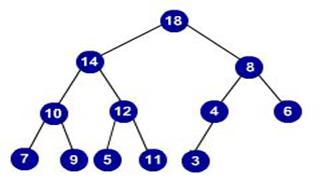
Heap Representation:
- A Heap can be
efficiently represented as an array
- The root is
stored at the first place, i.e. a[1].
- The children of
the node i are located at 2*i and 2*i +1.
- In other words,
the parent of a node stored in i th location is at [i/2] floor.
- The array
representation of a heap is given in the figure below.

This is how max-heap
is represented sequentially. An algorithm to create a heap of size i by
inserting a key to a heap of size i-1 where i>=1 is as follows:
s=i;
/*find the
parent node of i in the array */
parent = s div 2;
key[s] = newkey;
while (s <> 0 && key [parent]
<= key [s])
{
/*
interchange parent and child */
temp =
key [parent];
key
[parent] = key [s];
key [s]
= temp;
/*
advance one level up in the tree */
s =
parent;
parent
= s div 2;
}
Q.135 Construct an
expression tree for the expression  . Show all the steps
and give pre-order, in-order and post-order traversals of the expression tree
so formed. (8)
. Show all the steps
and give pre-order, in-order and post-order traversals of the expression tree
so formed. (8)
Ans :
The expression tree for the given formula is as follows
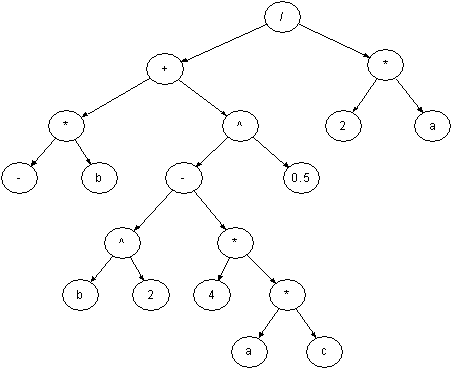
The Pre-order traversal of the tree is
/ + * - b ^ - ^
b 2 * 4 * a c 0.5 * 2 a
The Inorder traversal of the tree is
- * b + b ^ 2 -
4 * a * c ^ 0.5 / 2 * a
The Post-order traversal of the tree is
- b * b 2 * 4 a
c * * / 0.5 ^ + 2 a * /
Q.136 Write an algorithm to find solution to the
Towers of Hanoi problem. Explain the
working of your algorithm (with 3 disks) with diagrams. (10)
Ans:
The aim of the tower of Hanoi
problem is to move the initial n different sized disks from needle A to needle
C using a temporary needle B. The rule is that no larger disk is to be placed
above the smaller disk in any of the needle while moving or at any time, and
only the top of the disk is to be moved at a time from any needle to any needle.
We could formulate a recursive
algorithm to solve the problem of Hanoi to move n disks from A to C using B as
auxiliary.
Step1: If n=1, move the single disk from A
to C and return,
Step2: If n>1, move the top n-1 disks
from A to B using C as temporary.
Step3:
Move the remaining disk from A to C.
Step4:
Move the n-1 disk disks from B to C, using A as temporary.
If
we inplement this algorithm in a C language program, it would be like--
void hanoi ( int n, char
initial, char final, char temp)
{
if ( n==1 )
{
printf (“ move disk 1 from needle %c to %c\n”,
intial,final);
return;
}
hanoi( n-1, initial ,temp , final);
printf (“” nove diak %d from %c to %c “, n,
initial,final);
hanoi(n-1, temp, final, initial);
}
void main()
{
int n;
printf (“enter no of disks = “);
scanf (“%d”,&n);
hanoi ( n, ‘A’, ‘B’, ‘C’);
}
Now let us workout
the output when n=3
The output will be as follows:-
Move disk 1 from needle A to needle
C
Move disk 2 from needle A to needle
B
Move disk 1 from needle C to needle
B
Move disk 3 from needle A to needle
C
Move disk 1 from needle B to needle
A
Move disk 2 from needle B to needle
C
Move disk 1 from needle A to needle
C
Initially the disk is
at needle A
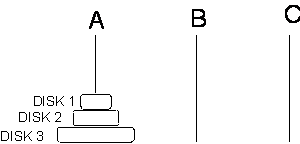
Move disk 1 from
needle A to needle C
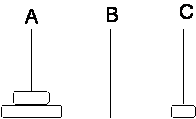
Move disk 2 from needle A to needle B
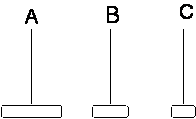
Move disk 1 from needle C to needle B
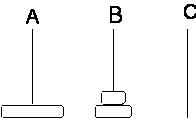
Move disk 3 from needle A to needle C
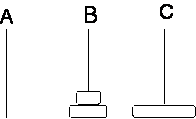
Move disk 1 from needle B to needle A
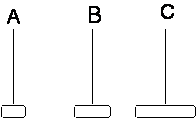
Move disk 2 from needle B to needle C
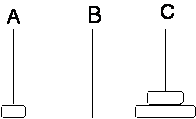
Move disk 1 from needle A to needle C
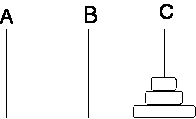
Thus finally all the
three disks is in the required position after the completion of the algorithm for n=3 as shown above.
Q.137 What is
recursion? A recursive procedure should have two properties. What are they? What type of recursive procedure can be
converted in to iterative procedure without using stack? Explain with example. (6)
Ans:
Recursion: - Recursion is defined as a technique of defining a set or
a process in terms of itself.
There are two
important conditions that must be satisfied by any recursive procedure. They
are: -
1. A smallest, base case that is processed without
recursion and acts as decision criterion for stopping the process of
computation and
2. A general method
that makes a particular case to reach nearer in some sense to the base case.
For
eg the problem of finding a factorial of a given number by recursion can be
written as
Factorial (int n)
{
int
x;
if
n = 0
return
(1);
x
= n - 1;
return
( n* factorial (x) );
}
in this case the
contents of stack for n and x as [n, x] when first pop operation is carried out
is as follows
[4, 3] [3, 2]
[2, 1] [1, 0] [0, -]
àtop of stack
Here the relation is
simple enough to be represented in an iterative loop, and moreover it can be
done without taking the help of stack. So such kind of recursive procedures can
always be converted into an iterative procedure.
The iterative
solution for the above problem would be
Factorial (int n)
{
int
x, fact = 1;
for
( x = 1 ; x <= n ; x++
)
fact
= fact * x;
return
fact;
}
If there are no statements after the recursion
call, that recursion can be converted to
iterative programme very easily.for example:
void fff (parameters)
{
if (condition)
{
step1
step2
step3
.
.
fff (parameter)
}
}
whereas, if there
are statements after a recursive call, a user stack will be required to convert
them into iterative programme. for example:
void fff (parameters)
{
if (condition)
{
step1
step2
fff (parameters)
step3
step4
fff (parameter)
}
}
Q.138 Give an  time non-recursive
procedure that reverses a singly linked list of n nodes. The procedure should not use more than
constant storage beyond that needed for the list itself. (8)
time non-recursive
procedure that reverses a singly linked list of n nodes. The procedure should not use more than
constant storage beyond that needed for the list itself. (8)
Ans:
The O (n) time non-recursive
procedure that reverses a singly linked list of n nodes is as follows.
reverse
(struct node **st)
{
struct
node *p, *q, *r;
p
= *st;
q
= NULL;
while
(p != NULL)
{
r =q;
q = p;
p = p à link;
q à link = r;
}
*st
= q;
}
Q.139 Device
a representation for a list where insertions and deletions can be made at
either end. Such a structure is called a
Deque (Double Ended Queue). Write
functions for inserting and deleting at either end. (8)
Ans :
Dequeue
A
Dequeue can be represented as follows



Let the total size of elements
be n in this Dequeue represented as an array
int
array[n];
Then
front = index of the first element
Rear = index of the last element
If front = rear then we suppose that the
Dequeue is empty
The Dequeue grows from front side till the index
of the front becomes 0 and from
rear side till the index of the rear equals the array size (n-1).
Now the functions for inserting at the front end of the Dequeue is:-
Insert_front ( int data )
{
if ( front == 0 )
printf (“Dequeue is full from the
front end”);
else
{
front--;
array[front] = data;
}
}
Inserting from the rear end is:-
insert_rear ( int data )
{
if (rear == n-1)
printf(“Dequeue is full
from rear end”);
else
{
rear++;
array [ rear ] = data;
}
}
Deleting from the front end: -
int delete_front ()
{
if (front == rear)
printf ( “the Dequeue is
empty”);
else
return ( array [ front++ ]
);
}
Deleting from the rear end:-
int delete_rear ()
{
if ( front == rear )
printf(“ the Dequeue is
empty ”);
else
return ( array [ rear-- ] );
}
Q.140 The
height of a tree is the length of the longest path in the tree from root to any
leaf. Write an algorithmic function,
which takes the value of a pointer to the root of the tree, then computes and
prints the height of the tree and a path of that length. (8)
Ans
height(Left,Right,Root,height)
1.
If Root=Null then height=0;
return;
2.
height(Left,Right,Left(Root),heightL)
3.
height(Left,Right,Right(Root),heightR)
4.
If heightL³heightR then
height=heightL+1;
Else
height=heightR+1;
5.
Return
Q.141 Two Binary trees are
similar if they are both empty or if they are both non-empty and left and right
subtrees are similar. Write an algorithm
to determine if two binary trees are similar.
(8)
Ans :
We assume two trees
as tree1 and tree2. The algorithm two determine if two Binary trees are similar
or not is as follows:
similar(*tree1,*tree2)
{
while ((tree1!=null) &&
(tree2!=null))
{
if ((tree1->root) ==
(tree2->root))
similar
(tree1->left,tree2->left);
similar
(tree1->right,tree2->right);
}
}
Q.142 Write
an algorithm for Binary search. What are
the conditions under which sequential search of a list is preferred over binary
search? (7)
Ans :
Algorithm
for Binary Search:-
Assuming that a [] is the array of items to
be searched, n is the number of items in the array a, and target is the value of the item that is to be searched.
int binsearch( int target,
int a[], int n)
{
int
low=0;
int high=1;
int mid;
while (low<=high)
{
mid=(low+high)/2;
if (target==a[mid])
return (mid);
if (target<a[mid])
high=mid-1;
else
low=mid+1;
}
return (-1);
}
Sequential search is preferred
over binary search in the following conditions:-
i). If the list is short sequential search is
easy to write and efficient than binary search.
ii) If the list is unsorted then binary search
cannot be used, in that case we have to use sequential search.
iii) If the list is unordered and haphazardly
constructed, the linear search may be the only way to find anything in it.
Q.143 Work through Binary Search algorithm on an
ordered file with the following keys
{1,2,3,4,5,6,7,8,9,10,11,12,13,14,15}.
Determine the number of key comparisons made while searching for keys 2,
10 and 15. (9)
Ans:
The given list is 1, 2, 3, 4, 5, 6, 7, 8, 9,
10, 11, 12, 13, 14, 15.
where n=14
initially low=0, high=14, mid=(low+high)/2=7
Searching for 2
1 2
3 4 5
6 7 8
9 10 11
12 13 14
15
(low) (mid) (high)
Comparison 1: 2< a[mid]
so
high=mid-1=6 and mid=(0+6)/2=3
1 2
3 4 5
6 7 8
9 10 11
12 13 14
15
(low) (mid) (high)
Comparison 2: 2< a[mid]
so
high=mid-1=2 and mid=(0+2)/2=1
1 2
3 4 5
6 7 8
9 10 11
12 13 14
15
(low)(mid)(high)
comparison 3: 2=a[mid]
So by the third comparison, we find the element in the list.
Searching for 10
1 2
3 4 5
6 7 8
9 10 11
12 13 14
15
(low) (mid) (high)
Comparison 1: 10 > a[mid]
so
low=mid+1=8 and mid=(8+14)/2=11
1 2
3 4 5
6 7 8
9 10 11
12 13 14
15
(low) (mid) (high)
Comparison 2: 10< a[mid]
so
high=mid-1=10 and
mid=(8+10)/2=9
1 2
3 4 5
6 7 8
9 10 11
12 13 14
15
(low)(mid)(high)
comparison 3: 10=a[mid]
So by the third comparison, we find the element in the list.
Searching for 15
1 2
3 4 5
6 7 8
9 10 11
12 13 14
15
(low) (mid)
(high)
Comparison 1: 15 > a[mid]
so
low=mid+1=8 and mid=(8+14)/2=11
1 2
3 4
5 6 7
8 9 10
11 12 13
14 15
(low) (mid) (high)
Comparison 2: 15> a[mid]
so
low=mid+1=12 and
mid=(12+14)/2=13
1 2
3 4 5
6 7 8
9 10 11
12 13 14
15
(low)(mid)(high)
comparison 3: 15>a[mid]
so
low=mid+1=14 and
mid=(14+14)/2=14
comparison 4: 15=a[mid]
So by the fourth comparison, we find the element in the list.
Q.144 Consider the following undirected graph:
(i)
Find the adjacency list representation of the graph.
(ii)
Find a depth-first spanning tree starting at A.
(iii)
Find a breadth-first spanning tree starting at A.
(iv)
Find a minimum cost spanning tree by Kruskal’s algorithm. (4 x 3 = 12)
Ans :
(i) The
adjacency list representation of the above graph is

(ii)
The depth-first spanning tree starting at A is
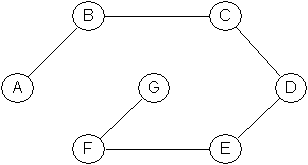
(iii)
The breadth-first spanning tree starting at A is
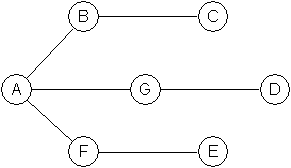
(iv)
The minimum cost spanning tree using Kruskal’s Algo is:-
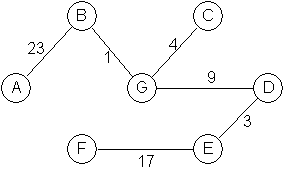
Q.145 Suppose that a graph has a minimum spanning
tree already computed. How quickly can
the minimum spanning tree be updated if a new vertex and incident edges are
added to G? (4)
Ans :
If the new vertex and the new edges are not
forming a cycle on the MST, pick up the smallest edge from the set of new
edges. If the new vertex and the corresponding edges are forming cycle on the
MST break the cycle by removing the edge with largest weight. This will update
the minimum spanning tree.
Q.146 Write code to implement a queue using arrays
in which insertions and deletions can be made from either end of the structure
(such a queue is called deque). Your code should be able to perform the
following operations
(i) Insert element in a deque
(ii) Remove element from a deque
(iii) Check if deque is empty
(iv) Check if it is full
(v) Initialize it (12)
Ans :
Here there are 4 operations
1. q insert front
2. q insert rear
3. q delete front
4. q delete rear
when front = rear
= -1, queue is empty when (rear+1) mod size of queue = front queue is full.
Here the queue is to be used circularly.
(1) q insert front
if (front==rear==-1)
then front=rear=0
q (front)=item
else if(rear+1)mod sizeof q=front
q is full, insertion not possible
else front = (front + sizeof q-1) mod sizeof
q
(2) q insert rear
if (front==rear==-1)
front=rear=0
q(rear)=item
else if (rear+1) mod sizeof queue + front
queue is full, insertion not possible
else rear = (rear+1) mode sizeof queue
q(rear) = item
(3) q delete front
if (front==rear==-1)
queue is empty
else if (front==rear)
k = q(front), front = rear= -1
return(k)
else k=q(front)
front = (front+1) mod sizeof queue
return (k)
(4) q delete
rear
if (front==rear==-1)
queue is empty
else if (front==rear)
k = q(rear), front=rear=-1
return(k)
else
k=q(rear)
rear = (rear +size of queue -1) mod sizeof q
return (k)
Q.147 What are stacks? List 6 different applications
of stacks in a computer system. (4)
Ans :
A stack
is an abstract data type in which items
are added to and removed only from one end called TOP. For example, consider
the pile of papers on your desk. Suppose you add papers only to the top of the
pile or remove them only from the top of the pile. At any point in time, the
only paper that is visible is the one on the top. This structure is called stack.
The six various application of stack in
computer application are:
1.
Conversion of infix to postfix notation and vice versa.
2.
Evaluation of arithmetic expression.
3.
Problems involving recursion are solved efficiently by making
use of
stack. For example-Tower of Hanoi
problem
4.
Stack is used to maintain the return address whenever
control passes from
one point to another in a program.
5.
To check if an expression has balanced number of
parenthesis or not.
6.
To reverse string.
Q.148 Write a recursive code to compute the sum
of squares as shown in the series
m2 + (m+1)2
+…. + n2 for m, n integers  (8)
(8)
Ans :
A recursive code to
compute sum of squares from m to n.
Make int n a global
variable so that it is not passed in every recursive cell.
int n;
void main()
{
int
m,sum;
clrscr();
printf
(" Value of m : ");
scanf
("%d",&m);
printf
(" Value of n : ");
scanf
("%d",&n);
sum=sum_recursive(m);
printf
("\n\n\n\n%d",sum);
}
int sum_recursive(int m)
{
int
sum;
if (m
== n)
return
(n*n);
else
sum
= (m*m) + sum_recursive(m+1);
printf
("\t%d",sum);
return
sum;
}
Q.149 Give
mathematical recursive definition of an AVL tree. (4)
Ans :
AVL tree definition:
1. An empty binary
tree a is an AVL tree
2. If ‘Bt’
is the non-empty binary tree with ‘BtL’ and ‘BtR’ as its
left and right-subtrees, then ‘Bt’ is an AVL tree if only if:
·
‘BtL’ and ‘BtR’ are AVL trees and
·
½hL-hR½£
1 where hL and hR are the heights of ‘BtL’ and
‘BtR’ respectively.
½hL-hR½ is called balance factor
of a node, its value can be {-1, 0, 1}
Q.150 Given the following recursive
code. Point out the possible errors in the code.
//num is a positive integer
int fac(int num)
{
if (num≤1)
return 1;
else {
return num*fac(num+1);
}
} (4)
Ans : There is no misplaced else.Two round brackets are missing for the
return statements.it
should have been
return (1)
return (num* fac (num-1))
Note
:- it is not (num+1) but (num-1)
Q.151 What are the properties of a heap? Distinguish between a max heap and a min heap. )
Ans
:
A complete binary tree, each of whose elements contains a
value that is greater
than or equal to the value of each of its children is called a Heap
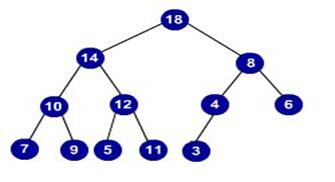
For example, above is a heap of
size 12. Because of the order property of heap, the root node always contains
the largest value in the heap. When we refer to such a heap, it is called a
"maximum heap (max heap)," because the root node contains the
maximum value in
the structure. Similarly we can also create a "minimum heap," each of
whose elements contains a value that is less than or equal to the value
of each of its children
Q.152 Transform
the array 2 8 6 1 10 15 3 12 11 into a heap with a bottom up method (8)
Ans :
Given array is 2, 8, 6, 1,
10, 15, 3, 12, 11


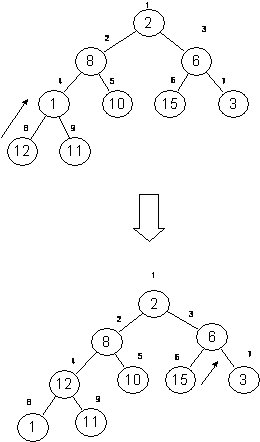
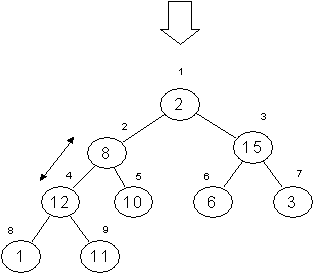
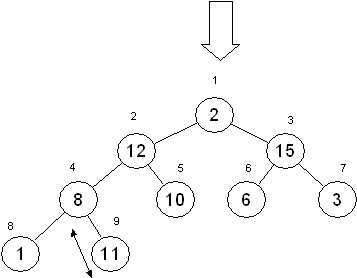

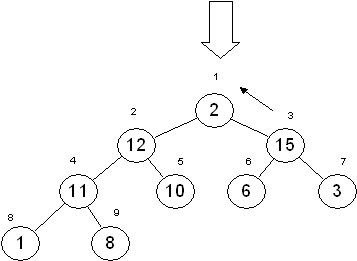
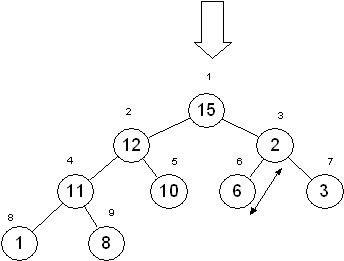
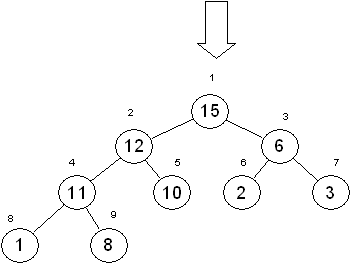
Final heap
Q.153 What are threaded binary trees?
Explain inorder threading using an example. (4)
Ans :
Threaded Binary Tree: If a node in a binary tree is
not having left or right child or it is a leaf node then that absence of child
node is represented by the null pointers. The space occupied by these null
entries can be utilized to store some kind of valuable information. One
possible way to utilize this space is to have special pointer that point to
nodes higher in the tree that is ancestors. These special pointers are called
threads and the binary tree having such pointers is called threaded binary
tree. There are many ways to thread a binary tree each of these ways either
correspond either in-order or pre-order traversal of T.A Threaded Binary Tree
is a binary tree in which every node that does not have a right child has a
THREAD (in actual sense, a link) to its INORDER successor. By doing this
threading we avoid the recursive method of traversing a Tree, which makes use
of stacks and consumes a lot of memory and time.
The node structure for a threaded binary tree
varies a bit and its like this
struct
NODE
{
struct NODE *leftchild;
int node_value;
struct NODE *rightchild;
struct NODE *thread;
}
Let's make the Threaded Binary tree out of a normal binary
tree...
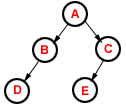
The INORDER traversal for the above tree is -- D B A E C.
So, the respective Threaded Binary tree
will be --
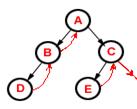
B has no right child and its inorder successor is A and so a
thread has been made in between them. Similarly, for D and E. C has no right
child but it has no inorder successor even, so it has a hanging thread.
Q.154 Write an algorithm to implement Depth-first
search? How is Depth-first search different from Breadth-first search? (10)
Ans :
Depth
First Search Algorithm
An
algorithm that does depth first search is given below:
struct node
{
int data ;
struct node *next ;
} ;
int visited[MAX]
;
void dfs ( int v,
struct node **p )
{
struct node *q ;
visited[v - 1] = TRUE ;
printf ( "%d\t", v ) ;
q = * ( p + v - 1 ) ;
while ( q != NULL )
{
if ( visited[q -> data - 1] == FALSE
)
dfs ( q -> data, p ) ;
else
q = q -> next ;
}
}
Depth-first search is different from Breadth-first search in
the following ways:
A depth search
traversal technique goes to the deepest level of the tree first and then works
up while a breadth-first search looks at all possible paths at the same depth
before it goes to a deeper level. When we come to a dead end in a depth-first
search, we back up as little as possible. We try another route from a
recent vertex-the route on top of our stack. In a breadth-first search,
we want to back up as far as possible to find a route originating from
the earliest vertices. So the stack is not an appropriate structure for finding
an early route because it keeps track of things in the order opposite of their
occurrence-the latest route is on top. To keep track of things in the
order in which they happened, we use a FIFO queue. The route at the front of
the queue is a route from an earlier vertex; the route at the back of the queue
is from a later vertex.
Q.155 Represent the
following graph as
(i) Adjacency list
(ii) Adjacency matrix
(iii) Incidence matrix (6)
Ans :
The given graph is –
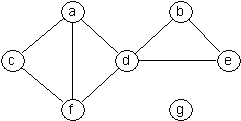
The
representation of the above graph is as follows: -
(i)
Adjacency List : -


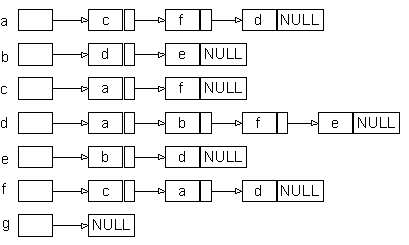
(ii)
Adjacency Matrix : -
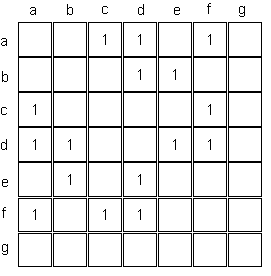
(iii)
Incidence Matrix : - This is the
incidence matrix for an undirected group. For directed graphs, the vertex from
where an edge is originating will have +1 and the vertex where the edge is
reaching will have a value -1.
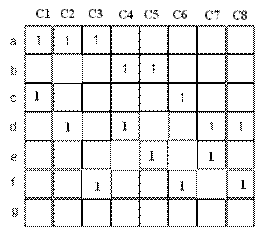
Rest of the entries are zero.
Q.156 Define B-tree of order m? When is it preferred to
use B-trees? (4)
Ans
:
A B-Tree of
order M is either the empty tree or it is an M-way search tree T with the
following properties:
(i)
The root
of T has at least two subtrees and at most M subtrees.
(ii)
All
internal nodes of T (other than its root) have between [M / 2] and M subtrees.
(iii)
All
external nodes of T are at the same level.
Just as AVL trees are balanced binary search trees, B-trees are balanced M-way search trees. By imposing a balance
condition, the shape of an AVL tree is constrained in a way which guarantees
that the search, insertion, and withdrawal operations are all O(log n), where n
is the number of items in the tree. The shapes of B-Trees are constrained for
the same reasons and with the same effect.
Q.157 Write an algorithm to search a key in a B-tree? What is the worst
case of searching in a B-tree? List the possible situations that can occur
while inserting a key in a B-tree? (8)
Ans :
B-tree search makes an n-way choice. By performing the
linear search in a node, correct child Ci of that node is chosen. Once the
value is greater than or equal to the desired value is obtained, the child
pointer to the immediate left of the value is followed. Otherwise rightmost
child pointer is followed. If desired value is obtained, the search is
terminated.
B-tree search (x, k) /*This function searches the key from the given B-tree*/
The Disk_Read
operation indicates that all references to a given node be preceded by a read
operation.
1.
Set i ß 1
2.
While (i < n[x]
and k > keyi [x])
Set i = i
+ 1
3.
If (i<= n[x] and k=keyi [x]) then
{ return (x, i) }
4.
If (leaf [x]) then
return NIL
else Disk_read (ci
[x])
return B-tree search
(ci [x], k)
The worst case of
searching is when a B-tree has the smallest allowable number of pointers per
non-root made, q=[m/2], the search has to reach a leaf (either for a successful
or an unsuccessful search)
There are three
common similarities that are encountered when inserting a key in a B-tree.
1)
A key is placed in a leaf that still has some room.
2)
The leaf in which the key should be placed is full. In this
case, the leaf is split, creating a new leaf and half of the keys are moved
from the full leaf to the new leaf. But the new leaf has to be incorporated in
to the B-tree. The last key of the old leaf is moved to the parent and a
pointer to the new leaf is placed in the parent as well. The same procedure can
be repeated for each internal node of the B-tree. Such a split ensures that
each leaf never has less than [m/2]-1 keys.
3)
A special case arises if the root of the B-tree is full. In
this case, a new root and a new sibling of the existing root has to be created.
This split results in two new nodes in the B-tree.
Q.158 What is
the complexity of the following code?
int counter = 0;
for (i=0; i<n; i++)
for (j=0; j<n*n; j++)
counter++; (4)
Ans :
The complexity of given code is
O(n2).
Q.159
Show
under what order of input, the insertion sort will have worst-case and
best-case situations for sorting the set {142, 543, 123, 65, 453, 879, 572,
434}. (8)
Ans :
The given list is
142 543 123 65 453 879 572
As
we know that insertion sort is based on the idea of inserting records into an
existing sorted file. To insert a record, we must find the proper place for the
record to be inserted and this requires searching the list.
An
insertion sort will have the worst-case when the list is reversely sorted i.e.
in a decreasing order. So for the above given list the insertion sort exhibits
its worse case when the list is in
following order
879 572 543 453 434 142 123 65
Again
since it is the property of the insertion sort that it searches for the correct
position in the list for an element, so this technique exhibits its best case computing when the list is
already sorted in ascending order as given below.
65 123 142 434 453 543 572 879
Q.160 Explain how Merge Sort sorts the following
sequence of numbers using a diagram {142, 543, 123, 65, 453, 879, 572, 434}. (8)
Ans :
Sorting
using Merge Sort
The given sequence of
numbers is:-
|
    Original Sequence Original Sequence
[434]
|
[142]
|
[543]
|
[123]
|
[65]
|
[453]
|
[879]
|
[572]
|
|
Pass one
[572
|
[142
|
543]
|
[65
|
123]
|
[453
|
879]
|
[434
|
|
Pass two
879]
|
[65
|
123
|
142
|
543]
|
[434
|
453
|
572
|
|
Pass three
[879
|
[65
|
123
|
142
|
434
|
453
|
543
|
572
|
This number sequence is sorted
in three passes using merge sort.
Q.161 Given
a stack s and a queue q, show the contents of each after the
indicated operations. The starting contents of s and q are shown.
If an operation would result in an error, write “error”
and assume the contents of s and q do not change. If there is no
change otherwise, leave the cell blank or use ditto marks (”). (8)
|
Operation
|
Contents of stacks
Top bottom
|
Contents of queue q
front
rear
|
|
Start
|
empty
|
2, 4
|
|
s.pop()
|
|
|
|
s.push(3)
|
|
|
|
q.add(5)
|
|
|
|
s.push(q.peek())
|
|
|
|
q.add(s.peek())
|
|
|
|
q.add(s.pop())
|
|
|
|
s.push(s.pop())
|
|
|
|
q.add(q.remove())
|
|
|
Ans :
pop(): Removing an element from
top of the satck
push(element):
inserting element on the top of stack
add(element):
inserting element from rear of the queue
remove():
removing element from front of the queue
peek():reading from the front of the
queue.
We have left the
cells blank where there is no change from the previous state.
|
Operation
|
Contents
of Stack
Top bottom
|
Content
of queue q
Front rear
|
|
start
|
empty
|
2,4
|
|
s.pop()
|
error
|
-do-
|
|
s.push(3)
|
3
|
-do-
|
|
q.add(5)
|
-do-
|
2,4,5
|
|
s.push(q.peek())
|
2,3
|
-do-
|
|
q.add(s.peek())
|
-do-
|
2,4,5,2
|
|
q.add(s.pop())
|
3
|
2,4,5,2,2
|
|
s.push(s.pop())
|
-do-
|
-do-
|
|
q.add(q.remove())
|
-do-
|
4,5,2,2,2
|
Q.162 If x is a pointer to a node in a
doubly linked list, then x-> prev is the pointer to the node before it and
x->next is the pointer to the node after it.
What
does this pair of statements, executed in order, do?
(x->next)->prev = x->prev;
(x->prev)->next = x->next;
If
we then execute this pair of statements (after executing the first pair of
statements), what happens?
(x->next)->prev = x;
(x->prev)->next
= x; (4)
Ans :
In the above given
condition, if the following
(x->next)->prev=x->prev;
(x->prev)-next=x->next;
statements are executed then the resulting
linked list will no longer have x as one of its elements i.e. the element x
gets deleted from the doubly linked list.
Now, after executing the
above pair of statements; if we execute the following pair i.e.-
(x->next)->prev=x;
(x->prev)->next=x;
then this causes the
element x to become a part of the linked list again(i.e. it gets inserted again) and at the same position as
before.


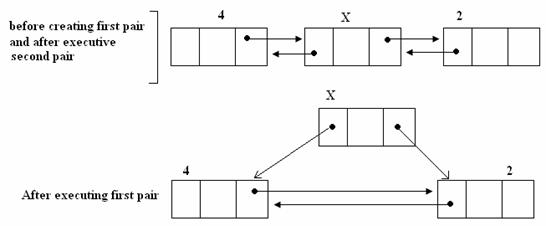
Q.163 Consider
an insertion of the key = 222 into the hash table shown in the figure.
Calculate and indicate the sequence of table entries that would be probed and
the final location of the insertion for the key for linear probing and
quadratic probing method. The hash function is h(y) = y mod 10, so for the key
= 222 , h(x) = 2 mod 10. In both cases start with the same initial table.
Example calculation given at index 2 (8)
|
0
|
|
|
|
1
|
|
|
|
2
|
152
|
h(222) = 2 mod 10
|
|
3
|
53
|
|
|
4
|
|
|
|
5
|
75
|
|
|
6
|
136
|
|
|
7
|
27
|
|
|
8
|
|
|
|
9
|
999
|
|
Ans :
Linear
Probing:
i.
Initially all locations marked ‘empty’
ii.
When new items are stored, filled locations marked ‘full’
iii.
In case of collisions, newcomers are stored at the next
available location, found via probing by incrementing the pointer (mod n) until
either an empty location is found or starting point is reached.
So in the given case we have 222 mod 10=2, index 2 is
probed. Since it is already filled so newcomer will go to the next available
location that is index
4.
Rehashing:
i. The collision key is move to the considerable distance from
the initial collision when the hashing
function compute the value then the quadratic probing work as follows
(Hash value+12) mod table
size
ii. If there is a
collision, take the second hash function as
(Hash value+22) mod table
size and so on.
iii. The probability that two key values will map to the same
address with two different hash
functions is very low.
So in the given case,
we see 222+12 mod 10=3 there is collision; Use next hash function.
222+22 mod 10=222+4=226 mod 10=6 ,
there is collision
222+32 mod 10=222+9=231 mod
10=1 so newcomer can be inserted at index 1.
Q.164 Using Dijkstra’s method find a spanning tree
of the following graph. (8)

Ans :
Disjkstra
algorithm Method is never used for finding Minimum-spanning tree
Minimum-spanning tree
tree=null;
edges=an
unsorted sequence of all edges of graph;
for j=1 to ½E½
add ej to tree;
If there is cycle in
tree
Remove an edge with maximum weight from this
only cycle.
The spanning tree
for given graph is given below:
Step 1

Step 2
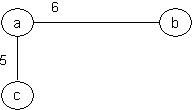
Step 3
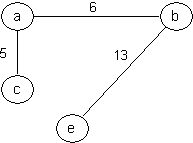
Step 4
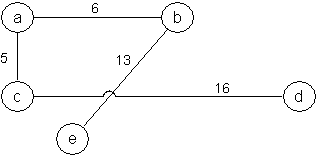
Step 5
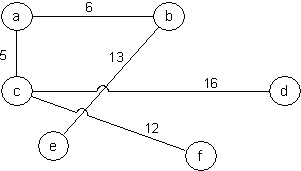
Step 6
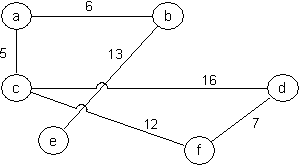
Since the above representation creates a cycle so we delete
the edge having the highest weight in the cycle and the new representation
would be as follows: -
Step 7
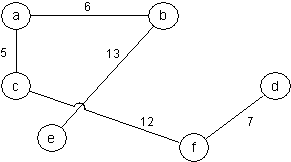
Step 8
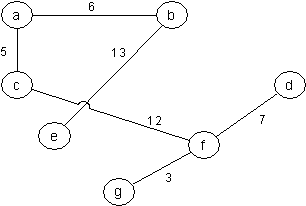
Step 9
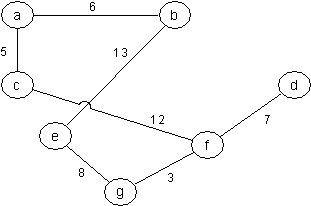
The above representation creates cycle so we’ll delete the
edge having the highest weight as shown below.
Step 10
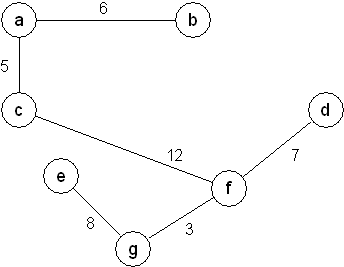
Q.165 What
are the three different ways of representing a polynomial using arrays?
Represent the following polynomials using any three different methods and
compare their advantages and disadvantages.
(i) 
(ii)  (8)
(8)
Ans
:
A general polynomial A(x) can be
written as anxn+an-1xn-1+…+a1x+a0 where
an ¹0 then we can represent A(x)
1.
As an ordered list of coefficients using a one dimensional
array of length n+2,
A=(n, an,
an-1,…,a1, a0) , the first element is the
degree of A followed by n+1 coefficients
in order of decreasing exponent. So the given polynomial can be represented as
i.
(5,7, -8,5,1,2,15)
ii.
(100,3,0,0,0,0…(45 times), -5, 0,0,0…(55 times),-10)
Advantage of this method is simple
algorithms for addition and multiplication as we have avoided the need to
explicitly store the exponent of each term. However there is a major
disadvantage of this method and that is wastage of memory for certain
polynomial like example (ii) because we are storing more zero values than
non-zero values.
2.
As an ordered list where we keep only non-zero coefficient
along with their exponent like (m,em-1,bm-1,em-2,bm-2,…,e0,b0)
where first entry is the number of nonzero terms, then for each term there are
two entries representing an exponent-coefficient pair. So the given polynomial
can be represented as
i. (6,5,7,4,-8,3,5,2,1,1,2,0,15)
ii. (3,100,3,55,-5,0,-10)
This method is solves
our problem of wasted memory like what happened in example 2.
Q.166 Write
an algorithm to evaluate the following polynomial. The number of additions and multiplications taken should be 5.
 (8)
(8)
Ans :
The given polynomial can be
evaluated using Hormer’s rule as
9x5-10x4+6x3+5x2-10x+15
≡ x4[9x-10]+6x3+5x2-10x+15
≡ x3[x[9x-10]+6x]+5x2-10x+15
≡ x2[x[x[9x-10]+6]+5]-10x+15
≡ x[x[x[x[9x-10]+6]+5]-10x+15
≡ x[x[x[x][9x-10]+6]+5]-10]+15
≡ 0[5]
Q.167 Let
P be a pointer to a circularly linked list. Show how this list may be used as a
queue. That is, write algorithms to add and delete elements. Specify the value
for P when the queue is empty. (10)
Ans : External
pointer should always point to the last node of the circularly linked list.
Then both the insertion and deletion from the queue can be done in O(1) time.


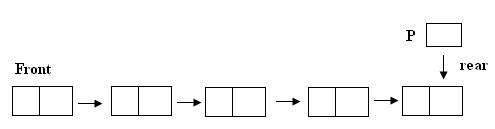
To add a new node x (insert a new element in the queue)
 x next = P next
P next = x
P=x
To delete a node (Deleting front element from queue)
x = P next
 P next = x next
return (x)
Q.168 Give an algorithm for a singly linked list,
which reverses the direction of the links. (6)
Ans
:
The algorithm to reverse the
direction of a singly link list is as follows:
reverse (struct
node **st)
{
struct node *p,
*q, *r;
p = *st;
q = NULL;
while (p != NULL)
{
r =q;
q = p;
p = p à link;
q à link = r;
}
*st = q;
}
Q.169 Suppose that we have numbers between 1 and
1000 in a Binary Search Tree and want to search for the number 363. Which of
the following sequences could not be the sequence of nodes examined? Explain
your answer.
(i)
2, 252, 401, 398, 330, 344, 397, 363
(ii)
924, 220, 911, 244, 898, 258, 362, 363
(iii)
925, 202, 911, 240, 912, 245, 363
(iv)
2, 399, 387, 219, 266, 382, 381, 278, 363
(v)
935, 278, 347, 621, 299, 392, 358, 363 (10)
Ans :
(i) This is a valid representation of
sequence.
(ii) This is also a valid representation of
sequence.
(iii)This could not
be the sequence since 240 is encountered after 911 so it must be its left
child, and any other node henceforth must be less than 911(parent). But the
node 912 breaks this sequence, which is greater than 911 and lies on the left
subtree of 911, which violates the basic rule of a Binary Search Tree.
(iv)This is also a valid representation of sequence.
(v)This could not be
a valid sequence since 621 is encountered after 347 so 621 must be its right
child, and any other node henceforth must be greater than 347(parent). But this
sequence is broken by the node 299 < 347 and lies on the right subtree of
347 which violates the basic rule of a Binary Search Tree.
Q.170 Professor
Banyan thinks he has discovered a remarkable property of binary search trees.
Suppose that the search for key k in a BST ends up in leaf. Consider three sets
(1) set A, the keys to the left of the search path, (2) set B the keys on the
search path and (3) set C, the keys on the right of the search path. Professor
Banyan claims that any three keys  must satisy
  . Is his claim true? Otherwise give a counter example to the
professor’s claim. (3)
. Is his claim true? Otherwise give a counter example to the
professor’s claim. (3)
Ans
:
Professor Banyan
claim is completely wrong.
The claim of professor Banyan is wrong.
Counter example is given below.
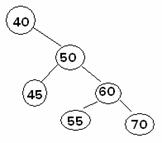
Let the key to
be searched is 70 then:
Set A = {45,
55}, B = {40, 50, 60, 70}and C = {}

 Here is very clear
that 45 ≤ 40 OR 55
≤ 50
Here is very clear
that 45 ≤ 40 OR 55
≤ 50
Q.171 Draw BSTs of height 2 and 3 on
the set of keys {1, 4, 5, 10, 16, 17, 21}. (3)
Ans :
The BST of height 2 is:
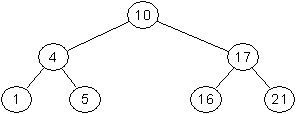
The BST of height 3 is:
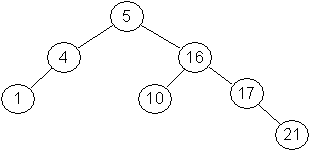
Q.172 Why don’t we allow a minimum degree of t=1
for a B-tree? (2)
Ans
:
According to the definition of B-Tree, a B-Tree of order n means
that each node in the tree has a maximum of n-1 keys and n subtrees. Thus a B-Tree of order 1 will have maximum 0
keys, i.e. no node can have any keys so such a tree is not possible and hence
we can’t allow a minimum degree of t=1 for a B-Tree.
Q.173 Show all legal B-Trees of minimum degree 3
that represent {1, 2, 3, 4, 5, 6}. (4)
Ans
:
B-Trees of minimum degree 3 are as
follows:
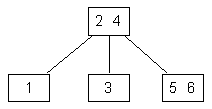
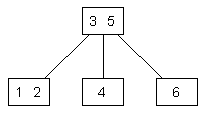
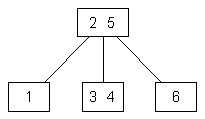
Q.174 Show the result of inserting
the keys 4,19, 17, 11, 3, 12, 8, 20, 22, 23, 13, 18, 14, 16, 1, 2, 24, 25, 26,
5 in order in to an empty B-Tree of degree 3. Only draw the configurations of
the tree just before some node must split, and also draw the final
configuration. (10)
Ans
:
4,
19

17, 11
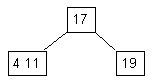
3, 12
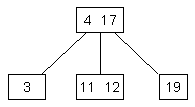
8, 20
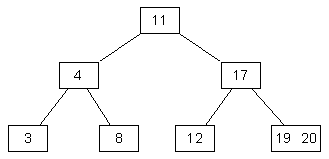
22, 23, 13, 18
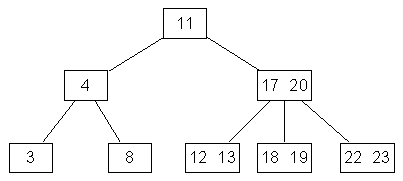
14, 16,
1
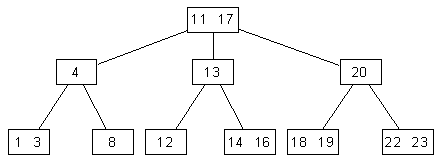
2
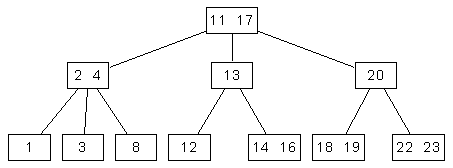
24, 25
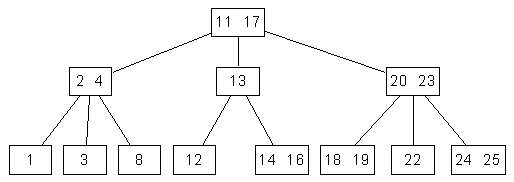
26
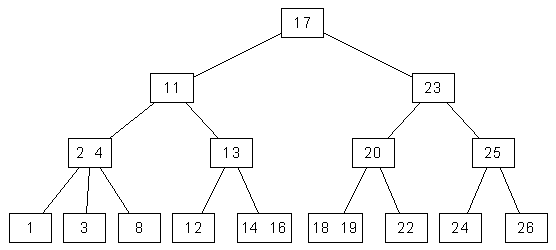
Finally 5 is inserted
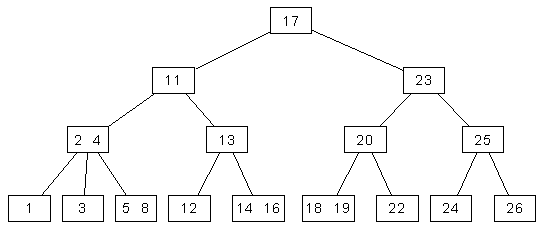 The
above is the final tree formed after inserting all the elements given in the
question.
The
above is the final tree formed after inserting all the elements given in the
question.
Q.175 Write down the
algorithm for quick sort. (8)
Ans
:
The algorithm for quick
sort is as follows:
void quicksort ( int a[ ], int lower, int
upper )
{
int i
;
if (
upper > lower )
{
i
= split ( a, lower, upper ) ;
quicksort
( a, lower, i - 1 ) ;
quicksort
( a, i + 1, upper ) ;
}
}
int split ( int a[ ], int lower, int upper )
{
int i,
p, q, t ;
p =
lower + 1 ;
q =
upper ;
i =
a[lower] ;
while
( q >= p )
{
while
( a[p] < i )
p++
;
while
( a[q] > i )
q--
;
if
( q > p )
{
t
= a[p] ;
a[p]
= a[q] ;
a[q]
= t ;
}
}
t =
a[lower] ;
a[lower]
= a[q] ;
a[q] =
t ;
return
q ;
}
Q.176 Show
how quick sort sorts the following sequences of keys:
5, 5, 8, 3, 4, 3, 2 (7)
Ans :
The given data
element to be sorted using quick sort is
5 5 8
3 4 3 2
Choosing pivot 5 (Pass1)
(2) 5
8 3 4 3 (5)
2
5 (5) 3 4 3 (8)

 2 5 (3) 3 4 (5) 8
choosing 2 as pivot
(pass2)
(2) 5 3 3 4 (5 8)


 choosing 5 as pivot (pass 3)
(2) (3 3 4 5) (5 8)
Pass (4), (5) and
(6) will not change the sub list
Q.177 On
which input data does the algorithm quick sort exhibit its worst-case
behaviour? (1)
Ans :
The Quick Sort technique
exhibits its worst-case behavior when the input data is “Already Completely
Sorted”.
Q.178 What do you mean by hashing? Explain any
five popular hash functions. (5)
Ans :
Hashing
Hashing provides the
direct access of record from the file no matter where the record is in the
file. This is possible with the help of a hashing function H which map the key
with the corresponding key address or location. It provides the key-to-address
transformation.
Five popular hashing functions are as follows:-
Division Method: An integer key x is divided by the table size m and the
remainder is taken as the hash value. It can be defined as
H(x)=x%m+1
For example, x=42 and
m=13, H(42)=45%13+1=3+1=4
Midsquare Method: A key is multiplied by itself
and the hash value is obtained by selecting an appropriate number of digits from
the middle of the square. The same positions in the square must be used for all
keys. For example if the key is 12345, square of this key is value 152399025.
If 2 digit addresses is required then position 4th and 5th
can be chosen, giving address 39.
Folding
Method: A
key is broken into several parts. Each part has the same length as that of the
required address except the last part. The parts are added together, ignoring
the last carry, we obtain the hash address for key K.
Multiplicative
method: In
this method a real number c such that 0<c<1 is selected. For a
nonnegative integral key x, the hash function is defined as
H(x)=[m(cx%1)]+1
Here,cx%1 is the
fractional part of cx and [] denotes the greatest integer less than or equal to
its contents.
Digit Analysis: This method forms addresses by
selecting and shifting digits of the original key. For a given key set, the
same positions in the key and same rearrangement pattern must be used. For
example, a key 7654321 is transformed to the address 1247 by selecting digits
in position 1,2,4 and 7 then by reversing their order.
Q.179 Draw the 11-item hash table resulting from
hashing the keys 12, 44, 13, 88, 23, 94, 11, 39, 20, 16 and 5 using the hash
function h (i) = (2i+5) mod 11 (7)
Ans :
Table size is 11
h(12) = (24+5) mod 11
= 29 mod 11 = 7
h(44) = (88+5) mod 11
= 93 mod 11 = 5
h(13) = (26+5) mod 11
= 31 mod 11 = 9
h(88) = (176+5)mod
11= 181mod 11 = 5
h(23) = (46+5) mod 11
= 51 mod 11 = 7
h(94) = (188+5)mod
11= 193mod 11 = 6
h(11) = (22+5) mod 11
= 27 mod 11 = 5
h(39) = (78+5) mod 11
= 83 mod 11 = 6
h(20) = (40+5) mod 11
= 45 mod 11 = 1
h(16) = (24+5) mod 11
= 29 mod 11 = 4
h(5) = (10+5) mod 11 = 15 mod 11 = 4
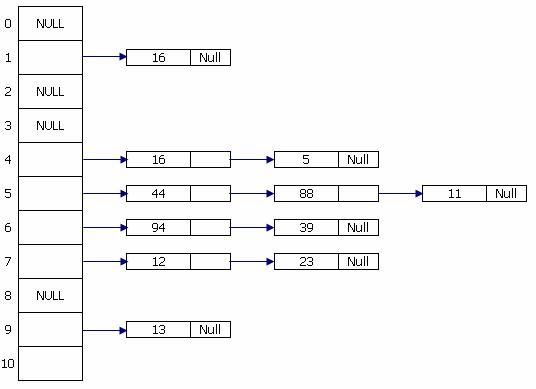
Q.180 Explain
any two methods to resolve collision during hashing. (4)
Ans :
The two
methods to resolve collision during hashing are:
Open addressing and Chaining.
Open addressing: The simplest way to
resolve a collision is to start with the hash address and do a sequential
search through the table for an empty location. The idea is to place the record
in the next available position in the array. This method is called linear
probing. An empty record is indicated by a special value called null. The major
drawback of the linear probe method is clustering.
Chaining: In this technique, instead of hashing function value as
location we use it as an index into an array of pointers. Each pointer access a
chain that holds the element having same location.
Q.181 Find
out the minimum spanning tree of the following graph. (8)
Ans
:
The minimum spanning tree of
given graph: -
Step 1: Edge (a, c) cost=5 add
to tree T
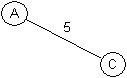
Step 2: Edge (c, e) cost=4 add
to T
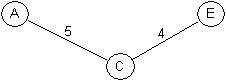
Step 3: Edge (c, f) cost=3 add
to T
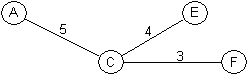
Step 4: Edge (f, d) cost=1 add
to T
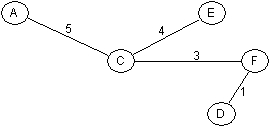
Step 5: Edge (f, b) cost=2 add to T
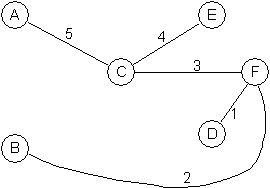
Thus
the above tree is the minimum spanning tree of the graph.
Q.182 Give
an algorithm to compute the second minimum spanning tree of a graph. (8)
Ans : Find out the minimum spanning tree using Prim`s or Kruskal`s
Algorithm. Remove one edge from MST. One vertex will become isolated. Add an
edge, which is not in the MST, such that the vertex gets connected. Find out
the increase in the total weight of the spanning tree.
Repeat this
process with every edge of the MST.
Remove that edge,
whose removal and addition of some other edge, will increase the total weight
of MST by minimum. This will give the second minimum spanning tree.
For example:-
Let G be as follows:-





Now MST:-
Remove AB from MST
Now to get a
spanning tree, either DB is to be added or CD is to be added. Addition of DB
will increase the weight by 2 units (i.e. 3 – 1) and addition of CD will
increase the weight by 4 units (5-1). Therefore removal of AB will increase the
weight of the next spanning tree by 2.
Now remove edge CB
then CD or BC is to be added, edge CVD will increase the weight of the tree by
3 units (5-2)
Similarly if AD is
to be removed, it will be replaced by CD which will increase the weight of the
tree by 3. Thus the second minimum spanning tree is obtained by remaining AB
and adding DB.
Q.183 Define a threaded binary tree.
Write an algorithm for inorder traversal of a threaded
binary tree. (6)
Ans :
Threaded
Binary Tree:-
If a node in a binary
tree is not having left or right child or it is a leaf node then that absence
of child node is represented by the null pointers. The space occupied by these
null entries can be utilized to store some kind of valuable information. One
possible way to utilize this space is to have special pointer that point to
nodes higher in the tree that is ancestors. These special pointers are called
threads and the binary tree having such pointers is called threaded binary
tree.
There are many ways
to thread a binary tree each of these ways either correspond either in-order or
pre-order traversal of T.A Threaded Binary Tree is a binary tree in which every
node that does not have a right child has a THREAD (in actual sense, a link) to
its INORDER successor. By doing this threading we avoid the recursive method of
traversing a Tree, which makes use of stacks and consumes a lot of memory and
time.
The node structure
for a threaded binary tree varies a bit and its like this
struct NODE
{
struct NODE *leftchild;
int node_value;
struct NODE *rightchild;
struct NODE *thread;
}
The INORDER traversal
for the above tree is -- D B A E C. So, the respective Threaded Binary tree
will be --
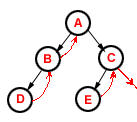
B has no right child
and its inorder successor is A and so a thread has been made in between them.
Similarly, for D and E. C has no right child but it has no inorder successor
even, so it has a hanging thread.
The algorithm for
doing the above task is as follows;
Void inorder
(NODEPTR root)
{
NODEPTR p, trail;
p = root;
do
{
trail = null;
while ( p!= null)
{
trail = p;
p = p -> left;
}
if (trail != null)
{
printf (“ %d\n”, trail->info);
p = trail -> right;
while ( trail -> rt &&
p != NULL)
{
printf (“%d/x”, p ->
info);
trail =p;
p = p -> right;
}
}
}
while (trail != NULL);
}
Q.184 Give an algorithm to sort data in a doubly
linked list using insertion sort. (10)
Ans :
Simple Insertion sort is easily adaptable
to doubly linked list. In this Let's make the Threaded Binary tree out of a
normal binary tree...
method there is an
array link of pointers, one for each
of the original array elements. Initially link[i] = i + 1 for 0 < = I <
n-1 and link [n-1] = -1. Thus the array can be thought of as a doubly link list
pointed to by an external pointer first initialized
to 0. To insert the kth element the linked list is traversed until the proper
position for x[k] is found, or until the end of the list is reached. At that
point x[k] can be inserted into the list by merely adjusting the list pointers
without shifting any elements in the array. This reduces the time required for
insertion but not the time required for searching for the proper position. The
number of replacements in the link array is O (n).
void
insertion_sort( input type a[ ], unsigned int n )
{
unsigned int j, p;
input type tmp;
a[0]
= MIN_DATA; /* sentinel */
for ( p=2; p <= n; p++ )
{
tmp = a[p];
for ( j = p; tmp < a[j-1]; j-- )
a[j] = a [j-1];
a[j] = tmp;
}
}
Q.185 What
is an Abstract Data Type (ADT)? Explain
with an example. (4)
Ans :
Abstract data types
or ADTs are a mathematical specification of a set of data and the set of
operations that can be performed on the data. They are abstract in the sense
that the focus is on the definitions of the constructor that returns an
abstract handle that represents the data, and the various operations with their
arguments. The actual implementation is not defined, and does not affect the
use of the ADT.
For example, rational numbers (numbers that can be written in the
form a/b where a and b are integers) cannot be represented natively in a
computer. A Rational ADT could be defined as shown below.
Construction: Create
an instance of a rational number ADT using two integers, a and b, where a
represents the numerator and b represents the denominator.
Operations: addition,
subtraction, multiplication, division, exponentiation, comparison, simplify,
conversion to a real (floating point) number.
To be a complete specification, each operation should be defined in terms
of the data. For example, when multiplying two rational numbers a/b and c/d,
the result is defined as ac/bd. Typically, inputs, outputs, preconditions,
postconditions, and assumptions to the ADT are specified as well.
When realized in a computer program, the ADT is represented by an
interface, which shields a corresponding implementation. Users of an ADT are
concerned with the interface, but not the implementation, as the implementation
can change in the future.
ADTs typically seen in textbooks and implemented in programming languages
(or their libraries) include:
·
String
ADT
·
List
ADT
·
Stack
(last-in, first-out) ADT
·
Queue
(first-in, first-out) ADT
·
Binary
Search Tree ADT
·
Priority
Queue ADT
·
Complex
Number ADT (imaginary numbers)
There is a distinction, although sometimes subtle, between the abstract
data type and the data structure used in its implementation. For example, a
List ADT can be represented using an array-based implementation or a
linked-list implementation. A List is an abstract data type with well-defined
operations (add element, remove element, etc.) while a linked-list is a
pointer-based data structure that can be used to create a representation of a
List. The linked-list implementation is so commonly used to represent a List
ADT that the terms are interchanged and understood in common use.
Similarly, a Binary Search Tree ADT can be represented in several ways:
binary tree, AVL tree, red-black tree, array, etc. Regardless of the
implementation, the Binary Search Tree always has the same operations (insert,
remove, find, etc.)
Q.186
Suppose we wish to multiply four matrices of real numbers M1*M2*M3*M4
were M1 is 10*20, M2 is 20*50, M3 is 50*1 and M4 is 1*100. Assume that the multiplication of a p*q
matrix by q*r matrix requires pqr scalar operations, find the optimal order in
which to multiply the matrices so as to minimize the total number of scalar
operations. (5)
Ans :
Here M1 = 10x20
M2
= 20x50
M3
= 50x1 and
M4=1x100
Now optimal order is
1.
M2*M3
= [20x50]*[50x1] = [20x1]
And no of scalar
operations are 20*50*1 = 1000
2.
M1*M2M3
= [10x20]*[20x1] = [10x1]
And no of scalar
operations are 10*20*1 = 200
3.
M1M2M3*M4
= [10x1]*[10x100] = [10x100]
And no of scalar
operations are 10*1*100=1000
So total no of scalar
operations require are 1000+200+1000=2200 .
Q.187 Show a tree (of more than one node) for which
the preorder and inorder traversals generate the same sequence. Is this possible for preorder and post order
traversals? If it is, show an example. (5)
Ans :
A binary tree with 5 nodes 0 , 1, 2, 3 and 4 whose
inorder and post order sequences
are the same .

This is not
possible for preorder and post order traversals.
Q.188 Write modules to do
the following operations on a Binary Tree.
(i)
Count the number of leaf nodes.
(ii)
Count the number of nodes with two children. (9)
Ans :
(i ) Leafcount (T)
{
static int n=0;
if (T!= NULL)
{leaf count (Tà left);
if (Tàleft == NULL && Tàright = NULL)
n++
leafcount (Tàright)
}
return (n);}
(ii) Leafcount (T)
{
static int n=0;
if (T! = NULL)
{leaf count (Tà left);
if (Tàleft!= NULL && Tàright! = NULL)
n++
leafcount (Tàright)
}
return (n);}
Q.189 If n >=1, prove that for any n-key B-tree
T of height h and minimum degree t >= 2, h <= log t (n+1)/2.
(7)
Ans :
In the case of a B-tree with a minimum no of keys , there is one key in the
root , 2 nodes at depth 1 , 2ti-1
nodes at depth i .
Let h be the height of the tree and n be the no of
nodes . Then
h
n >= 1+(t-1) S 2ti-1
i=1
which works out to th <= (n+1) / 2
So we take the logt of both sides
h <= logt(n+1)/2
Q.190 A cocktail shaker sort designed by Donald Kunth is a modification of
bubble sort in which the direction of bubbling changes in each iteration: in
one iteration, the smallest element is bubbled up; in the next, the largest is
bubbled down; in the next, the second smallest is bubbled up; and so
forth. Write an algorithm to implement
this and explore its complexity. (14)
Ans :
Cocktail sort, also known as bidirectional bubble sort, cocktail
shaker sort, shaker sort, ripple sort, or shuttle sort,
is a stable sorting algorithm that varies from bubble sort in
that instead of repeatedly passing through the list from top to bottom, it
passes alternately from top to bottom and then from bottom to top. It can
achieve slightly better performance than a standard bubble sort.
Complexity in Big O notation is O(n²) for a worst case, but becomes closer
to O(n) if the list is mostly ordered at the beginning.
void cocktail_sort (int A[], int n)
{ int left = 0, right = n;
bool finished;
do
{ finished = true;
--right;
for (int i = left; i < right; i++)
if (A[i] > A[i+1])
{ std::swap(A[i], A[i+1]);
finished = false;
}
if (finished) return; finished = true;
for (int i = right; i > left; i--)
if (A[i] < A[i-1])
{ std::swap(A[i], A[i-1]);
finished = false;
}
++left;
} while (!finished);
}
Q.191 Consider
the following undirected graph:
(i)
Find a minimum cost spanning tree by Kruskal’s algorithm.
(ii)
Find a depth-first spanning tree starting at a
and at d.
(iii)
Find a breadth-first spanning tree starting at a
and at d.
(iv)
Find the adjacency list representation of the graph. (3.5 x 4 = 14)
Ans :
(i)
Find a minimum cost spanning tree by kruskal’s algorithm .
Assume dh = 3
Edges (g f) = 1 Accept
(a b) = 2
Accept
(d e) = 2
Accept
(b c) = 3
Accept
(d h) = 3 Accept
(c d) = 4 Accept
(i h) = 4
Accept
(e
f) =
5 Accept
(a c) = 5 Reject
(b h) = 6 Reject
(a i ) = 7 Reject
(i d) = 8 Reject
(d g) = 9 Reject
So minimum cost spanning tree is :


 b c e
b c e
 a d f
a d f
g
 i h
i h
And Cost is 2+3+4+2+5+1+3+4 = 24
(ii) Find a Depth first spanning tree starting at a and d .
b c e


a
 d f
d f
i h g
b c e
d
a
f
i h g
(iii) Find a breadth first spanning tree starting
at a and d .




 b c e
b c e


 a
d
a
d
i
h g f


 b c e
b c e


 a
d f
a
d f
I h g
(iv) Find the adjacent list representation of the graph .
|
a
|
 
|
b,c,i
|
|
  
|
|
|
|
b
|

|
a,c,h
|
|
|

|
|
|
c
|

|
a,b,d
|
|
|
  
|
|
|
d
|
|
c,e,g,h,i
|
|
|
|
|
|
e
|
|
d,f
|
|
|
|
|
|
f
|
|
e,g
|
|
|
|
|
|
g
|
|
d,f
|
|
|
|
|
|
h
|

|
b,d,i
|
|
|

|
|
|
i
|
|
a,d,h
|
Q.192 Work
through Binary Search algorithm on an ordered file with the following keys:
{1,2,3,4,5,6,7,8,9,10,11,12,13,14,15,16}.
Determine the number of key comparisons made while searching for keys 2,
10 and 15. (6)
Ans :
Here
List={1,2,3,4,5,6,7,8,9,10,11,12,13,14,15,16}
Binary Search for key 2
(1) Here bottom =1 Top =16 and middle
=(1+16)/2 = 8
Since
2 < list(8)
(2) bottom = 1 Top = middle-1=7 and
middle=(1+7)/2 =4
2
< list(4)
(3) bottom = 1 Top = middle-1=3 and
middle=(1+3)/2 = 2
2
= List(2)
So total number of comparisons require
= 3
Binary
Search for key = 10
(1)
Here bottom=1 Top=16 and middle = 8
10
> List(8)
(2)
bottom = middle+1=9 Top=16 middle=(9+16)/2=12
10 < List(12)
(3) bottom =9 Top=middle-1=11 middle=(9+11)/2=10
10 = List(10)
So total no of comparisons = 3
Binary
Search for key = 15
(1)
Here bottom=1 Top=16 and middle = 8
15
> List(8)
(2)
bottom = middle+1=9 Top=16
middle=(9+16)/2=12
15 > List(12)
(3) bottom =middle+1=13 Top=16
middle=(13+16)/2=14
15 > List(14)
(4) bottom = middle+1 =15 Top=16
middle=(15+16)/2=15
15=List(15)
So total no of comparisons = 4
Q.193 What are threaded binary trees? What are the
advantages and disadvantages of threaded binary trees over binary search trees? (4)
Ans :
A
Threaded Binary Tree is a binary tree in which every node that does not have a
right child has a THREAD (in actual sense, a link) to its INORDER successor. By
doing this threading we avoid the recursive method of traversing a Tree, which
makes use of stacks and consumes a lot of memory and time.
The node structure
for a threaded binary tree varies a bit and its like this --
struct
NODE
{
struct NODE *leftchild;
int node_value;
struct NODE *rightchild;
struct NODE *thread;
}
Let's make the Threaded Binary tree out of a
normal binary tree...
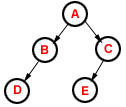
The INORDER traversal for the above tree is -- D B A E C. So, the
respective Threaded Binary tree will be --
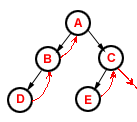
B has no right child and its inorder successor is A and
so a thread has been made in between them. Similarly, for D and E. C has no
right child but it has no inorder successor even, so it has a hanging thread.
Advantage
1. By doing threading we avoid the recursive
method of traversing a Tree , which makes use of stack and consumes a lot of
memory and time .
2 . The node can
keep record of its root .
Disadvantage
1.
This makes the Tree more complex .
2.
More prone to errors when both the child are not present & both values of
nodes pointer to their ansentors .
Q.194 Show that quick algorithm takes O  time in the worst
case. (4)
time in the worst
case. (4)
Ans :
The
Worst Case for Quick-SortThe tree illustrates the worst case of quick-sort, which
occurs when the input is already sorted!
The height of the tree is N-1 not O(log(n)). This is
because the pivot is in this case the largest element and hence does not come
close to dividing the input into two pieces each about half the input size. It
is easy to see that we have the worst case. Since the pivot does not appear in
the children, at least one element from level i does not appear in level i+1 so
at level N-1 you can have at most 1 element left. So we have the highest tree
possible. Note also that level i has at least i pivots missing so cna have at
most N-i elements in all the nodes. Our tree achieves this maximum. So the time
needed is proportional to the total number of numbers written in the diagram
which is N + N-1 + N-2 + ... + 1, which is again the one summation we know
N(N+1)/2 or Θ(N2.
Hence the worst case complexity of
quick-sort
is quadratic .
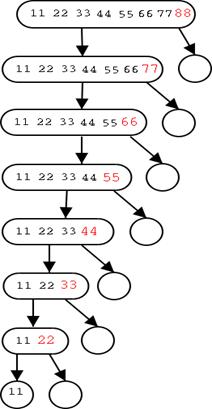
Q.195 Write an algorithm to convert an infix
expression to a postfix expression.
Execute your algorithm with the
following infix expression as your input.  (8)
(8)
Ans :
Algorithm: Polish (Q,P)
Suppose
Q is an arithmatic expression written in
fix notation. This algorithm finds the
equivalent postfix expression P.
1.
Push “ ( ” onto STACK, and add “)” to the end of Q
2. Scan Q from left to right and repeat Steps 3 to 6 for each element of
Q until the STACK is empty:
3. If
an operand is encountered, add it to P
4. If
a left parenthesis is encountered, push it onto STACK.

 5. If an operator is
encountered, then:
5. If an operator is
encountered, then:


 (a) repeatedly pop from STACK and add to p each operator (on the top of
stack) has the same precedence as or higher
precedence than
(a) repeatedly pop from STACK and add to p each operator (on the top of
stack) has the same precedence as or higher
precedence than
(b)
add to STACK.
[ End of If structure]
6. If
a right parenthesis is encountered, then:
(a)
Repeatedly pop from STACK and add to P each operator (on the top of STACK) until a left parenthesis is
encountered.
(b)
Remove the left parenthesis. [ Do not add the left parenthesis to P]
[End of If structure.]
[End of Step 2 loop.]
7.
Exit
Example :
Input (m+n)*(k+p)/(g/h)^(a^b/c)
 Step 1 : ( Output : nil Step 11 : ) Output : mn+kp+
(
*
 Step 2 : m
Output : m Step 12 :
/ Output : mn+kp+*
Step 2 : m
Output : m Step 12 :
/ Output : mn+kp+*
(
/

Step 13 :( ( Output : mn+kp+*
Step 3 : + Output : m /
 +
+
( Step
14 :g ( Output : mn+kp+*g
/
Step 4 : n + Output : mn
 ( Step
15 :/ / Output : mn+kp+*g
( Step
15 :/ / Output : mn+kp+*g
(
/
Step 5 : )
Output : mn+
 Step 16 : h /
Output : mn+kp+*gh
Step 16 : h /
Output : mn+kp+*gh
Step 6 : * Output : mn+ (
*
/
Step 7 : ( (
Output : mn+
*
Step 8 : k ( Output : mn+k Step 17 :^
^ Output : mn+kp+*gh/
*
/
Step 9 : + + Output : mn+k Step 18 :( (
Output : mn+kp+*gh/
(
^
* /
 Step 10 : p
Output : mn+kp Step 19 : a (
Output : mn+kp+*gh/a
Step 10 : p
Output : mn+kp Step 19 : a (
Output : mn+kp+*gh/a
+
^
(
/
*
Step 20 : ^ ^
Output : mn+kp+*gh/a
(
^
/
Step 21 : b ^
Output : mn+kp+*gh/ab
(
^
/
Step 22 : / /
Output : mn+kp+*gh/ab^
(
^
/
Step 23 : c /
Output : mn+kp+*gh/ab^c
(
^
/
Step 24 : ) ^
Output : mn+kp+*gh/ab^c/
/
Step 25 : End Output : mn+kp+*gh/ab^c/^/
Q.196 What
is recursion? A recursive procedure
should have two properties. What are
they? (4)
Ans :
Recursion means function call itself repeately .
Properties :
(1)
There must be some base case
where the condition end .
(2)
Each recursive call to the
procedure involve a smaller case of the problem .
Q.197 Suppose
characters a,b,c,d,e,f have probabilities 0.07, 0.09, 0.12, 0.22, 0.23, 0.27 respectively.
Find an optimal Huffman code and draw the Huffman tree. What is the average code length? (10)
Ans :
Huffman Tree :
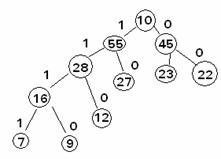
Huffman
Code are a=1111
b =1110
c=110
d=00
e=01
f=10
Average code length =
P(a).4+P(b).4+P(c).3+P(d).2+P(e).2+P(f).2
= 0.07*4+0.09*4+0.12*3+0.22*2+0.23*2+0.27*2
= .28+.36+.36+.44+.46+.54 =2.44
Q.198 Prove that the number of nodes
with degree 2 in any Binary tree is 1 less than the number of leaves. (4)
Ans :
The proof is by induction on the size n of T .
Let L(T) = No of
leaves & D2(T)= No of nodes of T of degree 2
To Prove D2(T)=L(T)-1
Basic
Case : n=1 , then T consists of a single node which is a leaf .
L(T)=1
and D2(T)=0
So
D2(T)=L(T)-1
Induction Step :
Let n > 1 and assume for all non empty trees T1 of size k<n
that
D2(T`)=L(T`)-1
Since n >1 , at least one of x=left(T) or y=right(T) is non empty .
Assume
x is non empty ; the other case is symetric
By the induction hypothesis ,
D2(x)
= L(y)-1
IF y is empty , then again by the induction hypothesis
,
D2(y)
=L(y)-1 and
D2(T)
=D2(x)+D2(y)+1
=L(x)-1+L(y)-1+1
= L(x)+L(y)-1
D2(T)
= L(T)-1 Hence Proved
Q.199 Equal keys pose problem for the
implementation of Binary Search Trees.
What is the asymptotic performance the usual algorithm to insert n items
with identical keys into an initially empty Binary Search Tree? Propose some technique to improve the
performance of the algorithm. (7)
Ans :
A sympotic
performance will be linear in O(n). That is the tree created will be skew
symmetric. Identical keys should be attached either as left or right child of
the parent, wherever positions are available. For eg.
18,3,5,2,4,7,2,9,2,16,2,11,2,10,2
The creation of
the tree should be as follows:
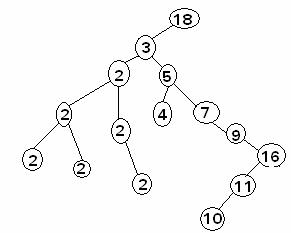
i.e. similar
keys should not skew to the BST. Then performance will become inferior.
Q.200
Consider
a list of numbers 9, 20, 6, 10, 14, 8, 60, 11 given. Sort them using Quick
Sort. Give step wise calculation. (8)
Ans:
9,20,6,10,14,8,60,11
choosing 9 as
Pivot(Pass—1)
6,8,9,10,14,20,60,11
The sublist on the
left side of 9 is sorted therefore, no more sorting on left sublist
Now choosing 10 as Pivot (pass – 2)
(10 is already in
the position)
6,8,9,10,14,20,60,11
Choosing 14 as Pivot (pass –3)
6,8,9,10,11,14,60,20
Choosing 60 as Pivot [pass – 4)
6,8,9,10,11,14,20,60
Q.201 What is a sparse matrix? Explain
an efficient way of storing a sparse matrix in memory. (4)
Ans:
Sparse
Matrix
A matrix in which number of zero entries are much higher
than the number of non zero entries is called sparse matrix. The natural method
of representing matrices in memory as two-dimensional arrays may not be
suitable foe sparse matrices. One may save space by storing for only non zero
entries. For example matrix A (4*4 matrix) represented below
where first row represent the dimension of matrix and last
column tells the number of non zero values; second row onwards it is giving the
position and value of non zero number.
|
0
|
0
|
0
|
15
|
|
0
|
0
|
0
|
0
|
|
0
|
9
|
0
|
0
|
|
0
|
0
|
4
|
0
|
Here the memory required is 16 elements X 2
bytes = 32 bytes
The above matrix can be written in sparse
matrix form as follows:
Here the memory
required is 12elements X 2 bytes = 24 bytes
Q.202 Evaluate
the following prefix expressions (9)
(i) + * 2
+ / 14 2 5 1
(ii) – * 6
3 – 4 1
(iii) + + 2
6 + – 13 2 4
Ans:
Evaluating a prefix
expression.
(i) + * 2 + / 14 2 5 1
= + * 2 + 7 5 1
= + * 2 12 1
= + 24 1
= 25
(ii) - * 6 3 - 4 1
= - 18 - 4 1
= - 18 3
= 15
(iii) + + 2 6 + - 13 2 4
= + 8 + - 13 2 4
= + 8 + 11 4
= + 8 15
= 23
Q.203
(i) Give four properties of Big –
O Notations. (4)
(ii) Give
the graphical notations of Big-O estimations for the following functions:
 ,
n ,
,
n ,  , n2, n3, 2n (3)
Ans:
(i) Four properties of Big-O notations are:
1.
Reflexivity
2.
Symmetry
3.
Transpose Symmetry
4.
Transitivity
Reflexivity:
f(n)=O(f(n))
Symmetry and
Transpose Symmetry
f(n)=O(g(n)) iff g(n)=W(f(n))
Transitivity
f(n)=O(g(n)) and g(n)=O(h(n)) implies f(n)= O(h(n))
(ii)
|
n
|
Sqrt n
|
n!
|
n2
|
n3
|
n4
|
logn
|
nlogn
|
2n
|
|
2
|
1.41
|
2
|
4
|
8
|
16
|
0.30103
|
0.60206
|
4
|
|
3
|
1.73
|
6
|
9
|
27
|
81
|
0.477121
|
1.431364
|
8
|
|
4
|
2.00
|
24
|
16
|
64
|
256
|
0.60206
|
2.40824
|
16
|
|
5
|
2.24
|
120
|
25
|
125
|
625
|
0.69897
|
3.49485
|
32
|
|
6
|
2.45
|
720
|
36
|
216
|
1296
|
0.778151
|
4.668908
|
64
|
|
7
|
2.65
|
5040
|
49
|
343
|
2401
|
0.845098
|
5.915686
|
128
|
|
8
|
2.83
|
40320
|
64
|
512
|
4096
|
0.90309
|
7.22472
|
256
|
|
9
|
3.00
|
362880
|
81
|
729
|
6561
|
0.954243
|
8.588183
|
512
|
|
10
|
3.16
|
3628800
|
100
|
1000
|
10000
|
1
|
10
|
1024
|
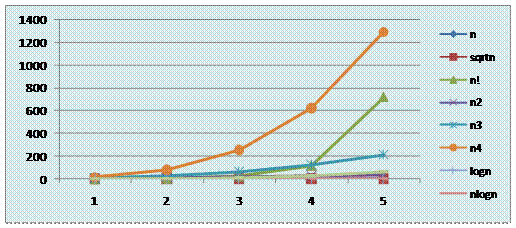
Q.204 Write
an algorithm to insert an element k
in double linked list at (8)
(i) Start of linked list
(ii) After a given position P of list
(iii) End of linked list.
Ans:
Algorithm to insert an element k in double linked list at a
position which is:-
(i) Start of a linked list
while inserting at the start
of the linked list we have to change the root node and so we need to return the new root to the
calling program.
nodeptr
insertatstart ( nodeptr root, nodeptr k)
{
k->next
= root;
k->back
= root->back;
root->back->next
= k;
root->back=k;
return
k;
}






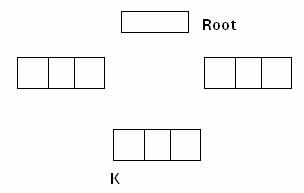
(ii)
After a given position p of list
Here we assume that p points to that
node in the doubly linked list after which insertion is required.
insertafter (
nodeptr p , nodeptr k )
{
if (p == null)
{
printf (“void
insertion /n”);
return;
}
k->back = p;
k->next = p->next;
p->next->back = k;
p->next = k;
return;
}


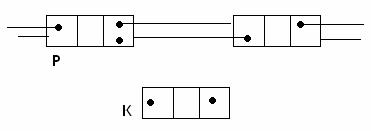
(iii)
End of linked list
Here k is the element
to be inserted and root is the pointer to the
first node of the
doubly linked list.
insertatend (
nodeptr root, nodeptr k )
{
nodeptr trav;
while (trav->next !=
root)
trav = trav->next;
k->next=root;
root->back=k;
trav->next = k;
k->back=trav;
return;
}
Q.2 05 Write
an algorithm to add two polynomials using linked list. (8)
Ans:
Algorithm to add two
polynomials using linked list is as follows:-
Let p and q be the two polynomials represented by
the linked list.
1. while p and q are not null, repeat step 2.
2. If powers of the two terms ate equal
then if the terms do not cancel
then insert the sum of the terms into the sum
Polynomial
Advance p
Advance q
Else if the power of the first polynomial>
power of second
Then insert the term from first polynomial into sum polynomial
Advance p
Else insert the term from second polynomial into sum polynomial
Advance q
3. copy the remaining terms
from the non empty polynomial into the sum polynomial.
The third step of the algorithm
is to be processed till the end of the
polynomials has not been reached.
Q.206 Write modules to perform the
following operation on Binary tree (8)
(i) count number of leaf nodes
(ii) find height of tree
Ans:
(i) count number of leaf nodes
int leaf count
(node *t)
 {
{
static int count = 0;
if (t! = NULL)
 {
{
leaf count (tà left)
if (tàleft == NULL
&& tàright == NULL)
count ++;
leaf count (tàright);
}
return (count);
}
(ii)
Module to find height of tree
height(Left,Right,Root,height)
1.
If Root=Null then height=0;
return;
2.
height(Left,Right,Left(Root),heightL)
3.
height(Left,Right,Right(Root),heightR)
4.
If heightL³heightR then
height=heightL+1;
Else
height=heightR+1;
5.
Return;
Q.207 Create B-Tree
of order 5 from the following list of data items: (8)
20, 30, 35, 85, 10, 55, 60, 25
Ans:
For the given list of elements as
20 30 35 85 10 55 60 25
The B-Tree of order 5 will be
created as follows
Step 1:
Insert 20, 30, 35 and 85

Step 2:
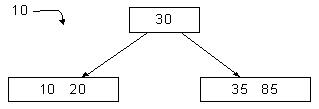
Step 3:
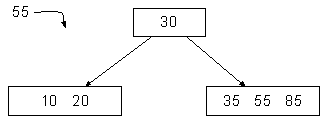
Step 4:
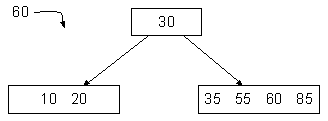
Step 5:
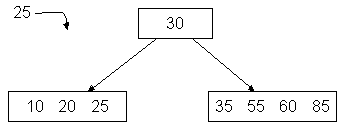
This is the final B-tree created
after inserting all the given elements.
Q.208 Write an algorithm to insert an element k into binary search tree. Give the analysis and example. (8)
Ans:
The algorithm to insert an
element k into binary search tree is as follows:-
/* Get a new node
and make it a leaf*/
getnode (k)
left(k)
= null
right(k)
= null
info
(k) = x
/*
Initialize the traversal pointers */
p
= root
trail
= null
/*
search for the insertion place */
while
p <> null do
begin
trail
= p
if
info (p) > x
then
p = left (p)
else
p
= right (p)
end
/*
To adjust the pointers */
If
trail = null
Then root = k /* attach it as a root in the
empty tree */
else
if
info (trail) > x
then
left
(trail) = k
else
right
(trail) = k
Analysis : - We notice that the shape of binary tree is determined by the
order of insertion. If the values are sorted in ascending or descending order,
the resulting tree will have maximum depth equal to number of input elements.
The shape of the tree is important from the point of view of search efficiency.
The depth of the tree determines the maximum number of comparisons. Therefore
we can maximize search efficiency by minimizing the height of the tree.
eg. For the values as
6, 7, 8, 9, 10
the
binary tree formed would be as follows
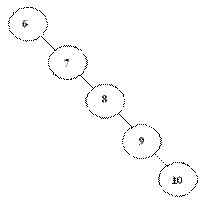
Q.209
Fill in the following table, showing the number of comparisons necessary to
either find a value in the array DATA or determine that the value is not in the
array. (8)
DATA
|
26
|
42
|
96
|
101
|
102
|
162
|
197
|
201
|
243
|
[1]
[2] [3] [4]
[5] [6] [7]
[8] [9]
Number of Comparisons
|
Value
|
Sequential
Ordered Search
|
Binary Search
|
|
26
|
|
|
|
2
|
|
|
|
103
|
|
|
|
244
|
|
|
Ans:
|
Value
|
Sequential
Ordered Search
|
Binary Search
|
|
26
|
1
|
4
|
|
2
|
1
|
4
|
|
103
|
6
|
3
|
|
244
|
9
|
4
|
Q.210 Explain
the functionality of linear and quadratic probing with respect to hashing
technique. (8)
Ans:
Linear
Probing: The simplest way to resolve
a collision is to start with the hash address and do a sequential search
through the table for an empty location. The idea is to place the record in the
next available position in the array. This method is called linear probing. An
empty record is indicated by a special value called null. The array should be
considered circular, so that when the last location is reached the search
proceeds to the first record of the array. An unoccupied record location is
always found using this method if atleast one is available; otherwise, the
search halts unsuccessfully after scanning all locations. The major drawback of
the linear probe method is that of clustering.
When the table is initially
empty, it is equally likely that a new record will be inserted in any of the
empty position but when the list becomes half full, records start to appear in
long strings of adjacent positions with gaps between the strings. Therefore the
search to find an empty position becomes longer.
Quadratic
probing:
In the above case when the first insertion is made the probability of new
element being inserted in a particular position is 1/n where n is the size of the array. At the
time of second insertion the probability becomes 2/n and so on for the kth
insertion the probability is k/n, which is k times as compared to any other
remaining unoccupied position. Thus to overcome the phenomenon of long sequence
of occupied positions to become even longer we use quadratic rehash, in this method if there is a collision at hash
address h, this method probes the array at locations h+1, h+4, h+9, ... That is
(h(key) +i2 % hash size) for i=1,2,... gives the ith hash
of h.
Q.211
The
following values are to be stored in a hash table
25, 42, 96, 101, 102, 162, 197, 201
Use division method of hashing
with a table size of 11. Use sequential method of resolving collision. Give the contents of array. (8)
Ans:
Table size is given as 11
H (25) = (25) mod 11
+ 1 = 3 + 1 = 4
H (42) = (42) mod 11
+ 1 = 9 + 1 = 10
H (96) = (96) mod 11
+ 1 = 8 + 1 = 9
H (101) = (101) mod
11 + 1 = 2 + 1 = 3
H (102) = (102) mod
11 + 1 = 3 + 1 = 4
H (162) = (162) mod
11 + 1 = 8 + 1 = 9
H (197) = (197) mod
11 + 1 = 10 + 1 = 11
H (201) = (201) mod
11 + 1 = 3 + 1 = 4
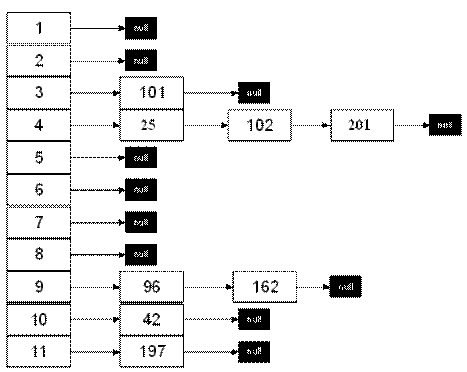
Q.212 Write Kruskal’s algorithm and give the
analysis. Compare it with Dijkstra’s method. (8)
Ans:
Kruskal’s Algorithm for minimum cost spanning tree
1.
Make the tree T empty.
2. Repeat steps 3, 4 and 5 as long as T contains
less
than n-1 edges and E not
empty; otherwise proceed to step 6.
3. Choose an edge (v,w) from E of lowest cost.
4.
Delete (v,w) from E.
5.
If (v,w) does not create a cycle in T then add(v,w)
to T
else dicard(v,w).
6.
If T contains fewer than n-1 edges then print (‘no
spanning tree’).
The complexity of this algorithm is determined by the complexity of
sorting method applied; for an efficient sorting it is O(½E½log½E½).It
also depends on the complexity of the methods used for cycle detection which is
of O(½V½) as only ½V½-1
edges are added to tree which gives a total of O(E logV) time. So complexity of
Kruskal’s algorithm is is O(½V+E½log½V½). As V is asymptotically no
larger than E, the running time can also be expressed as O(E log V).
Dijkstra has not developed any
algorithm for finding minimum spanning tree. It is Prim’s algorithm. Dijkstra’s
algorithm to find the shortest path can be used to find MST also, which is not
very popular.
Q.213 Write algorithm for Breadth First
Search (BFS) and give the complexity. (8)
Ans:
This traversal algorithm uses a queue to store
the nodes of each level of the graph as and when they are visited. These nodes
are then taken one by one and their adjacent nodes are visited and so on until
all nodes have been visited. The algorithm terminates when the queue becomes
empty.
Algorithm for Breadth First Traversal is as
follows:
clearq (q)
visited (v) = TRUE
while not empty (q) do
for all vertices w adjacent to v do
if not visited then
{
insert (w , q)
visited (w) = TRUE
}
delete (v, q);
Here each node of the graph is entered in the queue only
once. Thus the while loop is executed n times, where n is the order of the graph. If the graph is
represented by adjacency list, then only those nodes that are adjacent to the
node at the front of the queue are checked therefore, the for loop is executed
a total of E times, where E is the number of edges in the graph. Therefore,
breadth first algorithm is O (N*E) for linked expression. If the graph is
represented by an adjacency matrix, the for loop is executed once for each
other node in the graph because the entire row of the adjacency matrix must be
checked. Therefore, breadth first algorithm is O (N2) for adjacency
matrix representation.
Q.214 A binary tree T has 10 nodes. The inorder and
preorder traversals of T yield the following sequence of nodes:
Inorder : D
B H E
A I F
J C G
Preorder :
A B D
E H C
F I J
G
Draw the tree T. (8)
Ans:
Given of a tree, the
INORDER: D
B H E A I F J C G
PREORDER: A
B D E H C F I J G
Then the tree of whose traversal is given is as follows
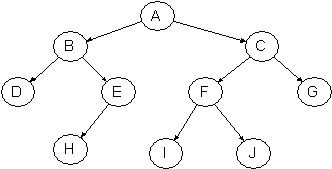
Q.215 Construct AVL tree from the following set of elements
{ March, May, November, August,
April, January, December, July } (8)
Ans:
The AVL tree from the given set of elements is as follows:
{March, May, November, August,
April, January, December, July}
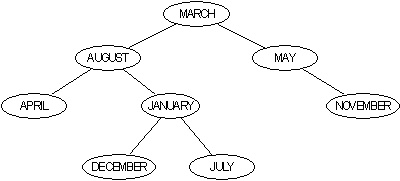
Q.216 Evaluate
the following postfix-expression using stack. Show the content of the stack in
each step.
6 2
3 + -
3 8 2
/ + *
2 $ 3 + (6)
Ans:
The
content of stack in each iteration will be as follows:
|
Symbol
|
Opnd1
|
Opnd2
|
Value
|
Stack
|
|
6
|
|
|
|
6
|
|
2
|
|
|
|
6,2
|
|
3
|
|
|
|
6,2,3
|
|
+
|
2
|
3
|
5
|
6,5
|
|
-
|
6
|
5
|
1
|
1
|
|
3
|
6
|
5
|
1
|
1,3
|
|
8
|
6
|
5
|
1
|
1,3,8
|
|
2
|
6
|
5
|
1
|
1,3,8,2
|
|
/
|
8
|
2
|
4
|
1,3,4
|
|
+
|
3
|
4
|
7
|
1,7
|
|
*
|
1
|
7
|
7
|
7
|
|
2
|
1
|
7
|
7
|
7,2
|
|
$
|
7
|
2
|
49
|
49
|
|
3
|
7
|
2
|
49
|
49,3
|
|
+
|
49
|
3
|
52
|
52
|
The value returned is 52.
Q.217 Write
an algorithm that will split a circularly linked list into two circularly
linked lists. (7)
Ans:
A function that split
a circular linked list into two linked list is as follows:
nodeptr
splitlist(nodeptr p)
{
nodeptr p1, p2, p3;
p1 = p2 = p3 = p;
if (not p) return NULL;
do {
p3 = p2;
p2 = p2->next; /* advance 1 */
p1 = p1->next;
if (p1) p1 = p1->next; /* advance 2 */
} while (p1);
/* now form new list after p2 */
p3->next = NULL; /* terminate 1st half */
return p2;
} /* splitlist */
Q.218 Let A[n] be an array of n numbers. Design
algorithms to perform the following operations:
Add (i, y): Add the value y to the ith number in
the array
Partial-sum(i)
: returns the sum of the first i numbers in the array (4)
Ans:
Operation 1
add (i ,y)
{
A[i]
= A[i] + y;
}
Operation 2
partialsum (i, y)
{
int sum=0;
for ( ; i > 0 ; i--)
sum = sum + A[i];
return sum;
}
Q.219 Calculate the efficiency of Quick sort. (4)
Ans:
Efficiency of Quick sort
Assume that the file size n is a
power of 2
say n=2m
m=log2n (taking log on both sides).................
(A)
Assume also that the
proper position for the pivot always turns out to be exact middle of the sub
array. In that case, there will be approx n comparisons (actually n-1) on the
first pass, after which the file is split into two sub files each of size n/2.
Each of them will have n/2 comparisons and file is again split into 4 files
each of size n/4 and so on halving it m times.
Proceeding in this way:-
No. of comparisons
1. file of size n 1*n=n
2. file of size n/2 2*n/2=n
3. file of size n/4 4*n/4=n
...
...
n file of size 1 n*1=n
Total no. of comparisons for entire sort
= n+n+n+.......+n (m times)
= nm
=n log2n (from
A)
Therefore the efficiency of Quick sort is O (n log2n).
Q.220 Formulate an algorithm to perform insertion
sort on a linked list. (8)
Ans:
Simple Insertion
sort is easily adaptable to singly linked list. In this method there is
an array link of pointers, one for
each of the original array elements. Initially link[i] = i + 1 for 0 < = I
< n-1 and link [n-1] = -1. Thus the array can be thought of as a linear link
list pointed to by an external pointer first
initialized to 0. To insert the kth element the linked list is traversed
until the proper position for x[k] is found, or until the end of the list is
reached. At that point x[k] can be inserted into the list by merely adjusting
the list pointers without shifting any elements in the array. This reduces the
time required for insertion but not the time required for searching for the
proper position. The number of replacements in the link array is O (n).


Each node from
the unsorted linked list is to be detached one by one from the front and
attached to the new list pointed by s head. While attaching, the value got
stored in each node is considered so that it is inserted at the proper
position.
S head = head
head=head
ànext
S headà next = NULL
While (head!=NULL)
{
P=head
head= head ànext
q=S head
while (qàinfo<Pàinfo & q!NULL)
{
r=q
q=qànext
}
Pànext=q
rànext=P
}
Q.221 The following values are to be stored in a
Hash-Table:
25,
42, 96, 101, 102, 162, 197, 201
Use
the Division method of Hashing with a table size of 11. Use the sequential
method for resolving collision. (6)
Ans:
The given values are
as follows: -
25 42 96 101 102 162 197 201
Table size is = 11
Division method of Hashing: -
H (k) = {Hash address range from 0 to m-1. Key (mod)
table-size.}
H (25)= 3
H (42) = 9
H (96) = 8
H (101) = 2
H (102) = 3
H (162) = 8
H (197) =10
H (201) = 3
The Hash table is as follows
Hash [0] = [197]
Hash [1] = [NULL]
Hash [2] = [101]
Hash [3] = [25] ß Collision Occurred
Hash [4] = [102] ß Inserted in next available slot
Hash [5] = [201]
Hash [6] = [NULL]
Hash [7] = [NULL]
Hash [8] = [96]
Hash [9] = [42]
Hash [10] = [162]
|
0
|
197
|
|
|
1
|
|
|
|
2
|
101
|
|
|
3
|
25
|
---102(collision)
|
|
4
|
102
|
---201
|
|
5
|
201
|
|
|
6
|
|
|
|
7
|
|
|
|
8
|
96
|
|
|
9
|
42
|
|
|
10
|
162
|
|
Q.222 Rewrite your solution to
part (b) using rehashing as the method of collision resolution. Use
[(key+3) mod table-size] as rehash function. (5)
Ans:
Rehash function [(key+3) mod table size]
H(25) = 28 mod 11
H(42) = 45 mod 11
H(96) = 99 mod
11
H(101) =
104mod 11
H(102) =
105mod 11
H(162) = 165
mod 11
H(197) = 200mod
11
H(201) = 204mod
11
The newly
created hash function is as follows:-
Hash[0] = [96]
Hash[1] = [42]
Hash[2] =
[162]
Hash[3] =
[197]
Hash[4] =
[NULL]
Hash[5] =
[101]
Hash[6] = [25]
Hash[7] =
[102]
Hash[8] =
[201]
Hash[9] =
[NULL]
Hash[10] =
[NULL]
Q.223 How many AVL trees
of 7 nodes with keys 1, 2, 3, 4, 5, 6, 7 are there? Explain your answer. (6)
Ans:
Step 1
 No rebalancing
required
No rebalancing
required
Step 2

Step 3
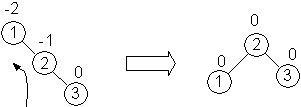
Step 4
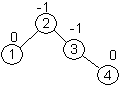
Step 5
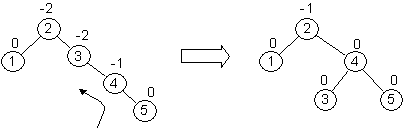
Step 6
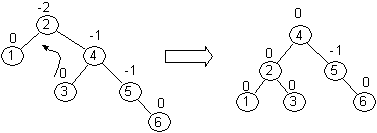
Step 7
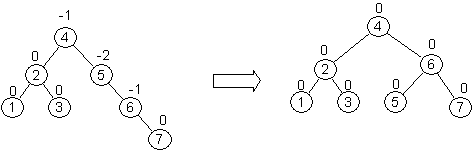
Q.224 Describe
the Dijkstra’s algorithm for finding a shortest path in a given graph. (8)
Ans:
Let G = (v,e) be a simple
graph. Let a & z be any two vertices of the graph. Suppose L(x) denotes the
label of the vertex z which represents the length of the shortest path from the
vertex a to the vertex z. Wij denotes the weight of the edge eig
= (Vi, Vj)
1. let P = Q where
p is the set of those vertices which have permanent labels &
T = {all vertices of the graph G}
Set L (a) = 0, L (x) = ∞for all x €T & x≠a
2. Select the vertex v in T which has the
smallest label. This label is called the permanent label of v.
Also set P = P U {v}
and T = T-{v}
if v=z then L (z) is
the length of the shortest path from the vertex a to z and stop.
3. If v ≠z then revise the labels of
vertices of T i.e. the vertices which do not have permanent labels. The new
label of a vertex x in T is given by
L (x) = min{old
L(x),L(v)+w(y,x)}
where w (v,x) is the
weight of the edge joining the vertex v & x
If there is no direct
edge joining v & x then take w(v,x) = ∞
4. Repeat steps 2 and
3 until z gets the permanent label.
Q.225
Explain
the difference between depth first and breadth first traversing techniques of a
graph. (4)
Ans:
Depth-first search is different
from Breadth-first search in the following ways:
A depth search
traversal technique goes to the deepest level of the tree first and then works
up while a breadth-first search looks at all possible paths at the same depth
before it goes to a deeper level. When we come to a dead end in a depth-first
search, we back up as little as possible. We try another route from a
recent vertex-the route on top of our stack. In a breadth-first search,
we want to back up as far as possible to find a route originating from
the earliest vertices. So the stack is not an appropriate structure for finding
an early route because it keeps track of things in the order opposite of their
occurrence-the latest route is on top. To keep track of things in the
order in which they happened, we use a FIFO queue. The route at the front of
the queue is a route from an earlier vertex; the route at the back of the queue
is from a later vertex.
Q.226 Consider
the following undirected graph and answer the following questions.
Assume that the edges are
ordered alphabetically (i.e. when facing with alternatives, choose the edges in
alphabetical order)
(i)
List the nodes (cities) of the graph by depth first search
starting from Varanasi.
(ii)
List the nodes (cities) of the graph by breadth first search
starting from Calcutta. (8)
Ans:
(i) The list of nodes from the graph by
performing Depth-First-Search starting
from
Varanasi
is as follows
Varanasi
à Kanpur
à Bangalore
à Calcutta
à Delhi à Pune à Ranchi à
LucknowàTrichi
(ii)
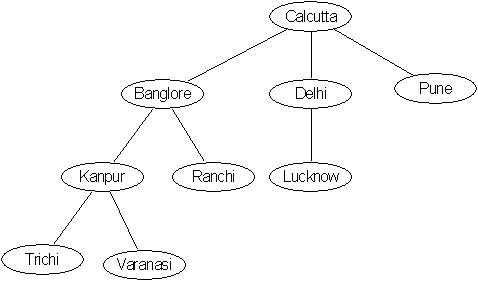
The list of nodes from the graph by performing
Breadth-First-Search starting from Calcutta
is as follows
Calcutta à Bangalore
à Delhi
à Pune à Kanpur à Ranchi
à Lucknow àTrichi àVaranasi
Q.227 Consider
the following function
F(int n, int m)
{if n < = 0 OR m<= 0 then return 1 else return (F(n-1,
m) + F(n, m-1));}
Now answer the following
questions assuming that n and m are positive integers.
(i)
What is the value of F(n, 2), F(5, m), F(3, 2), F(n, m)?
(ii)
How many recursive calls are made to the function F,
including the original call when evaluating F(n, m)? (4)
Ans:

The recursion continues till every function call gets its
absolute value. Order is 
(i)
The value of
a.
F (n,2) = O(n)
b.
F (5, m) = O (m)
c.
F (3, 2) = O (1).
d.
F (n, m) = O (n). O(m) = O(n.m).
(ii) While evaluating F(n, m) , since it is of order O (n,
m) so the number of recursive calls
required is of the order n x m.
Q.228 Write
a recursive function that has one parameter which is an integer value
called x. The function prints x asterisks followed by x exclamation
points.
Do not use any loops. Do not use any
variables other than x. (4)
Ans:
The recursive function printast
() for the required task is as follows:-
void printast (int a)
{
if (a
> 0)
{
printf
("*");
a--;
printast
(a);
}
if
(a!=0)
printf
("!");
}
Q.229
Sort the following list using selection Sort. Show each pass of the
sort.
45, 25, 75, 15, 65, 55, 95, 35 (7)
Ans:
The original array is 45, 25,
75, 15, 65, 55, 95, 35

After Pass 1

After Pass 2

After Pass 3

After Pass 4

After Pass 5

After Pass 6

After Pass 7

The array is sorted after 7
passes of selection sort.
Q.2 30 What is Hashing? Can a perfect Hash function be made?
Justify your answer. Explain in brief the various methods used to resolve
collision. (9)
Ans:
Hashing : Hashing provides the direct access of record from the file
no matter where the record is in the file. This is possible with the help of a
hashing function H which map the key with the corresponding key address or
location. It provides the key-to-address transformation.
No a perfect hash function
cannot be made because hashing is not perfect.
Occasionally, a collision occurs
when two different keys hash into the same hash value and are assigned to the
same array element. Programmers have come up with various techniques for
dealing with this conflict.Two broad classes of collision resolution techniques
are: open addressing and chaining.
Open addressing: The simplest way to
resolve a collision is to start with the hash address and do a sequential
search through the table for an empty location. The idea is to place the record
in the next available position in the array. This method is called linear
probing. An empty record is indicated by a special value called null. The major
drawback of the linear probe method is clustering.
Chaining: In this technique, instead of hashing function value as
location we use it as an index into an array of pointers. Each pointer access a
chain that holds the element having same location.
Because two
entries cannot be assigned the same array element, the programmer creates a
linked list. The first user-defined structure is assigned to the pointer in the
array element. The second isn’t assigned to any array element and is instead
linked to the first user-defined structure, thereby forming a linked list.
For example: in a table size of 7
42, 56 both are
mapped to index 0 as 42%7=0 and 56%7=0.
25, 42, 96, 101,
102, 162, 197 can be mapped as follows:
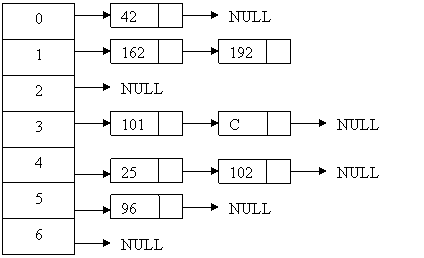
Q.231 Define a B tree of order m.
Write algorithms to
(i)
Search for a key in B-tree.
(ii)
Insert a key in a B-tree.
(iii)
Delete a key from a B-tree. (10)
Ans:
B Tree of order m
A balanced multiway
search tree of order m in which each nonroot node contains at least m/2 keys is
called a B-Tree of order m. where order means maximum number of sub-trees.
A B-Tree of order m is
either the empty tree or it is an m-way search tree T with the following
properties:
(i)
The root of T has at least two
subtrees and at most m subtrees.
(ii)
All internal nodes of T (other
than its root) have between [m / 2] and m subtrees.
(iii) All external nodes of T are at the same level.
Algorithm to search for a key in B-tree is as follows:
B-tree search makes
an n-way choice. By performing the linear search in a node, correct child Ci of
that node is chosen. Once the value is greater than or equal to the desired
value is obtained, the child pointer to the immediate left of the value is
followed. Otherwise rightmost child pointer is followed. If desired value is
obtained, the search is terminated.
B-tree search (x, k) This function searches the key
from the given B-tree
The Disk_Read operation indicates that all
references to a given node be preceded by a read operation.
1.
i ß 1
2.
While (i ≤ n[x]
and k > keyi [x])
Set i ß i + 1
3.
If (i<= n[x] and k=keyi [x]) then
{ return (x, i) }
4.
If (leaf [x]) then
return NIL
else Disk_read (ci [x])
return B-tree search (ci [x], k)
Algorithm to insert a key in B-tree is as follows:
1.
First search is done for the place where the new record must
be put. As the keys are inserted, they are sorted into the proper order.
2.
If the node can accommodate the new record, insert the new
record at the appropriate pointer so that number of pointers remains one more
than the number of records.
3.
If the node overflows because there is an upper bound on the
size of a node, splitting is required. The node is split into three parts; the
middle record is passed upward and inserted into parent, leaving two children
behind. If n is odd (n-1 keys in full node and the new target key), median key
int(n/2)+1 is placed in parent node, the lower n/2 keys are put in the left
leaf and the higher n/2 keys are put in the right leaf. If n is even, we may
have left biased or right biased means one key may be more in left child or
right child respectively.
4.
Splitting may propagate up the tree because the parent, into
which splitted record is added, may overflow then it may be split. If the root is required to be split, a new
record is created with just two children.
Q.232 Given the following tree
Show how the tree will change when the
following steps are executed one after another
(i)
Key ‘i’ is deleted
(ii)
Key ‘v’ is deleted
(iii) Key ‘t’ is deleted (6)
Ans:
The given tree is:-
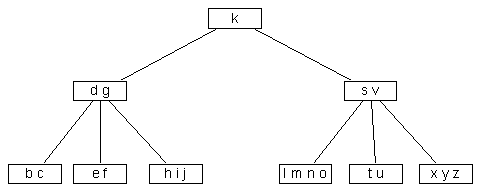
(i) Key ‘i’ is deleted
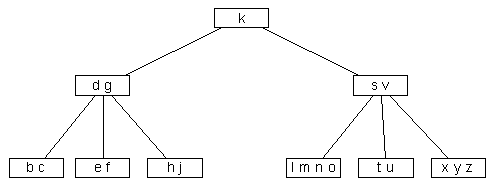
(ii) Key ‘v’ is deleted
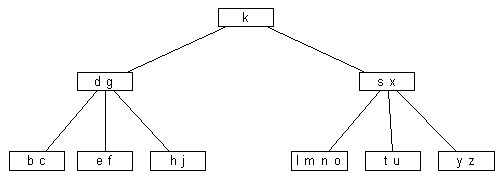
(iii) Key ‘t’ is deleted
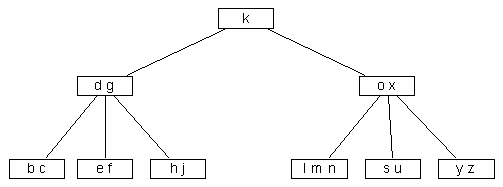
Q.233 Write an algorithm to reverse a singly linked
list. (4)
Ans:
The algorithm to
reverse a singly link list is as follows:-
reverse (struct node **st)
{
struct node *p,
*q, *r;
p = *st;
q = NULL;
while (p != NULL)
{
r =q;
q = p;
p = p à link;
q à link = r;
}
*st = q;
}
Q.234 Consider a 2D array as char A[5] [6] stored
in contiguous memory locations starting from location 1000” in column major
order. What would the address of a[i] [d]? (2)
Ans:
Considering the given char array A[5][6] stored in
contiguous memory in column major order;
the address of a[i] [d] would be calculated as
base (a) + (d*n1 +i) * size ; where
base(a) =1000 (given).
Since it is a char array so
size=1 and n1 is the total no of rows
here n1=6 (0,1,2,3,4,5,) Substituting
values we get the address of
A[i]
[d] = 1000 + d*6 + i
Q.235 What
are priority Queues? How can priority queues be implemented? Explain in brief.
(4)
Ans:
Priority
Queues:-
There are some queues in which
we can insert items or delete items from any position based on some property.
Now, those queues based on the property of priority of the task to be processed
are referred to as priority queues.
To implement a priority queue we
first need to identify different levels of priority and categorize them as the
least priority through the most priority level. After having identified the
different levels of priority required, we then need to classify each incoming
item (job) as to what priority level should be assigned to it. While creating
the queues, we need to create n queues if there are n priority levels defined
initially. Let suppose there are three priority levels identified as P1, P2,
and P3. In this case we would create three queues as Q1, Q2 and Q3 each
representing priority levels P1, P2, and P3 respectively. Now every job would
have a priority level assigned to them. Jobs with priority level as P1 will be
inserted in Q1. Jobs with priority level P2 are inserted in Q2 and so on.
Each queue will follow FIFO
behavior strictly. Jobs are always removed from the front end of any queue.
Elements in the queue Q2 are removed only when Q1 is empty and the elements of
the queue Q3 are only removed when Q2 is empty and so on.
Q.236 Consider
a linked list with n integers. Each node of the list is numbered from
‘1’ to ‘n’. Write an algorithm to split
this list into 4 lists so that
first
list contains nodes numbered 1,5, 9, 13- - -
second
list contains nodes numbered 2, 6, 10, 14- - -
third list contains nodes numbered
3, 7, 11, 15- - -
and
fourth list contains nodes numbered 4,8, 12, 16- - - (8)
Ans:
Algorithm for the above said task
is as follows: -
Let us denote the pointer to an
item in the original linked list as P
Then the data and consequent
pointers will be denoted as
P->data and P->next respectively.
We assume that the functions list1.add (x), list2.add (x),
list3.add (x) and list4.add (x) is defined to insert the “item x” into the
linked list list1, list2, list3 and list4 respectively.
start
set i = 1
while ( P->next != NULL )
Do
If (i % 4 = 1)
List1.add (P->data)
Else if (i % 4 = 2)
List2.add (P->data)
Else if (i % 4 = 3)
List3.add
(P->data)
Else
List4.add
(P->data)
P
= P->next //increment P to point to its next location
i++
// increment i to count the next node in sequence.
Done
End
Q.2 37 Write
a recursive algorithm to find Greatest Common Divisor of two integers with
the help of Euclid’s
algorithm, as per the following formula
 (4)
(4)
Ans:
Recursive
algorithm to find the GCD of two numbers using Euclid’s
algorithm is as follows;
int gcd (n, m)
{
if (n
< m)
return
(gcd (m, n));
else
if ( n >= m && n % m == 0)
return
(m);
else
return
(gcd (m, n % m));
}
Q.238 Traverse the
following binary tree in inorder,
preorder and postorder. (3)
Ans:
The binary tree traversal is as
follows:-
Preorder
1,5,7,11,9,13,15,17,188,25,27,20
Inorder
11,7,9,5,15,13,17,1,25,27,188,20
Postorder
11,9,7,15,17,13,5,27,25,20,188,1
Q.239 Define the following:
(i)
Tree ( recursive defination)
(ii)
Level of a node.
(iii)
Height of a tree.
(iv)
Complete Binary tree.
(v)
Internal Path length.
(2+1+1+2+1)
Ans:
(i) Tree (recursive definition)
A tree is a finite
set of one or more nodes such that.
(1) There is a
specially designated node called the root.
(2) The remaining
nodes are partitioned into n>=0 disjoint sets
T1, T2 ... Tn where each of these sets is
a tree. T1, T2 ... Tn
are called the subtree of the root.
(ii) Level of a node
The root is at level
0(zero) and the level of any node is 1 more than the level of its parent.
(iii) Height of a tree
The length of the
longest path from root to any node is known as the height of the tree.
(iv) Complete Binary tree
A complete binary
tree can be defined as a binary tree whose non leaf nodes have nonempty left and right sub tree and all
leaves are at the same level.
(v) Internal Path length
It is defined as the
number of node traversed while moving through one particular node to any other
node in the tree.
Q.240 What is an AVL tree?
Explain how a node can be inserted into an AVL tree. (6)
Ans:
AVL
Tree
An AVL tree is a binary tree in
which the difference in heights between the left and the right subtree is not
more than one for every node.
We can insert a node into an
AVL tree by using the insertion algorithm for binary search trees in which we
compare the key of the new node with that in the root and then insert the new
node into the left subtree or right subtree depending on whether it is less
than or greater than that in the root. Insertion may or may not result in
change in the height of the tree. While inserting we must take care that the
balance factor of any node not changes to values other than 0, 1 and -1. A tree
becomes unbalanced if and only if
(i) The newly inserted node is a
left descendant of a node that previously had a balance of 1.
(ii) The newly inserted node is a right descendent of a node
that previously had a balance of -1.
If the balance factor of any node changes during insertion
than one of the subtree is rotated one or more times to ensure that the balance
factor is restored to correct values.
Q.241 Describe Kruskal’s
algorithm to find minimum spanning trees.
Apply Kruskal’s algorithm for the
above graph. (10)
Ans:
Applying Kruskal’s Algorithm
starting from the node a
Step 1: Start from node a, Add to tree T

Step 2: Edge (a, b) cost=6 add
to T

Step 3: Edge (a, c) cost=5 add
to T

Step 4: Edge (b,e) cost=13 add to T
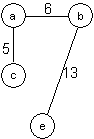
Step 5: Edge (e, g) cost=8 add
to T
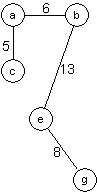
Step 6: Edge (g, f) cost=3 add to T
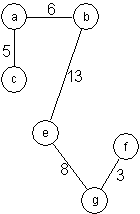
Step 7: Edge (f, d) cost=7 add
to T
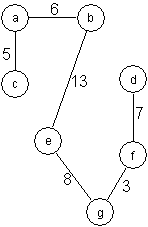
This is the minimum spanning
tree of the given graph.
Q.2 42
Differentiate between
(i) Top-down and Bottom-up
programming?
(ii) Structured and
Modular programming. (6)
Ans:
(i) Top-down and Bottom up programming.
Top down method is also known as
step-wise refinement. Here the problem is first divided into main tasks. Each
of these is divided into subtasks and so on. These subtasks should more
precisely describe how the final goal is to be reached. Whereas the Bottom-up
programming is just the opposite of the top-down approach. In this technique,
all small related tasks are grouped into a major task and the main task becomes
the main program.
(ii) Structured and Modular programming.
Structured programming means the
collection of principles and practices that are directed toward developing
correct programs which are easy to maintain and easy to understand. It should
read like a sequence from beginning to end instead of branching from later
statements to earlier ones and back again. Whereas in modular programming the
modularity of a system can be represented by a hierarchical structure which has
a single main module at level 1 and gives a brief description of the system. At
level 2 the main module refers to a number of sub program modules the give a
more detailed description of the system and so on. An important aspect in this
hierarchical structuring process is the desire to understand a module at a
certain level independently of all other modules at the same level.
Q.243 How is recursion handled internally. Explain
with the help of a suitable example. (4)
Ans:
Internally, each
recursive call to a function needs to store the intermediate values of the
parameters and local variables in a run time stack. The general algorithm for
any recursive procedure contains the following steps:
1. Save the parameters, local variables and
return address.
2. If the base criterion has been reached,
then perform the final computation and go to step 3, otherwise perform the
partial computation and go to step 1 with reduced parameter values (initiate a
recursive call).
3. Restore the most recently saved parameters,
local variables and return address. Go to this return address.
All parameters is
accessed by their positions relative to the top of the stack. Whenever a
subroutine is started the variables are pushed onto the stack and whenever it
completes execution, the variables are popped off the stack. For ex. consider
the factorial function.
Factorial (int n)
{
int x;
if n =
0
return
(1);
x = n
- 1;
return
(n * factorial (x));
}
let the initial call is Y = factorial (4)
At first time, 4 locations are put in the run time stack
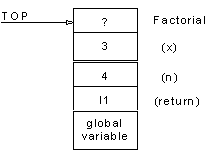
And on each subsequent calls the intermediate values of all
these variables are pushed till the condition reaches where n=0. and then the
contents are popped one by one and is returned to the place of the precious
call. This continues until the control is back to the first call.
Q.244 Write
an algorithm to add two polynomials using linked list. (12)
Ans:
Algorithm to add two polynomials
using linked list is as follows:-
Let p and q be the two polynomials
represented by linked lists
1. while p and q are not
null, repeat step 2.
2. If powers of the two terms ate equal
then if the terms do not cancel
then insert the sum of the terms
into the sum Polynomial
Advance p
Advance q
Else if the power of the
first polynomial> power of second
Then insert the term from
first polynomial into sum polynomial
Advance p
Else insert the term from
second polynomial into sum polynomial
Advance q
3. copy the
remaining terms from the non empty polynomial into the sum polynomial.
The third step of the algorithm is to be processed till the end of the
polynomials has not been reached.
Q.245 Execute
Dijkstra’s algorithm on the following graph with vertices numbered 1 to 6. The
graph is given in the form of an adjacency list.
i.
: (6, 2), (4, 7)
ii.
: (1,3), (3,4)
iii.
: (5,6)
iv.
: (2,2) (3,5), (1,5), (5,1)
v.
: (4,4), (6,3)
vi.
: (4,3)
Here (3,4) in vertex 2’s
adjacency list means that vertex 2 has a directed edge to vertex 3 with a
weight of 4. Assuming the source vertex to be 2, find the shortest distance and
the path to all the remaining vertices. (16)
Ans:
The source vertex is
2 (given).
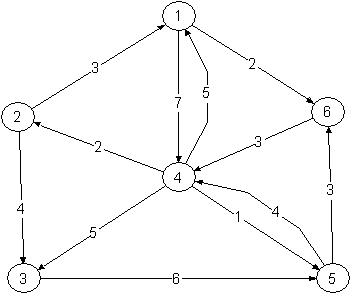
Step 1
P=Q T = {1, 2, 3, 4, 5, 6}
L(2)
= 0 Starting Vertex
L(x)
= ∞ for all x Є
T, x≠2
Step 2
V=2 (vertex 2 has smallest label)
P
= {2} T = {1, 3, 4, 5, 6}
Calculate
new labels for all vertices of T.
L
(1) = min (∞, 0+3) = 3
L
(3) = min (∞, 0+4) = 4
L
(4) = min (∞, 0+∞) = ∞
L
(5) = ∞
L
(6) = ∞
Step 3
V=1 (Permanent label L (1) = 3)
P
= {2, 1} T = {3, 4, 5, 6}
Calculate
new labels for all vertices of T.
L
(3) = min (4, 3+∞) = 4
L
(4) = min (∞, 3+7) = 10
L
(5) = min (∞, 3+∞) =∞
L
(6) = min (∞. 3+2) = 5
Step 4
V=3 (Permanent label L (3) = 4)
P
= {2, 1, 3} T = {4, 5, 6}
Calculate
new labels for all vertices of T.
L
(4) = min (10, 4+∞) = 10
L
(5) = min (∞, 4+6) = 10
L
(6) = min (5. 4+∞) = 5
Step 5
V=6 (Permanent label L (6) = 5)
P
= {2, 1, 3, 6} T = {4, 5}
Calculate
new labels for all vertices of T.
L
(4) = min (10, 5+3) = 8
L
(5) = min (10, 5+∞) = 10
Step 6
V=4 (Permanent label L (4) = 8)
P
= {2, 1, 3, 6, 4} T = {5}
Calculate
new labels for all vertices of T.
L
(5) = min (10, 8+1) = 9
The
vertex 5 got its permanent label and all the vertices got their respective
permanent labels as shown in the table below.
|
Vertex (v)
|
Permanent Label L (v)
|
|
1
|
3
|
|
3
|
4
|
|
4
|
8
|
|
5
|
9
|
|
6
|
5
|
Now, assuming the source vertex
to be 2, the shortest distance and the path to all remaining vertices are as
follows: -
Vertex
1
Shortest
distance = 3
Path
is 2à1
Vertex
3
Shortest
distance = 4
Path
is 2 à 3
Vertex
4
Shortest
distance = 8
Path
is 2à1 à 6à4
Vertex
5
Shortest
distance = 9
Path
is 2à1à 6à4à5
Vertex
6
Shortest
distance = 5
Path
is 2à1à 6
Q.246 Two
stacks are implemented using an array. What should be the initial values of top
for the two stacks? Arrows show the direction of growth of the stack.
Array A
 S1
S2
S1
S2


How can we implement
m stacks in a contiguous a memory. Explain how the stacks will grow and
indicate the boundary condition. Write push and pop programs for such a
scenario. (10)
Ans:
Two stacks s1 and s2
can be implemented in one array A [1, 2... N] as shown in the following
figure

We define A[1] as the bottom of stack S1 and let S1 “grow”
to the right and we define A[n] as the bottom of the stack S2 and S2 “grow” to
the left. In this case, overflow will occur only S1 and S2 together have more
than n elements. This technique will usually decrease the number of times
overflow occurs. There will separate push1, push2, pop1 and pop2 functions to
be defined separately for two stacks S1 and S2. These will be defined as
follows:-
initial volume of top for
stack S1 is top1=0 and
for stack S2 is top 2=n+1
S1. Push 1(x)
{
if (top 1+1==top2)
print if (“Stack S1 is overflowing”)
Else
{
top 1++
A[top1]= x
}
}
S1.POP()
{
if (top1==0)
print if (“stack S1 is empty”)
return (-1)
}
return (A[top--])
}
S2.push2(x)
}
if (top1+1==top2)
print if (“S2 is over flowing”)
else
{
top2—
A [top2]=x
}
}
S2.POP2()
{
if (top2==n+1)
}
print if (“stack is empty”)
return(-1)
}
else
return( A[top2++])
}
Q.247 How can we modify almost any algorithm to
have a good best case running time? (4)
Ans: Guess
an answer
Verify that it is correct, in that case
stop.
Otherwise run the original algorithm.
OR
Check whether
the input constitutes an input at the very beginning
Otherwise run
the original algorithm.
Q.248 Sketch
an algorithm to find the minimum and the maximum elements from a sequence of n
elements. Your algorithm should not take more than (3n/2)-2 number of comparisons where n
is a power of 2. (6)
Ans:
Rather than processing each element of the input by comparing it
against the correct minimum and maximum, at the cost of 2 comparisons per
element, we process elements in pairs. We compare pairs of elements from the
input first with each other, and then we compare the smaller to the current
minimum and the larger to the current maximum, at the cost of 3 comparisons for
every 3 elements.
If n is off, we set both the minimum and maximum to the value of
first element and the process the rest of the elements in pairs.
If n is even, we perform 1 comparison on the first 2 elements to
determine the initial values of minimum and maximum, and the process the rest
of the elements in pairs.So if n is odd, we perform 3[n/2] comparisons.
If n is even, we perform one initial comparison followed by 3(n-2)/2
comparisons for a total of 3n/2-2. Thus in either, number of comparisons are
almost 3[n/2]
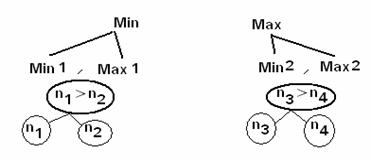
Q.249 Write
an O(1) algorithm to delete a node p in a singly linked list. Can we use this
algorithm to delete every node? Justify. (7)
Ans:
One deletion operation consists in deleting a node at the
beginning of the list and returning the value stored in it. This operation is
implemented by a member function deleteFromHead() given below. In this
operation, the information from the first node is temporarily stored in local
variable and then head is reset so that what was the second node becomes the
first node. In this way, the former first node can be deleted in constant O(1)
time.
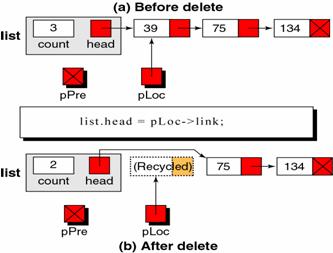
Deleting the first
node, from a linked list pointed by ‘head’ can be done is O(i) time
head = head ànext
Deleting a note
that follows a node with address P can also be done in O(i) time


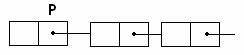
P ànext = (P ànext) à next
But a node with
address P cannot be deleted in O(i) time. It takes linear time.
//Delete
the first node
deleteFromHead(struct
node *q,int num)
{
struct node *temp;
temp=*q;
*q=tempàlink;
free(temp);
}
We can use this algorithm to delete every node by calling it
recursively. The best case is when the head node is to be deleted, which takes
O(1) time to accomplish. The worst case is when the last node needs to be
deleted because in that case it will take O(n) performance.
Q.250 Suggest
an efficient sorting algorithm to sort an array of n large records, while
minimizing number of exchanges. (2)
Ans:
Selection sort
In all cases: n2/2
comparisons and n exchanges execution time is not sensitive to original ordering of Input data.






Suppose K is the
node after which the list is to be split. Then
head2 = k àfront
kàfront = head
head à back = k
P = head2
while (Pàfront:=head)
P=Pà front
Pàfront=head2
head2àback=P
Q.2 51
Give an AVL tree for which the deletion of a node requires two double
rotations. Draw the tree and explain why two rotations are needed? (10)
Ans:
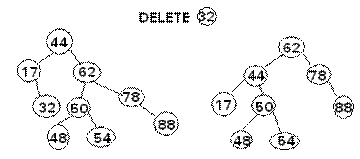
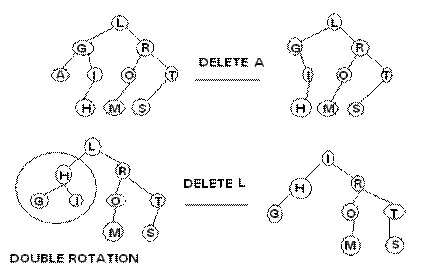
Q.252 A funny tree is a binary tree such
that, for each of its nodes x, the number of nodes in each sub tree of x is at most
2/3 the number of nodes in the tree rooted at x. Draw the tallest funny tree of
5 nodes. (7)
Ans:
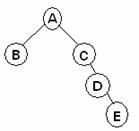
Q.253 Explain the term step-wise refinement. (3)
Ans:
Step Wise Refinement
Refinement is a process of elaboration. Here
one begins with a statement of function that is defined at a high-level
abstraction. That is the statement describes the program/function conceptually
but provides no information about internal working. Refinement causes the
programmer to elaborate on the original statement providing more and more
detail. In a stepwise refinement, at each step of refinement one or several
instructions of the given program are decomposed into more detailed
instructions. The successive refinement terminates when all the instructions
are expressed in terms of atomic expressions of the language.
Q.254 What is the difference between top-down and bottom-up, programming? (4)
Ans: Top-down
and Bottom-up Approaches
In Top-down programming approach, we start by
identifying the major modules of the program, decomposing them into their lower
modules and iterating until the desired level of detail is achieved. This is
also termed as Step Wise Refinement; starting from an abstract design, in each
step the design is refined to a more concrete level until we reach a level
where no more refinement is needed and the design can be implemented directly,
whereas in Bottom-up programming approach, we identify modules that are
required by programs and decide how to combine these modules to provide larger ones;
to combine those to provide even larger ones, and so on, till we arrive at one
big module which is the whole of the desired program.
In Bottom-up approach, we need to use a lot of
intuition to decide exactly what functionality a module should provide. This is
not the case in Top-down approach.
Q.255 What do you mean by complexity of an algorithm? Derive the
asymptotic time complexity of a non recursive, binary search algorithm. (7)
Ans:
The term complexity is used to describe the
performance of an algorithm. Typically performance is measured in terms of time
or space. Space complexity of an algorithm is the amount of memory is needed to
run the algorithm. Time complexity of an algorithm is the amount of computer time
it needs to run the algorithm. Most
common notation for describing time complexity
0(f(n)), where n is the input size and f is a function of n. An algorithm ~
0(f(n)) means there exists N such that for all
n > N the run time of the algorithm is less
than c.f(n), where c is a constant.
Binary search can be applied on a sorted array
to search for a particular item. Given array positions A[l], the search is
conducted in the following way.
Binsearch (x,
l,n)
{
L=l;
U = n;
While (L <= U)
{ mid = (L + U) / 2;
If (A[mid] = x)
Return.True;
Else
If (A[mid ] >
x)
L = mid + 1;
Else
U = mid - 1;
}
return False;
}
Thus at each state the array is halved into two
equal parts. In the worst case the algorithm terminates when the portion of the
array considered is of length 1, Thus if n = 2 , in the worst case the while
loop will have to repeat k times. Where k = log n. Thus asymptotic complexity
is O(log n).
Q.256 Assume the declaration of multidimensional arrays A and B
to be,
A (-2:2, 2:22) and B (1:8, -5:5, -10:5)
(i) Find the length of each dimension and
the number of elements in A and B. (3)
(ii)
Consider the element B[3,3,3] in B. Find the effective indices E1, E2,
E3 and the address of the element, assuming Base (B) = 400
and there are W = 4 words per memory location.
(4)
Ans:
(i) A (-2:2,2:22),
B (1:8, -5:5, -10:5) length of 1st dimension in A= 2-(-2)+1
= 2+2+1=5
length
of 2nd dimension in A =22-2+1=21
LI
= length of 1st dimension in B=8-l+l=8
L2
= length of 2nd dimension in B= 5-(-5)+1=11 L3= length of 3rd
dimension in B=5-(-10)+l=16 No. of elements in A= 5*21=105
No.
of elements in B=8*11*16=1408
|
(ii) B[3,3,3], Base(B)=400, W=4
El= 3-1=2
E2=3-(-5)=8
E3=3-(-10)=13
Address of B[3,3,3]=400+4(493) =2372
|
|
E1L2=2*11=22
E1L2+E2=22+8=30 (E1L2+E2)L3=30*16=480 (E1L2+E2)L3+E3=480+13=
493
|
Q.257. (i) what is meant by the terms 'row-major
order' and 'column-major order'?
(2)
(ii) Can the size of an array be declared
at runtime?
(2)
(iii)
The array DATA [10, 15] is stored in memory in 'row - major order'.
If base address is 200 and element size is 1.
Calculate the address of element
DATA [7, 12].
(3)
Ans: (i) Storing the array column by column is known
as column-major order and storing the array row by row is known as
row-major-order. The particular order used depends upon the programming
language, not the user. For example consider array A (3,4) and how this array
will be stored in memory in both the cases is shown below
|
|
(1,1)
|
|
|
(1,1)
|
|
|
|
(2,1)
|
Column1
|
|
(1,2)
|
Row1
|
|
|
(3,1)
|
|
|
(1,3)
|
|
|
|
(1,2)
|
|
|
(1,4)
|
|
|
|
(2,2)
|
Column2
|
|
(2,1)
|
Row2
|
|
|
(3,2)
|
|
|
(2,2)
|
|
|
|
(1,3)
|
|
|
(2,3)
|
|
|
|
(2,3)
|
Column3
|
|
(2,4)
|
|
|
|
(3,3)
|
|
|
(3,1)
|
Row3
|
|
|
(1,4)
|
|
|
(3,2)
|
|
|
|
(2,4)
|
Column4
|
|
(3,3)
|
|
|
|
(3,4)
|
|
|
(3,4)
|
|
(ii) No,
the size of an array can't be declared at run time, we always need to mention
the dimensions of an array at the time of writing program i.e before run time
(iii) Base address=200
Element
Size=l
Address of
element DATA [7,12]
= 200+[(7-l)*15+(12-l)]*l
= 200+[6*15+11]
=
200+[90+11]=301
Address of DATA [7,12]=301
Q.258 Write
an algorithm to insert a node after a given node in a linear linked list. (7)
Ans:
Suppose we are given
a value of LOC where LOC is the location of the node
'A' in the linked list.
The following algorithm inserts an 'ITEM' into LIST (given
Linked list) so that ‘TTEM' follows node 'A'.
1. If AVAIL =
NULL , Then write overflow and exit
2. set NEW =
AVAIL and AVAIL=:link[AVAIL] [remove first node from AVAIL LIST]
3. set
INFO[NEW]=ITEM [copies new data into new node]
4. if LOC=NULL
then [insert as first node]
set LINK[NEW]= START and START = NEW
else [insert after node with location LOC]
set LINK[NEW]=LINK[LOC] and LINK[LOC]=NEW
[end of if
structure]
5. exit
Q.259 Show how the following polynomial can be represented using
a linked list. (4)
7x2y2-4x2y+5xy2-2
Ans:
Representation of Polynomial using Linked List
Each node will have
four parts(as shown below)
|
Coeff
|
Power of'x'
|
Power of 'y'
|
Next address
|
The
polynomial is


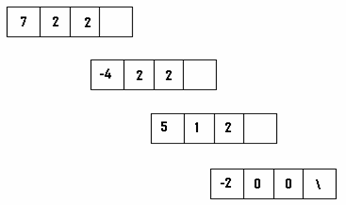
Q.260. What is the advantage of doubly linked list
over singly linked list?
(3)
Ans:
Advantages of the doubly linked list over singly
linked list
1 A
doubly linked list can be traversed in two directions; in the usual forward
direction from the beginning of the list to the end, or in the backward
direction from the end of the list to the beginning of the list.
2 Given the
location of a node 'N' in the list, one can have immediate access
to both the next node and the preceding node in the list.
3 Given a pointer
to a particular node 'N', in a doubly linked list, we can delete the Node 'N'
without traversing any part of the list. Similarly, insertion can also be made
before or after 'N' without traversing the list.
Q.261 What is a binary
tree? Write an algorithm for the preorder traversal of a binary
tree using stacks. , (7)
Ans:
A binary tree 'T' is defined as
A finite set of elements, called nodes, such that: either
(i) or (ii) happens:
(i) T is empty (called the 'null tree' or 'empty
tree')
(ii) T contains a distinguished node R, called the 'root'
of T and the remaining nodes of 'T' form an ordered pair of the disjoint binary
tree Tl and T2.
If 'T' contains a root 'R' then the two trees Tl and T2 are
called, the 'left' and 'right' sub trees of R, respectively.
Algorithm for the pre order traversal of a
binary tree using a stack
A binary tree T is in memory, an array 'STACK'
is used to temporarily hold the addresses of the nodes. "PROCESS"
is the operation that will be applied to each node of the tree.
(1)
Set TOP=1, STACK [1] = NULL and PTR= ROOT [initially push
null onto Stack and initialize PTR]
(2)
repeat steps (3) to (5) while PTR
!= NULL
(3)
apply PROCESS to INFO[PTR]
(4) [right child ?]
if RIGHT[PTR] != NULL then[push on STACK]
Set TOP=TOP+1 band STACK[TOP]=RIGHT[PTR]
[End
of IF Structure]
(5) [Left Child ?]
if LEFT[PTR] != NULL then:
set PTR= LEFT[PTR]
else [POP from STACK]
set PTR=STACK[TOP] and TOP=TOP+1
[End
of IF structure]
(6) Exit
Q.262. A
binary tree T has 9 nodes. The in order and preorder traversals of T
yield
the following sequences of nodes:
In Order: EACKFHDBG
Pre order:FAEKCDHGB
Draw the tree T. Also give the yield of the post
order traversal.
(7)
Ans:
Inorder :EACKFHDBG
Preocder : E A
E K C D H G B
Tree ‘T’
is
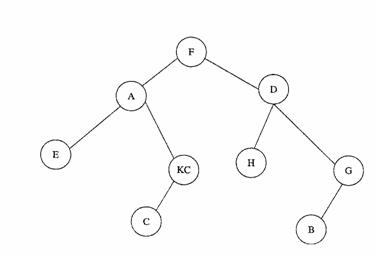
Postorder
Traversal -.ECKAHBGDF
Q.263 Write short notes on the following:
(i) Threaded binary
tree.
(ii) Buddy systems.
(iii) B - trees.
(iv)
Minimum spanning tree.
(14)
Ans:
(i) Threaded binary tree
: Consider the linked representation of a binary tree 'T. Approximately half of
the entries is the pointer fields 'LEFT' and 'RIGHT' will contain null
elements. This space may be more efficiently used by replacing the null entries
by some other type of information. Specially we will replace certain null
entries by special pointers which points to nodes in the tree. These special
pointers 4 are called 'threads' and binary trees with such pointers are called
'threaded trees'.
There are two major types of threading: - one way threading and
two way threading.
In the one way threading
of T, a thread will appear in the right field of a node and will point to the
next node in the inorder traversal of T and in the two way threading of T, a
thread will also appear in tl left field of a node and will point to the
preceding node in the inorder traversal of T. There is another kind of one way
threading which corresponds to the preorder traversal of T.
(ii) Buddy systems:
A method of handling the storage management problem is kept separate free lists
for blocks of different sizes. Each list contains free blocks of only one
specific size. For example, memory contains 1024 words then it might be divided
into fifteen blocks, one block of 256 words, t blocks of 128 words, four blocks
of 64 words, and 8 blocks of 32 words. Whenever sport is requested the smallest
block is whose size is greater than or equal to the size needed to reserve for
example a block of 97 words is field by a block of size of 128 but in this
method there are several limitation, first, space is wasted due to internal
fragmentation, second, a request of block size 300 cannot be filled. The
largest size is maintained is 256, the source of this problem is that free
space are never combined
A variation to this scheme
is buddy system and is quite useful. In Buddy systems several free list constituets
of various sized blocks are maintained. Adjacent free blocks are smaller size
may be removed from list combined into free blocks of larger size, and placed
on the larger size free list. These larger blocks can be used intact to satisfy
a request for a large amount of memory or they can be split once into their
smallest constituents to satisfy several smaller request.
(iii) B-tree : A B-tree is a balanced m-way tree. A node of
the tree may contain many records or key and pointers to children. It is also
known as the balanced sort tree. It finds its use in external sorting. It is
not a binary tree.
B-tree of order m has following properties:
(1) each node has a maximum of m children and minimum of
m/2 children or any number from 2 to maximum.
(2) The no. of keys in a node is one less than its no of
children. The arrangement
po ki pi
.... Kn Pn
Δ Δ Δ
To ti
Tn each Tl is a m-way tree
(3) The keys 'in a node Ki — Kn are arranged in
sorted order K1 < K2
— <Kn. All the keys present
in the subtree pointed to by a pointer Pi Ki.Pi.Ki+1
are greater than
(4) When a new key is to be inserted into a full node, the
key is split into two nodes and the key with the median value is inserted in
the parent node. In case the parent node is a root, a new root is created.
(5) All the leaves are on the same level i.e. there is no
empty subtree above the level of the leaves. All the normal nodes of B-tree
(Except 'root' and terminal nodes) have between m/2 and m children.
(iv)
Minimum Spanning Tree : Given a weighted graph G, it is often desired to
create a spanning tree T for G, such that the sum of weights of the edges in T
is the least. Such a tree is called a minimum spanning tree and represents the
cheapest way of connecting all the nodes in G . There are no. of techniques to
create a minimum spanning tree for a weighted graph. For ex. Kruskal's algo.
Prim's algorithm.
Example :-The given connected weighted graph G
is 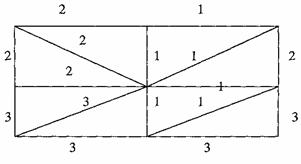
One
of the minimum spanning trees of the graph G is:-
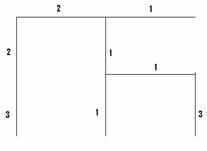
Minimum cost of the spanning tree = 14
Q.264. What
is memory allocation? Explain the first fit and best fit algorithms for storage
allocation with suitable examples.
(7)
Ans:
Memory Allocation : It is the technique of allocating memory storage to
program in order that the program can be run.
First fit algorithm: The question asked for examples not algorithms the first
fit algorithm may be explained.
Suppose the memory allocation is as follows:
suppose  indicates
allocated block &
indicates
allocated block &  denotes a free block. The size of the free
blocks are indicated. Suppose the current requirement is 8K. Then the first fit
algorithm will allocate it from the block of 20K.
denotes a free block. The size of the free
blocks are indicated. Suppose the current requirement is 8K. Then the first fit
algorithm will allocate it from the block of 20K.
The
advantage ; it is part disadvantage : fragmentation.
P=freeblock
aloc= null
q=null;
while (p!=null && size
(p) < n )
{
Q=p;
p=next(P)
}/* end while */
if (p!=null){/* there is block
large enough*/
s=size(p);
alloc=p+s-n; /* alloc contain the
address of the designed block*/
if(s==n)
/* remove the block from the free
list*/
if (q==null)
freeblock=next(p);
else
next(q)=next(p);
else
/* adjust the size of tile
remaining free block*/
size(p)=s-n;
}/* end if*/
The Best fit algorithm : The best fit method obtains the smallest free
block whose size is greater than or equal to n. An algorithm to obtain such a
block by traversing the entire free list follows. We assume that the memsize is
the total no. of words in memory.
The
Best fit algorithm allocates the memory from the block that fits the
requirement best i.e. the block that has size greater than the requirement, but
no other block of lesser size can meet the requirement. Thus for the above
problem the allocation will be made from block of size 10 K. Advantage :
fragmentation is reduced
Disadvantage
: more time.
p=freeblock; /*p is used to traverse the free list */
q==null;
/* q is one block behind p*/
r=null;
/* r points to the desired block*/
rq=null; /* rq is one block behind r */
rsize=memsize+l; /* rsize is the size of the
block at r */
alloc = null; /* alloc will point
to block selected */
while(!=null)
{
if(size(p)>= n && size(p)<rsize)
{
/* we have found a free block
closer in size */
r=p;
rq=q;
rsize=size(p);
}
/* END IF */
/* continue traversing the free
list */
q=P;
p=next (p);
}
/* end while */
if{r!=null)
{
/* there is block of sufficient
size */
alloc = r + r size – n ;
if (r size = =n){
/*
remove the block from the free list */ if(rq= = null )
freeblock = next (r );
else
next(rq)= next( r );
else size(r) = rsize- n ;
} /* end if */
Q.265. Consider the following
graph

Fig 2
Let the nodes be stored in memory in an array G as :G; X, Y,
Z, W
(i) Find the adjacency matrix A of the graph G.
(ii) Find the path matrix P of G using powers of
the adjacency matrix -A.
(iii) Is G strongly connected?
(3+3+1)
Ans:
Adjacercy Matrix 'A' =
|
|
|
X
|
Y
|
Z
|
W
|
|
|
X
|
0
|
1
|
1
|
1
|
|
(i) =
|
Y
|
0
|
0
|
0
|
1
|
|
|
Z
|
0
|
1
|
0
|
1
|
|
|
W
|
0
|
0
|
1
|
0
|
|
|
|
|
|
|
|
|
0
|
1
|
1
|
1
|
|
A=
|
0
|
0
|
0
|
1
|
|
|
0
|
1
|
0
|
1
|
|
|
0
|
0
|
1
|
0
|
(ii) =
|
|
0
|
1
|
1
|
1
|
|
A2 =
|
0
|
0
|
0
|
1
|
|
|
0
|
1
|
0
|
1
|
|
|
0
|
0
|
1
|
0
|
|
0
|
1
|
1
|
1
|
|
0
|
0
|
0
|
1
|
|
0
|
1
|
0
|
1
|
|
0
|
0
|
1
|
0
|
|
|
0
|
1
|
1
|
2
|
|
A2 =
|
0
|
0
|
1
|
0
|
|
|
0
|
1
|
1
|
1
|
|
|
0
|
1
|
0
|
1
|
|
A3=A2.A=
|
0
|
1
|
1
|
2
|
|
0
|
1
|
1
|
1
|
|
0
|
0
|
1
|
0
|
0
|
0
|
0
|
1
|
|
0
|
0
|
1
|
1
|
0
|
1
|
0
|
1
|
|
0
|
1
|
0
|
1
|
0
|
0
|
1
|
0
|
|
|
|
|
=
|
0
|
1
|
2
|
2
|
|
|
|
0
|
1
|
0
|
1
|
|
|
0
|
1
|
1
|
1
|
|
|
0
|
0
|
1
|
1
|
|
|
|
|
|
A4
= A3.A=
|
0
|
1
|
2
|
2
|
|
0
|
1
|
1
|
1
|
|
0
|
1
|
0
|
1
|
0
|
0
|
0
|
1
|
|
0
|
1
|
1
|
1
|
0
|
1
|
0
|
1
|
|
0
|
0
|
1
|
1
|
0
|
0
|
1
|
0
|
|
|
|
|
A4=
|
0
|
2
|
2
|
3
|
|
|
|
0
|
0
|
1
|
1
|
|
|
0
|
1
|
1
|
2
|
|
|
0
|
1
|
1
|
1
|
|
|
A+A2
+ A3 + A4 =
|
|
|
|
|
0
|
1
|
1
|
1
|
+
|
0
|
1
|
1
|
2
|
|
|
0
|
0
|
0
|
1
|
0
|
0
|
1
|
0
|
|
0
|
1
|
0
|
1
|
0
|
0
|
1
|
1
|
|
0
|
0
|
1
|
0
|
0
|
1
|
0
|
1
|
|
|
|
|
+
|
0
|
1
|
2
|
2
|
+
|
0
|
2
|
2
|
3
|
|
|
|
0
|
1
|
0
|
1
|
0
|
0
|
1
|
1
|
|
|
0
|
1
|
1
|
1
|
0
|
1
|
1
|
2
|
|
|
0
|
0
|
1
|
1
|
0
|
1
|
1
|
1
|
|
|
|
|
|
=
|
0
|
5
|
6
|
8
|
|
|
|
0
|
1
|
2
|
3
|
|
|
0
|
3
|
3
|
5
|
|
|
0
|
2
|
3
|
3
|
|
|
Path matrix ‘P’ =
|
|
|
|
0
|
1
|
1
|
1
|
|
|
0
|
1
|
1
|
1
|
|
0
|
1
|
1
|
1
|
|
0
|
1
|
1
|
1
|
|
(iii) No, G is not strongly
connected.
|
|
|
|
|
|
|
|
|
|
|
|
|
|
|
|
|
|
|
|
|
|
|
|
|
|
|
Q.266. What
is a hash function? Describe any three hash functions. (7)
Ans:
Hash function : This is the function from the set 'K' of keys into the set
'L' of memory addresses.
H : Kà L
These are used to determine the address of a record with
the use of some key. Such a function 'H' may not yield distinct values: it is
possible that two diff keys Kl and K2 will
yield the same hash address;
This situation is called collision and some method must be
used to resolve it.
Examples
1. Division method: Choose a number 'm' larger than the number 'n'
of keys in K: (The number m is usually chosen to be a prime number). The hash
function 'H' is defined by
H(K)= k (mod m)
Where K(mod m ) denotes the remainder when 'K'
is divided by m.
2. Midsquare method: The key 'K' is
squared, then the hash function 'H' is defined by
H (K) =1 Where 1 is obtained by deleting digits from both
ends of K2.
3. Folding Method: The key 'K' is partitioned into a no. of
parts k1, k2,……kT, Where each part except ,
possibly the last, has the same number of digits as the required address. Then
the parts are added together, ignoring the last carry, that is
H (k) = k1, k2,……kT,.
Where the leading digits carries, if any, are ignored.


 (A) ABDULbbbbb (B) bbbbbABDUL
 (C) ABDULbbbbbbbbbb (D)
bbbbbbbbbbABDUL
(C) ABDULbbbbbbbbbb (D)
bbbbbbbbbbABDUL
 (B)
(B)

 (D)
(D) 
 (B)
(B)

 (D)
(D) 
 (B)
(B)
 (D)
(D) 
 Tree.
Tree. (B)
(B)

 (D)
(D)