Code: AE-01/AC-01/AT-01                                                                       Subject: MATHEMATICS-I

PART - I, VOL – I


TYPICAL QUESTIONS & ANSWERS


OBJECTIVE TYPE QUESTIONS


Each Question carries 2 marks.


Choose correct or the best alternative in the following:


Q.1       The value of limit  is


                   (A)  0                                                  (B)  1

(C)    2                                                 (D)  does not exist


                           Ans: D


Q.2       If , then  equals


(A)    0                                                  (B)  u

(C)  2u                                                (D)  3u


             Ans: A    

  Q.3     Let .  Then  the value of  is


(A)    *                                            (B)  0

(C)                                              (D) 


             Ans: B

Q.4       The value of  is


(A)    1                                                      (B)

(C)                                              (D)  3       


             Ans: A


Code: AE-01/AC-01/AT-01                                                                                      MATHEMATICS-I


Q.5       The solution of  is                                                               

(A)                                           (B) 

(C)                                      (D) 


             Ans: C


Q.6       The solution of  is  


(A)     sin x                                             (B)  cos x

(C)  x sin x                                          (D)  x cos x


             Ans: D


Q.7 .     Let    and  be elements of .  The set of vectors  is


(A)     linearly independent                      (B)  linearly dependent

(C)  null                                               (D)  none of these


             Ans: A

Q.8       The eigen values of the matrix  are


(A)    * and 1                                  (B) 0, 1 and 2

(C) –1, 2  and 4                                (D) 1, 1 and –1


             Ans: A


  Q.9     Let , ,  be the Legendre polynomials of order 0, 1, and 2, respectively.  Which of the following statement is correct? 


(A)             (B)

(C)              (D)


                           Ans: B


Code: AE-01/AC-01/AT-01                                                                                      MATHEMATICS-I


Q.10     Let  be the Bessel function of order n.  Then  is equal to   


(A)                                    (B) 

(C)                                 (D)

Ans: D

Q.11     The value of limit  


                   (A)  0                                                  (B)  

(C)                                             (D)  does not exist


                           Ans:  D                                                                                                        


Q.12       Let a function f(x, y) be continuous and possess first and second order partial derivatives at a point (a, b).  If  is a critical point and , ,  then the point P is a point of relative maximum if 


(A)                           (B)   

(C)                           (D) 


             Ans:  B                                                         


Q.13           The triple integral  gives


(A)  volume of region T                        (B)  surface area of region T

(C)  area of region T                            (D)  density of region T


                           Ans:  A


Q.14           If  then matrix A is called


(A) Idempotent Matrix                        (B) Null Matrix

(C)  Transpose Matrix                        (D)  Identity Matrix           


                           Ans:  A


Code: AE-01/AC-01/AT-01                                                                                      MATHEMATICS-I


Q.15           Let  be an eigenvalue of matrix A then , the transpose of A, has an eigenvalue as                                                            

(A)                                                  (B) 

(C)                                                   (D) 


             Ans:  C


Q.16           The system of equations is said to be inconsistent, if it has 


(A)  unique solution                              (B)  infinitely many solutions

(C)  no solution                                    (D) identity solution


             Ans:  C


Q.17           The differential equation  is an exact differential equation if  


(A)                                     (B) 

(C)                                     (D) 

             Ans:  B


Q.18           The integrating factor of the differential equation  is  


(A)                                                  (B)

(C) xy                                                 (D)

                           Ans:  D


Q.19           The functions  defined on an interval I, are always  


(A) linearly dependent                          (B) homogeneous

(C) identically zero or one                    (D) linearly independent


                           Ans:  D


Code: AE-01/AC-01/AT-01                                                                                      MATHEMATICS-I


Q.20     The value of , the second derivative of Bessel function in terms of  and  is  

(A)                             (B) 

(C)                            (D)


             Ans:  C


Q.21                                                                      The value of limit  is


                  (A) 0                                                    (B) 1

                  (C) -1                                                   (D) does not exist


             Ans:  A


Q.22          If  , the total differential of the function at the point (1, 2) is


                  (A) e (dx + dy)                                     (B) e2(dx + dy)

                  (C) e4(4dx + dy)                                   (D) 4e4(4dx + dy)


             Ans:  D


Q.23          Let  , x > 0, y > 0  then

             equals


                  (A) 0                                                    (B) 2u

                  (C) u                                                    (D) 3u


             Ans:  B


Q.24       The value of the integral  over the domain E bounded by planes                       x = 0, y = 0, z = 0, x + y + z = 1 is


                  (A)                                                 (B)

                  (C)                                               (D)


             Ans:  C

Code: AE-01/AC-01/AT-01                                                                                      MATHEMATICS-I


Q.25       The value of α so that  is an integrating factor of the differential equation  is


                  (A) -1                                                   (B)   1

                  (C)                                                   (D)


             Ans:  C


Q.26       The complementary function for the solution of the differential equation  is obtained as


                  (A) Ax + Bx -3/2                                    (B) Ax + Bx 3/2

                  (C) Ax2 + Bx                                        (D) Ax -3/2 + Bx 3/2


             Ans:  A


Q.27       Let  be elements of R3. The set of vectors  is


                  (A) linearly independent                        (B) linearly dependent

                  (C) null                                                 (D) none of these


             Ans:  A

Q.28       The value of µ for which the rank of the matrix  is equal to 3 is

                  (A) 0                                                    (B) 1

                  (C) 4                                                    (D) -1


             Ans:  B


Q.29       Using the recurrence relation, for Legendre’s polynomial                                                             (n + 1) , the value of P2 (1.5) equals to


                  (A) 1.5                                                 (B) 2.8

                  (C) 2.875                                             (D) 2.5


             Ans:  C

Code: AE-01/AC-01/AT-01                                                                                      MATHEMATICS-I


Q.30       The value of Bessel function J2(x) in terms of J1(x) and J0(x) is


                  (A) 2J1(x) – x J0(x)                               (B)

                  (C)                            (D)


             Ans:  D


Code: AE-01/AC-01/AT-01                                                                                      MATHEMATICS-I

PART – II, VOL – I


NUMERICALS


  Q.1     Consider the function f (x, y) defined by

                   Find  and

                   Is  differentiable at (0, 0)?  Justify your answer.                                                       (8)


             Ans:



                   The partial derivatives are



                   Therefore,   df = 0       

                   Let   dx = r cosq       dy = r sinq                         


                   \  f(Y)  is differentiable.


Code: AE-01/AC-01/AT-01                                                                                      MATHEMATICS-I



Q.2      Find the extreme values of  subject to the constraints of  (x, y, z) = 2x + y =0 and h(x, y, z) = x + y + z = 1                                                                                                  (8) 

       

                   Ans:

                          Consider the Auxiliary function

                        

                           For the extremum, we have the necessary conditions

                          

                           From (4)  we get    y = -2x.

                           Taking   y = -2x in (1),  we get  -2x + 2l1 + l2 = 0         -----------(6)

                           (2) & (6)  implies    3l1 + 2l2 = 0         -----------(7)

                           From  (5)   x + y = 1- z.  putting this in (1), we get 2 – 2z + 2l1 + l2 = 0    ----(8)

                           (3)  and  (8)  implies  2l1 + 2l2 = -2         -----------(9)

                           (7)  and  (9)  implies  l1 = 2, l2 = -3              


                           The point of extremum is



                          The extremum value is                                                                                


Code: AE-01/AC-01/AT-01                                                                                      MATHEMATICS-I



Q.3     Find all critical points of  and determine  relative extrema at these critical points.                                                                      (8)

 

             Ans:



                   \ The only critical point is (x, y) = (0, 0)                   



Code: AE-01/AC-01/AT-01                                                                                      MATHEMATICS-I


Q.4       Find the second order Taylor expansion of  about the point .                                                                                         (4)

             Ans:


                   Second  order Taylor expansion of   f (x, y) is



Code: AE-01/AC-01/AT-01                                                                                      MATHEMATICS-I


Q.5       Change the order of integration in the following double integral and evaluate it :  .                                                                              (4)

 

             Ans:  


                   The region of integration is given by      y £ x £ 1     and   0 £ y £ 1.

                   Hence, it is bounded by  the straight lines x= y and x = 1 between y = 0 and y = 1.


                                  y

                                                                  x = y

                   y = 1                                                   


                y = 0           0                                                         x

                                                                              x = 1


                To find the limits of integration in the reverse order, we observe that the region is

                 Also given by       0 £ y £ x   and  0 £ x £ 1                                           


                   Hence,



Code: AE-01/AC-01/AT-01                                                                                      MATHEMATICS-I


Q.6       Solve the differential equation .                                                                           (4)

             Ans:


                   This is linear equation of 1st order

                   I.F. =

                   Solution is

                  

                   .

                   Therefore      is the solution.


Q.7       Solve the differential equation .                                          (6)

             Ans:  


                                                      Hence  the  equations is exact. 


Code: AE-01/AC-01/AT-01                                                                                      MATHEMATICS-I



             \  From  (1)  and   (2)   above,   we get


                   Therefore,    j(y) = -y + c                                  

                   Therefore,


Q.8       Find the general solution of the differential equation  by method of undetermined coefficients.                                                                                                            (6)                                                                                                 

             Ans:


                   So the linearly independent solutions of the homogeneous equation are 


                   The particular solution

                               By the method of undetermined coefficients, the particular solution is in the form     y(z) = c1ez + c2z ez                                            


Code: AE-01/AC-01/AT-01                                                                                      MATHEMATICS-I



              Substituting in the equation(1), we get


             Hence  the general solution


             y = c3 Sin2z + c4 Cos2z

             y = c3 Sin2(logx) + c4 Cos2(logx) .


Q.9       Find the general solution of the differential equation .                                                                                       (9)

             Ans:

                   This is Cauchy’s homogeneous linear equation.

                   Putting x = et,

                   Then given equation becomes (D(D – 1)(D -2) – D(D-1) + 2D – 2)y = e3t.


                   which is linear equation with constant coefficients.


                   A.E. is .

                   => D = 1, 1, 2.

                   .

                   .

                          = .


Code: AE-01/AC-01/AT-01                                                                                      MATHEMATICS-I


Q.10           Show that the eigen values of a Hermitian matrix are real.                                                  (7)


             Ans:


             We have  Ax = lx.         Premultiplying by        ,  we  get



             The denominator        x   is always real and positive. Therefore the behaviour of l is

             determined by      Ax.                                           


Q.11    Using Frobenius method, find two linearly independent solutions of the differential equation .                                                                                             (10)

 

             Ans:

                   The point x = 0 is a regular singular point of the equation.



                   The lowest degree term is the term containing   xr-1.


Code: AE-01/AC-01/AT-01                                                                                      MATHEMATICS-I


                   Setting this coefficient to zero,  we get


                   (1)    may be written as


\        For  m  ³  0,  we  get

\         


                   when    r = 0


                            when    r = ½                                                                                                                          

Code: AE-01/AC-01/AT-01                                                                                      MATHEMATICS-I


Q.12           Solve the following system of equations by matrix method:                                                  (6)


             Ans:


                      Therefore    rank(A|b)  =  rank(A)  =  3


                       So   System admits unique solution.    


Code: AE-01/AC-01/AT-01                                                                                      MATHEMATICS-I


                       Now the resultant system is

                       4z = 3   =>  

                       y + 2z = 1    =>  

                       x + y +2z = 0    =>  x = -1.


Q.13           Express the polynomial  in terms of Legendre polynomials.                               

                                                                                                                                                              (8)

         Ans:


                                                                              .

                   writing various powers of x in terms of legendre polynomials.


                   Now,


Code: AE-01/AC-01/AT-01                                                                                      MATHEMATICS-I


Q.14         Let  be the Bessel function of order .  Show .                                                                                                                                                                                                               (8)

                                                                                                                            Ans:


                                                                                                    Now  we  know  that

                                                                                                              =

                                                                                             =


                                                                     = 

Code: AE-01/AC-01/AT-01                                                                                      MATHEMATICS-I


                                                                                                         = .


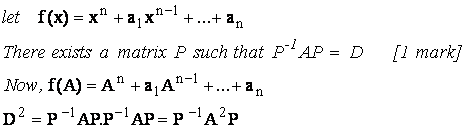
Q.15           If A is a diagonalizable matrix and f (x) is a polynomial, then show that       f (A) is also diagonalizable.                                                                                                                                 (7)


             Ans:


                   by  induction, we may  show that


                   Since   D is a diagonal matrix, f(D) is also diagonal.


                   Thus f(A) is diagonalizable.


Q.16.    Let.  Find the matrix P so that  is a diagonal matrix.                            (9) 

             Ans:


                   Eigen values are


                   Therefore     l = 2, 2, 4 are Eigen values .


Code: AE-01/AC-01/AT-01                                                                                      MATHEMATICS-I


                   Eigen values corresponding to  l = 2  is


                   The eigen vectors are (-2 1 0) T  and  (-1 0 1) T


                   Eigen vector  corresponding to  l = 4  is


                   \   The  eigen vector  is  (1 0 1)ù                                               


Q.17     Show that the function


                   is continuous at (0, 0) but its partial derivatives  and  do not exist at (0, 0).                                                                                          (8)

         Ans:  We have


Code: AE-01/AC-01/AT-01                                                                                      MATHEMATICS-I


                       Hence the given function is continuous at (0, 0)


                   Now at (0, 0),  we have


                   Hence limit does not exist. Therefore fx does not exist at (0, 0).

                   Also at (0, 0),  the limit


                   Hence limit does not exist at (0,0).


Q.18    Find the linear and the quadratic Taylor series polynomial approximation to the function  about the point (1, 2).  Obtain the maximum absolute error in the region  and  for the two approximations.                                                       (8) 

             Ans:


                   The linear approximation is given by


                   Maximum absolute error in the linear approximation is given by


Code: AE-01/AC-01/AT-01                                                                                      MATHEMATICS-I


                   The quadratic approximation is given by


                   The maximum absolute error in the quadratic approximation is given by


Q.19    Find the shortest distance between the line  and the ellipse .        (8) Ans:

                   Let (x, y) be a point on the ellipse and (u, v) be a point on the line and the ellipse is the square root of the minimum value of


                   Subject to the constraints


Code: AE-01/AC-01/AT-01                                                                                      MATHEMATICS-I


                   Dividing we get 8y=9x. Substituting in ellipse we get


                                                                                            u = 2v – 2.


                   Substituting in the equation of line 2u + v –10 = 0, we get


                   Hence an extremum is obtained when (x, y) =

                   The distance between the two points is        .


                   The distance between these two and pts is               .

                   Hence shortest distance between line and ellipse is          .


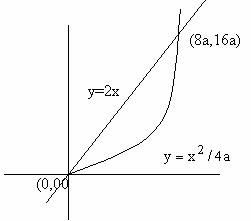
Q.20    Evaluate the double integral , where R is the region bounded by the x-axis, the line y = 2x and the parabola .                                                                                                                 (8)

             Ans:


                   The points of intersection of the curves


                   The region


Code: AE-01/AC-01/AT-01                                                                                      MATHEMATICS-I


                   We evaluate the double integrate as


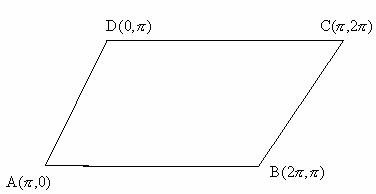
Q.21    Evaluate the integral  where R is the parallelogram with successive vertices at , ,  and .                                                                           (8)


             Ans:

                   The region R is given in figure


                   The equations of the sides AB, BC, CD and DA are respectively

Code: AE-01/AC-01/AT-01                                                                                      MATHEMATICS-I


                   x – y = p, x + y = 3p, x – y = -p, x + y = p.


                   Let y – x = u, y + x = v. Then   -p £ u £ p and p £ v £ 3p


Q.22                                                                      Show that where  is the Bessel function of  order.                                                                                             (8)


                  Ans:


                       We know that


Code: AE-01/AC-01/AT-01                                                                                      MATHEMATICS-I


                   Substituting  n=0, 1,2, …………..adding we get


Q.23           Show that .                                   (6)


             where  are the Legendre polynomials of order K.


             Ans:


                   Integrating by parts


Code: AE-01/AC-01/AT-01                                                                                      MATHEMATICS-I


                   Now by orthogenality property, we have


                   If m = n   

                                                      = .

                                                      =

                                                      = .

                   ,   m = n.                                                                   


Q.24           Find the power series solution about x =2, of the initial value problem                     

             . Express the solution in closed form.                   (10)

             Ans:

                   We have


                   Putting x = 2,  we get


Code: AE-01/AC-01/AT-01                                                                                      MATHEMATICS-I


Q.25     Solve the initial value problem  y(0) = 0, , .                                                                                           (8)

             Ans:

                   A.E. is


                   m = 1, 2, 3.

                   .

                   y(0) = 0

                   =>

                   y1 (0) = 1

                   => 

                   y11 (0) = -1

                   =>  .

                   Thus 

                   ~    


                   Solving .

                   Thus solution of initial value problem is .


Code: AE-01/AC-01/AT-01                                                                                      MATHEMATICS-I


Q.26           Solve .                                                                                  (8)

             Ans:

                   Let  x = et.

                   (D(D – 1) + D – 1)y = .

                   A.E.  m2 – 1 = 0.

                                    m =  1.

                   C.F.   .

                   P.I.   = 

                            =

                            =

                            =

                            =


                   .


Q.27    Show that set of functions  forms a basis of the differential equation .  Obtain a particular solution when .                                                                (6)


             Ans:


Code: AE-01/AC-01/AT-01                                                                                      MATHEMATICS-I


                   Hence y1(x) and y2(x) are solutions of  the given equation.

                   The Wronskian is given by


                   Thus the set{y1(x), y2(x)} forms a basis of the equation.

                   The general solution is


Q.28                                                                      Solve the following differential equations:     (25 = 10)

                   (i)    


                   Ans:

                       ,

                        M = ,

                        .


                        .

                        Thus, the equation is not exact and M, N are homogenous function of degree 2,  


Code: AE-01/AC-01/AT-01                                                                                      MATHEMATICS-I


                         Thus equation is


                         Now  M1 = .


                   (ii)   


                   Ans:


                           Integrating,  we get


Code: AE-01/AC-01/AT-01                                                                                      MATHEMATICS-I


Q.29    Let  be a linear transformation defined by .  Taking  as a basis in  determine the matrix of linear transformation.                                                                                                                                                               (8)

             Ans:

                   The given matrix which maps the elements in R3 into R2 is a 2 x 3 matrix.


                   Solving these equations, we obtain the matrix    


Code: AE-01/AC-01/AT-01                                                                                      MATHEMATICS-I


Q.30           If  then show that , for .     Hence find .                                                                                    (8)


             Ans:

                   The characteristic equation of A is given by


                   Using Cayley Hamilton theorem,  we get


                   Adding we get


                   .


Code: AE-01/AC-01/AT-01                                                                                      MATHEMATICS-I


Q.31     Examine whether matrix A is similar to matrix B, where  , .                                                                                              (8)

             Ans:

                   The given matrices are similar if there exists an inevitable matrix P such that


                   Solving, we get  a = 1, b = 1, c = 1, d = 2


                   Thus                            which is a non-singular matrix. Hence the matrices A and B


                   are similar.


Q.32           Discuss the consistency of the following system of equations for various values of


                   and if consistent, solve it.                                                                                                   (8)       


             Ans:

                   The augmented matrix is 


Code: AE-01/AC-01/AT-01                                                                                      MATHEMATICS-I


                    rank (A:B) = 3 and rank (A) = 2, hence the system is inconsistent.

                             When l = 7, rank (A:B) = 2 = rank (A), hence consistent.


Q.33    Show that for the function f(x, y) = , partial derivatives  and  both exist at the origin and have value 0. Also show that these two partial derivatives are continuous except at the origin.                                                                                                                          (8)


            Ans:

                  Now at (0, 0),


                  If the function is differentiable at (0, 0), then by definition , where φ and  are functions of k and h and tend to zero as (h, k) (0, 0). Putting h = r cosθ, k = r sinθ and dividing by r, we get . Now for arbitrary θ, r 0, implies that (h, k) (0, 0). Taking the limit as r 0, we get , which is impossible for all arbitrary θ. Hence the function is not differentiable at (0, 0) and consequently the partial derivatives  cannot be continuous at (0, 0). For (x, y) (0, 0).

Code: AE-01/AC-01/AT-01                                                                                      MATHEMATICS-I


                  =

                  Now as h 0, we can take x + h > 0, i.e.  = x + h, when x > 0 and x + h < 0 or .


                  Similarly,


                  which is not continuous at the origin.


Q.34    In a plane triangle ABC, if the sides a, b be kept constant, show that the variations of its angles are given by the relation

                                                                                      (8)


            Ans:

                  By the sine formula we have

                  Taking differentials on both sides, we get a cos B dB = b cos A dA.


Code: AE-01/AC-01/AT-01                                                                                      MATHEMATICS-I


                  Also, by the projection rule in triangle ABC we have a cos B + b cos A = c, and

A + B + C = p, we have  dA + dB + dC = 0 or dA + dB = - dC. Therefore, equation (1), becomes


Q.35    Find the shortest distance from (0, 0) to hyperbola  in XY plane.            (8)


            Ans:

We have to find the minimum value of x2 + y2  (the square of the distance from the origin to any point in the xy plane) subject to the constraint x2 + 8xy + 7y2 = 225.

Consider the function F(x, y) = x2 + y2 + l (x2 + 8xy + 7y2 – 225),   where x, y are independent variables and l is a constant.


Thus dF  = (2x + 2xl +  8yl) dx + (2y + 8xl + 14yl) dy

Therefore, (1+l) x  + 4ly = 0  and,  4lx + (1 + 7l) y = 0.

Thus l = 1, -1/9. For, l = 1, x = -2y, and substitution in x2 + 8xy + 7y2 = 225,               gives y2 = - 45, for which no real solution exists.


For l =  -1/9,  y = 2x, and substitution in x2 + 8xy + 7y2 = 225, gives  x2 = 5, y2 = 20 and so x2 + y2 = 25.

and cannot vanish because (dx, dy) ¹ (0,0).  Hence the function x2 + y2 has a minimum value 25.


Code: AE-01/AC-01/AT-01                                                                                      MATHEMATICS-I


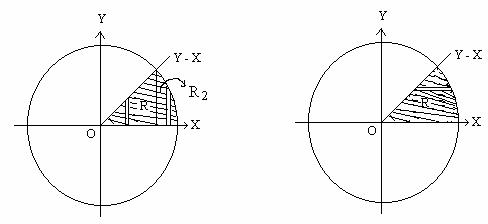
Q.36    Express , as a single integral and then evaluate it.      (8)

            Ans:

                  Let    and     


Let R1 and R2 be the regions over which I1 and I2 are being integrated respectively and are depicted by the shaded portion in fig. I. 

As it is clear from Fig.II, R = R1+ R2


                               Fig. I                                                                                 Fig. II


Thus, I = I1 + I2.  For evaluating I we change the order of integration hence the elementary strip has to be taken parallel to x-axis from y = x to


Code: AE-01/AC-01/AT-01                                                                                      MATHEMATICS-I


dy    


Q.37    Obtain the volume bounded by the surface  and a quadrant of the elliptic cylinder , z > 0 and where a, b > 0                                                                        (8)


            Ans:

In solid geometry   represents a cylinder whose axis is along z-axis and guiding curve ellipse. Required volume is given by


Let us use elliptic polar co-ordinates x = a r cosθ, y = b r sinθ, where 0 ≤ r ≤ 1,

dx dy = ab r dr dθ, and , hence


Code: AE-01/AC-01/AT-01                                                                                      MATHEMATICS-I


.


Q.38    Solve the following differential equations:                                                                                   (8)


            (i)     


                     Ans:

                    The given equation can be written as


                    It is linear in y, and here P =  - cos x and Q = sin x cos x. 

                    Then I.F. = . Hence the solution of (1) is

                    Y(I.F.) =  or 

                    Now, putting  –sin x  = t, we get 


                    Therefore, the solution is y = - (1 + sin x) +

                                                               => y + 1 + sinx = cesinx

                    This is the required solution where c is an arbitrary constant.


Code: AE-01/AC-01/AT-01                                                                                      MATHEMATICS-I


            (ii)    


                     Ans:

                    The given equation is of the form M dx + N dy = 0 where


                    Multiplying the given equation throughout by cos y, we get

                    which is exact.

                    Therefore, the solution is


                    This is the required solution where c is an arbitrary constant.


Q.39    Solve the following differential equation by the method of variation of parameters.


                                                                                                                  (9)


            Ans:

First of all we find the solution of the equation .

This is a homogeneous equation. Putting x = ez  and , the equation reduces to

[D(D-1)+D-1] y = 0 , which gives D = 1, -1.

Code: AE-01/AC-01/AT-01                                                                                      MATHEMATICS-I


                  Therefore, ,

Therefore, ,

Writing the given equation in standard form, we get

      (1)


Let  y = Ax+ B/x  be a solution of equation (1), where A, B are functions of x. Then

, Choose A and B such that                     (2)


Therefore, ,

Substituting the values of y,  in equation(1), we get

                 (3)


Solving equations (2) and (3), we get

.

On integrating, we get

.


Thus, the complete solution is y = Ax + B/x  

i.e.


Code: AE-01/AC-01/AT-01                                                                                      MATHEMATICS-I


Q.40    Solve                                                                                            (7)


            Ans:

The auxiliary equation is m2 – 4m + 1 = 0   which gives m = 2 ± Ö3.

Therefore, C.F. = y = .


               Further P.I. =


               Hence, the general solution of the given equation is

               y = .


Q.41    Show that non-trivial solutions of the boundary value problem


             are

             y(x) = , where Dn are constants.                                                                   (9)


            Ans:

Assume the solution to be of the form y = emx . The characteristic equation  is given as  m4 – ω4 = 0 or .

The general solution is given by

y(x) =

Substituting the initial conditions, we get   y(0) = A + C = 0.

;

.


Code: AE-01/AC-01/AT-01                                                                                      MATHEMATICS-I


Solving, the two equations, we get A = 0, C = 0. We also have

 Adding, we obtain 2B sinh ωl = 0 or B = 0. Therefore, we obtain

 D sin ωl = 0. Since we require non-trivial solutions, we have D ≠0.

 Hence, sin ωl = 0 = sin nπ, n = 1,2,3,…..

 Therefore, .

 The solution of the boundary value problem is

By superposition principle, the solution can be written as

.


Q.42    Show that the matrices A and AT have the same eigenvalues. Further if λ, μ are two distinct eigenvalues, then show that the eigenvector corresponding to λ for A is orthogonal to eigenvector corresponding to μ for AT.                                                                (7)


            Ans:

We have ,

                  Since A and AT have the same characteristic equation, they have the same eigenvalues.

                  Let λ and µ be two distinct eigenvalues of A. Let x be the eigenvector corresponding to the eigenvalue λ for A and y be the eigenvector corresponding to the eigenvalue µ for AT. We have Ax = λx. Premultiplying by yT , we get

                                                             (1)

and 

Post multiplying by x, we get                        (2)

Subtracting equation (1) and (2), we obtain

  Since λ ≠ μ, we obtain .

Therefore, the vectors x and y are mutually orthogonal.

Code: AE-01/AC-01/AT-01                                                                                      MATHEMATICS-I


Q.43    Let T be a linear transformation defined by


            Find         

                                                                                                                                                            (7)


            Ans:

                  The matrices , , ,  are linearly independent and hence form a basis in the space of 2X2 matrices. We write for any scalars  not all zero


                  = .


                  Comparing the elements and solving the resulting system of equations, we get , , , . Since T is a linear transformation, we get


Code: AE-01/AC-01/AT-01                                                                                      MATHEMATICS-I


Q.44    Find the eigen values  and eigenvectors of the matrix .                                (9)

            Ans:

The characteristic equation of A is

            Thus, the eigen values of A are 1=0,  2 = 3,  3 = 15. The eigenvector X1 of A corresponding to 1=0, is the solution of the system of equations


            Eliminating from the last two equations gives       

            Setting

                  Therefore, the  eigenvector of A corresponding to  =  0, is

            Similarly for  =  3, we get X2   is

            , we get X3 as .

            Further, since A is symmetric matrix, the eigen vectors   X1,  X2, X3 should be mutually orthogonal. Let us verify that

            X1 *  X2  = (1)(2) + (2)(1) + (2) (-2) = 0.

            X2 *  X3  = (2)(2) + (1)(-2) + (-2) (1) = 0.

            X3 *  X1  = (2)(1) + (-2)(2) + (1) (2) = 0.

Code: AE-01/AC-01/AT-01                                                                                      MATHEMATICS-I


Q.45    Solve the following system of equations:


                                                                                                                               (6)


            Ans:

                  The given system in the matrix equation form is AX = B;  where


                   ~

            (on operating R2 →  R2 - 3 R1 ,  R3 →  R3 - 2 R1 and  R4 →  R4 - R1 )

            ~  (on operating R2 →  R2 - R3 and   R3 →  R3 – 2 R4 )

            ~  (on operating R2 →  - R2  and   R4 →  R4 + 3 R2 )

            ~  (on operating   R4 →  R4 - 2 R3 )

Code: AE-01/AC-01/AT-01                                                                                      MATHEMATICS-I


Therefore, rank (A : B) = rank A = 3 = number of unknowns, hence unique solution. To obtain this unique solution, we have

(A : B) ~  (on operating R1 → R1 + R3  and   R1 →  R1 - 2 R2 )

Therefore, the unique solution is x = -1, y = 4, z = 4.


Q.46    Find the series solution about the origin of the differential equation

            .                                                                                                   (10)


            Ans:

            We find that x = 0 is a regular singular point of the equation. Therefore, Frobenius series solution can be obtained.

                  Let y(x) =  be solution about x = 0


         Then given differential equation becomes


         .

The lowest degree term is the term containing xr . Equating coefficient of xr to zero, we get


Code: AE-01/AC-01/AT-01                                                                                      MATHEMATICS-I


The  indicial roots are r = -2, -3. Setting the Coefficients of xr+1  to zero, we get

. For r= -2, a1 is zero and for r = -3, a1 is arbitrary. Therefore, the indicial root r = -3, gives the complete solution as the corresponding solution contains two arbitrary constants. The remaining terms are


.


Setting n-2 = t in the first sum and changing the dummy variable t to n, we get


.


Setting the coefficient of xn+r+2 to zero, we get

, n 0.


We have , ,……

For r = -3, we get ,……


The solution is given by

=


For  r = -2, we get


Therefore, the solution is

We find that the indicial root r = -2, product a linearly dependent solution.


Code: AE-01/AC-01/AT-01                                                                                      MATHEMATICS-I


Q.47    Express f(x) =  in terms of Legendre polynomials.                                (8)


            Ans:

                  We know that, various powers of x in terms of Legendre polynomials can be written as



                  =

                  Therefore,

                  .


Q.48    Evaluate , where  denotes Bessel function of order n.                                (8)


            Ans:

                  Using the recurrence relation,



                  Using the recurrence relation,